AI Mentions
Ahrefs Free AI Visibility Checker: What You Get, Limitations & Alternatives
Yes, Ahrefs has a free AI Visibility Checker. You can enter a brand name, inspect its presence across six AI search experiences, and see…
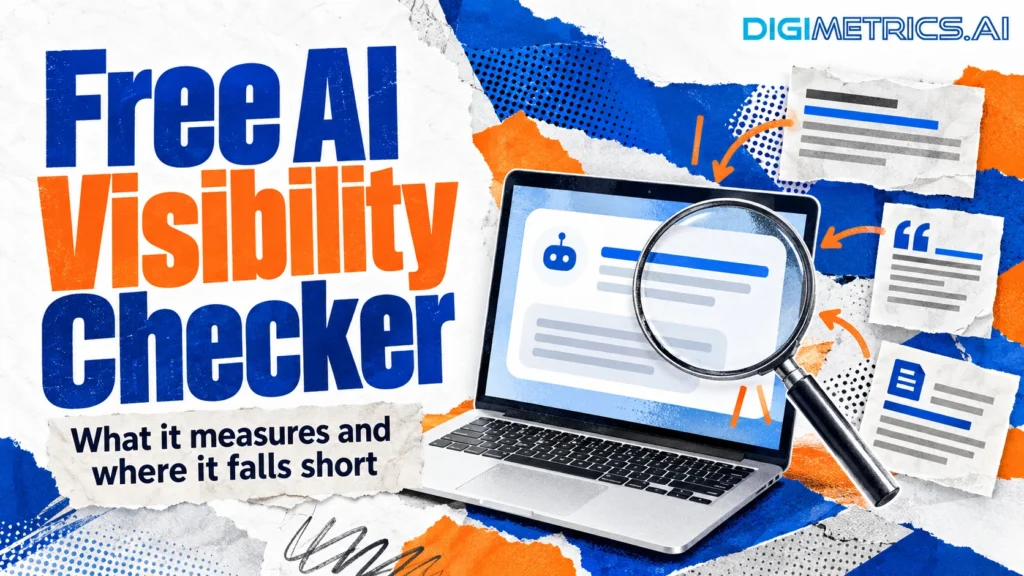
When a prospect asks an AI assistant which vendors to shortlist, the answer either names your brand or it does not. Traditional rank tracking cannot answer that, because a page can rank well in search and still never appear in an AI answer. AI search visibility tracking measures how often and how prominently a brand appears in AI-generated answers, including how often a rival or competitor is mentioned in those same answers.
A free AI visibility checker is a useful first look, not a measurement to budget against. Semrush’s free checker allows three brand checks per day, and Frase’s free tier covers one ChatGPT run. Both are good for a snapshot, but neither can support a trend claim. If you only need a quick baseline, use a free checker. If you need to report trends or track more than 20 to 30 prompts, you need paid monitoring. This article compares the free options, explains their limits, and sets out the best practice for using them well. For teams that want to check their site setup alongside outcomes, digimetrics.ai covers AI search readiness in more depth.
AI visibility covers three questions: how often your brand appears across buyer questions, how prominently it sits in those answers, and in what context (recommendation, passing comparison or warning). It spans ChatGPT, Gemini, Perplexity, Copilot, Google AI Overviews and Google AI Mode. Each engine draws on its sources, so a brand that wins on one may be absent from another. Tracking the content those engines cite and the data behind it shows where each platform draws its answers from. Strong brand visibility on one engine can still hide gaps on another.
Two metrics do most of the work. Share of voice in AI answers is the proportion of relevant answers that name your brand, compared with those of named competitors. Prompt coverage is the proportion of your target prompts for which your brand appears at all. Report both per platform before averaging, because a blended score can hide weak results on one engine.
Mentions and citations need separate tracking. A mention is your brand’s name in the answer text. A citation is a linked source, usually a URL. You can be mentioned without being cited and cited without being named. A checker that counts only one will miss either brand recall or the links that drive traffic.
AI visibility also does not follow organic rank. Ahrefs found that only 38% of pages cited in AI Overviews also rank in the top 10 organic results, while 62% come from outside the top 10. Judging AI visibility by your rank tracker will misread both strengths and gaps.
Most free checkers run the same basic pipeline. A set of prompts is sent to each AI platform, the responses are captured, and the tool extracts the brand names and links that appear. Each brand is scored on its frequency, position in the answer, and whether it is linked as a source. The output is only as trustworthy as each step behind it. Semrush says its checker draws from a database of more than 289 million prompts and responses and updates key visibility data daily, which is broader than a one-off capture, though free users still see only a small slice.
Checkers fall into two groups. Outcome checkers measure what the models actually say about a brand. Readiness scanners inspect the website itself, looking at crawler access, sitemap coverage, clean HTML text and files such as llms.txt. An outcome checker tells you whether ChatGPT or Perplexity names you today. A readiness scanner tells you whether your site gives AI systems the means to find and use your content. Treat them as complementary. A single visibility score from either type should be read alongside the underlying captures, not on its own.
Most of the tools below are outcome checkers. Readiness scanners and paid benchmarks follow the table, so the comparison now shifts from outcome checkers to readiness tools and paid benchmarks.
| Tool | Free allowance | Platforms shown | Mentions and citations |
|---|---|---|---|
| Semrush AI Visibility Checker | Three checks per day | Several major AI engines | Both reported |
| Frase AI Visibility Checker | One ChatGPT run; expanded results via email | ChatGPT, plus Perplexity and Gemini by email | Check the export |
| Ahrefs | Limited free access | ChatGPT, Gemini, Perplexity, Copilot, Google AI Overviews, Google AI Mode | Check the export |
| Ubersuggest | Limited free checks | Check current vendor page | Check current vendor page |
| Indexly | Limited free checks | Check current vendor page | Check current vendor page |
| amivisibleonai.com | Limited free checks | Check current vendor page | Check current vendor page |
On September 24, 2026, we checked free allowances and platform coverage using public vendor documentation. Please confirm the current allowance on each vendor’s pricing page, as terms may change.
Ubersuggest, Indexly and amivisibleonai.com each offer free checks, but each measures visibility differently. Ubersuggest is best known for keyword and SEO data, so its AI checks are a secondary view. Indexly and amivisibleonai.com focus on AI answer presence, but their free allowances are small, and you should verify the platforms each covers on the live page before using the results. Each competitor in this list measures visibility differently, so compare results only within the same tool.
Readiness scanners answer a different question. A scanner tells you whether crawlers can reach your content and whether your pages are straightforward to extract. It does not tell you what an AI model says about your brand. Use it alongside an outcome checker, never in place of one.
Paid monitoring is priced at entirely unique levels. Profound is an enterprise product, starting at about $2,000 per month as of early 2026, and covers eight or more LLMs. Otterly starts at about $29 per month as of early 2026. Prices may change, so please confirm the current figures on each vendor page before budgeting.
Free checkers have three main limits. First, they cap how much you can test. Second, they report only a single run, which cannot show a trend. Third, they often bundle outcome data with a score whose weighting is not published. Each limit is covered in the reliability section below, and together they set the boundary for when a free result is enough.
A checker’s visibility score depends on its own prompt set, its own weighting and its capture method. A score of 60 in one tool does not match a score of 60 in another. Compare results over time within the same tool, never across tools.
AI platforms are sending referral traffic, but a visibility score does not measure clicks or revenue. Pew Research found that users clicked traditional results about 8% of the time when an AI summary appeared, compared with 15% when no summary appeared, while cited links inside the summary received clicks about 1% of the time. Visibility and clicks are related but separate measures, so report them separately.
The same prompt can produce different answers on different days and sometimes within the same day. AI responses are generated rather than retrieved from a fixed index, so a single capture is one sample. A brand that appears in one run may be absent in the next. Treat each free run as a single data point, and never report a single run as a trend.
Sampling several runs narrows the noise. If the brand appears in most of the ten runs across several days, you have a signal. If it appears once in ten, you have an occasional mention, which carries different implications. A result that holds across repeated runs is worth acting on. A result from one run is only worth investigating.
A checker is only as good as the prompts it chooses. A checker that tests broad category prompts will show a different picture from one that tests branded comparison prompts, even for the same company. Testing the prompts a buyer would actually use to find the best option in a category gives a more useful picture than a generic set. Scoring a brand against a rival competitor on the same prompts shows how its brand visibility compares in practice.
The number of prompts matters as much as their wording. Free tools usually track a small set, and one prompt change can swing the score sharply. Most teams outgrow free options once they want to monitor more than 20 or 30 prompts. The 20-to-30 figure is a working heuristic for this guide, not a published threshold, and it is used the same way throughout. When you read a free checker’s result, ask which prompts were tested and how many.
Use a free checker for a baseline, then move to paid monitoring when any of three conditions holds: you need to track more than 20 to 30 prompts, you need to report trends rather than snapshots, or you need results across more platforms than the free tier covers.
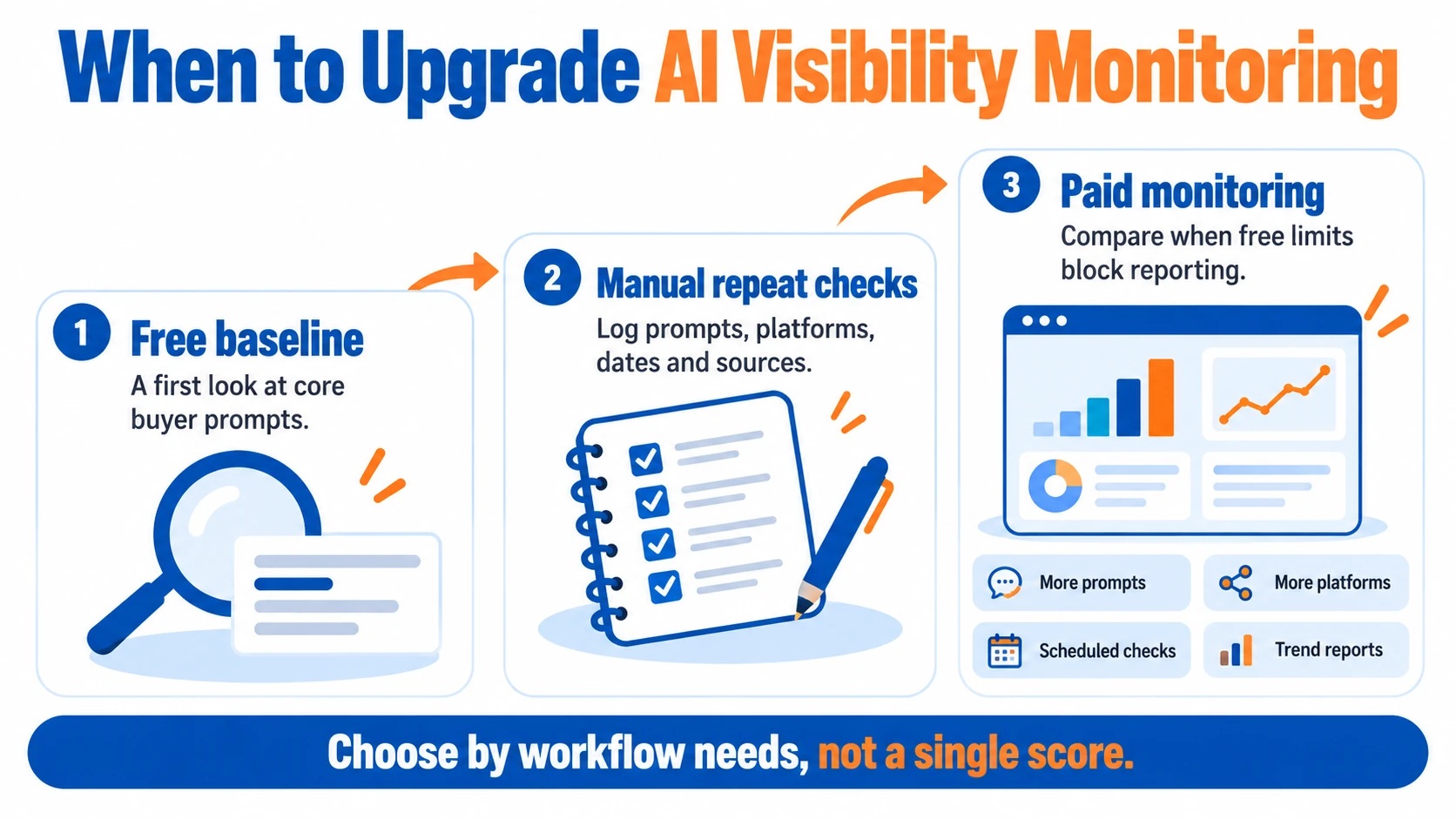
A team with 12 prompts and two engines runs each prompt ten times on each engine over several days, then records mentions and citations. If the brand appears in most runs on one engine and rarely on the other, the team has a platform-specific gap to investigate. With 12 prompts, a free checker can cover the set, so the team stays on free tools. The score and action are strong on one engine and weak on the other, so investigate the weak engine before expanding. The team stays on free tools until its prompt count grows past the 20-to-30 working threshold.
Free checkers give you a snapshot, not a trend. Treat a free score as directional: it helps spot gaps and form questions, not report progress. Tracking share of voice over time requires more than one reading, and that is where the limits below start to matter.
Three limits matter, and a fourth sits beneath them:
The single-run and prompt-set points are consolidated in the reliability section below, which sets out the rule for when a free score is no longer enough.
Checkers weight differently. One may favor ChatGPT over Gemini or Perplexity, another may count linked citations above text mentions, and a third may count only mentions. Examine each tool’s weighting and engine coverage, including whether Gemini is included, before comparing scores. A higher competitor score means little if the tools measure different things.
Source type matters too. A 2025 study on generative engine optimization found AI search shows a systematic bias toward earned media, such as press and third-party reviews, over brand-owned and social content. A brand strong mainly on its own website may score lower in AI answers than in organic search, and a free checker will not explain why.
Use a free checker for a baseline: run your core prompts once, record the results with platform and date, and do not budget against that number or report it as a trend. Compare your visibility against each competitor’s share of voice on the same prompts. Each run is a single data point, since AI answers vary between runs, so repeat the runs before drawing conclusions.
Score your need on five checks, one point each, when it exceeds the free tier’s limits (total 0 to 5):
What to do at each score:
The ladder works best when tested. Take a team tracking 12 buyer prompts across two engines, ChatGPT and Gemini. That is under the 20 to 30 prompt heuristic, so it scores 0 for prompts tracked. If it needs only a monthly view and reports nothing externally, it scores 0 to 1 and stays on the free tier. If it must show a trend across several days, it scores 2 and adds a manual sample logged over those days. If the same team also reports to stakeholders, it scores 3 and should compare paid monitoring.
On one day, we ran the same 12 buyer prompts through Semrush’s free AI Visibility Checker and Frase’s free ChatGPT run, logging every mention and citation. That single day provides a baseline, not a trend, since the same prompts can return different brand lists on different days. Semrush’s free tier allows three brand checks per day, so a full sweep across several platforms and days exceeds the cap. Under the ladder, free results alone are not enough at that point. Repeat the test on your own prompts before relying on its figures.
Free AI visibility checkers give a directional first look at how your brand appears in AI answers, not a dependable measurement. One run is a single sample of a model that can answer the same prompt differently on different days, and free tiers cap how often you can check. Treat the score as a prompt for questions, not a figure to budget against.
Three actions to take this week:
Yes, but only in limited form. Semrush’s free AI Search Visibility Checker allows up to three brand checks per day, and its free plan includes one demo project and 10 reports. Frase’s AI Visibility Checker is free with one ChatGPT run, with expanded results including Perplexity and Gemini delivered by email. These allowances are capped and change over time, so the current limits are confirmed on each vendor’s site. The public pages for these tools were reviewed in May 2026.
Treat them as directional rather than precise. AI answers vary between sessions, and each tool weights platforms, prompts and mention types differently. Use a result to spot gaps, not to measure progress.
A mention is a brand that is named in the answer text. A citation is a linked source the engine points to. A brand can be mentioned without being cited, so track both separately.
An llms.txt file points AI systems to a site’s most important content, much as robots.txt guides crawlers. It can help AI systems find key pages, but it does not guarantee that any engine will cite your content.
Move to a paid tool once you need to track more than about 20 to 30 prompts, run repeated checks to see trends, or report results to stakeholders. Below that, a free baseline plus manual sampling is usually enough. Paid plans start from about US$29 per month for Otterly, while enterprise tools such as Profound start near US$2,000 per month, as of early 2026.

Tom is the CEO of MediaOne, a leading digital marketing agency. He is a business-experienced SEO consultant as well as a Google Gold Search Expert serving the international community. He has consulted for MNCs like Canon, Maybank, Capitaland, SingTel, ST Engineering, WWF, Cambridge University, as well as Government organisations like Enterprise Singapore, Ministry of Law, National Galleries, NTUC, e2i, SingHealth. His articles are published and referenced in CNA, Straits Times, MoneyFM, Financial Times, Yahoo! Finance, Hubspot, Zendesk, CIO Advisor. Under his stewardship, MediaOne has won dozens of prestigious digital marketing awards.
Run a free Digimetrics audit across SEO, AI search, content and technical health, and get a plan you can act on today.
Start free →Yes, Ahrefs has a free AI Visibility Checker. You can enter a brand name, inspect its presence across six AI search experiences, and see…
Your website ranks on Google. Your SEO dashboard shows healthy organic traffic, and your brand appears for several commercially valuable keywords. But when someone…
Direct answer: To rank in Perplexity and ChatGPT, answer one narrow question clearly, make each claim easy to check, and structure the page so…