AI Mentions
Ahrefs Free AI Visibility Checker: What You Get, Limitations & Alternatives
Yes, Ahrefs has a free AI Visibility Checker. You can enter a brand name, inspect its presence across six AI search experiences, and see…
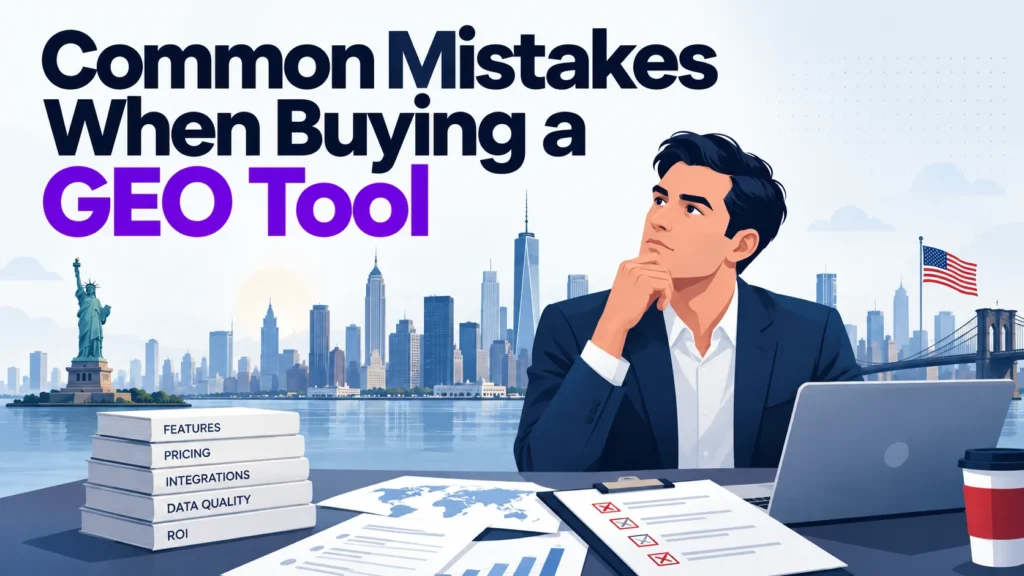
Generative engine optimisation (GEO) tools promise to show whether ChatGPT, Gemini or Perplexity mention your brand, with some listing public entry prices from $29 a month. Yet many purchases disappoint. The software is rarely the problem. Buyers measure the wrong thing and skip the checks that make AI citation possible. This guide covers the most common geo tool mistakes and how to avoid them.
Generative engine optimisation (GEO) is the practice of getting a brand cited, mentioned or recommended inside AI-generated answers, rather than ranking a link on a results page. GEO tools track which prompts trigger your brand, which sources the answers cite, and where competitors appear. That is useful, but a tool can only report what AI engines already do. It cannot make them choose your site.
SEO rewards pages that rank, and clicks follow. GEO rewards being named in the answer, and clicks often do not follow. A falling click count is therefore not a reliable verdict on AI visibility. Muck Rack’s report found that 82% of AI citations come from earned media, and journalism alone makes up 27% of cited links. On-site tweaks rarely change that mix, so judge a tool against your actual visibility problem, not its feature list. Good news for local services businesses is that earned coverage in local press can still move the needle, so judge tools against your actual local visibility problem and the content your work genuinely earns.
Tools sample a finite set of prompts, so coverage gaps are real. A tracker may miss questions your customers phrase differently, including the local and service-specific wording your blog posts and content target. Models also change without notice, which can break historic comparisons across months. Treat trend lines as directional, not precise.
Work through these gates in order, using your own Search Console and GA4 data. Fix any failed gate before moving on.
Four mistakes recur. Measuring only clicks misses AI citations that never send a visit. Skipping indexation checks means reporting on pages no engine can see. Buying before a baseline makes later improvement impossible to prove. Unsourced claims, such as “85% of failures”, give buyers nothing to verify.
A business judged its GEO tool by monthly mention totals, which stalled. The Buy-Gate Checklist showed the real problem: key pages were not indexed, so the tool could never show them being cited. The right measure was the indexation rate of priority URLs. Fixing indexation, then building press coverage, produced a baseline the tool could finally track.
GEO tools only pay off once your key pages are indexed by Google and your brand has earned coverage AI systems can draw from. Before shortlisting vendors, run the five-gate Buy-Gate Checklist against your Search Console and GA4 data, and fix any failed gate first.
Only once the basics are in place. Run the Buy-Gate Checklist first: confirm key pages are indexed in Google Search Console, check whether earned media drives citations, then decide. If indexation is weak, a GEO tool reports visibility for pages AI engines never see. Entry plans start at $29 a month, but fix the foundations first.
SEO aims to rank your page in search results. GEO aims to get your content cited inside AI-generated answers. Success shifts from position and clicks to whether AI systems name or link you, and clicks alone will understate your visibility.

Tom is the CEO of MediaOne, a leading digital marketing agency. He is a business-experienced SEO consultant as well as a Google Gold Search Expert serving the international community. He has consulted for MNCs like Canon, Maybank, Capitaland, SingTel, ST Engineering, WWF, Cambridge University, as well as Government organisations like Enterprise Singapore, Ministry of Law, National Galleries, NTUC, e2i, SingHealth. His articles are published and referenced in CNA, Straits Times, MoneyFM, Financial Times, Yahoo! Finance, Hubspot, Zendesk, CIO Advisor. Under his stewardship, MediaOne has won dozens of prestigious digital marketing awards.
Run a free Digimetrics audit across SEO, AI search, content and technical health, and get a plan you can act on today.
Start free →Yes, Ahrefs has a free AI Visibility Checker. You can enter a brand name, inspect its presence across six AI search experiences, and see…
Your website ranks on Google. Your SEO dashboard shows healthy organic traffic, and your brand appears for several commercially valuable keywords. But when someone…
Direct answer: To rank in Perplexity and ChatGPT, answer one narrow question clearly, make each claim easy to check, and structure the page so…