AI Mentions
Ahrefs Free AI Visibility Checker: What You Get, Limitations & Alternatives
Yes, Ahrefs has a free AI Visibility Checker. You can enter a brand name, inspect its presence across six AI search experiences, and see…
AI search optimisation makes your website’s content easy for AI systems to find, read, extract from and cite. It builds on SEO rather than replacing it, and works inside the answer itself. For most businesses, that means keeping content that helps customers and structuring it for AI tools.
Buyers increasingly ask AI tools for recommendations. Capgemini’s 2025 consumer study found 58% of consumers have replaced traditional search with generative AI for product and service recommendations. Pages can now earn citations without ranking first. Understanding this shift keeps content visible where buyers look. For local visibility, see our guide to the best local seo tools.
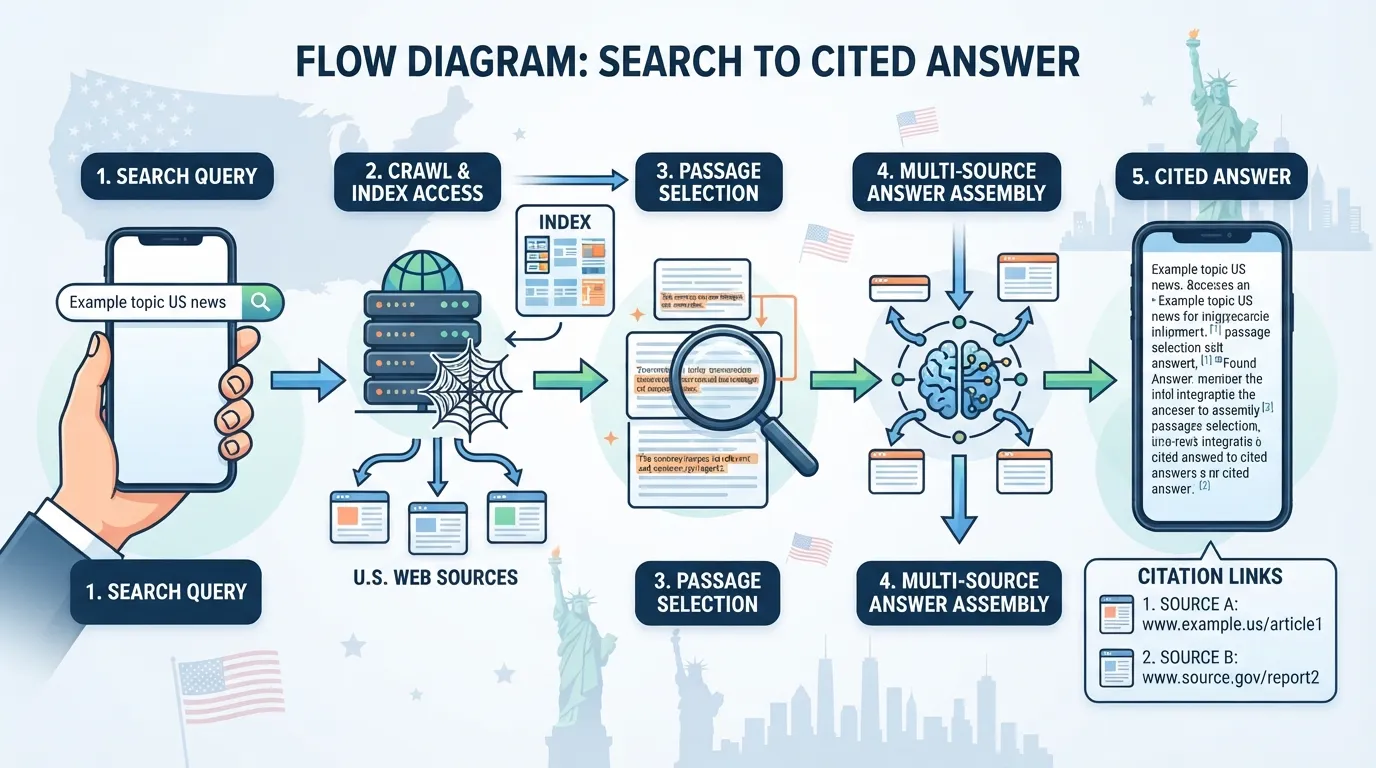
What is AI search optimisation? It is the practice of making a website easy for AI systems to find, read, extract from and cite. Those systems include Google’s AI Overviews and AI Mode, ChatGPT with search, Gemini and Perplexity. They often assemble one answer from several sources instead of returning a ranked list of links. Your goal is to make your page a useful, reliable ingredient in that answer, which is a core strategy for businesses that want their information surfaced in digital search experiences.
The discipline was first defined in a 2023 Princeton University research paper. The shift is real: Capgemini’s 2025 consumer study found that 58% of consumers had replaced traditional search with generative AI tools for product and service recommendations. A page that never gets cited is effectively invisible to buyers who ask an assistant first.
AI search optimisation is a layer on top of SEO, not a replacement for it. Google advises applying the same foundational search optimization practices for AI features as for Google Search overall, so a weak SEO foundation rarely produces strong AI answers. An effective seo strategy covers both the technical and content work that feeds these systems. AEO (answer engine optimisation) and GEO (generative engine optimisation) share the same goal: being quoted inside an answer. If your content cannot be reached, read and attributed, AI systems will not use it, whatever label you give the work.
AI assistants do not work from a ranked list. They assemble one answer, and the process differs by platform.
Google’s AI Overviews summarise search results by selecting details from multiple sites. A page that is not indexed or cannot be read has no path into the summary. Access comes first, then the system selects passages that answer the query and links to the pages it drew from. A search engine can only use content it has technical access to, so clean crawlability is the first help you can give it.
These platforms also pull from pages they can find and read, then compose one answer from several sources. ChatGPT has two modes: one answers from training data alone, the other runs a live search and cites recent pages. To test which you are seeing, ask about something published last week. A passage must be both reachable and extractable, because it has to stand on its own once lifted into a composed answer. Many of these platforms draw on large language models, or llms, to compose that answer.
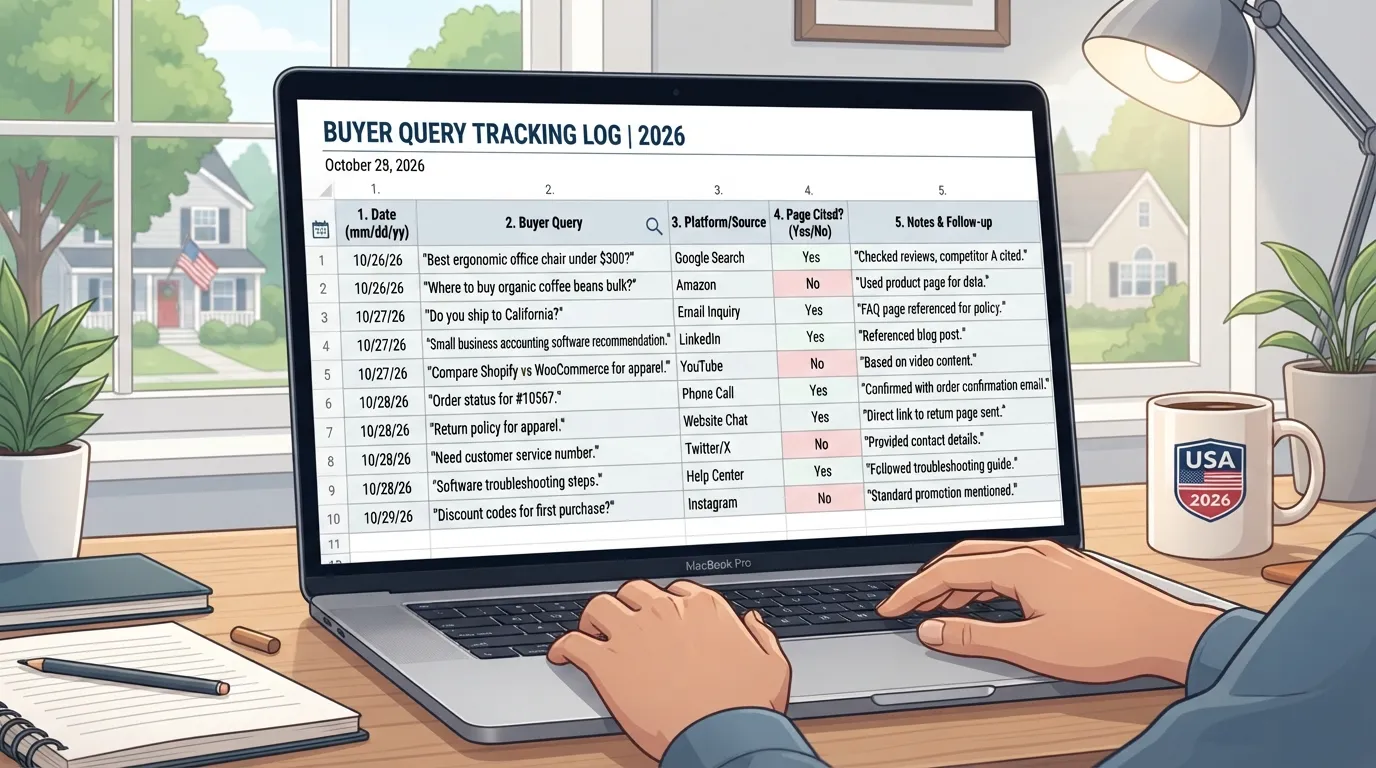
AI answers vary from day to day, so a single check tells you very little. Log the same set of buyer queries at regular intervals and note whether your pages are cited. Judge the trend over several weeks, and keep the record in a shared file so your team can review it together.
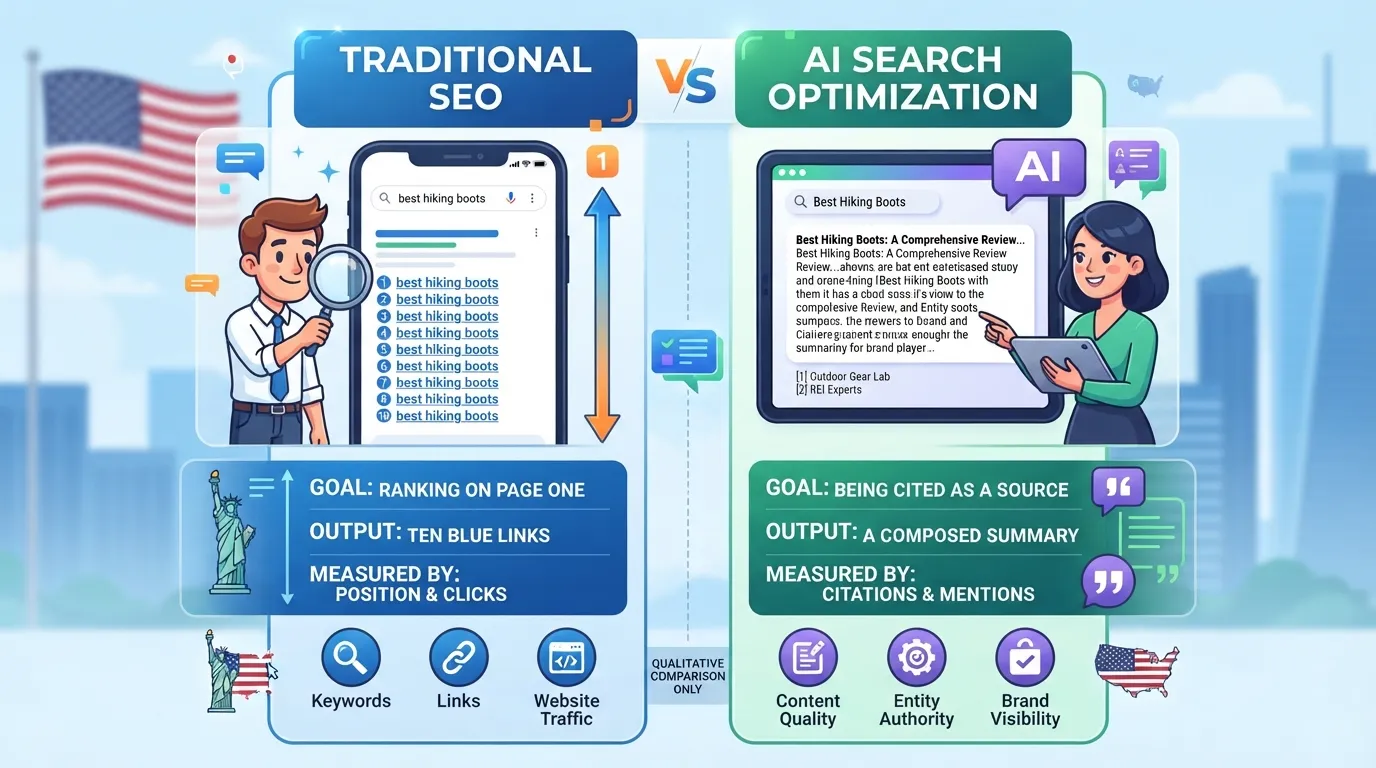
Traditional SEO aims to rank a page in a list of links, measured by position, clicks and sessions. AI search optimisation aims to have a page used as a source inside a generated answer, measured by citations, mentions and AI Overview presence. The goals overlap but are not the same, so treating them as one will mislead your reporting. Both forms of search experience reward clear, trustworthy content, but they reward it in different ways.
| Aspect | Traditional SEO | AI search optimisation |
|---|---|---|
| Primary goal | Rank in the results list | Be extracted and cited in an answer |
| Typical output | Ten blue links or ranked cards | A summary built from several sources |
| Key signals | Relevance, links, page quality | Clear passages, entity identity, evidence, structured data |
| Measurement | Rankings, clicks, impressions | Citations, mentions, AI Overview presence |
Answers change from day to day, so one check tells you little. Expect early signals in impressions first, with stability often taking several weeks. Judge AI visibility over that window, asking your questions across several LLMs and tracking how your website is cited over time. A useful test is whether a customer searching a business question finds your passage quoted, which shows the strategy is working in practice.
Crawl access comes first, because AI systems can only use pages they can reach and read. Google advises applying the same foundational SEO best practices to AI features as to Google Search overall, which means the technical basics of search engine optimization still apply. A page that is weak in traditional search is rarely a strong AI source, so helpful content still matters most, and reliable information you already know well is the best starting point.
AI search optimisation rests on three questions to ask of any page: can AI systems access it, can they extract a clean answer from it, and can they attribute that answer to a credible source? The foundations of good SEO still apply, and the additions sit on top.
Check that your robots.txt does not block the crawlers that feed retrieval, and that key pages render without heavy client-side scripting. Structured data such as Organization, Article and FAQPage schema helps machines identify what a page is and who stands behind it. One controlled test found no clear effect on AI citations, but its scope was limited, so treat it as a starting point. The llms.txt file is a proposed convention with no confirmed AI platform support. It does not guarantee citations and is no substitute for crawl access.
Extraction depends on self-contained passages. ChatGPT, Gemini and Perplexity assemble one answer from several sources, so each section must answer its own heading in full. Lead with a direct two to three sentence answer, then add supporting detail. Short FAQ blocks drawn from real search questions give extraction engines a clean unit to lift.
Most teams start in the wrong place. They buy an llms.txt file or rewrite every FAQ before checking whether AI crawlers can read the website at all. Work through the steps below in order, and score each page against the Access, Extract, Attribute test as you go. A page passes, partly passes or fails each test. Good content is only useful to a business if the system can find it, and this checklist keeps that help in view.
Confirm that Google can index the page, since AI Overviews and AI Mode build their summaries from pages in Google’s index. Check robots.txt, noindex tags and blocked JavaScript. A page that fails here cannot be cited. Rate it Access: pass, partial or fail.
Pick the 10 to 20 pages that earn the most organic traffic or sales. Open each with a self-contained answer of two to three sentences under the main heading, then support it with clear subheadings and an FAQ. ChatGPT, Gemini and Perplexity assemble one answer from several sources, so a passage that reads correctly on its own is the one most likely to be lifted. Rate it Extract.
Add authorship, a named company identity and dated evidence to each priority page. Link related pages, such as the best local seo tools guide where it fits the reader’s task. Tie each page to a clear SEO strategy and a digital presence that search engines can read. Rate it Attribute.
Answers shift from day to day, so a single check tells you little. Log the same set of buyer questions weekly. Record whether an AI Overview appears, whether your page is cited and whether the citation holds. Compare this against conversions, not just visibility, before deciding where to invest next. Your customer experience improves when you know which pages the systems actually use.
AI search optimization is not a replacement for SEO. It is a layer on top of it. Its job is to make a page easy for AI systems to find, read, extract from and cite, which matters most where answers are assembled from several sources. Each element of your digital content should be clear and easy to parse, so that the information it carries is useful to both readers and machines.
Use a simple test on each important page. Can AI crawlers reach and read it (Access)? Can one passage answer the query on its own (Extract)? Does the page show clear authorship and evidence worth citing (Attribute)? Fix access problems first, because no later improvement helps a page that cannot be read.
Keep measurement honest. AI answers shift from day to day, so judge changes over several weeks. Expect early signals in impressions first. If you are weighing AI visibility against conversions or traffic quality, make that choice deliberately. More citations do not automatically mean more customers for businesses.
No, though the two overlap heavily. SEO is the wider discipline of making a website findable and ranking in search results. AI search optimization adds a focus on whether AI systems can access, extract from and cite your content. Google advises that the same foundational SEO best practices apply to AI features. A page that is weak in classic search engine optimization is rarely strong in AI answers, so treat AI search optimization as an addition to your SEO strategy, not a replacement.
The core work is the same: open access, self-contained answers and clear authorship. The difference lies in how each system retrieves sources. Google’s AI Overviews summarize search results, selecting details from multiple sites. ChatGPT with search cites pages it can find and read, and it has two modes that look identical from the outside, so test both. Check your key questions on each platform rather than assuming one result carries over.
llms.txt is a proposed plain-text file that points AI systems to your most important content. It does not guarantee citations, and platforms have not confirmed they adopt it, so treat it as optional. Fix crawl access and page structure first.
Schema markup helps machines interpret your content, so it may support extraction and attribution. One controlled test found no clear effect on AI citations, but that result reflects its own scope, sample and date, so treat it as a single finding rather than settled proof. Use schema to describe what the page already says accurately. Do not treat it as a shortcut to visibility.
Expect to wait. Track the same set of questions weekly and expect early signals in impressions first, with stability often taking several weeks. Measure citation presence, not just traffic, because an AI answer can cite your page without sending a click.

Tom is the CEO of MediaOne, a leading digital marketing agency. He is a business-experienced SEO consultant as well as a Google Gold Search Expert serving the international community. He has consulted for MNCs like Canon, Maybank, Capitaland, SingTel, ST Engineering, WWF, Cambridge University, as well as Government organisations like Enterprise Singapore, Ministry of Law, National Galleries, NTUC, e2i, SingHealth. His articles are published and referenced in CNA, Straits Times, MoneyFM, Financial Times, Yahoo! Finance, Hubspot, Zendesk, CIO Advisor. Under his stewardship, MediaOne has won dozens of prestigious digital marketing awards.
Run a free Digimetrics audit across SEO, AI search, content and technical health, and get a plan you can act on today.
Start free →Yes, Ahrefs has a free AI Visibility Checker. You can enter a brand name, inspect its presence across six AI search experiences, and see…
Your website ranks on Google. Your SEO dashboard shows healthy organic traffic, and your brand appears for several commercially valuable keywords. But when someone…
Direct answer: To rank in Perplexity and ChatGPT, answer one narrow question clearly, make each claim easy to check, and structure the page so…