An AI assistant can answer a customer’s question using information from your website without ever mentioning your business.
It might summarise your findings, explain your methodology, or use your article to support a recommendation. Sometimes it links to the original page. Sometimes it mentions your brand. Sometimes it uses information from several sources without quoting any of them directly.
That creates a new problem for content teams.
You can publish a thorough, well-researched article, rank reasonably well in Google, and still find that ChatGPT, Perplexity, or another AI search experience rarely references it.
The obvious response is to restructure the content. Make the answers shorter, add more headings, create comparison tables, and turn everything into easily extractable paragraphs.
Some of those changes are useful. But they’re not a guaranteed route into AI-generated answers.
The goal isn’t to make every paragraph sound like something an AI assistant would say. It’s to make your information clear, original, verifiable, and easy to understand without stripping away the context that makes it accurate.
That distinction matters because Google and Microsoft don’t describe AI search optimisation in exactly the same way.
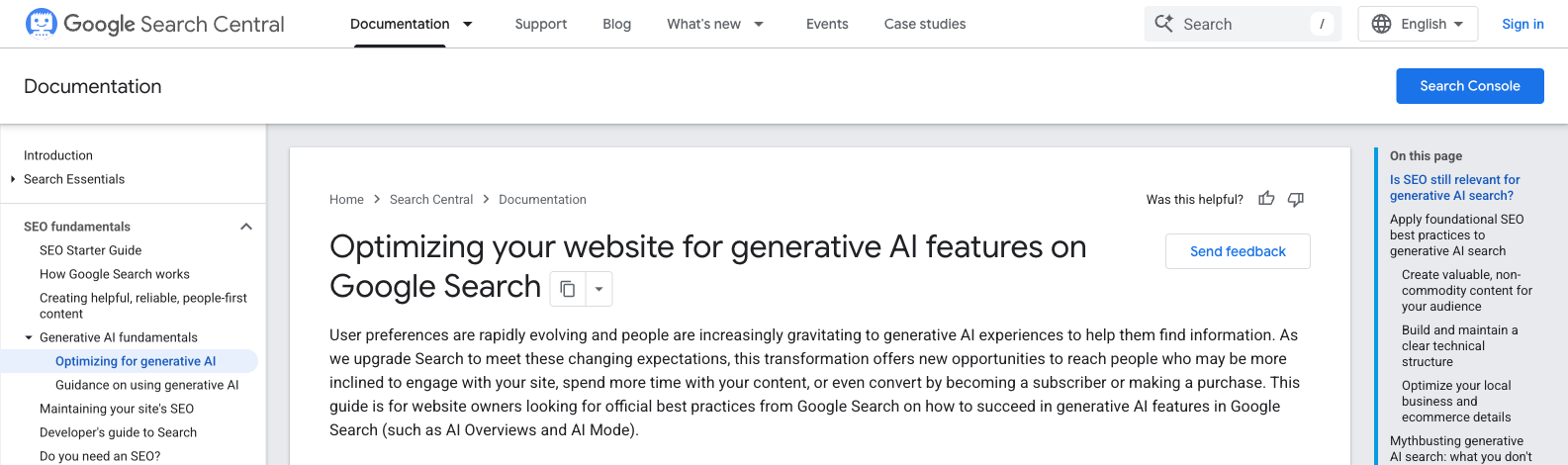
Google says its existing SEO fundamentals remain important and explicitly advises against treating content chunking as a special requirement. Microsoft recommends clear headings, self-contained explanations, structured information, and supporting evidence to make content easier to interpret and reference.
Both approaches point toward a practical editorial principle: write useful content, organise it around real questions, and make important claims defensible.
In this guide, we’ll explain how to structure a page for AI search visibility, show before-and-after content examples, examine what makes a claim worth citing, and outline a repeatable process for checking whether your improvements are having any measurable effect.
What Does It Mean for an AI Answer Engine to Quote Your Page?
Before changing your content, understand what you’re trying to achieve.
AI citations, brand mentions, quotations, and website visits are different outcomes.
Outcome
What Happens
Example
AI citation
An AI answer links to your page as a source
An assistant references your guide to explain an analytics feature
Brand mention
The answer names your business or product
An assistant lists your software among several options
Direct quotation
The answer reproduces specific wording from your page
The assistant quotes a short passage from your original research
Paraphrase
The answer restates information using different language
An assistant summarises your findings without reproducing the wording
AI referral visit
Someone clicks from an AI experience to your website
A reader opens your cited article from ChatGPT Search
These outcomes aren’t interchangeable.
An AI system might cite your article while recommending a competitor. It might mention your company without linking to your website. And a citation doesn’t necessarily generate a click.
That’s why the more accurate objective is usually earning useful source visibility, rather than trying to force an AI system to quote a specific sentence.
The important takeaway is that good information architecture and AI-specific formatting tricks are not the same thing.
Clear sections and helpful comparisons make content easier for readers to use. They may also help retrieval and interpretation in some AI search systems.
But no official guidance establishes that writing every paragraph to a particular word count or adding a question after every heading guarantees citation.
1. Start With the Exact Question Your Page Answers
A surprising amount of content fails before the first paragraph because the writer never defines the question the page is supposed to answer.
Consider an article targeting the topic AI citation tracking tools.
A weak opening might say:
As artificial intelligence continues to transform digital marketing, businesses increasingly need innovative solutions to stay competitive in the evolving search landscape.
That sounds professional, but it doesn’t explain what the reader came to learn.
A stronger opening would say:
An AI citation tracking tool monitors which websites and pages AI-powered search systems reference when answering questions. Depending on the platform, it can record cited URLs, citation frequency, competing sources, and changes over time.
The second explanation is more useful because it defines the subject immediately.
It also provides context that remains understandable when someone reads the paragraph separately from the rest of the article.
How to write a useful opening answer
For informational articles, use the opening section to establish the subject, the relevant distinction, and the practical value of the explanation.
You don’t need to force everything into exactly forty or sixty words. There is no universal ideal answer length.
Some questions need one sentence. Others require a qualification, comparison or example.
The goal is to give readers a useful answer before asking them to read another thousand words.
Match the format to the question
Different questions require different answers.
Reader’s Question
Useful Content Format
What is AI citation tracking?
Concise definition and explanation
How do I measure AI citation rate?
Formula, worked example and limitations
Which tools track citations?
Comparison table with documented capabilities
Why isn’t my page being cited?
Diagnostic checklist
Is llms.txt required?
Direct answer with official source
How do I improve a product comparison?
Before-and-after example
How do I evaluate citation changes?
Repeatable measurement process
Don’t build a 3,000-word article around every question.
Choose the format that communicates the required information with the least unnecessary work for the reader.
2. Make Important Claims Understandable Outside Their Original Paragraph
One of the most useful editorial improvements is making important statements understandable when read independently.
This doesn’t require cutting every paragraph into tiny blocks.
It means identifying the subject, the actual claim, and the relevant qualification without relying on vague references to earlier sections.
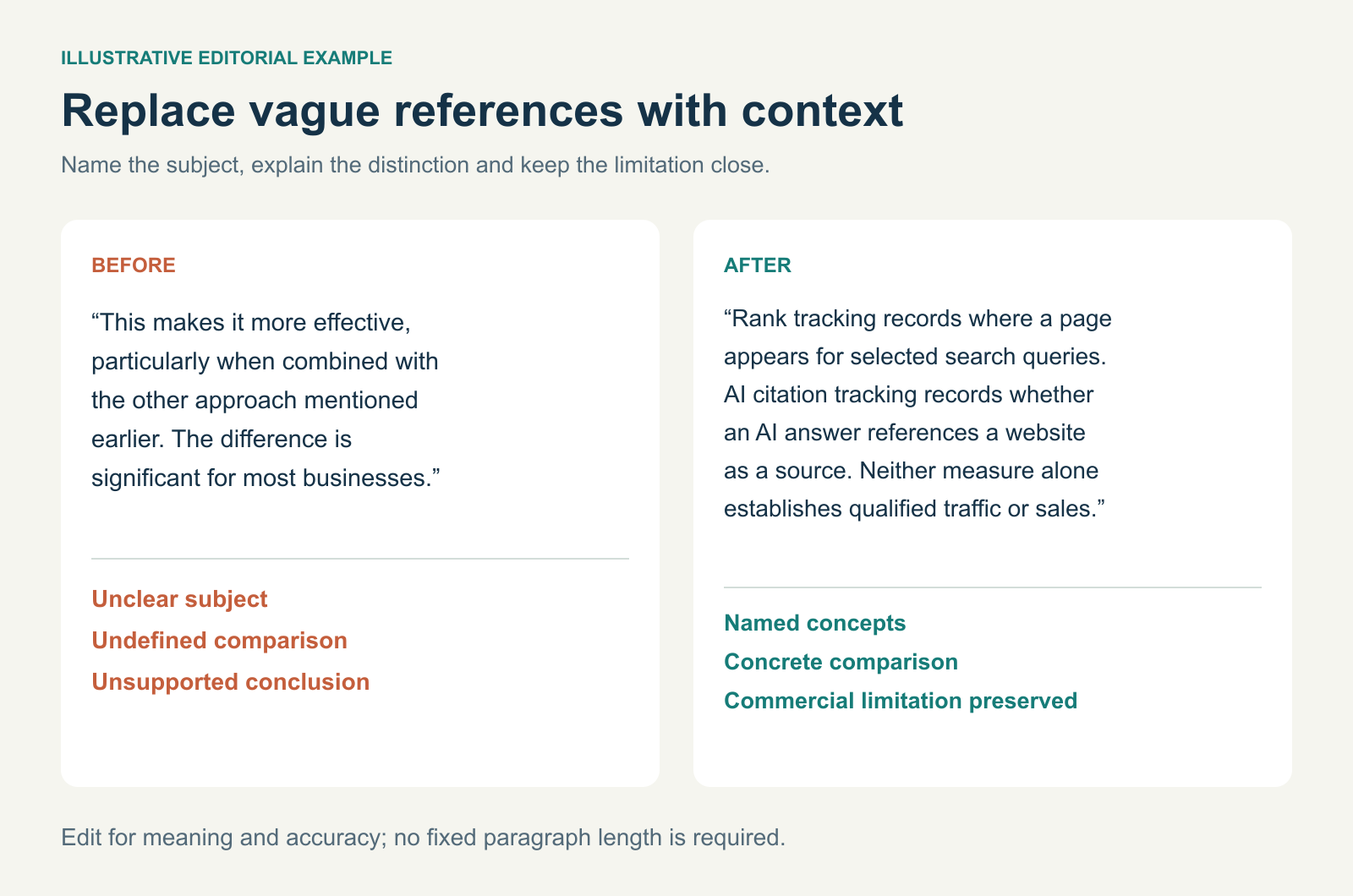
Weak example
This makes it more effective, particularly when combined with the other approach mentioned earlier. The difference is significant for most businesses.
What is “this”? Which approach is being compared? What does “more effective” mean?
Even a human reader would need to search the surrounding paragraphs for context.
Improved example
AI citation tracking and conventional rank tracking measure different types of search visibility. Rank tracking records where a page appears for selected search queries, while citation tracking records whether an AI-generated answer references a website as a source. Neither measurement alone establishes whether the exposure generated qualified traffic or sales.
The improved paragraph identifies both concepts, explains the difference, and prevents an unsupported commercial conclusion.
That makes it useful as a standalone explanation without turning the writing into a series of disconnected sentences.
The self-contained paragraph test
When editing an important paragraph, ask:
Can a reader identify what the claim is about?
Does the paragraph explain the relevant relationship or distinction?
Would the statement become misleading if separated from the surrounding text?
Is a material qualification missing?
Can the reader check the source, method or evidence behind the claim?
Not every paragraph must pass this test independently. Narrative transitions, examples, and conclusions naturally depend on surrounding context.
Apply it primarily to definitions, comparisons, factual claims, findings, and recommendations.
3. Give Each Section a Clear Job
Headings help readers find information and understand the relationship between different sections.
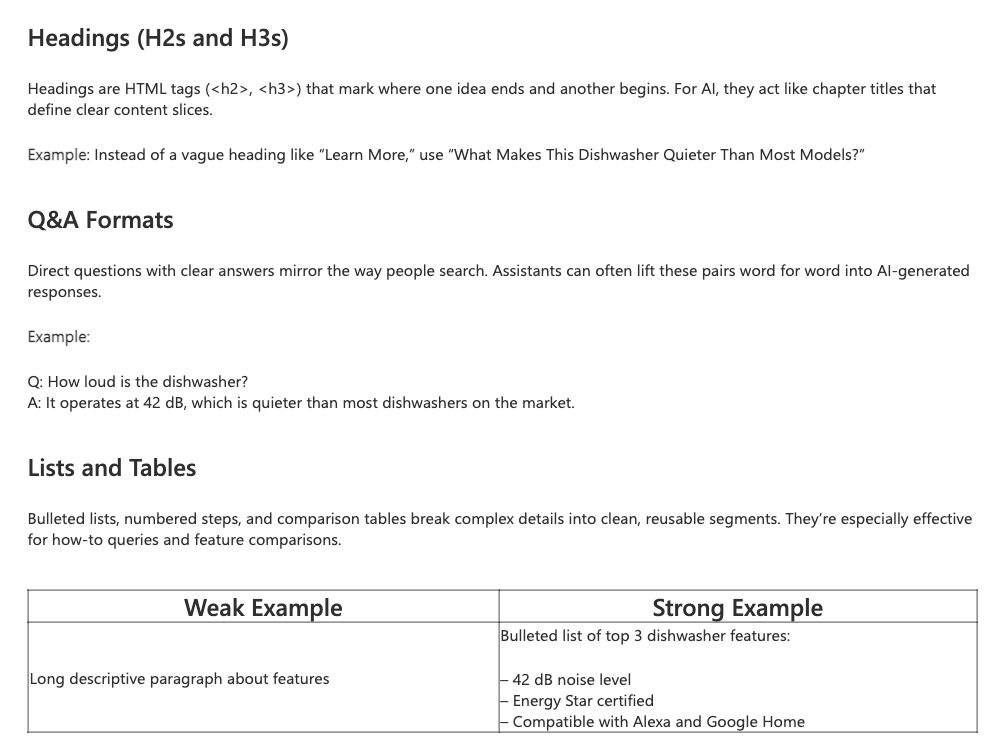
Microsoft’s guidance explicitly recommends descriptive headings for AI-search content.
Google also encourages well-organised content while noting that no special heading formula is required for generative search.
The practical lesson is straightforward: headings should describe what the section actually covers.
Compare these heading approaches
Weak Heading
Better Heading
Why It Helps
Overview
What Is AI Citation Tracking?
Establishes the question
Benefits
Why Do AI Citations Matter?
Clarifies the topic
Features
Which Citation Tracking Features Are Useful?
Identifies the comparison
Pricing
How Much Do AI Citation Tracking Tools Cost?
Gives the reader a clear destination
Important Considerations
Why AI Citation Counts Can Be Misleading
Identifies the specific issue
Results
How to Measure Changes in AI Visibility
Explains the purpose
Don’t turn every heading into a question merely because people ask conversational questions in ChatGPT.
A statement such as “Why Citation Counts Can Be Misleading” can be just as useful as a question.
Keep related ideas together
A section explaining how to calculate citation rate should ideally contain the definition, formula, example, and limitations.
Don’t put the calculation in one section, its denominator in another, and the caveat about sampling five headings later.
That fragmentation makes the page harder to understand.
The section should contain enough context for the reader to complete the task.
4. Turn Vague Marketing Claims Into Verifiable Statements
This is where many AI-generated articles fall apart.
A page can have perfect headings, a comparison table, short paragraphs, and correct schema markup while still containing almost no useful evidence.
Consider this statement:
Our tool delivers industry-leading accuracy and helps marketing teams dramatically improve AI search performance.
What does accuracy mean? What was measured? Which teams? Compared with what?
The sentence cannot be meaningfully verified.
Now consider a more useful claim:
In our documented evaluation, we compared each tool’s extracted source URLs against a manually verified reference set of 120 citations. The reported accuracy metric counts URLs correctly matched to that reference set, with redirects and duplicate URLs handled according to the published rules.
This statement describes a concrete methodology.
It can support an actual result once the study has been conducted and its records are available.
The example above illustrates how a methodology should be documented. It is not a claim that DMT completed a 120-citation test for this article.
What a verifiable claim needs
Claim Type
Supporting Information
Software pricing
Official pricing page, plan, currency and verification date
Product feature
Current documentation showing the relevant capability
Performance improvement
Baseline, result, measurement period and method
Product recommendation
Comparison criteria and evidence relevant to the reader
Research finding
Data source, sample, method and limitations
Industry statistic
Original research publication and population measured
Expert opinion
Identifiable expert, relevant experience and context
The claim doesn’t need an academic footnote system.
It needs enough information for an editor or interested reader to determine whether the statement is true.
Attribute claims where they appear
Suppose a vendor reports a 40% increase in customer conversions.
A weak article might state that the tool increases conversions by 40%, with no indication of where the number originated.
A better version would identify the vendor, client or campaign, reporting period and measurement limitation.
For example:
According to the vendor’s published case study, the client recorded a 40% increase in conversions during the specified campaign period. The published summary does not establish whether the increase was caused exclusively by the software.
This preserves both the claim and the uncertainty.
That matters more than making the prose sound confident.
5. Add Information That Is Actually Worth Referencing
Formatting makes information easier to read.
It doesn’t make ordinary information original.
If ten articles explain the same software feature using slightly different wording, another rewritten explanation contributes little new value.
AI answer engines already have multiple sources covering the subject.
Your page needs a reason to be useful.
Original information that can strengthen a page
Content Type
Example
Why Readers Benefit
Firsthand testing
A documented comparison using the same dataset across tools
Helps readers understand meaningful differences
Original research
A survey with disclosed sample, dates and questions
Provides information not available in other articles
Expert analysis
An experienced editor explaining a recurring implementation failure
Adds informed judgement
Reproducible calculation
A pricing model with inputs, assumptions and formulas
Helps readers make their own decision
Practical workflow
An exact process with steps and quality checks
Makes the advice actionable
Evidence-backed comparison
A table separating documented features from tested results
Helps readers evaluate alternatives
Clearly explained limitation
A finding showing why a popular metric is misleading
Prevents poor decisions
You don’t have to commission a major research study for every article.
Sometimes the original contribution is a better framework, a documented comparison, or a useful worked example.
The important point is to distinguish original evidence from general knowledge and vendor claims.
Example: A useful explanation of citation tracking
A generic article might say:
AI citation tracking helps brands improve visibility in artificial intelligence platforms.
A stronger article could explain:
A citation monitoring system records which URLs appear as supporting sources in a defined collection of AI answers. If a domain is cited in 18 of 120 sampled responses, its observed citation rate is 15% for that sample. The result doesn’t establish that the domain is cited in 15% of all real user conversations.
That explanation gives the reader a definition, an example, a calculation, and the main limitation.
The numbers are illustrative, but the reasoning is reusable.
6. Use Tables and Lists When They Help People Compare Information
Tables are useful for structured comparisons.
They can help readers distinguish products, features, requirements, evidence and limitations without repeatedly interpreting lengthy paragraphs.
Microsoft also recommends lists and tables where they improve information clarity.
But a table isn’t automatically better than prose.
A comparison table containing unsupported claims simply packages unreliable information more neatly.
Weak comparison
Tool
Features
Value
Tool A
Excellent
Best
Tool B
Advanced
Great
Tool C
Powerful
Good
The table offers no meaningful evidence.
Better comparison structure
Tool
Relevant Capability
Evidence Source
Limitation
Tool A
Tracks cited URLs for supported AI answers
Current product documentation
Engine coverage depends on plan
Tool B
Exports prompt-level citation observations
Current product documentation
Export allowance may vary
Tool C
Reports AI mentions alongside search metrics
Current product documentation
Mentions are not equivalent to citations
This is an illustrative table structure using fictional tools, not a verified product comparison.
The second format makes the comparison auditable.
It also helps editors spot missing information before the article reaches publication.
When not to use a table
Use prose when you need to explain a complicated trade-off, provide context, or develop an argument.
For example, why a citation-monitoring platform might report different results from another provider is easier to explain in a cohesive paragraph than in several disconnected table cells.
Structure should clarify the information, not flatten its meaning.
7. Make Your Sources Easy to Find and Check
An article that relies on external information should identify where that information came from.
This is especially important for changing facts such as software prices, platform requirements, regulations, and product functionality.
An external link should lead to the specific source supporting the claim whenever possible.
Linking to a vendor’s homepage is not equivalent to citing the product documentation that confirms a particular feature.
A practical source-verification workflow
Before publishing a factual claim, check:
Source relevance: Does the linked page directly support the specific statement?
Source quality: Is it primary documentation, original research, or an attributed secondary source?
Freshness: Is the information current enough for the claim?
Context: Does the original source contain limitations that the draft omits?
Accuracy: Has the draft changed the meaning or certainty of the original statement?
For changing product information, record the verification date internally.
When sources conflict, don’t silently choose the more attractive number.
Explain the conflict, investigate it, or omit the unsupported claim until it can be resolved.
Don’t confuse attribution with authority
Adding ten external links does not automatically make an article trustworthy.
The links need to support its claims.
Likewise, quoting a recognised research organisation does not automatically make your analysis correct if the findings refer to a different population, period, or problem.
A source can be authoritative and still be irrelevant to the point you’re making.
8. Make Sure AI Search Systems Can Access the Actual Content
Editorial improvements won’t solve a technical access problem.
A page might contain excellent original research but fail to appear in search because it is blocked, unavailable, incorrectly canonicalised, or difficult for a crawler to process.
Technical checks worth prioritising
Check
Why It Matters
How to Verify
Indexability
Search systems need access to eligible pages
Search Console and index inspection
robots.txt
Crawlers may be blocked from relevant content
Inspect rules for the intended crawler
Canonical URL
Duplicate or alternate URLs can complicate indexing
Confirm the intended canonical
Server responses
Errors can prevent successful crawling
Check HTTP responses and server logs
Main content rendering
Important information should be available to relevant systems
Inspect rendered page and available text
Internal links
Important pages need clear discovery paths
Review navigation and contextual links
Snippet controls
Restrictive settings may limit available content
Review robots meta and snippet directives
Structured data
Markup should accurately reflect visible information
Validate with supported tools
Google AI Overviews and AI Mode
Google says eligible pages must be indexed and permitted to appear with a snippet in Google Search.
It does not require additional AI-only structured data.
Google’s documentation also explains that nosnippet, data-nosnippet, and max-snippet controls affect what content can be shown or used in its search experiences, including AI features.
Review these settings deliberately rather than changing them solely to chase citations.
ChatGPT Search
OpenAI distinguishes between its search crawler and its training crawler.
GPTBot is associated with content crawling for foundation-model training.
The controls are separate.
A website can allow the search crawler while choosing to disallow the training crawler.
Permitting search crawling doesn’t guarantee that ChatGPT will cite the website.
However, blocking relevant search access can prevent a site from appearing in ordinary ChatGPT search-source results.
For technical teams, checking actual crawler access is more useful than assuming a new AI optimisation file will resolve visibility problems.
9. Don’t Treat llms.txt, Schema, or Content Chunking as Citation Shortcuts
These recommendations appear frequently in GEO discussions.
Some are useful in particular circumstances, but they’re often described with far more confidence than the evidence supports.
Does llms.txt improve Google AI visibility?
Google’s current guidance is explicit: Google Search ignores llms.txt for rankings and generative search visibility.
Some other systems or workflows may choose to use such files.
That doesn’t establish that publishing one improves citations in Google AI Overviews.
If your team wants to maintain an llms.txt file for a documented use case, evaluate it on that basis.
Don’t prioritise it over missing content, poor internal linking, or technical SEO problems.
Does schema markup guarantee AI citations?
No.
Structured data can help describe eligible information and support conventional search features.
But Google does not require a special AI-related schema type for its generative search experiences.
Markup should accurately represent the visible page.
Adding unsupported ratings, invented reviews, or irrelevant schema creates more problems than it solves.
Should every paragraph be a fixed number of words?
No.
Microsoft recommends concise and self-contained explanations where appropriate.
Google explicitly says content does not need to be divided into artificially small chunks for generative AI.
Use short paragraphs for direct definitions or instructions.
Use longer paragraphs when an argument, example, or qualification needs more space.
There is no defensible universal paragraph length that guarantees AI citation.
Do FAQ sections help?
FAQ sections can help readers find answers to specific questions.
They’re particularly useful when the questions are genuinely distinct and not already answered thoroughly in the main article.
However, adding twenty repetitive FAQs to a weak article isn’t a reliable AI-search strategy.
Write them because they improve the page, not because an optimisation tool recommends a fixed quota.
10. Structure the Entire Page Around a Useful Reading Journey
A good article needs more than independently understandable paragraphs.
Its sections should follow a logical sequence.
For a practical technical guide, we’d usually start with the answer, explain the necessary concepts, introduce the method, demonstrate an example, and finish with verification and limitations.
Recommended content structure
Page Section
What It Should Accomplish
H1 and introduction
Identify the exact subject and answer the main question
Key distinction
Explain commonly confused concepts
Core explanation
Present the essential facts and reasoning
Practical steps
Show how the reader can apply the advice
Worked example
Demonstrate the method using real or clearly illustrative data
Evidence and caveats
Show the sources, assumptions and limits
Troubleshooting
Address common failures
FAQ
Answer useful questions not fully covered elsewhere
Conclusion
Summarise what matters and what to do next
This isn’t a mandatory template.
A product review, news article, software tutorial, and original research report should have different structures.
The purpose is to make the content fit the task.
For teams publishing at scale, our AI-assisted content workflow guide shows how to connect research, drafting, verification, editing, and publishing to named responsibilities.
11. How to Test Whether Your Page Is Being Cited
Making a page clearer is a worthwhile editorial improvement.
But if your objective is AI visibility, you still need to measure what happens after publication.
Don’t rely on one favourable ChatGPT screenshot.
AI answers vary between platforms and collection conditions.
A page may appear in one response and not another, even when the question is similar.
Step 1: Choose a consistent question set
Start with questions the page genuinely answers.
For example, an article about AI citation tracking might monitor:
What is an AI citation tracking tool?
How do you calculate AI citation rate?
Which metrics distinguish citations from brand mentions?
Can Google Search Console track AI citations?
How do companies monitor citations in ChatGPT?
Choose questions that reflect relevant user intent.
Avoid selecting only prompts that contain your own brand name.
Step 2: Record a baseline
Run the selected questions across the AI search experiences you intend to monitor.
Record the platform, collection date, prompt wording, response, cited URLs, and brand mentions.
Repeat observations where feasible to understand variation.
If a system doesn’t provide visible citations for a particular response type, document that limitation.
Step 3: Improve the page
Make specific changes based on editorial problems you’ve identified.
That could mean adding an answer to a previously unanswered question, correcting an unsupported statistic, improving a comparison, or publishing original research.
Document the changed sections and publication date.
Step 4: Recheck the same questions
Use consistent collection conditions for the follow-up review.
Compare citation appearances, source URLs, brand mentions, and other relevant observations.
Keep the platform results separate.
Step 5: Interpret the change carefully
A higher citation rate after publication is useful evidence of a change in observed visibility.
It doesn’t prove that the page edit caused the improvement.
Search demand, competing content, retrieval methods, and platform changes may also affect the results.
Example measurement table
Metric
Baseline
Follow-Up
Interpretation
Responses sampled
100
100
Equal sample size
Responses citing the website
12
19
Observed citation rate increased from 12% to 19%
Responses mentioning the brand
18
22
Observed brand mentions increased
Identifiable AI referral visits
35
41
More recorded referral traffic
Qualified enquiries
3
4
Small change; insufficient to infer cause
Entirely hypothetical illustration. No live experiment was conducted for this article.
Notice that citation rate, mentions, traffic and enquiries are reported separately.
A page may earn more citations without producing more customers.
That doesn’t necessarily make the content unsuccessful, but it changes how the result should be interpreted.
Google also provides a dedicated Generative AI performance report in Search Console for supported Google Search experiences.
These tools don’t expose every answer across every AI platform.
Bing’s citation counts and Google’s AI impressions are different measurements. Don’t add them together into one artificial visibility score.
Similarly, a third-party citation monitor usually observes a defined sample rather than every private AI conversation.
12. How to Audit an Existing Article for AI Citation Readiness
Before buying another content optimisation tool, try improving one article manually.
Choose a page that already attracts relevant visitors or answers commercially important questions.
Then review it against the following criteria.
Audit Question
What to Look For
Priority if Missing
Does the page answer its main question?
Clear, accurate explanation near the beginning
High
Is the page accessible?
Crawlability, indexability and readable text
High
Are important factual claims supported?
Relevant primary sources and clear attribution
High
Does it add original value?
Testing, expertise, analysis, useful examples or research
High
Are sections logically organised?
Descriptive headings and complete explanations
Medium
Can comparisons be understood?
Defined criteria and meaningful differences
Medium
Are examples and calculations reproducible?
Inputs, assumptions and methodology
High where findings depend on them
Is the information current?
Accurate prices, dates, product details and sources
High for changing facts
Does the article include relevant internal links?
Useful pathways to supporting content
Medium
Is there an AI visibility baseline?
Documented prompts, engines and sources
Needed for evaluation
The priorities are editorial recommendations, not an official ranking-factor model.
For most teams, the biggest improvements will come from correcting factual problems, adding missing evidence, addressing search intent, and fixing technical accessibility.
These changes can make a page more useful regardless of whether an AI system cites it.
13. Should You Use an AI Content Tool to Improve Citation Readiness?
AI writing and optimisation tools can support the process.
They can help identify unclear sections, suggest questions readers may have, extract factual claims for checking, and prepare structured outlines.
But they should be evaluated on the quality of that work—not how many words they generate.
Where an AI tool can genuinely help
A content editor reviewing a long guide may use an AI assistant to identify:
Questions introduced but never answered.
Sections that repeat the same explanation.
Claims lacking source information.
Vague comparisons without criteria.
Inconsistent terminology.
Paragraphs that depend on unclear references.
Missing qualifications around statistics.
These tasks are valuable because the output can be reviewed against the actual article.
Where the tool can create more work
An AI assistant may invent citations, rewrite uncertain statements as confident facts, or suggest a large number of additional sections that don’t serve the reader.
It may also recommend changes based on unsupported assumptions about how an AI search engine selects sources.
Those recommendations shouldn’t be accepted automatically.
How to evaluate the tool
Measure whether it helps resolve real editorial issues.
A useful trial could involve one article and a manually prepared set of known problems.
Evaluation Metric
What to Record
Valid issues found
Problems accurately identified from the existing article
False positives
Suggested problems that aren’t actually errors
Important issues missed
Known problems the tool fails to identify
Time to first useful action
Time until a valid recommendation is implemented
Editing time saved
Reduction in total editorial effort
Cost per resolved issue
Tool and review cost divided by verified problems resolved
The final measure is especially useful when a team is paying for several content tools.
A platform that produces fifty suggestions but only helps resolve three real problems may offer less value than a simpler assistant that identifies eight actionable issues.
Don’t treat a vendor’s AI optimisation score as proof that the page will earn citations.
A score is useful only if the underlying checks identify genuine issues and help the team improve the content.
The Editorial Workflow We’d Use for Citation-Focused Content
For a new DMT article, we’d use the following process.
1. Define the reader’s question. Identify the problem, search intent, intended audience, and expected answer before drafting.
2. Build an evidence register. List important claims, primary sources, dates, and information that still needs verification.
3. Identify the original contribution. Decide what the article will add beyond competing pages, whether that’s a useful test, practical framework, original example, or evidence-backed analysis.
4. Prepare the structure. Organise the page around the main question and the supporting questions readers actually need answered.
5. Draft around verified information. Keep claims attributed, explain relevant limitations, and avoid filler written purely to satisfy a word count.
6. Edit for clarity and independence. Make important definitions, explanations, and findings understandable without artificial fragmentation.
7. Complete technical and link checks. Confirm indexing requirements, live internal and external links, metadata, and relevant structured data.
8. Establish a visibility baseline. Track selected AI search questions and relevant traditional search performance before drawing conclusions about changes.
9. Review after publication. Update inaccurate information, investigate citation patterns, and record what was learned.
The purpose is to improve editorial quality while keeping the work accountable.
Writing faster is useful only when the finished article is worth publishing.
Common Mistakes That Make AI Citation Optimisation Less Useful
Writing everything as a short answer
Not every subject can be explained adequately in fifty words.
If the reader needs a detailed comparison or important caveat, provide it.
Repeating the same definition throughout the article
Repetition can make a page longer without improving understanding.
Define the concept clearly, then use subsequent sections to answer new questions.
Adding statistics without sources
A precise percentage is not credible merely because it sounds plausible.
Identify the original source and the population, method and time period behind the number.
Inventing testing results
Don’t describe a product evaluation as hands-on testing unless it actually occurred.
A documented research-based comparison is legitimate. Presenting it as an experiment that never happened is not.
Creating artificial content chunks
Don’t split cohesive explanations into tiny paragraphs solely because a tool suggests it.
Write for comprehension.
Hiding important limitations
A citation-rate increase observed in a small prompt sample isn’t proof of market-wide AI visibility growth.
Keep material caveats close to the findings they qualify.
Chasing citations at the expense of visitors
A citation isn’t always a recommendation, and not every citation results in a click.
Track whether the content contributes to useful discovery and commercial outcomes.
Treating schema or llms.txt as magic
Technical files and structured data should serve documented purposes.
They don’t replace original information, search relevance or credible evidence.
Final Verdict: Make Your Content Worth Citing Before Making It Easy to Extract
There’s a temptation to treat AI search optimisation as a formatting problem.
Rewrite every heading as a question. Shorten every paragraph. Add another comparison table. Publish an llms.txt file. Run the draft through an AI optimisation tool until it reports a higher score.
The finished page might look different.
But if it contains the same generic information, unsupported recommendations and recycled examples, its value hasn’t necessarily improved.
The better approach is less complicated.
Answer questions people genuinely ask. Support factual claims. Add something original. Organise the explanation so readers can find and understand it. Make sure the page is accessible to the relevant search systems.
Then measure what happens without pretending that an observed citation increase proves your formatting caused it.
The best way to make a page useful to an AI answer engine is to make it a source worth using in the first place.
Clear writing helps that source communicate its value.
Evidence gives readers a reason to trust it.
And a good editorial process makes both possible without another unnecessary tool subscription.
Frequently Asked Questions
How do I structure content for AI search citations?
Start with a clear answer to the main question, organise related information under descriptive headings, support important claims with verifiable evidence, and include useful examples or comparisons. Make sure the page is technically accessible. These practices can improve content quality and interpretability, but citations are not guaranteed.
What makes an article more likely to be useful as an AI source?
Relevant, original and reliable information is the foundation. Clear explanations, accessible content, supporting evidence, and practical examples can make that information easier to understand and reference. The final source selection remains under the AI search system’s control.
Should I write shorter paragraphs for AI search?
Use paragraph lengths that fit the idea being explained. Short paragraphs can help with definitions, but complicated explanations may need more space. Google explicitly states that artificial content chunking isn’t required for its generative search features.
Does adding FAQs improve AI citations?
FAQs can make content more useful when they answer genuine questions clearly. They don’t guarantee citations, and repeating existing content purely to expand an FAQ section adds little value.
Is llms.txt necessary for AI search?
Google says its search systems ignore llms.txt and do not require special AI text files for AI Overviews or AI Mode. Other services may use such files for different purposes, so assess the actual use case before implementing one.
Does schema markup help AI answer engines?
Accurate structured data can help describe content and support conventional search features. However, Google doesn’t require special AI schema and does not guarantee citation or ranking improvements from adding markup.
Can AI engines quote my page without linking to it?
AI-generated responses may paraphrase or use information without presenting a visible source link in every case. A visible citation, a direct quotation, and a paraphrase are different outcomes and should not be measured as though they are equivalent.
How do I know if ChatGPT is citing my website?
You can inspect citations in individual ChatGPT Search answers or use third-party tools that monitor a defined set of prompts. These observations don’t cover every user conversation or guarantee representative results.
Can Google Search Console measure AI citations?
Google provides generative AI visibility reporting for supported Search experiences. Its measurements are not equivalent to a complete URL-level citation log. Bing Webmaster Tools provides more explicit citation reporting for supported Microsoft AI experiences.
How often should I update citation-focused content?
Update content when important information becomes inaccurate, new evidence materially changes the answer, or users’ questions change. Fixed publishing schedules are less useful than keeping claims reliable and relevant.
Are AI content optimisation tools necessary?
Not always. A capable editor can improve structure, sourcing and clarity without a dedicated platform. Tools become more useful when they reliably identify issues, reduce verification effort and support a repeatable editorial process.
Can better content structure guarantee an AI citation?
No. Search platforms select sources using systems publishers do not control. Strong structure, original evidence and technical accessibility are worthwhile improvements, but they cannot guarantee inclusion in any particular AI response.
About the author
Tom Koh
Tom is the CEO of MediaOne, a leading digital marketing agency. He is a business-experienced SEO consultant as well as a Google Gold Search Expert serving the international community. He has consulted for MNCs like Canon, Maybank, Capitaland, SingTel, ST Engineering, WWF, Cambridge University, as well as Government organisations like Enterprise Singapore, Ministry of Law, National Galleries, NTUC, e2i, SingHealth. His articles are published and referenced in CNA, Straits Times, MoneyFM, Financial Times, Yahoo! Finance, Hubspot, Zendesk, CIO Advisor. Under his stewardship, MediaOne has won dozens of prestigious digital marketing awards.
An AI search visibility checker measures whether AI answer engines mention your brand, cite your pages and place you in their recommendations. A strong…