AI Mentions
Ahrefs Free AI Visibility Checker: What You Get, Limitations & Alternatives
Yes, Ahrefs has a free AI Visibility Checker. You can enter a brand name, inspect its presence across six AI search experiences, and see…
Your brand appears in a ChatGPT recommendation on Monday. By Wednesday, it has disappeared. On Friday, the same question produces an answer citing your competitor’s website instead.
Has your AI search visibility suddenly collapsed?
Not necessarily.
AI-generated answers can change between requests, even when the question stays the same. Search results, source selection, model behaviour, location settings, and the timing of the request can all affect which businesses and websites appear.
That creates a measurement problem for marketers.
You want to know whether ChatGPT, Perplexity, Google AI Overviews, Gemini, and other AI experiences are mentioning your brand or citing your website. But checking a few questions manually doesn’t necessarily tell you how consistently those appearances occur.
This is where AI citation tracking tools come in.
Platforms such as Ahrefs Brand Radar, Semrush, Peec AI, Otterly.AI, and Profound collect AI-search observations, identify mentions and sources, and help marketers understand how their visibility changes.
Some also offer sentiment analysis, competitor comparisons, custom prompt monitoring, and reporting integrations.
However, a citation dashboard is only as useful as the data behind it.
Before paying for one, you need to understand what it monitors, how often it collects answers, how it distinguishes brand mentions from source citations, and whether the results are representative of the questions your customers ask.
In this guide, we’ll compare seven tools, explain what they can and cannot measure, and show how to evaluate their accuracy before committing to a subscription.
Before choosing software, we need to separate three outcomes that are often grouped together in GEO dashboards.
A brand mention, a website citation, and a recommendation are not the same thing.
| AI Search Outcome | Example | What It Actually Means |
|---|---|---|
| Brand mention | “Acme Analytics provides reporting tools for small businesses.” | The AI answer names your brand |
| Website citation | The answer links to an article published on acmeanalytics.com |
Your website is referenced as a source |
| Brand recommendation | “For a small marketing team, consider Acme Analytics.” | The answer actively suggests your product or business |
| Negative or cautionary mention | “Acme Analytics may not suit enterprises requiring complex integrations.” | Your brand appears, but in a potentially unfavourable context |
Examples are fictional and provided to illustrate measurement differences.
This distinction is important because a tool can correctly report a brand mention without establishing that the AI assistant recommended your company.
Likewise, your website may receive a citation without the answer naming your brand.
For example, ChatGPT could recommend three competing accounting tools while linking to a comparison guide on your website.
Your domain was cited, but your company wasn’t necessarily among the recommended products.
The reverse is also possible. An answer may recommend your brand while citing another publication as supporting evidence.
Our recommendation: Choose a tool that reports mentions, citations, and context separately instead of combining them into one unexplained visibility score.
For a more detailed explanation, see our guide to AI citation tracking tools.
One reason AI citation tracking software became popular was the lack of dedicated reporting from major AI search platforms.
That situation has changed during 2026.
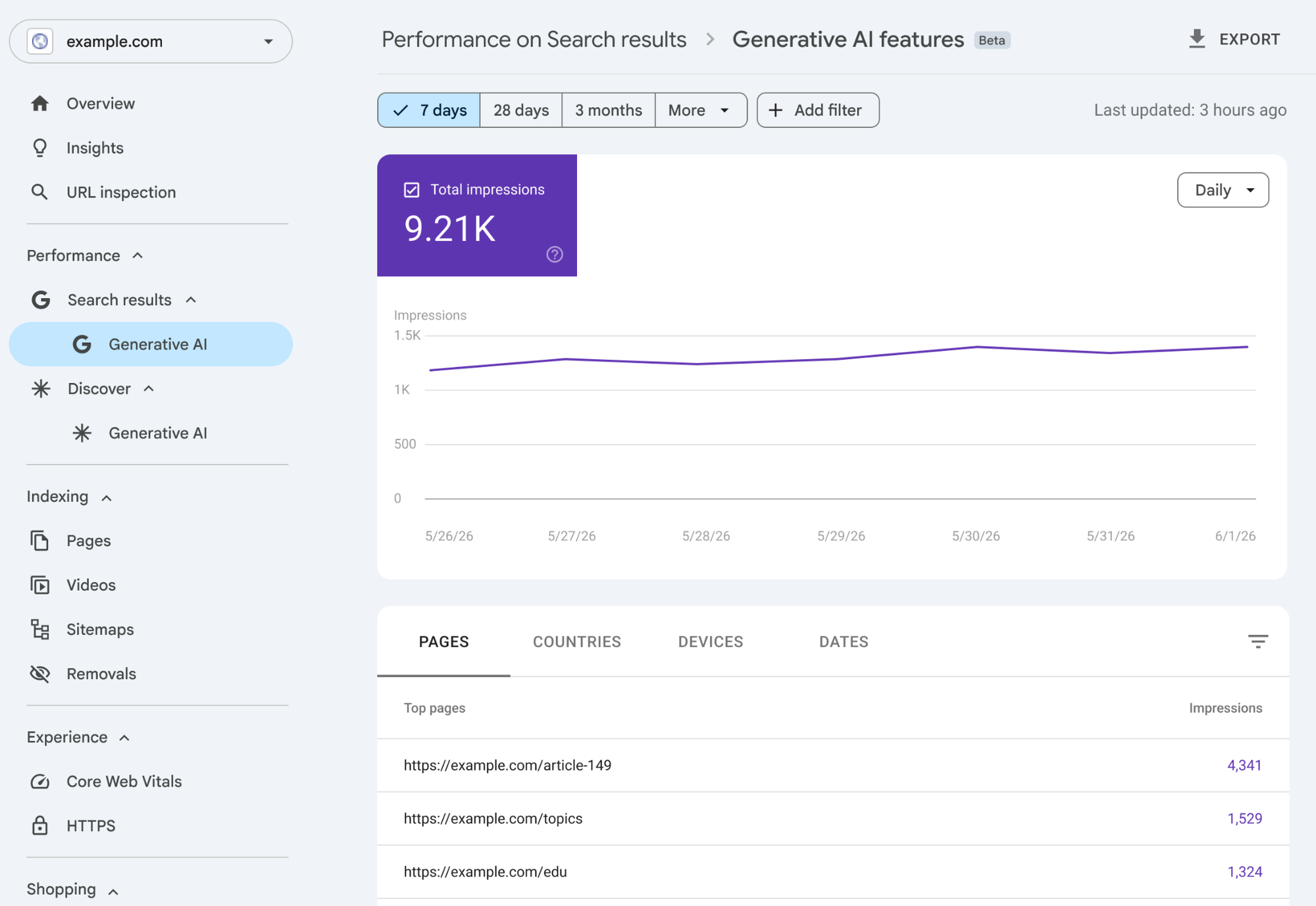
In June 2026, Google introduced dedicated generative AI performance reporting in Search Console, with worldwide availability by August 31.
The report provides impression data for supported Google AI search features, including AI Overviews and AI Mode.
Site owners can examine relevant page, country, date, and device breakdowns.
This is valuable first-party information about visibility for a verified website.
However, the report doesn’t provide a complete competitor-monitoring dashboard across ChatGPT, Perplexity, Gemini, and other AI systems.
It also shouldn’t be confused with a record of every conversation in which an AI assistant mentions your brand.
See Google’s official generative AI performance documentation.
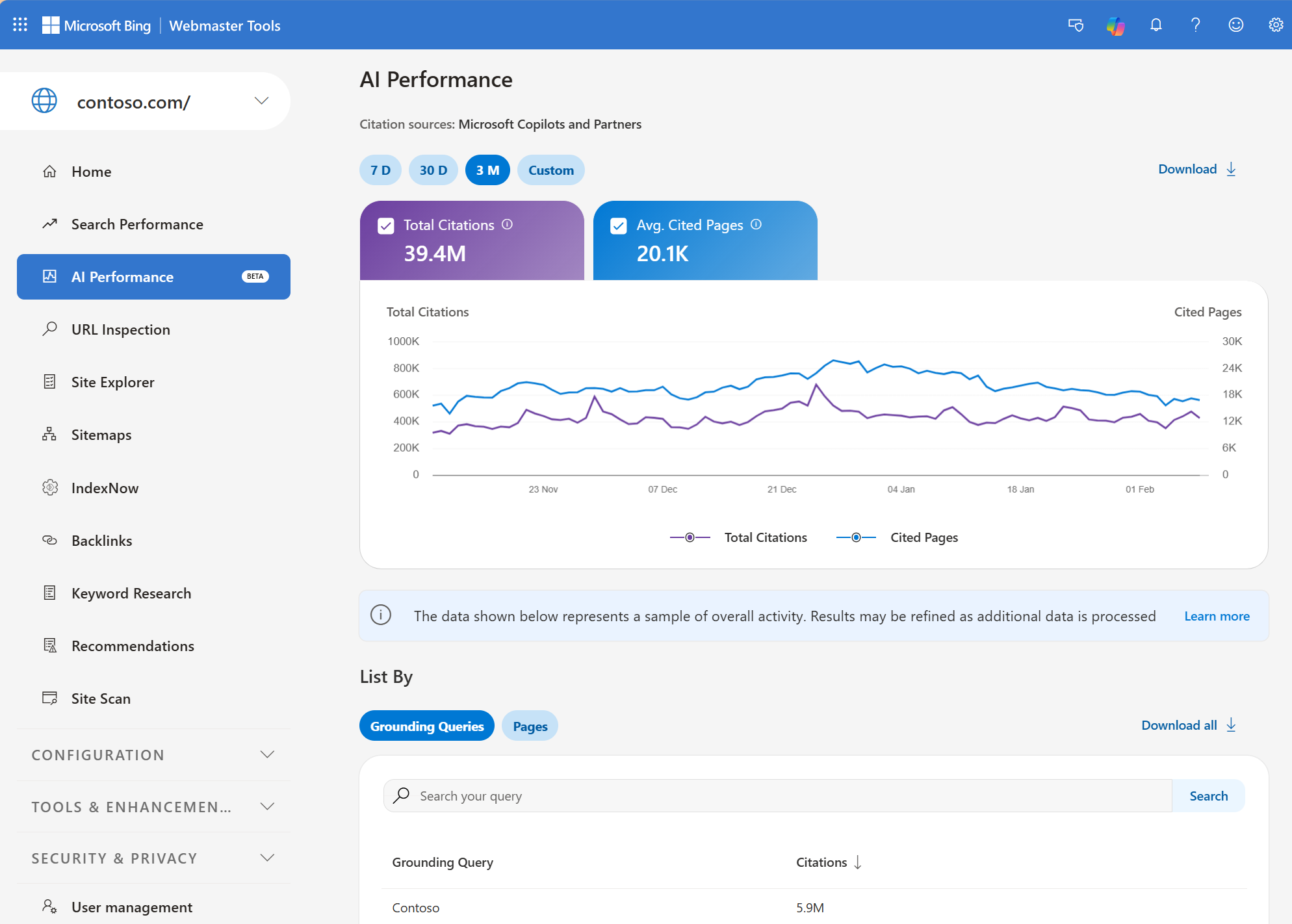
Microsoft introduced AI Performance reporting in Bing Webmaster Tools in February 2026.
The report provides citation information for supported Microsoft AI experiences, including details about cited pages and grounding queries.
Microsoft added further insights in June, including topics, intents, citation share, and comparisons. In October, it also introduced Topics Portfolio in beta.
These features help website owners understand where their content appears within Microsoft’s supported AI ecosystem.
See the official Bing AI Performance announcement.
First-party reporting and independent monitoring answer different questions.
Google Search Console can provide first-party exposure information for supported Google experiences, while a third-party monitoring tool may help you compare which brands appear for specific customer questions across several AI platforms.
The important thing is not to mix those measurements.
A Google AI impression, a Bing citation, and a mention observed by a third-party ChatGPT tracker are different events under different measurement systems.
They should be reported separately.
Not every product has the same focus.
Some specialise in tracking specific prompts. Others provide large AI-search research datasets or integrate GEO monitoring with traditional SEO tools.
Here’s how seven relevant platforms differ.
| Tool | Main Strength | What to Verify Before Buying |
|---|---|---|
| Ahrefs Brand Radar | Large AI visibility research dataset, mentions, citations, and competitor analysis | Difference between broad prompt-database research and custom prompt tracking |
| Semrush AI Visibility Toolkit | Brand visibility, source citations, sentiment, competitor insights, and SEO integration | Custom prompt limits, supported engines, and domain-based pricing |
| Peec AI | Prompt-level tracking, sentiment, competitor comparisons, and source analysis | Models, prompt allowances, projects, and reporting exports |
| Otterly.AI | Scheduled AI prompt monitoring, citation tracking, and recurring reports | Which engines are included and which require add-ons |
| Profound | AI visibility, citations, sentiment, prompt research, and enterprise workflows | Platform coverage and the features available in each subscription |
| SE Visible | AI visibility, competitor monitoring, sources, and brand perception | Project capacity, supported platforms, and subscription limits |
| Digimetrics | AI mention monitoring within a broader SEO and GEO toolkit | Exact citation-level evidence, history, usage credits, and exports available in the selected plan |
This is a feature-based comparison. We haven’t independently established which product has the lowest false-positive rate, most reliable sentiment classifier, or best statistical sampling accuracy.
Let’s examine where each fits.
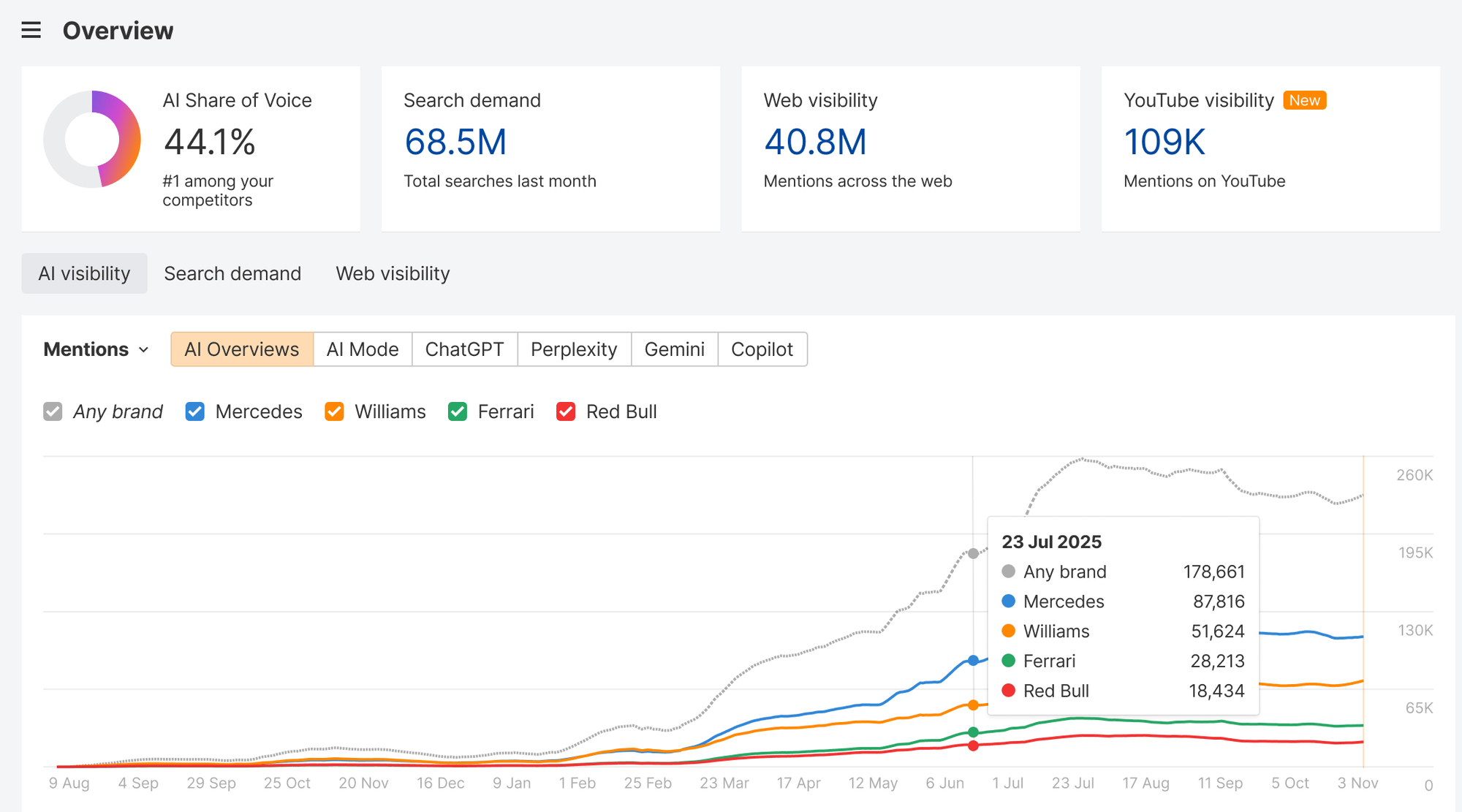
Best for: SEO teams researching brand presence across large collections of AI-search questions.
Ahrefs Brand Radar is designed to help marketers investigate how brands and websites appear in AI-generated answers.
Its platform provides information about brand mentions, source citations, estimated impressions, and AI share of voice.
One major distinction is its large search-backed prompt database.
Instead of requiring users to create every tracking question manually, Ahrefs builds a substantial dataset from search-related information and collects responses across supported AI platforms.
This can be useful when you want to discover how your brand appears across a wider topic or market.
Imagine your company provides cybersecurity software.
You might know that customers ask about endpoint protection and ransomware, but not every variation they use when comparing products.
Brand Radar’s wider research dataset can help surface visibility patterns beyond a short custom prompt list.
Its reporting also distinguishes mentions from citations.
That matters when your brand appears in an answer but your website isn’t referenced as a source.
A large dataset is not automatically a representative sample of every AI conversation.
The tool’s underlying prompt selection, weighting, and platform coverage still influence the results.
Ahrefs also documents that changes to its prompt database can produce sudden shifts in reported brand visibility.
This means a dashboard spike may reflect a dataset update rather than a genuine change in how customers encounter your business.
Our assessment: Ahrefs Brand Radar is worth considering when broad market research matters, but make sure you understand the difference between its indexed dataset and your own custom tracking.
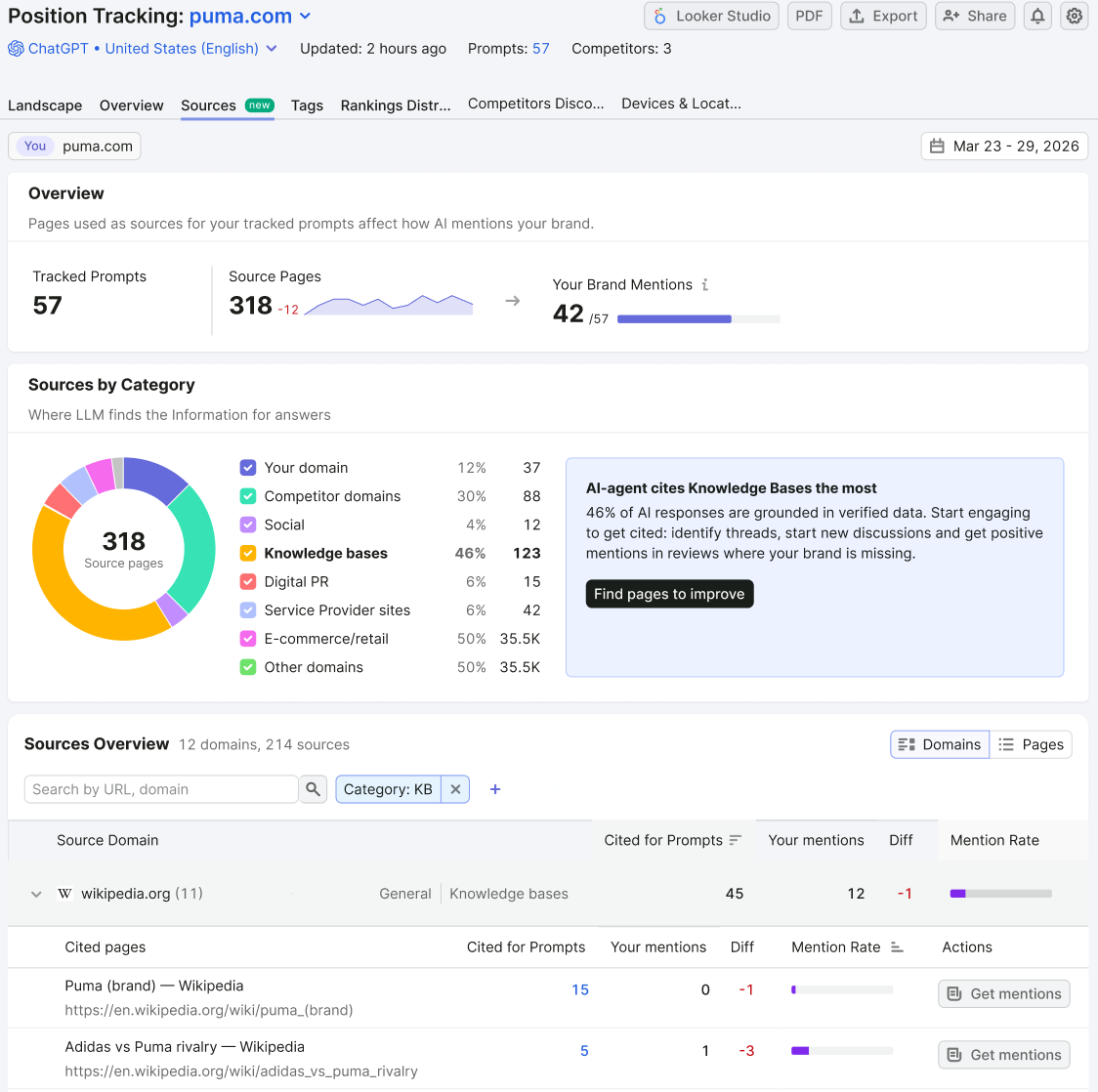
Best for: Marketing teams already using Semrush that want to incorporate AI visibility into their broader SEO reporting.
Semrush’s AI Visibility Toolkit provides brand-monitoring, citation, competitor, and prompt-tracking capabilities.
Its reports cover metrics such as mentions, cited pages, citations, share of voice, sentiment, and related brand-perception information.
Semrush also offers custom prompt tracking, which allows marketers to monitor selected questions over time.
Suppose an accounting software provider wants to monitor both its traditional search performance and its visibility in AI-generated recommendations.
Semrush can help bring those activities into a more connected research workflow.
Its Sources reporting also helps identify domains and pages being cited in responses to relevant prompts.
For example, you might discover that AI assistants regularly cite competitor product comparisons while rarely referencing your own guides.
That provides a useful topic for further research.
Semrush has different datasets and reporting capabilities.
Its large visibility research database should not automatically be compared with the results of a small custom tracking campaign.
A product’s share-of-voice measurement may also differ depending on which report you’re viewing.
The official AI Visibility pricing page advertises an entry point from $99 per month per domain, subject to the stated billing conditions.
Our assessment: Semrush is attractive for teams connecting GEO reporting with SEO research, but check the exact feature set and limits rather than assuming every AI visibility report works the same way.
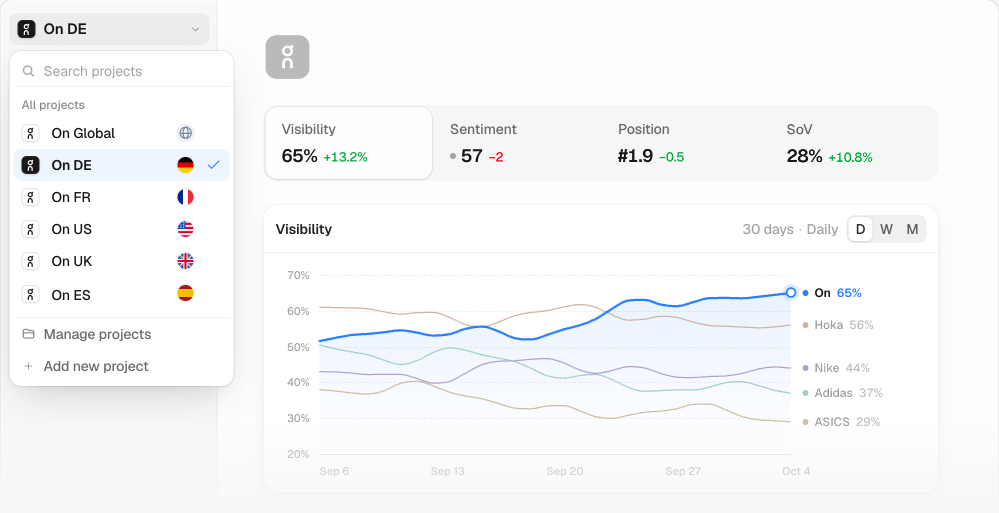
Best for: Marketing teams needing custom AI-search monitoring, competitor analysis, and brand-perception reporting.
Peec AI monitors how brands appear across supported AI engines.
Its product documentation describes visibility, position, share of voice, sentiment, and source analysis.
This makes it relevant for businesses concerned not only with whether they’re mentioned, but also with how AI systems describe them.
Imagine you’re monitoring a project-management software brand.
Your company appears frequently for prompts about affordable project-management software, but AI answers regularly mention limitations involving larger teams.
Peec’s sentiment and brand-context information can help reveal that recurring perception.
Its source analysis can also help identify the websites appearing alongside those answers.
These findings may point to product documentation, comparison pages, or third-party sources worth investigating.
Sentiment is not always straightforward.
An AI-generated answer can describe several brands in the same paragraph, compare one positively against another, or mention a genuine limitation without expressing an overall negative opinion.
That’s why you should inspect the full response behind important sentiment findings.
Peec’s published features are promising for brand-perception research, but their accuracy should be verified with a relevant sample of actual responses.
Our assessment: Peec is worth investigating when sentiment and source analysis are central to your GEO workflow.
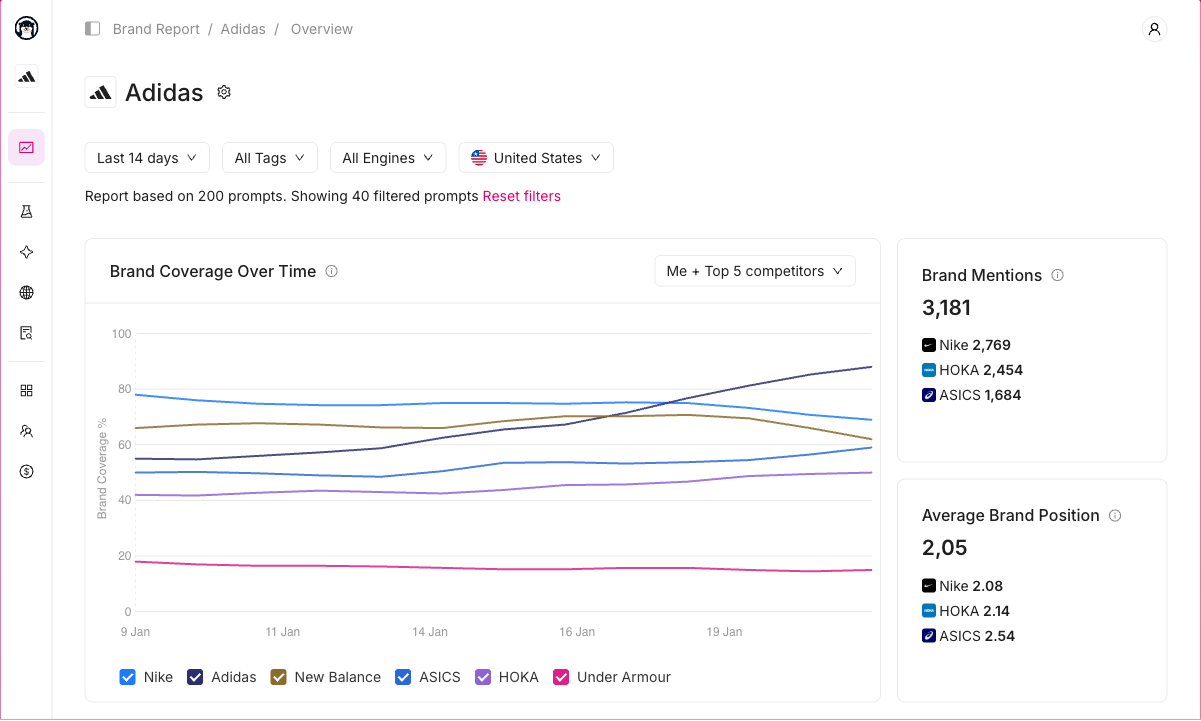
Best for: Small businesses, freelancers, and agencies that want scheduled AI visibility tracking.
Otterly.AI provides monitoring for selected prompts across supported AI search engines.
Its features include brand monitoring, citations, competitor comparisons, sentiment-related reporting, and historical trends.
This is a practical approach when you already know which questions matter to your business.
Suppose you operate a Singapore-based payroll software company.
You might track questions about payroll compliance, affordable payroll software, and alternatives to established providers.
Otterly can monitor these questions on a recurring schedule, helping you observe whether your brand appears and which sources are cited.
Its reporting integrations may also be useful for agencies preparing regular client updates.
Otterly’s entry-level Lite plan is advertised from $29 per month, with 15 tracked prompts.
However, not every supported AI engine is necessarily included at that starting price. Some platforms are available as additional paid options.
You should therefore calculate your requirements before choosing a plan.
A business tracking 15 questions on a few included platforms has a different workload from an agency tracking hundreds of questions across several countries.
Our assessment: Otterly is a practical option for recurring monitoring, provided its prompt allowances and engine coverage match your requirements.
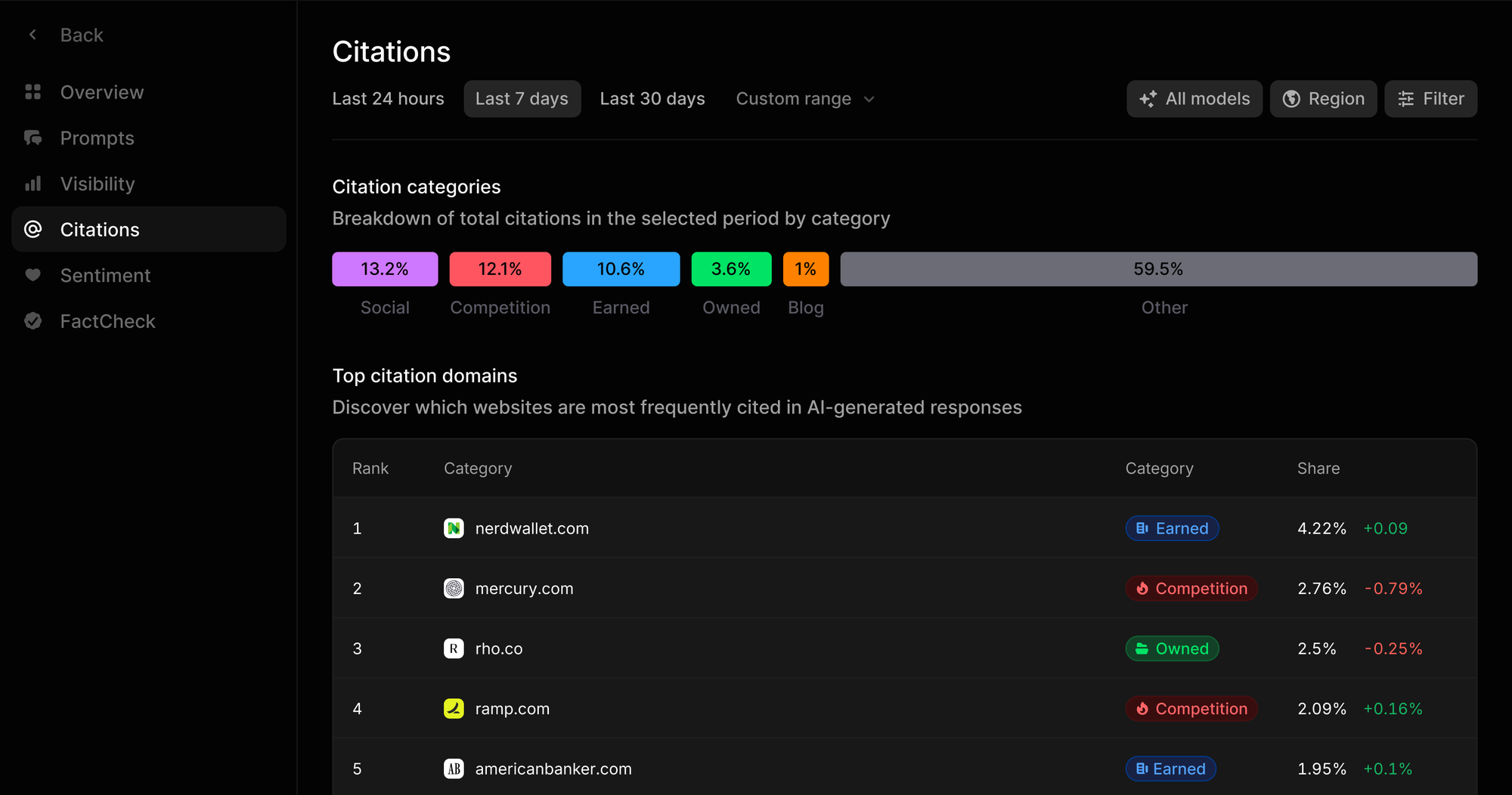
Best for: Businesses and larger marketing teams requiring AI visibility, citations, source analysis, and more advanced workflows.
Profound provides AI-search monitoring across several aspects of brand presence.
Its Answer Engine Insights product includes visibility, citations, sentiment, and prompt-level analysis.
The platform also offers additional research and workflow capabilities for more extensive GEO programmes.
One important feature is the ability to investigate the underlying prompt executions behind reporting changes.
For example, if your citation coverage declines during a particular period, reviewing the recorded responses can help determine which questions or sources contributed to the change.
This is more useful than relying entirely on an unexplained trend line.
Profound also publishes documentation discussing sampling frequency and the relationship between prompt coverage, repeated observations, and measurement precision.
Profound advertises a Starter plan from $99 per month with annual billing, but entry-level platform coverage differs from its higher tiers.
Its Starter package focuses on ChatGPT, while broader engine coverage is available through other plans.
For buyers, the important question is whether the selected subscription includes the platforms, historical data, and detailed evidence required.
Our assessment: Profound is worth evaluating for teams that need extensive AI-search analysis, but the value depends on the particular plan and monitoring scope.
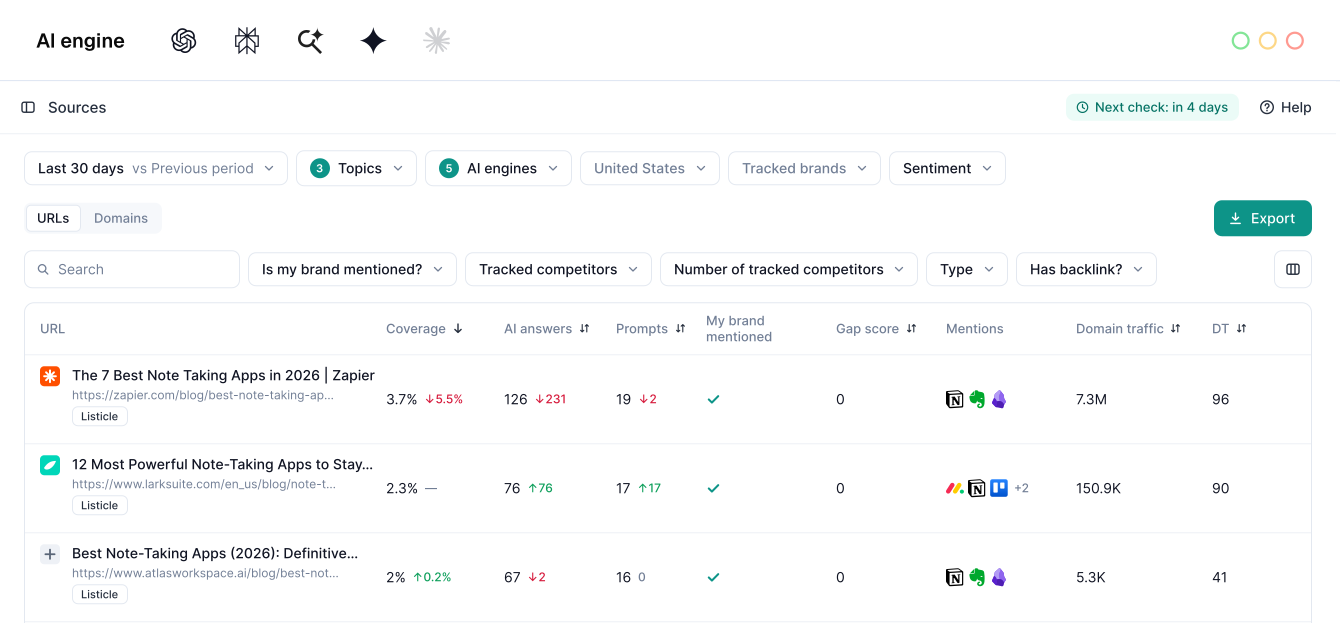
Best for: SEO teams and agencies interested in AI visibility, competitors, and recurring brand reporting.
SE Visible is an AI visibility monitoring platform associated with SE Ranking.
Its product documentation describes tracking brand appearances, competitor visibility, sentiment, and sources across supported AI experiences.
It also provides reporting designed to help marketers understand how brands compare within monitored topics.
For an agency monitoring several clients, a useful feature is the ability to investigate which source domains and pages appear in relevant AI answers.
For example, if competitors repeatedly appear in recommendations for a particular software category, source-level analysis may identify publications or comparison pages influencing those answers.
That can guide content and digital PR research.
SE Visible’s documentation also describes country and location-related monitoring, which may matter for businesses serving multiple markets.
Check the precise subscription allowance, project capacity, and engine coverage.
Some GEO products include a fixed number of engines in their self-serve plans, while others allow additional coverage through upgrades.
You should also investigate whether the tool preserves enough response-level evidence to validate important sentiment and citation findings.
Our assessment: SE Visible is an option worth comparing when you want ongoing brand monitoring alongside traditional SEO workflows.
Best for: Businesses looking to connect AI brand monitoring with SEO, content optimisation, and technical website analysis.
Digimetrics provides an integrated digital marketing toolkit that includes GEO-related features.
Its official website lists an AI Mentions Tracker, AI Discovery Audit, GEO On-Page Optimisation, and GEO+SEO Forensic Audit.
This makes it different from a product focused exclusively on monitoring AI answers.
A business might identify that its brand rarely appears for a particular category of questions.
Instead of treating that as an isolated reporting problem, the team may also want to examine whether relevant website pages provide useful information, whether technical issues are present, and whether content improvements are necessary.
Digimetrics’ broader toolkit is positioned around connecting these tasks.
That may appeal to teams seeking several marketing functions within one environment.
The presence of an AI Mentions Tracker doesn’t automatically establish that every citation-analysis or statistical reporting feature is available.
Before choosing a plan, confirm which AI engines are supported, whether individual source URLs are retained, how often monitoring runs, and whether full responses can be exported.
Also check the usage-credit arrangements, particularly if GEO monitoring shares allowances with content or technical marketing tools.
Our assessment: Digimetrics is worth evaluating for integrated marketing workflows, but its dedicated citation-tracking capabilities should be compared feature by feature with specialist products.
This is where AI citation tracking becomes more complicated than traditional keyword rank tracking.
AI-generated responses are not guaranteed to remain identical.
You can submit the same question twice and receive different recommendations or citations.
That means one observation tells you what happened during that request, not necessarily what will happen every time someone asks a similar question.
Research published in 2026, including Quantifying Uncertainty in AI Visibility and Don’t Measure Once, examines the variability of AI-search responses and why repeated measurements matter.
Imagine you’re monitoring this question:
“What are the best accounting tools for a small Singapore business?”
You collect 12 responses from the same monitored AI experience under documented conditions.
Your website receives a citation in five responses.
Your observed citation frequency is:
5 ÷ 12 × 100 = 41.7%
That is more informative than a single yes-or-no result.
However, it doesn’t mean there’s a precisely established 41.7% probability that any future real-world customer will see your citation.
The sample is small, the observations may not be independent, and real users may ask different questions or receive different responses.
Still, repeated observations provide a clearer view of variability than one screenshot.
Before subscribing, request a demonstration showing the monitoring method.
Specifically, ask whether the tool records individual responses, how frequently prompts are checked, and whether historical observations can be inspected.
You should also find out how failed collections are handled.
A failed response shouldn’t automatically be counted as a successful check where your brand was absent.
And if a tool reports an aggregated citation rate, you should understand its denominator.
Is it counting unique prompts, total response executions, or the number of generated citations?
Those measurements aren’t interchangeable.
You don’t need a massive enterprise dataset to evaluate whether a tool suits your business.
A small, controlled pilot can reveal whether the software collects enough evidence and whether its reports are understandable.
Here’s a two-week test framework.
Choose questions reflecting actual customer needs.
A reasonable starting distribution is:
| Prompt Type | Number |
|---|---|
| Problem-solving questions | 5 |
| Category discovery | 5 |
| Competitor comparisons | 5 |
| Branded questions | 5 |
| Total | 20 |
Keep branded questions separate from non-branded discovery questions.
If every question contains your company name, the resulting mention rate may provide little information about how often unfamiliar customers encounter your business.
Choose two platforms relevant to your audience.
For example, you might use ChatGPT Search and Perplexity.
Document the exact AI experiences, country, language, and collection settings.
Don’t assume an API response is equivalent to a consumer search-enabled interface unless the product’s collection method supports that comparison.
Suppose you run the same 20 prompts across two platforms on three days each week for two weeks.
Your planned observation count is:
20 prompts × 2 platforms × 3 collection days × 2 weeks = 240 responses
This is a manageable pilot, not a statistically representative sample of all customer AI interactions.
It gives you six planned observations per prompt-platform pair.
That’s still a limited sample for estimating individual prompt frequencies, but it helps you evaluate response retention, collection consistency, and reporting quality.
For a selected group of responses, manually inspect:
Look especially for false positives involving similar brand names.
For example, a software brand named Mercury shouldn’t necessarily receive credit for every reference to Mercury the planet or another unrelated company.
At the end of the pilot, ask which tool helped you understand the observations most effectively.
Could you identify prompts with recurring citations? Could you see competitor sources? Could you investigate a negative mention in context?
A good result isn’t necessarily the highest visibility score.
It’s a report that helps you understand what was observed, what remains uncertain, and what to investigate next.
Citation tracking tells you whether your website appeared as a source.
Sentiment analysis attempts to interpret how an AI answer describes your brand.
That can be useful, especially when prospective customers are asking AI assistants to compare products or providers.
However, sentiment is one of the easiest places to overinterpret an automated score.
Consider this hypothetical response:
“Unlike Acme Analytics, which has struggled with complex integrations, BetaMetrics provides a simpler setup for enterprise teams.”
The answer mentions both brands.
But it presents Acme Analytics unfavourably in that comparison.
A sentiment classifier that looks only at nearby positive words or part of the sentence could misclassify the mention.
The problem becomes more complicated when answers include several companies, qualifications, or mixed assessments.
For example, an answer might say a product is affordable and easy to use but lacks advanced reporting.
Is that positive, negative, or neutral?
The answer depends on what the user asked and how the tool defines sentiment.
For a manageable test, select 30–50 brand mentions from actual captured responses.
Have a reviewer classify each mention using a consistent set of categories such as positive recommendation, neutral description, qualified recommendation, and negative or cautionary mention.
Then compare those human classifications with the software’s output.
Disagreements should be reviewed in context.
This does not establish the tool’s universal accuracy, but it helps reveal whether its sentiment labels are useful for your particular brand and industry.
Our recommendation: Don’t treat a sentiment score as a final verdict. Use it to locate important answers, then read the relevant context before making marketing decisions.
Most businesses don’t need dozens of GEO measurements.
A useful report should separate several core outcomes.
| Metric | Calculation or Definition | What It Doesn’t Prove |
|---|---|---|
| Brand mention rate | Responses naming your brand ÷ monitored responses | Actual audience reach |
| Website citation rate | Responses visibly citing your domain ÷ monitored responses | Brand endorsement |
| Recommendation rate | Responses explicitly recommending your brand ÷ monitored responses | Sales or conversions |
| Competitor mention rate | Responses naming a particular competitor ÷ monitored responses | Total competitor market share |
| Negative-context rate | Responses describing your brand negatively ÷ responses mentioning your brand | Overall customer satisfaction |
| Unique cited pages | Distinct URLs on your site appearing as sources | Number of people clicking those URLs |
These metrics should be calculated within a clearly defined monitoring setup.
For example, a citation rate based on 100 non-branded ChatGPT prompts shouldn’t be compared directly with one based on 20 branded Perplexity questions.
The underlying questions and platforms differ.
Also, don’t assume that a rising citation rate is automatically accompanied by more website traffic.
AI users can read an answer without opening the cited sources.
For broader measurement guidance, see our guide to measuring GEO performance.
Pricing remains difficult to compare because the products use different subscription models.
Some charge according to tracked prompts. Others include prompt allowances within broader SEO subscriptions or use credits and additional platform charges.
Here are selected publicly advertised starting points.
| Tool | Pricing Information | Important Limitation |
|---|---|---|
| Otterly.AI | Lite from $29/month | 15-prompt entry allowance; selected additional engines cost extra |
| Semrush AI Visibility | From $99/month per domain | Domain and custom prompt limits apply |
| Profound | Starter from $99/month equivalent with annual billing | Entry-level engine coverage is limited |
| Peec AI | Tiered plans; verify current checkout price | Prompt, model, and project allowances vary |
| SE Visible | Subscription tiers and custom options | Confirm the active regional price and engine allowance |
| Ahrefs Brand Radar | Pricing depends on the selected research and tracking access | Broad prompt-index research differs from custom prompt monitoring |
| Digimetrics | Tiered subscription and shared-credit model | Dedicated GEO capacity depends on the relevant tools’ credit consumption |
Selected official pricing information checked in October 2026. All amounts are USD unless stated otherwise. Prices and features may change; check current plans before buying.
Suppose you’re monitoring 30 prompts across four AI platforms every day.
Over a 30-day month, that represents:
30 prompts × 4 platforms × 30 days = 3,600 planned observations
One provider might include that workload within its tracked prompt allowance.
Another might charge separately by platform, while a credit-based tool may consume different amounts depending on the engine.
You therefore need to compare the actual cost of the same monitoring setup.
And if you need several brands, countries, or client workspaces, account for those too.
Our GEO tools pricing guide explains how to calculate these costs in more detail.
The right choice depends on the question you’re trying to answer.
If your priority is broad research into AI citations and competitors, Ahrefs Brand Radar or Semrush may be appropriate starting points.
If you want recurring monitoring of a defined set of questions, Otterly.AI, Peec AI, Profound, or SE Visible may be worth trialling.
If you need GEO monitoring alongside technical SEO and content workflows, Digimetrics is another option to investigate, with its current tracking details verified before purchase.
But don’t choose solely from the feature list.
The more important considerations are whether the tool monitors the AI experiences relevant to your customers, whether its data can be inspected, and whether its observations are consistent enough to support useful decisions.
| Evaluation Area | Suggested Weight |
|---|---|
| Relevant AI platform and location coverage | 20% |
| Prompt selection and tracking flexibility | 20% |
| Access to underlying responses and citations | 25% |
| Repeated monitoring and historical consistency | 15% |
| Sentiment and competitor reporting | 10% |
| Pricing and workflow efficiency | 10% |
| Total | 100% |
These are recommended evaluation weights, not performance scores assigned to the products in this article.
Score only the capabilities you’ve actually verified during a trial or demonstration.
For example, if a vendor advertises detailed sentiment analysis but doesn’t provide access to the underlying responses, that should affect how confidently you use the feature.
One answer can confirm that your website appeared at a particular moment.
It cannot establish how frequently the same result occurs across different users, locations, or repeated requests.
Look for historical monitoring and a consistent prompt panel.
A brand can appear without its website being cited.
A website can also be cited without the brand receiving an explicit recommendation.
Keep these outcomes separate.
Automated sentiment is useful for identifying possible issues, but context matters.
Review important negative or positive classifications before drawing conclusions.
Different platforms may use different prompts, datasets, collection intervals, and scoring methods.
A 60% visibility score from one product may not be equivalent to 60% in another.
A cited website may receive no click.
A customer may also discover a company through an AI answer and visit later through Google or another channel.
Use citation monitoring alongside Search Console, analytics, and relevant business data rather than treating AI mentions as proven sales attribution.
This article reviews seven platforms using their publicly documented capabilities, official feature pages, and current pricing information.
It also proposes a repeatable testing method for evaluating citation and sentiment reporting.
We have not conducted an identical multi-platform benchmark that establishes comparative detection rates or statistical accuracy across the seven products.
The worked calculations are illustrative, and no historical client result is represented as firsthand research.
Our broader approach to testing, evidence, scoring, and disclosure is explained in How We Review GEO Tools.
Yes. AI visibility tools can monitor selected ChatGPT responses and identify brand mentions or website citations.
However, third-party tools don’t have a complete record of every private ChatGPT conversation involving your business.
Their findings describe the monitored prompts and responses.
A brand mention occurs when an AI-generated answer names your business.
A citation occurs when the answer references a source, often through a linked webpage.
The two outcomes can happen independently.
Accuracy depends on the tool’s collection method, prompt selection, citation detection, and reporting process.
A tool can correctly report the responses it observed while still providing a limited picture of the wider AI-search environment.
Inspect the underlying responses and repeat important checks.
It depends on your reporting goals and budget.
Daily monitoring can provide a useful history, but the results still need to be interpreted across a consistent period.
Weekly or monthly reviews may be sufficient for some smaller businesses.
The important thing is to avoid making strategic decisions based on a single fluctuating answer.
Some platforms provide sentiment and brand-context analysis.
However, automated classifications can misinterpret comparisons, sarcasm, mixed recommendations, or qualified statements.
Review the full answer before treating a sentiment score as conclusive.
They can be useful when you need recurring monitoring, competitor comparisons, source analysis, and historical reporting.
However, if you’re only investigating a few questions, free first-party data and a small manual monitoring process may be enough to start.
Google Search Console provides dedicated generative AI performance reporting, including impressions for supported Google AI search features.
That is not identical to a cross-platform citation tracker.
Bing Webmaster Tools provides more explicit AI citation information for supported Microsoft experiences.
No.
AI assistants can cite a website without the user clicking it.
Citation monitoring should therefore be treated as a visibility measurement rather than guaranteed traffic or revenue.
AI citation tracking can help marketers answer questions traditional SEO tools weren’t originally designed to address.
You can investigate whether your brand appears in AI-generated answers, which pages are cited, how competitors are represented, and whether those observations are changing over time.
But the numbers only become useful when their methodology is clear.
Before buying, ask what prompts the product monitors, which AI experiences it uses, how often it repeats observations, and whether you can inspect the underlying answers.
Also check whether it distinguishes mentions from citations, whether sentiment can be verified in context, and how the subscription scales with your monitoring requirements.
The best AI citation tracker isn’t necessarily the one reporting the most mentions. It’s the one that helps you understand what actually happened, how confident you should be in the evidence, and what to investigate next.
Start with a small, consistent prompt set. Compare the underlying results. Then choose the tool that provides the clearest and most useful evidence for your business.

Tom is the CEO of MediaOne, a leading digital marketing agency. He is a business-experienced SEO consultant as well as a Google Gold Search Expert serving the international community. He has consulted for MNCs like Canon, Maybank, Capitaland, SingTel, ST Engineering, WWF, Cambridge University, as well as Government organisations like Enterprise Singapore, Ministry of Law, National Galleries, NTUC, e2i, SingHealth. His articles are published and referenced in CNA, Straits Times, MoneyFM, Financial Times, Yahoo! Finance, Hubspot, Zendesk, CIO Advisor. Under his stewardship, MediaOne has won dozens of prestigious digital marketing awards.
Run a free Digimetrics audit across SEO, AI search, content and technical health, and get a plan you can act on today.
Start free →Yes, Ahrefs has a free AI Visibility Checker. You can enter a brand name, inspect its presence across six AI search experiences, and see…
Your website ranks on Google. Your SEO dashboard shows healthy organic traffic, and your brand appears for several commercially valuable keywords. But when someone…
Direct answer: To rank in Perplexity and ChatGPT, answer one narrow question clearly, make each claim easy to check, and structure the page so…