AI Mentions
Ahrefs Free AI Visibility Checker: What You Get, Limitations & Alternatives
Yes, Ahrefs has a free AI Visibility Checker. You can enter a brand name, inspect its presence across six AI search experiences, and see…
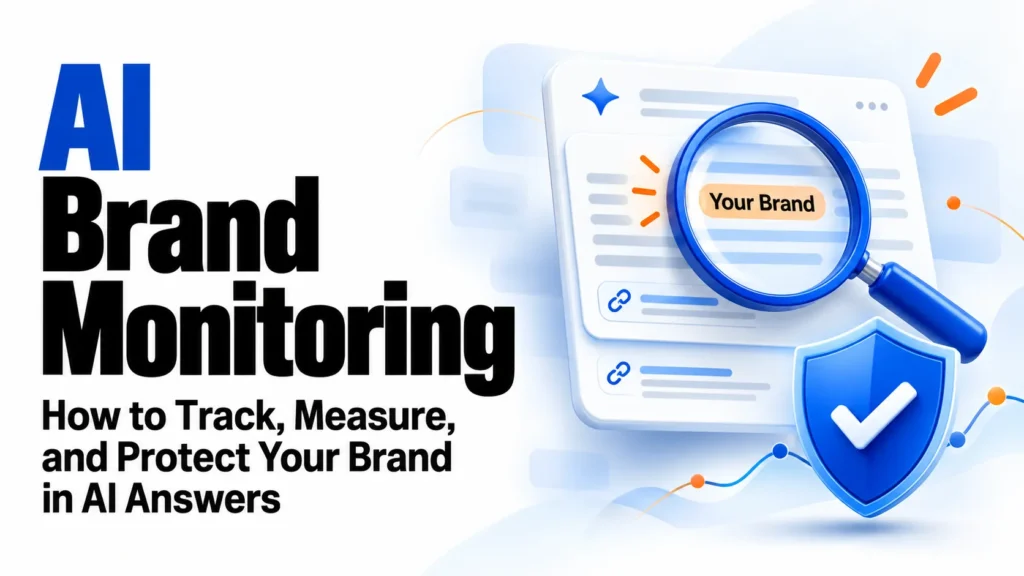
AI brand monitoring tracks how AI assistants describe your brand, how often they mention it, and which sources they rely on. Buyers now ask ChatGPT, Gemini, Claude or Google’s AI Overviews to shortlist vendors and identify the best options for their needs. G2’s 2026 AI Search Insight Report finds AI chatbots are the top influence on B2B shortlists (54%), ahead of review sites (43%). The question is no longer “Where do we rank?” but “How are we described?”
Most buyers no longer scroll blue links before shortlisting a vendor. They ask an assistant, such as “best project management tool for a 40-person agency,” and get a paragraph naming three or four brands. Your brand is either in that paragraph, described accurately, or absent.
Buyers now start with the chatbot. In G2’s March 2026 survey of 1,076 B2B decision-makers, AI chatbots ranked as the top shortlist influence at 54%, ahead of review sites at 43%.
Visibility now means representation, not just ranking. AI brand monitoring shows which brands an engine names and how it describes them, so product, marketing and sales teams can see the same picture.
Errors are common. Searchable’s AI Brand Misinformation Report found 9.2% of AI-stated facts were false, across 32,556 facts and 1,704 brands. A wrong price can cost a deal before sales know the buyer has asked.
The sections below cover what to measure, how to run a baseline audit, and how to fix misleading sources.
AI brand monitoring tracks whether an AI assistant mentions your brand in response to a relevant buyer question, how it describes the brand, and which sources it relies on. The most important platforms are ChatGPT, Gemini, Claude, and Google AI Overviews. Unlike rank tracking, it asks what a buyer hears in an answer, not where your page sits in a results list. Teams use the resulting data and insights, including brand mentions, to see how these engines represent their content.
A search engine returns ten links to compare. An answer engine reads many sources and writes one response. Gemini, for example, draws on your website, competitors and authoritative sites to produce a single AI Overview with citations. Its responses can change as the underlying content changes.
The pages an engine cites shape the answer more than your ranking does. In one Ahrefs sample, only about 12% of what AI assistants cite overlaps with Google’s top 10 results for the same query, as Rework reports in its review of AI brand monitoring tools. A brand can rank well and still be described through a comparison site or an outdated directory listing. Marketing intelligence therefore has to cover third-party content as well as your pages.
Traditional brand monitoring asks where people are saying your name. Social media listening tools, news alerts and review trackers capture public mentions and sort them by volume and tone. Each result is a fixed document that a team can reproduce by running the same search again.
AI brand monitoring asks what an answer engine says about your brand when a buyer requests a recommendation. That answer is generated on demand and changes from run to run. Claude, ChatGPT and Gemini can each answer the same question differently, so each platform needs its own check. Ongoing visibility tracking shows whether your brand appears across those answers over time.
A traditional alert tells you a negative review was posted. An AI audit tells you that ChatGPT, asked for the best tools in your category, leaves your brand out or describes pricing you retired last year.
| Dimension | Traditional brand monitoring | AI brand monitoring |
|---|---|---|
| Data source | Fixed posts, articles, reviews and forum threads | Answers synthesized from many web sources |
| Output type | A list of mentions with volume and sentiment labels | Generated prose plus the sources behind it |
| Reproducibility | High: the same query returns the same documents | Low: outputs vary, so a fixed prompt panel is needed |
| Remediation path | Reply, report or request removal on the same channel | Correct or strengthen the sources the AI draws on, then re-test |
The remediation row matters most. With AI monitoring, the mention is a symptom; the cure lies upstream in source pages, directory listings, and third-party articles the model weighted. Because responses vary, scoring a single prompt once can mislead you in either direction. Marketing and communications teams should read the results together, since the same insights can point to a content gap, a stale listing or a missing third-party reference.
AI monitoring should not be bolted onto social listening as one more channel. It needs its own prompt panel, accuracy scoring and correction log.
A spreadsheet works for a small panel of 20 prompts checked by hand once a month. It stops being enough when the panel grows, when several platforms must be tested on a shared schedule, or when a team needs answer history to confirm a fix worked. Dedicated tools generally fall into three groups: visibility trackers, accuracy checkers and citation analysers. Check current feature lists before buying, as the category changes quickly.
Buyer habits are shifting. Clutch’s guide to AI brand monitoring reports that 19% of consumers now use AI assistants as their primary research tool, changing how they discover products. This is one publisher’s survey, so treat it as directional.
If a chatbot answer is a buyer’s first research step, it is the brand’s first impression. Search rankings alone miss that step, so teams need monitoring tools that track how AI tools such as Claude describe the brand and its content across these platforms, using the best available data to guide what to fix first.
Four metrics cover most of the picture: mention rate (share of panel prompts where the brand appears), sentiment (how the answer frames it), accuracy (share of facts matching your verified facts) and citation source (which pages the answer relies on). Share of voice compares your mention rate with competitors across these AI responses.
Track these by platform, since a brand may rank well in one assistant and be absent from another. Keep data clean, dated and tied to each platform so results stay comparable and the insights are reliable for product teams, including those managing social media channels.
Mention analysis records whether the brand appears in what position and alongside which competitors. A brand named ‘first’ carries more weight than one that is listed as ‘fifth’.
Sentiment analysis tags the framing of each mention. Phrases such as “a budget option” shape buyer views. Check a sample by hand, since sarcasm and hedged praise are easy to misread.
Citation analysis lists the URLs behind each answer. An outdated cited page is a fix target. A citation shows correlation, not proof of cause, so confirm a correction by re-running the prompts. Start with the pages cited most often, then check whether the answers change after each update.
A visibility score combines mention rate, sentiment and accuracy into one figure. Score each prompt 0 to 2 for presence (0 absent, 1 mentioned, 2 recommended), then 0 to 2 for accuracy. Weight presence at 60% and accuracy at 40%. A prompt scoring 2 for presence and 1 for accuracy gives (2 ÷ 2 × 0.6) + (1 ÷ 2 × 0.4) = 0.80, or 80%. Average across the panel, and run the same panel each cycle.
The 60/40 weighting is one illustrative choice, not an industry standard. Adjust it to fit your business. Treat the result as a working estimate, not a benchmark. Small panels swing widely, and scores vary between runs. Have two reviewers score the panel, and record the date and platform with every result so tracking stays consistent. Verify every figure against its original source before publishing.
Ownership is often the real bottleneck. AI brand monitoring touches SEO, because AI tools cite web pages. It also touches PR, since third-party articles and reviews shape how a brand is described, and product marketing, since feature and pricing claims must be accurate. Each team needs clean data and consistent responses from the same monitoring tools to act with confidence.
A workable split: SEO owns the tracking log and owned-source fixes. PR owns third-party corrections. Product marketing owns the fact reference sheet. One person owns the visibility score and schedule. Teams should agree on one set of approved claims before requesting any correction, and review sentiment analysis trends alongside broader market intelligence to see how the market is shifting.
Integrated tracking may pay off. 81% of brands that integrated AI visibility tracking into an existing SEO workflow reported increased traffic or leads from AI platforms, versus 36% that managed the two separately. This is correlational, so treat it as a reason to integrate, not as proof of cause.
A single outdated figure can spread quickly once it appears in a generated answer. Trace each error before deciding on a fix. The diagram below traces one error from the statement back to its source page, then through the correction and re-run.
Clear, factual owned pages help most, since they give the engine a clean source. Well-structured content is easier for AI tools to cite accurately.
Small brands with few buyers may rarely appear in AI answers, so the panel returns little. Outputs also vary between runs, so one answer is not a trend.
The audit pays for itself when enough category questions circulate, as a wrong fact could cost a deal. Start with the prompt panel, then track the questions that matter most.
AI answer engines have shifted the contest from rank to the sentence that describes your brand. ChatGPT, Gemini and Google AI Overviews synthesize an answer, and it either names your brand accurately or it does not. Brand mentions in these answers now matter as much as rankings did.
Treat AI representation as its channel, with its own metrics and correction process. Run AI brand monitoring audits on a schedule, using consistent prompts to track brand visibility over time, and prioritise the sources behind the worst answers first.
Your first three actions for the next 30 days:
AI brand monitoring tracks what answer engines say about your brand. Tools such as ChatGPT, Gemini and Google AI Overviews generate answers from web sources. Monitoring checks whether your brand is mentioned, how it is described, whether the facts are correct, and which sources the AI cites. Because buyers often read the answer without clicking through, these responses can shape perception before a visit ever happens.
Social listening tracks what people say about a brand on social media and review sites. Traditional tracking focuses on posts and mentions. AI brand monitoring tracks the responses generated by AI tools to buyer questions. The same prompt can return different answers on different runs, so monitoring relies on fixed prompt panels and repeated runs. This is the main gap in traditional brand monitoring.
Run a fixed prompt panel at least monthly. Increase the frequency to weekly during a product launch, pricing change or public controversy. Set alerts for serious issues, such as a new factual error about pricing or leadership.
Often, yes, but indirectly. Correct the web source carrying the error, such as your product page or a directory listing. Then re-run the affected prompts. Changes may take time to appear, so please verify the result rather than assume it.
No. A team can run a manual baseline with a spreadsheet, 20 to 30 buyer-intent prompts and a few hours a month. A dedicated tool becomes worth the cost when you need historical tracking, automated alerts and citation reporting.
Track mentions, description sentiment and accuracy. Mark each stated fact as correct, false or unverifiable. Accuracy matters most, because a wrong mention can still damage a brand. Keep a log of cited sources, which often differ from pages that rank in search.

Tom is the CEO of MediaOne, a leading digital marketing agency. He is a business-experienced SEO consultant as well as a Google Gold Search Expert serving the international community. He has consulted for MNCs like Canon, Maybank, Capitaland, SingTel, ST Engineering, WWF, Cambridge University, as well as Government organisations like Enterprise Singapore, Ministry of Law, National Galleries, NTUC, e2i, SingHealth. His articles are published and referenced in CNA, Straits Times, MoneyFM, Financial Times, Yahoo! Finance, Hubspot, Zendesk, CIO Advisor. Under his stewardship, MediaOne has won dozens of prestigious digital marketing awards.
Run a free Digimetrics audit across SEO, AI search, content and technical health, and get a plan you can act on today.
Start free →Yes, Ahrefs has a free AI Visibility Checker. You can enter a brand name, inspect its presence across six AI search experiences, and see…
Your website ranks on Google. Your SEO dashboard shows healthy organic traffic, and your brand appears for several commercially valuable keywords. But when someone…
Direct answer: To rank in Perplexity and ChatGPT, answer one narrow question clearly, make each claim easy to check, and structure the page so…