AI Mentions
Ahrefs Free AI Visibility Checker: What You Get, Limitations & Alternatives
Yes, Ahrefs has a free AI Visibility Checker. You can enter a brand name, inspect its presence across six AI search experiences, and see…
Brands now ask a simple question: when a buyer asks an AI assistant about our category, do we get named? Gartner’s forecast, as reported by Gracker, predicts that traditional search engine volume will fall 25% by 2026 as users shift to AI assistants. When an AI summary appears, searchers click through to a result about 8% of the time, against 15% without one.
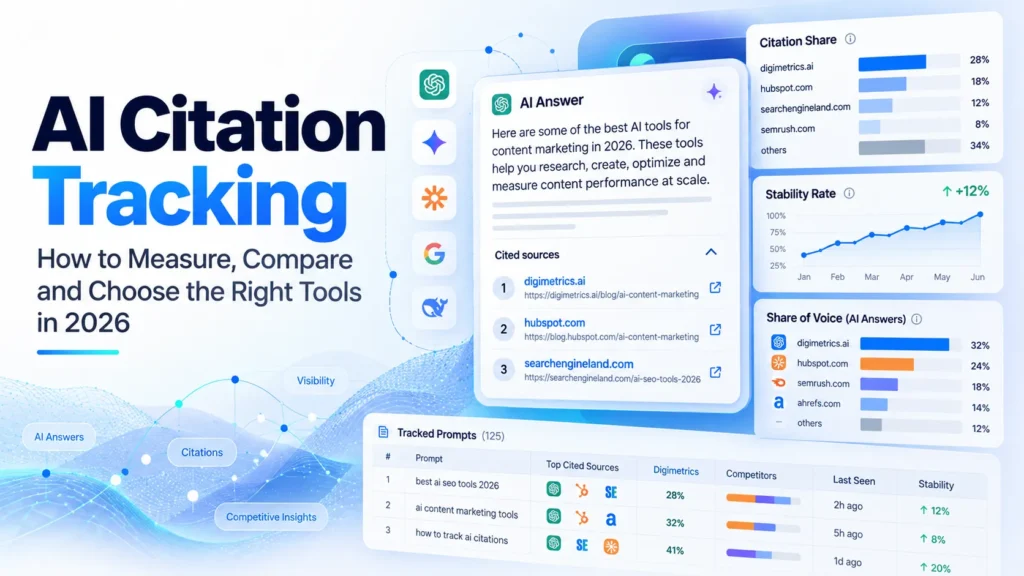
AI citation tracking measures how often a brand’s pages are cited as sources in AI answers, so you can see whether your content is part of the answer at all. Use it to track citation share, stability rate and share of voice across a focused prompt panel. Ongoing monitoring shows whether visibility is rising or slipping over time. Enterprise teams often add a platform such as Semrush to combine citation data with existing search reporting. A paid tool pays off once you have defined buyer-intent prompts, a repeatable visibility baseline and a plan to act on the results. Regularly analysing that baseline helps you decide which pages to update first.
AI citation tracking measures how often a brand’s pages are cited as sources in answers from AI engines such as ChatGPT, Perplexity, Gemini, and Google AI Overviews. A rank tracker shows where your page sits in a list of links. A citation tracker shows whether the engine used your page to build its answer at all.
Rank is a position. A citation is a yes or no per prompt, per engine, per day, and it can change on every run. A page can rank third on Google and never be cited, or it can sit on page two and still be cited for a niche question. Track both to see the full picture, and the best way to judge visibility is to compare the two side by side.
A mention is your brand name in an answer, and tracking brand mentions alongside links shows how an engine describes you even when it does not cite your URL. A citation is a source reference to your URL. An engine can name a competitor without linking anywhere or cite your article without writing your brand name. Record both in separate columns, or your share figures will blur together.
Buyers are moving part of their research into AI assistants, and enterprise teams are feeling it first. Gartner forecasts that traditional search engine volume will drop 25% by 2026. When an AI summary appears, searchers click through to a result only 8% of the time, against 15% when no summary appears. A brand absent from the answer loses the visit before any click happens.
Generative Engine Optimization makes pages easier for AI engines to retrieve, trust and quote. That means direct answers near the top of each page, clear headings, stated facts with named sources, and current content. GEO is the work, and this guide to citation tracking checks whether that work is landing.
Most citation tracking dashboards open with a single headline number. Before you trust it, know what it measures, how it is calculated, and how much it changes each week. The four metrics below turn raw answer logs into a decision.
Citation frequency counts how many answers, across a fixed prompt set, name or link to your domain. A visibility score usually weights prompts by importance, so a high-intent prompt counts for more than a broad informational one. Weighting differs between tools, so please ask your vendor for the formula. A raw count you can reproduce in a spreadsheet is more useful than a composite score you cannot explain. Brand mentions without a link still signal visibility, so track them separately from linked citations. The best starting point is a simple count you can verify yourself.
Citation share is the percentage of tracked prompts where your site is cited as a source. You divide cited prompts by total prompts, then multiply by 100.
Citation share = prompts citing your domain ÷ total tracked prompts × 100
In a set of 100 tracked prompts, your site is cited in 15, so your citation share is 15%. A competitor cited in 30 prompts has a 30% share. One prompt can pull from 5 to 15 sources, since one question can trigger several sources during the search. Read and share alongside the answer text so you can see which sources drove the result. Compare the traffic these cited answers send to your site, rather than just the share itself.
Stability rate measures whether citations persist. Divide the prompts that cited you last week and still cite you this week by all the prompts that cited you last week. If 20 answers cited you last week and 16 still cite you, your stability rate is 80%.
Answers change between runs, so the same prompt can return different sources on different days. A one-week swing of three or four points is usually sampling noise. A sustained drop across several weeks points to a real change in how engines treat your content. Use a traditional rank-tracking mindset here: look at the trend, not the single week.
Share of voice compares your citations to those of named competitors across the same prompt set. Citation share shows how often you appear. Share of voice shows where you stand in the field. Track three to five competitors using the same prompts and engines each time. Changing the prompt list between periods makes the comparison meaningless. Follow the guide above for consistent setup so the figures stay comparable over time. For enterprise teams, a shared prompt library keeps the comparison consistent across departments.
The prompt panel is the core of any tracking method. List the questions a real buyer asks before contacting a company like yours, including questions that enterprise buyers typically ask during vendor evaluation. Aim for 20 to 30 prompts across three types: category questions (“best payroll software for a 30-person agency”), comparison questions (“Brand A vs Brand B for small teams”) and problem questions (“why is my invoice reconciliation so slow”).
Write each prompt the way a person types into a chat box. Keep the wording consistent so that results stay comparable from one month to the next, and record how each brand and piece of content appears in the answers.
Run each prompt in the same engines on the same schedule. Use a fresh session and log out of personal accounts where possible. Answers change between runs, so repeat the full panel before drawing conclusions about visibility.
One row per prompt, per engine, per run is enough for most teams. Record:
You calculate citation share per engine by dividing cited prompts by total prompts. You calculate stability by counting how many previously cited prompts still cite you. Keep the sheet’s structure fixed from month to month so the trend stays comparable.
Manual tracking is slow, inconsistent (two people can phrase the same prompt differently) and hard to scale.
Set a clear threshold for moving to a paid tool. If the routine takes more than about two hours a month, or you need coverage beyond roughly 50 prompts, a low-cost platform starts to earn its fee. At Ayzeo’s published rates, the Lite plan at $29 per month covers 15 prompts and the Standard plan at $189 covers 100 prompts (Ayzeo). Manual sampling stays cheaper until your prompt set and engine list outgrow what one person can run reliably.
Most vendors offer the same basics: a prompt list, a set of answer engines and a dashboard showing whether your brand appears in search results. The differences sit underneath. Check how many prompts the plan includes, which answer engines are covered, whether the report shows the cited URL or only the brand name, and whether prompts rerun on a schedule you control.
The prompt set matters most. Conductor generates prompts per topic based on your chosen intents and personas, with a typical range of 50 to 150. This helps teams without their own buyer questions. Check whether generated prompts match what your customers actually type, since that determines how accurate your brand visibility and monitoring data will be.
| Platform tier | Typical entry price | Prompts included | Key feature to check |
|---|---|---|---|
| Entry-level (e.g. Ayzeo Lite) | $29 per month | 15 | Engine add-ons priced separately |
| Mid-tier (e.g. Ahrefs Brand Radar) | Accessed through the Ahrefs Lite plan at $129 per month | Varies by plan | Competitor and brand share reporting |
| Enterprise suites | Quote-based | Hundreds | Integrations and white-label options |
Prices reflect vendor pages checked in October 2026. Plans change, so confirm current pricing on each vendor’s pricing page before you buy.
The headline price is rarely the real monthly cost. Ayzeo’s Lite plan is $29 per month for 15 prompts, Standard is $189 for 100 and Premium is $489 for 400. Some engines are sold as add-ons too: Google AI Mode and Gemini are paid per-tier add-ons, from $9 on Lite up to $149 per month on Premium, per engine.
Trials differ. Profound offers a free 7-day trial with 50 prompts run daily across ChatGPT, Gemini and Google AI Overviews. Gracker’s paid plans start from $79 per month billed annually or $99 billed monthly, with a 7-day free trial that requires a credit card. Check whether a trial asks for a card and whether its prompts match the ones you would track long term.
Compare plans on cost per tracked prompt. Lite at $29 for 15 prompts works out to about $1.93 per prompt per month. Standard at $189 for 100 works out to about $1.89. Add one $9 Lite engine add-on and the Lite total becomes $38, or about $2.53 per prompt.
Engine coverage decides what your data can tell you. A tool that tracks ChatGPT and Perplexity but not Google AI Overviews misses a surface where many US searchers first see a summary. Growth covers three answer engines, which is less coverage than some rivals but a lower add-on cost. Compare coverage against the engines your buyers actually use.
Depth varies too. Some tools record only whether your brand is named. Others log the cited URL, its position in the answer and the sources used. The cited URL is the most useful field for content decisions, because it shows which page to improve. Otterly’s April 2026 help documentation confirms there is no native white-label option, so agencies reselling reports should check this first.
AI citation tracking tools return approximate results. Answer engines are non-deterministic, so the same prompt can produce different answers on different days or even between runs. Each tool query is one sample, not a fixed reading of a ranking, and the monitoring output should be read as a sampled estimate rather than a precise measurement.
Sampling variance alone can move citation share. A shift from 15% to 18% between two monthly reports may reflect noise rather than a real change. Act only on movements that persist for two or three consecutive periods, or that cross a threshold you set in advance.
Results also vary by methodology, location, account and model version. Treat every tool output as an estimate and compare it with the same method over time to keep your visibility readings consistent.
One question often triggers several sources because the engine breaks it into subtopics. Stackmatix’s analysis of AI search citation tracking reports that one prompt can pull from five to 15 sources. A citation count shows presence, not proof that a specific page earned the mention. Where the distinction affects a content decision, open the cited URL and check it yourself, since a traditional rank report would not reveal this.
Native white-labelling is not universal. Otterly’s April 2026 help documentation confirms it offers no native white-label option, as noted in Ayzeo’s comparison of citation tracking platforms. Check this before signing. Confirm the tool exports raw prompt-level data, because dashboard-only tools make it hard to join citation data with traffic data, and the best tools for your team will make that export straightforward.
AI citation tracking earns its cost only when three things are in place: buyer-intent prompts, a clear view of which answer engines matter to your customers, and a named owner who acts on the data. Without them, a dashboard produces numbers nobody uses.
Our recommendation is to start with a manual panel of 20 to 50 prompts, logged in a spreadsheet and reviewed monthly. Move to a paid platform only when prompt volume or engine coverage outgrows that routine. Compare the true monthly cost, including per-engine add-ons, against the cost per tracked prompt rather than the headline plan price.
AI citation tracking is the practice of checking whether answer engines such as ChatGPT, Perplexity, Gemini and Google AI Overviews cite your website when they respond to buyer questions. You run a fixed set of prompts, record which sources each answer names, and measure how often your domain appears. Tools automate this, but a spreadsheet and a disciplined prompt list can do the same job at small scale.
A citation is a link or source reference that points to your domain. A brand mention is your name appearing in the answer text without a link. A citation sends readers to your page, while a mention builds awareness. Track them separately to see whether an answer engine is reading your content or only recognising your name.
They are useful but approximate. Answer engines are non-deterministic, so the same prompt can return different answers on different days, and tools sample a limited number of runs. Results can also vary by location, account and model version. Treat a single month-on-month movement as a signal to investigate, and look for sustained trends before acting.
Pricing depends on prompt volume and the number of engines covered. Ayzeo lists a Lite plan at $29 per month for 15 prompts, a Standard plan at $189 for 100 prompts and a Premium plan at $489 for 400 prompts. Ahrefs Brand Radar is accessed through the Ahrefs Lite plan at $129 per month. Some engines, including Google AI Mode and Gemini, can be paid add-ons, so the headline price understates real spend. Divide the total cost by your prompt count to compare plans fairly.
Yes, at a basic level. You can run a manual panel of 20 to 30 buyer-intent questions across two or three engines each month and log the cited sources in a spreadsheet. Some vendors also offer free checkers covering your domain and up to five competitors. Free options give a snapshot but rarely offer historical tracking or alerts, so they suit a first audit.
Check your core prompt set monthly, which is enough to see trends without chasing sampling noise. Review priority pages on a 90-day refresh cadence and compare citation share across quarters. Check more often only during a launch or PR push. Record the date, engine and prompt wording each time so comparisons stay like-for-like.

Tom is the CEO of MediaOne, a leading digital marketing agency. He is a business-experienced SEO consultant as well as a Google Gold Search Expert serving the international community. He has consulted for MNCs like Canon, Maybank, Capitaland, SingTel, ST Engineering, WWF, Cambridge University, as well as Government organisations like Enterprise Singapore, Ministry of Law, National Galleries, NTUC, e2i, SingHealth. His articles are published and referenced in CNA, Straits Times, MoneyFM, Financial Times, Yahoo! Finance, Hubspot, Zendesk, CIO Advisor. Under his stewardship, MediaOne has won dozens of prestigious digital marketing awards.
Run a free Digimetrics audit across SEO, AI search, content and technical health, and get a plan you can act on today.
Start free →Yes, Ahrefs has a free AI Visibility Checker. You can enter a brand name, inspect its presence across six AI search experiences, and see…
Your website ranks on Google. Your SEO dashboard shows healthy organic traffic, and your brand appears for several commercially valuable keywords. But when someone…
Direct answer: To rank in Perplexity and ChatGPT, answer one narrow question clearly, make each claim easy to check, and structure the page so…