AI Mentions
Ahrefs Free AI Visibility Checker: What You Get, Limitations & Alternatives
Yes, Ahrefs has a free AI Visibility Checker. You can enter a brand name, inspect its presence across six AI search experiences, and see…
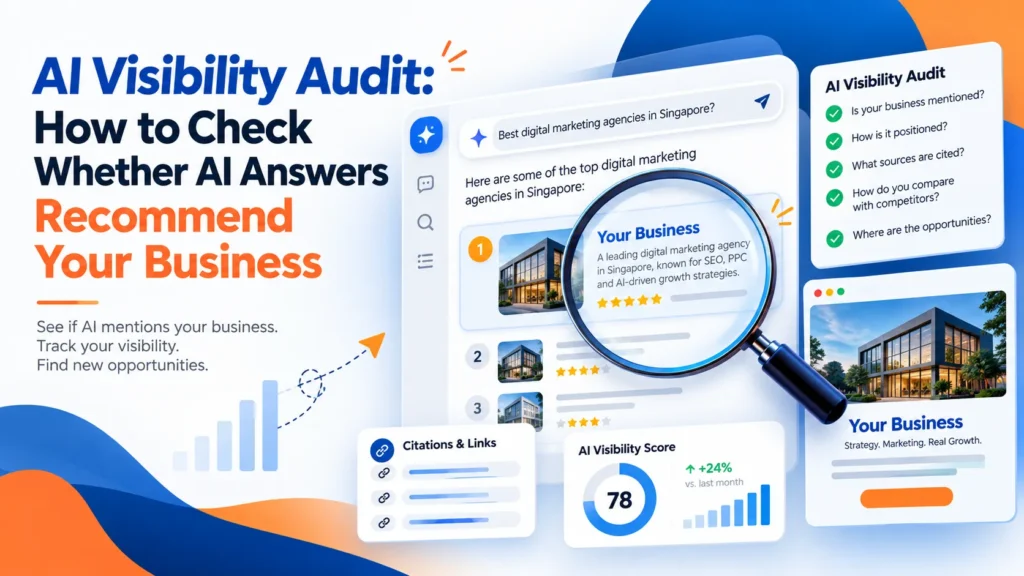
An AI visibility audit checks whether AI answer engines name your business when buyers ask purchase-driving questions. It records whether you appear, how you are described, whether the facts are right, and which sources the answer cites. A page-one ranking does not guarantee any of those outcomes.
When buyers ask ChatGPT, Perplexity or Google’s AI Overviews to shortlist vendors, the answers draw on sources unrelated to your rankings. PwC research cited by Mentionlytics finds that 47% of B2B buyers use AI for market research and 38% use it to shortlist vendors. If your brand isn’t in those answers, your search visibility will not show it.
Most audits check the wrong layer. They measure rankings and assume the AI answers follow. In practice, a brand can rank well and still be absent from the answers buyers read, so the audit must test the answers directly.
This guide is for US marketers, founders and local business owners who want to know what buyers actually hear from AI tools. It treats AI answers as a separate channel with their own sources and failure modes. Each audit starts with a content inventory, then follows a repeatable testing process, one step at a time, across the digital channels buyers actually use.
When a US buyer asks an AI assistant which vendors to shortlist, the answer draws on different sources than top organic results. A healthy rank can sit alongside near-total absence from that answer, so strong search visibility in classic results does not guarantee a place in the shortlist.
Consider a US services firm that ranks well for its brand name but never appears when a committee asks an assistant for “managed IT providers for a 40-person law firm”. The firm’s search results look healthy, yet it is missing from the decision that matters.
Channels also diverge. In PipeRocket Digital’s analysis of 53 B2B SaaS brands, Customer Support SaaS drew 87% of its traffic from organic search. Cybersecurity SaaS AI-referred leads converted to SQLs at 20%, compared to 81% for organic leads. Each channel needs its own AI visibility audit, and you should check every step against the buyer’s actual question, since many businesses still measure only rankings.
An AI visibility audit tests whether AI answer engines name your business when buyers ask key questions. It records presence, brand description, factual accuracy and cited sources. Traditional SEO audits check rankings and crawlability, which measure different things, so the two audits answer different questions.
Each buyer-language prompt is audited across four layers, in sequence:
A layer 1 miss usually calls for stronger entity signals and grounding sources. A layer 3 error usually points to a stale page that needs correcting, and each finding should feed a clear action plan.
Gather access to ChatGPT, Perplexity, Gemini, Claude and Google AI Overviews. You also need your sales markets, a run log and one named owner accountable for results. Without an owner, audits often produce reports nobody acts on.
The prompt set matters more than the tooling. Pull phrases from sales calls, support tickets, reviews and Reddit threads, since buyers often use different words than your marketing team does.
Build the prompt set in four categories:
Aim for 20 to 50 prompts across 4 buyer-intent categories, weighting comparison and problem prompts most heavily.
Test six engines: ChatGPT, Claude, Perplexity, Gemini, Grok and Google AI Overviews. Each retrieves from different sources, so a brand can be strong in one and invisible in another. Keep each prompt’s wording identical across runs, and log the location, account, and date for each run. Use the same prompts on every engine so the comparison is fair, since you can measure each business and service the same way.
Answers vary between sessions and between engines, so scores are comparative within a run set, not absolute measures. Run each prompt at least three times and log the date, engine and full response. Three runs that agree tell you something real, while a single run may not. Queries that return consistent results across runs give you a more reliable baseline for decisions.
Score every run on four layers. Presence is binary: 0 if absent, 1 if named. Prominence rates position and emphasis from 0 to 2. Sentiment rates tone from 0 (negative) to 2 (positive). Accuracy rates stated facts from 0 to 3, where 3 means every claim is correct. Accuracy matters most, because an engine that repeats a wrong fact damages trust in your brand and weakens your perceived authority. Record the underlying data for each layer in the same log so runs can be compared.
Share of voice for a prompt is the number of runs in which the brand appears, divided by all runs across the brand and its competitors. If your brand is named in two of three engine runs, its share is two out of three before competitors are counted.
Here is a completed example row for checking your log:
| Date | Engine | Prompt | Presence | Prominence | Sentiment | Accuracy | Notes |
|---|---|---|---|---|---|---|---|
| Log the date of each test run | Name the AI engine tested | Comparison prompt | 1 | 1 | 2 | 1 | Stale directory listing cited |
Work through the path. Suppose a comparison prompt returns your brand on two engines, but one answer quotes a stale price. Presence is 1, prominence is 1, sentiment is 2, and accuracy is 1. The low layer 3 score flags the stale directory listing. Correct that listing, re-run the same prompt and confirm that accuracy moves up. Traditional SEO work, such as updating listings and page content, often fixes it.
Use these thresholds to decide what to act on in each layer:
| Layer | Act now | Monitor |
|---|---|---|
| Presence | Absent on a comparison or category prompt | Named on most runs |
| Prominence and sentiment | Named but negative or buried | Named, neutral to positive |
| Accuracy | Any claim scored below 3 | All claims correct |
| Source trace | Cited sources do not mention you | Cited sources include your pages |
| Symptom | Likely cause | First action |
|---|---|---|
| Absent from all engines | Weak entity signals or no grounding sources | Build category pages and third-party profiles |
| Present but misquoted | Stale directory or review listings | Correct the source pages the answer cites |
| Present on one engine only | Engine favours a source you lack | Trace citations and target that source |
Treat 30% share of voice as the author’s own working heuristic, not an industry benchmark. Compare yourself with competitors on the same prompts, since a rival at 35% changes what 30% means. Near zero on a core query is the starting point for a diagnosis, not a verdict on the brand.
Zero share of voice on a key query usually has one of three causes:
Most audits ask whether a brand appears in an AI answer. The more useful question is where that answer came from. Retrieval-augmented answers select citations from retrievable web pages, and the brands they name tend to be the ones those pages describe. Source tracing shows whether a gap needs an on-page fix or an off-site one, and it helps businesses find where to invest in search visibility with specific intent.
List the domains each engine cites for your category across your prompt set. Count how often each domain appears and which competitors it names. Treat these counts as a snapshot and repeat them on a schedule, since engine behaviour can change. On Perplexity, Reddit drives up to 46.7% of citations, according to LSX Partners, so community sources need separate handling.
Sort sources into five types: review sites, directories, forums, video platforms and your own website. Reviews and directories need accurate listings. Forums need genuine participation, not promotional posts. Your website needs clear, quotable pages that state your services plainly, because engines are most likely to retrieve and cite that content. Each type carries a different level of domain authority, so weigh a listing’s authority alongside how often it is cited, and consider whether an agency can help with off-site outreach.
Audience size is a weak filter for video. LSX Partners reports that 40% of cited YouTube videos have fewer than 1,000 views. Judge a source by whether it is cited and whether it states facts about your business correctly.
Run the same prompts through the same engines and four-layer map against three to five rivals so that businesses can read search visibility as a relative measure. Share of voice then becomes relative. Industry guidance suggests that under 15% indicates a significant citation gap, 25-40% is competitive, and above 40% suggests strong visibility. This 30% threshold is the author’s own heuristic, not a published standard. llmrefs.com sets out these bands.
Score each gap on query value, source fixability and effort. Work on high-value, fixable, low-effort gaps first. Record each action with an owner, a deadline and a metric, such as “named in the Perplexity answer for prompt 7 by 30 June.” Re-run the prompts afterwards to confirm which actions moved visibility. Answers vary between sessions and engines, so treat scores as comparative within a run set, not absolute measures. Each re-run is one step in tracking how search results change over time, and compares the data against the same baseline. Building topical authority across these prompts helps the gains hold over time.
Worked example. Prompt 7 asks which accounting software suits a small firm. Your brand is absent from the Perplexity answer, which cites a review site with an outdated listing. Scored: presence 0, source fixable, low effort. Action: update the listing with current pricing and features, owner named, deadline 30 June, metric “named in the Perplexity answer for prompt 7.” If the re-run names you with correct details, the action is confirmed.
| Prompt | Engine | Presence | Accuracy | Source | Action | Owner | Deadline |
|---|---|---|---|---|---|---|---|
| 7 | Perplexity | 0 | n/a | Outdated review listing | Update listing | Marketing lead | 30 June |
A monitoring tool shows what happened: presence, citations and share of voice over time. It rarely explains why a result changed. Pair it with your own log of prompts, wording and model versions, so changes in search visibility can be tied to specific edits and turned into an action plan that your agency or in-house team can act on. Track how your results compare with competitors over the same prompt set, so you can see where your topical authority is gaining or slipping.
| Tool type | What it measures | Best for | Limitation |
|---|---|---|---|
| Free manual process (spreadsheet and fixed prompt set) | Presence, accuracy and sources, scored by hand | Small, hand-run prompt sets | Time-consuming on repeat runs |
| Paid monitoring platform | Presence, citations and share of voice over time | Tracking many prompts across several engines | Shows a score without explaining why it moved |
| Custom-built process | Whatever your team defines, logged and reported your way | Large prompt sets, client reporting | Needs development and maintenance time |
Scorecard-only tools miss three things: sampling variance between runs, bias in the prompts you chose, and any causal diagnosis of why a source was picked. Free tools cost time, while custom-built tools cost development effort. Check each vendor’s current feature list before you buy, as capabilities change.
Decision rules for re-auditing:
Align audits with campaign launches so results can be read in context, and keep content changes tied to the same log. Businesses that follow this cadence can separate genuine shifts from normal variation.
An AI visibility audit measures what rankings reports cannot: whether AI engines name your business when buyers ask decision-making questions. It takes four steps: build prompts from real buyer language, run them across engines, score answers on presence, prominence, sentiment and accuracy, then trace each answer to its sources.
Start with 20 prompts on two engines. Assign one owner, set a 90-day action plan from the worst gaps, and schedule your next run before the first ends.
No. An SEO audit checks whether your pages rank and can be crawled. An AI visibility audit checks whether AI answers your brand name, describes it accurately, and cites sources you can fix. In PipeRocket Digital’s analysis of Cybersecurity SaaS, organic leads converted to SQLs at 81%, compared with 20% for AI-referred leads.
Run a full audit monthly in competitive categories and quarterly in stable ones. Re-run it after a major model update, site migration, or large change to reviews or directory listings.
No. A spreadsheet, a fixed prompt set and manual runs across three or four engines will show presence, accuracy and source trace. Paid tools save time on repeat runs but do not explain why a score moved.
Start with ChatGPT, Perplexity, Gemini, Claude and Google AI Overviews, weighted by where your buyers search. Reddit can drive as much as 46.7% of Perplexity’s citations, according to LSX Partners. Log each engine separately.
Plan to track 30 to 60 prompts across the engines your buyers use, plus time to map sources. Later audits run faster.

Tom is the CEO of MediaOne, a leading digital marketing agency. He is a business-experienced SEO consultant as well as a Google Gold Search Expert serving the international community. He has consulted for MNCs like Canon, Maybank, Capitaland, SingTel, ST Engineering, WWF, Cambridge University, as well as Government organisations like Enterprise Singapore, Ministry of Law, National Galleries, NTUC, e2i, SingHealth. His articles are published and referenced in CNA, Straits Times, MoneyFM, Financial Times, Yahoo! Finance, Hubspot, Zendesk, CIO Advisor. Under his stewardship, MediaOne has won dozens of prestigious digital marketing awards.
Run a free Digimetrics audit across SEO, AI search, content and technical health, and get a plan you can act on today.
Start free →Yes, Ahrefs has a free AI Visibility Checker. You can enter a brand name, inspect its presence across six AI search experiences, and see…
Your website ranks on Google. Your SEO dashboard shows healthy organic traffic, and your brand appears for several commercially valuable keywords. But when someone…
Direct answer: To rank in Perplexity and ChatGPT, answer one narrow question clearly, make each claim easy to check, and structure the page so…