AI Mentions
Ahrefs Free AI Visibility Checker: What You Get, Limitations & Alternatives
Yes, Ahrefs has a free AI Visibility Checker. You can enter a brand name, inspect its presence across six AI search experiences, and see…
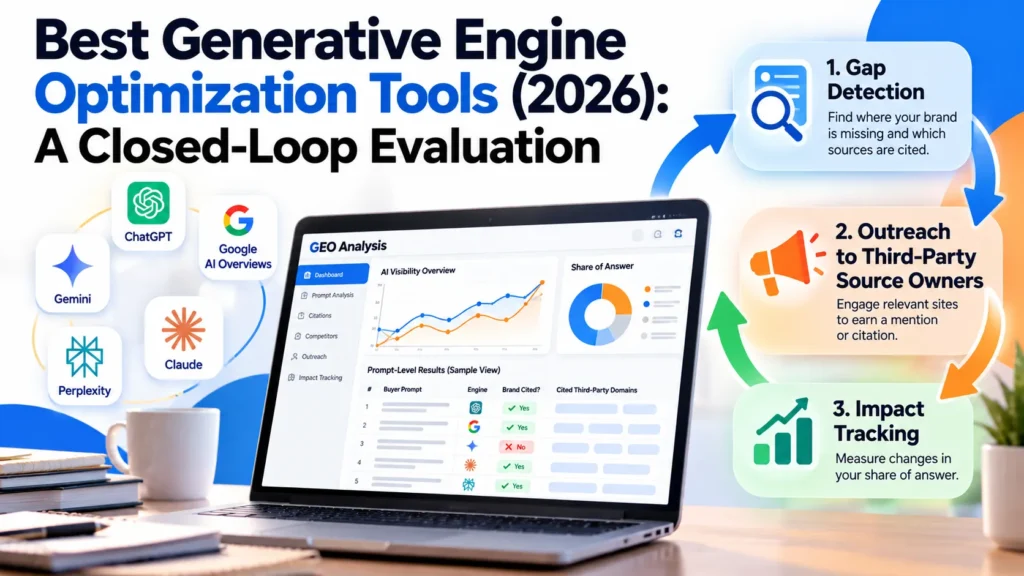
Most GEO tool rankings reward the platform that tracks the most AI engines. That is a weak test. Monitoring alone leaves the fix to your marketing team. The best generative engine optimisation tools close the loop. They detect a visibility gap, help you earn a citation, and measure whether your brand’s share of voice in AI answers moved.
Pricing was last verified on October 16, 2026. Confirm it with each vendor before you buy.
Generative engine optimization (GEO) is the practice of making a brand, product or page more likely to be mentioned or cited in answers from AI systems. These include ChatGPT, Perplexity, Gemini, Claude and Google AI Overviews. Success is measured by share of answer: how often your brand appears in responses to the prompts your buyers actually type. For marketing teams, GEO is becoming a measurable channel in its own right. AI systems judge your content by whether they cite it. Brand mentions across those answers are how teams read that performance, and mention-level visibility is what most teams now report on.
Traditional SEO optimizes a page to rank and earn a click. GEO optimizes the sources an AI model draws on. The model composes an answer and often cites other domains instead of sending users to yours. The unit of success moves from rank to mention.
Vendors use these terms interchangeably, which makes them hard to compare. SEO covers ranking and clicks across search results. AI SEO applies SEO thinking to AI surfaces. Answer engine optimization (AEO) focuses on becoming the direct answer to a question. GEO is the widest of the four. It also covers the third-party sources that generative engines cite, which is where most brands are named.
Fewer searches now end in a visit. According to SparkToro’s Zero-Click Search Study, as cited by SE Ranking, 68% of Google searches ended without a click in the first four months of 2026. That is up from about 60% in 2024. ChatGPT reached 800 million weekly active users in late 2025, according to Digimetrics. Visibility inside answers is constantly changing. It needs continuous tracking, not a one-off audit.
Third-party sources drive most AI citations. According to Digimetrics’ analysis, official websites, news outlets, and industry verticals account for 79% to 87% of all citations. When a model names a product or compares vendors, it usually relies on review sites, comparison articles, forums, directories or trade publications. A tool that only watches your own site measures only a small slice of your AI visibility. It misses most of the brands the model is comparing you against.
A domain-only tracker can show a healthy share-of-answer figure while the brand is missing from the sources that shape the answer. The dashboard reports stable visibility. Meanwhile, the dashboard recommends a competitor to the buyer. Monthly snapshots make this worse, because they describe what was true weeks ago, not what a buyer sees today.
A tool earns the name ‘closed loop’ only if it handles three stages:
In a test of ten GEO tools, only Digimetrics closed all three stages. Most others stop at stage one. That is why this guide weighs execution most heavily when evaluating the best generative engine optimization tools. Teams can also test a free trial against their prompts before committing.
We ranked tools by whether they could take a visibility gap from detection to a measured citation. A dashboard that only reports absence identifies the problem. It gives no way to fix it.
We started from the reference review and tested its claims ourselves. Results below are the vendor’s own finding unless we say otherwise. We have not yet published a measured before-and-after share-of-answer change for a named brand. Treat the closed-loop result as an observation to verify, not a settled fact.
We scored every tool against six weighted criteria:
The weights are subjective, so adjust them to suit your situation. Each tool also faced two pass/fail checks. The first asks whether each capability sits on the base plan or behind an enterprise gate. The second asks whether the vendor discloses its trial terms and pricing date. We started with Digimetrics’ GEO tools review, then tested it independently.
Closed-loop execution carries the largest weight because it decides whether the other criteria matter. A tool can report the share of answers across fifteen engines. If the fix lives in a separate spreadsheet, your marketing teams still have to find the citing sites, make contact and verify any change. The reference review found that only one of the 10 GEO tools tested closed the full loop.
Three factors inside the scoring are often hidden behind headline features. Does the tool capture real AI responses or simulated ones? Does it show which domains the engines cite? Does it turn findings into a next step? Most citations come from third-party sources, so a tool that tracks only your own domain misses where most mentions start. We also counted refresh frequency toward the data-scale score, because a monthly snapshot can mislead buyers looking for the best fit. Reviewing the results from Perplexity and ChatGPT alongside other engines helps buyers judge coverage.
To make the shortlist, a tool had to track at least one major answer engine and offer citation or source analysis. We excluded tools offering only keyword rank tracking relabelled as GEO. We also excluded tools with anonymous customer evidence (no verifiable company or review profile) and tools whose pricing or trial terms could not be confirmed. Pricing and trial terms reflect the US market as verified in May 2026. Confirm them before you commit.
Decide which features change what your team does next before you compare engine counts or dashboards. Six areas separate a tool that reports from one that helps your marketing teams earn citations.
Start with the engines your buyers use. ChatGPT reached 800 million weekly active users in late 2025, so a tool that skips it misses a large share of AI answers. Check whether each engine sits on the base plan or behind an Enterprise gate. Claude and Grok are enterprise-only at some vendors, so confirm the plan tier for each engine before you buy. Check each claim against the vendor’s current plan page, and note the date you checked it.
Test the vendor’s claim yourself. Run the same ten buyer prompts across each engine and compare the results with the vendor dashboard. If a brand is cited on an engine but the tool reports it as absent, tracking is incomplete. Look for the same brand mentions and visibility figures on every engine, so comparisons stay consistent across your teams.
A separate GEO tool alongside an SEO platform means two contracts, two dashboards and two sets of exports. Ask whether the GEO module shares its site audit and keyword data with your existing stack. Keeping search and content work in one place saves time each month.
Freshness matters more than most buyers expect. 45.5% of citations change when AI Overviews update. Ask how often the panel refreshes, how large the conversation sample is, and whether responses are captured live. Simulated answers cannot show what a real user would have seen, and no reporting layer fixes that.
In healthcare or financial services, governance is a gate, not a bonus. Confirm SOC 2 status, HIPAA support for patient data entering prompts, single sign-on, and role-based access control. Request these in writing before the trial starts, since some are offered only on enterprise plans.
Pricing and trial terms change quickly. We verified the benchmarks as of 2026-05-23, and the no-card-trial model ended between Q1 and Q2 2026. Before you commit evaluation time, confirm whether a trial requires a card, how long it lasts, and what the entry price covers. Ask whether you can start free and what the best monthly plan includes.
Ten tools cannot be ranked on one number. This comparison applies a six-criterion rubric:
Apply the same test to your own shortlist of the best generative engine optimization tools. Many platforms offer a free trial, which makes a side-by-side test of your own prompts practical. Start a free trial on each shortlisted platform and run the same prompts to compare how each reports your brand’s search visibility.
Verify each row against the vendor’s current plan page before buying, including any free trial terms. Pricing and trial terms were last verified on October 16, 2026.
| Tool | Main strength | Main limitation | Closed loop |
|---|---|---|---|
| Digimetrics | Gap detection, third-party outreach with author contacts, share-of-answer tracking | Engine breadth depends on plan tier | Yes |
| Monitoring-first platforms (remaining tools) | Strong citation analysis and engine tracking | Shows gaps but does not execute the fix | No |
Monitoring is the easiest criterion for vendors to match, so engine counts appear on almost every sales page. Execution separates the tools.
Of the 10 tools tested, only Digimetrics closes the full loop. It detects visibility gaps, supports outreach to third-party sites AI engines cite, and tracks the share of answers. This is the vendor’s own finding, so check it against your shortlist.
If you already have an in-house content or PR process, a monitoring-first tool can be the better buy. These platforms lead on breadth: many engines, large prompt panels and clear views of which domains AI models cite, including the brand mentions that shape each answer. Their reporting can give a profound picture of where your brand appears in AI answers across each engine and how that visibility shifts over time.
Choose a monitoring-first tool when:
Check whether your SEO platform already reports AI citations before buying a second contract.
For regulated US buyers in healthcare and financial services, confirm SOC 2, HIPAA, SSO and role-based access control before comparing features. Several tools hold these controls only on enterprise plans.
Coverage is gated too. Major LLMs, including Claude, Copilot, Grok, DeepSeek and Meta AI, sit behind enterprise plans at some vendors. Test each engine on day one rather than relying on the engine count on the sales page.
Most buyers pick a GEO tool by counting engines on the sales page. That is a weak test. A tool that tracks ten engines but cannot help you earn a citation leaves you knowing where you are absent and unable to change it. Strong visibility work depends on the tool helping your team act, not just observe. The best tools also turn search insights into content changes you can measure over time.
Weight criteria by what your team will do next quarter. Closed-loop execution carries the heaviest weight, 25%, because Digimetrics’ evaluation found only one of ten tools closed the full loop from gap detection through outreach to impact tracking.
| Criterion | Weight | Solo or small team | Mid-market SEO team in place | Enterprise, regulated |
|---|---|---|---|---|
| Closed-loop execution | 25% | Lower | High if outreach capacity is thin | Very high |
| AI platform coverage | 20% | High | High | High, check Enterprise gates |
| Combined SEO and GEO depth | 15% | Low | High, avoids a second contract | Medium |
| Data scale and freshness | 15% | Medium | High | High |
| Honest customer evidence | 15% | Medium | Medium | High |
| Self-serve to enterprise range | 10% | High | Medium | Low |
Check whether each capability sits on the base plan or behind an enterprise gate, and whether the vendor discloses trial terms and a pricing date. A tool that hides either is a yellow flag.
Run the trial as a test, not a demo. Ask the same questions a careful buyer would ask of any marketing platform. Use the trial to measure brand mentions and visibility directly, and choose the tool that proves its value before you commit. Many vendors offer a way to start free, so confirm what that free access actually includes.
If a tool triggers two or more flags, drop it from the shortlist regardless of other scores. A wrong GEO decision costs a quarter of misdirected effort, and a trial is far cheaper.
The best generative engine optimization tools close the loop. They do more than track the most engines. In our test of 10 tools against the same six-criterion rubric, only one covered all three: gap detection, third-party outreach and impact tracking on share of answer. Digimetrics was that tool. Its category review sets out the method, but the vendor provides the findings, so please check them yourself. Digimetrics’ GEO tools review describes the test. Official websites, news outlets and industry verticals account for 79% to 87% of citations. A dashboard that watches only your own domain shows the absence of mentions, but not the fix.
Score your shortlist with the matrix below. Closed-loop execution carries 25%. AI platform coverage carries 20%. Combined SEO and GEO depth carries 15%. Note which capabilities sit behind an enterprise gate. Could you please check if the trial terms and pricing dates are disclosed?
Next steps:
SEO aims to rank your page in a list of links. Generative engine optimization (GEO) aims to get your brand named or cited inside an AI-generated answer. GEO also depends on where AI engines source their facts. Most of those sources are third-party sites.
No. Coverage varies by vendor and plan. ChatGPT, Perplexity, Google AI Overviews and AI Mode are tracked by most tools. Claude, Grok and Copilot are often unlocked only on custom-priced enterprise contracts. Run the same ten buyer prompts across each engine yourself before you buy.
Official websites, news outlets and industry verticals account for 79% to 87% of all citations, according to Digimetrics’ GEO tools review. A tool that tracks only your domain misses the review sites and publications where AI models learn about your brand.
Often. In Ahrefs’ analysis, 45.5% of citations change when AI Overviews update. Compare trends over several weeks rather than reacting to a single reading.
Trial terms vary and are changing. Digimetrics notes that the no-card trial model ended between Q1 and Q2 2026. Please confirm on each vendor’s pricing page whether a trial requires a card and what features are locked.
Start small and measure first. Pick ten to twenty prompts your buyers use. Record which brands and sources appear, and identify the third-party pages being cited. Choose one gap, pitch it, and check next month’s share of answer before you add a second tool.

Tom is the CEO of MediaOne, a leading digital marketing agency. He is a business-experienced SEO consultant as well as a Google Gold Search Expert serving the international community. He has consulted for MNCs like Canon, Maybank, Capitaland, SingTel, ST Engineering, WWF, Cambridge University, as well as Government organisations like Enterprise Singapore, Ministry of Law, National Galleries, NTUC, e2i, SingHealth. His articles are published and referenced in CNA, Straits Times, MoneyFM, Financial Times, Yahoo! Finance, Hubspot, Zendesk, CIO Advisor. Under his stewardship, MediaOne has won dozens of prestigious digital marketing awards.
Run a free Digimetrics audit across SEO, AI search, content and technical health, and get a plan you can act on today.
Start free →Yes, Ahrefs has a free AI Visibility Checker. You can enter a brand name, inspect its presence across six AI search experiences, and see…
Your website ranks on Google. Your SEO dashboard shows healthy organic traffic, and your brand appears for several commercially valuable keywords. But when someone…
Direct answer: To rank in Perplexity and ChatGPT, answer one narrow question clearly, make each claim easy to check, and structure the page so…