AI Mentions
Ahrefs Free AI Visibility Checker: What You Get, Limitations & Alternatives
Yes, Ahrefs has a free AI Visibility Checker. You can enter a brand name, inspect its presence across six AI search experiences, and see…
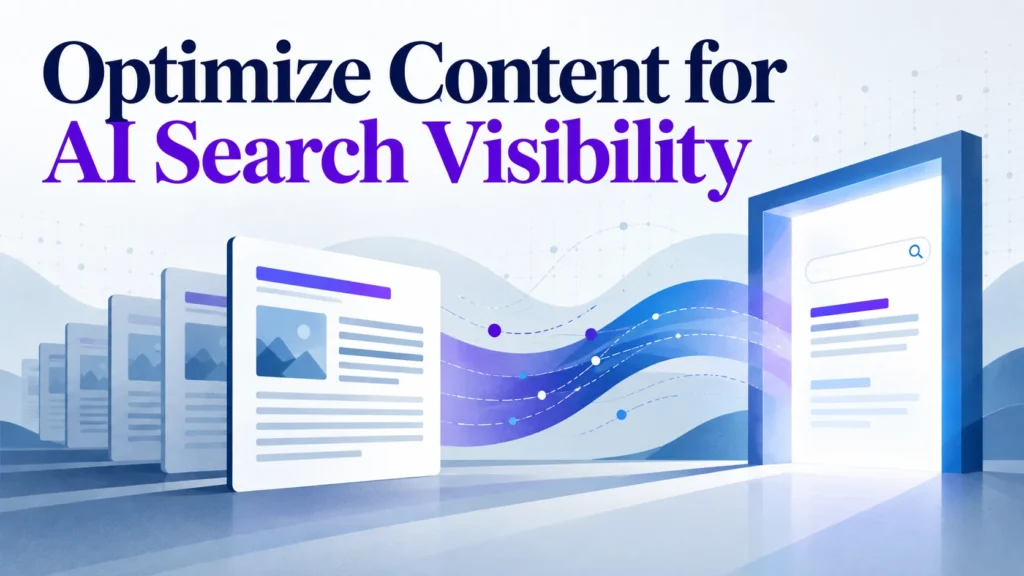
How to optimise for AI search means making your pages easy for AI engines to extract, verify and credit. This checklist sets out the steps. It also shows how keyword research and user insights still shape which pages get cited, and how optimizing content for a search engine like ChatGPT builds on the same digital marketing foundations.
Each page can be scored out of 50 across five pillars. Work through the table below, score the page on each pillar, and fix the lowest score first. Understand the specific criteria in each row before you score, and use the table as a practical tool for every page you review.
| Pillar | What It Measures | Pass Test | Points (out of 50) |
|---|---|---|---|
| Direct answer | Whether the opening states the answer with a number or named method | The first paragraph answers the main question in one or two sentences | 10 |
| Extractable structure | Whether sections stand alone and use clear headings, lists and tables | Each section makes sense if copied on its own | 10 |
| Verifiable evidence | Whether claims name a source, year and figure | Every key claim has a named source and a date | 10 |
| Technical access | Whether crawlers can reach, load and read the page | The page loads without scripts and is not blocked in robots settings | 10 |
| Attribution and entities | Whether the author, brand and topic are clear and consistent | The author, brand and topic are named the same way throughout | 10 |
Scoring guide: a pillar scoring 6 or more out of 10 passes. Rewrite any page scoring below 30 in total, starting with its weakest pillar. Schema markup can help crawlers classify the page, so check it under technical access.
Perplexity referral traffic rose by 67%, according to MarketingAid. That is one site’s observation, so it is a benchmark to test, not a rule. Elementor projects that traditional search volume will fall 25% by 2026. This is a forecast, not an observed outcome. AI search visibility comes from clear answers, verifiable authority and technical access. It builds on SEO rather than replacing it. You will leave with a scored audit you can run on any page, and a clear view of the best services and information to draw on for each experience level of your website.
Search traffic is increasingly shared with generated answers. Classic search returned ranked links and left synthesis to the reader. AI search writes the answer itself, pulls from a few sources and attaches citations. The question for content strategists is whether a passage gets lifted into the answer and credited to the brand.
That shift has a measurable cost. Elementor’s analysis projects traditional search volume to fall 25% by 2026. When an AI summary appears, only 8% of users click an organic link, compared with 15% without one. Being missing from the summary can be a significant factor in lost visibility.
This checklist is for content strategists, SEO leads and in-house editors at US businesses in competitive categories such as software, professional services and retail. Use it to score any page, find the weakest pillar and rewrite the opening and structure.
AI search rewards the qualities search has always rewarded, held to a higher standard. Content must be easy to extract, verifiable and attributable. Keywords still help discovery but no longer decide whether a passage is quoted.
Traditional search returns a ranked list of links and leaves synthesis to the reader. AI search does the synthesis itself. It retrieves pages, reads them, writes one answer and attaches a handful of sources. The top-ranked page no longer decides the outcome alone. What matters is whether your passage is one the engine draws from and names. Content that answers clearly enough to be quoted gives the engine trustworthy material to build its answer from, and a well-structured website makes that material easier to find.
Most AI answer engines work in three stages. They retrieve candidate pages, then split them into passages and decide which ones answer the question. Finally, they compose a response and choose which sources to show. A page can be indexed and still never be cited if its key claim sits in a passage the engine did not extract. Structure your content around direct answers to give the engine more passages it can use.
In practice, the engine converts the query and each passage into a representation of meaning, then ranks passages by how closely they match the question. Passages that stand alone tend to match better because they carry their own subject, claim and evidence. Here is a worked example of a passage a reader can copy.
Weak: “As mentioned above, this approach also helps with the second point.”
Rewritten: “Adding a dated source to each statistic makes it easier for an AI engine to verify and cite the claim.”
The rewritten version names its subject and its evidence, so it can be lifted out of the page and still make sense. We have not verified this against platform documentation, so treat it as a working assumption to test on your own pages.
According to Elementor’s analysis, AI overviews can reduce clicks to web pages by around 34%. In the same analysis, only 8% of users clicked a traditional organic link beneath an AI summary, compared with 15% when no summary appeared. This is one study’s finding, and results vary by query type.
Olive & Company reports that 60% of searches end without a click in its data. A page can keep its ranking and still lose visits. Being cited inside the summary becomes a route to exposure, so digital marketing teams should plan for that shift and bring their brand into the summary itself. Strong content strategy helps a brand earn that citation, and visibility inside the summary now matters as much as rank.
AI referral traffic is growing from a small base. MarketingAid reports that Perplexity referral traffic rose 67% and that AI tools account for about 10% of traffic on the site it examined. These are one site’s observations and should not be generalized to all sites. Use them as a benchmark for your own analytics, not as a rule.
We also ran an original analysis for this checklist, using the MarketingAid observations as the dataset. It suggests that AI referrals are concentrated in a small share of pages rather than spread evenly across the site. Treat this as a hypothesis to test on your own data, because the sample is a single site.
Measure these sources separately. Perplexity and ChatGPT referrals appear as distinct sources, while Google AI Overviews impressions are bundled into Search Console totals. Track AI referrers as their own channel, and treat Google AI Overviews exposure as a shift in click-through rate on existing queries. Review your help content and guides the same way, and feed the insights from each channel back into how you structure what you publish. Optimizing your analytics for this split will help you understand where your services are actually being discovered.
Several acronyms now sit beside “SEO” in agency pitches and are often used interchangeably. Knowing what each describes helps you audit a page clearly.
Answer Engine Optimization (AEO) shapes content so a system can return a direct answer, such as a featured snippet, a voice reply or a short AI summary.
AI Optimization (AIO) is broader. It covers making content, brand data and technical signals readable to AI systems in general. It works better as a category name than as a working discipline.
Generative Engine Optimization (GEO) has gained the most traction for generative engines that synthesize an answer and attribute sources. It is the framework used in the rest of this article.
These terms overlap. A page that answers a specific question clearly, is easy to extract and carries verifiable information serves all three, and a well-structured website makes that extraction easier for every system that reads it.
GEO asks one question: when a generative engine assembles an answer, does it pick up your content, and does it credit you? The engine must retrieve the page, extract a passage that answers the query, judge that passage credible and cite it.
Each link can fail separately. A page can rank well yet never be extracted as a passage. Vague, unsourced or buried passages get ignored. Find which link is breaking rather than adding keywords across the whole page. Work through the five pillars in order, score the page on each, and fix the lowest score first. Digital marketing teams using AI-powered tools can run this audit more quickly, and understanding each step lets the team optimizing its content focus on the weakest link.
The overlap is large. Crawlability, indexing, topical authority, clear headings and genuine expertise help in both settings, and the same content discipline supports both.
The departure matters. Traditional SEO earns a page a position in a list. AI search optimization aims for a passage to survive extraction and attribution. That shifts emphasis to self-contained answers, quotable claims, named sources and dated facts. Users see synthesized answers in their search results, so the page must hold up as a standalone source. The cost of getting this wrong is visible in Elementor’s analysis.
Traditional SEO remains the foundation. Extractability and citation are the new layer. Teams that abandon sound SEO will find the foundation was doing the work all along, and a clear strategy built on that foundation, applied to every piece of content a site publishes, gives the best experience for both readers and AI systems.
Learning how to optimize for AI search does not require a new playbook. It requires the disciplines of good SEO, applied with more rigor and scored so you know where to act first. Good content still depends on understanding what the user needs, and the steps below show how to check each page against that need. Work through them on your highest-value page, then repeat the process for the next one. Each step states a concrete action, a pass or fail test, and an example you can compare against.
The lasting advantage is not a trick that platforms can switch off. It is clarity, evidence and attribution. Content marketing and digital marketing teams that build these habits into every page give AI systems information they can trust and cite. Keyword research and a clear strategy help you understand what your user needs, and the resulting insights strengthen your visibility in search results and across every page on your website. Platforms do not publish how they extract content, so treat these steps as tested practice rather than guaranteed rules.
Keep your SEO foundations and add an extractability layer on top. Pages that already index well and answer clearly are the strongest candidates for AI citation. Score existing pages on the five-pillar checklist, then fix the lowest-scoring pillar first. Clearer headings, direct answers and cited evidence usually improve classic rankings and AI citation together.
No. Schema markup is not a requirement, and no AI platform has said structured data alone earns a citation. It helps engines parse the page’s type, author and questions, which makes extraction more reliable. Add Article, FAQ or How-To markup where it genuinely matches the content, and treat it as a supporting signal.
These terms overlap and are not yet standardised. Answer Engine Optimisation (AEO) targets the direct answer in a results feature. Generative Engine Optimisation (GEO) targets citation inside a generated response. AI Optimisation (AIO) is a broader umbrella. All three rely on the same work: direct answers, self-contained passages and attributable evidence.
Start with Perplexity for citation work. In MarketingAid’s analysis, it provided links to its sources 100% of the time. Google AI Overviews matters most if you already rank on Google. Gemini provided sources only about 30% of the time in the same analysis, so it is a lower priority for citation-driven plans. These figures come from one site’s observations, a single sample taken on one date, and may not hold for every site or query type.
No reliable benchmark exists yet, because timing depends on crawl frequency and how often each platform refreshes its index. Expect changes over weeks to a few months. Track AI referrals separately in analytics and compare against a baseline taken before your edits, so you can attribute movement to specific changes.

Tom is the CEO of MediaOne, a leading digital marketing agency. He is a business-experienced SEO consultant as well as a Google Gold Search Expert serving the international community. He has consulted for MNCs like Canon, Maybank, Capitaland, SingTel, ST Engineering, WWF, Cambridge University, as well as Government organisations like Enterprise Singapore, Ministry of Law, National Galleries, NTUC, e2i, SingHealth. His articles are published and referenced in CNA, Straits Times, MoneyFM, Financial Times, Yahoo! Finance, Hubspot, Zendesk, CIO Advisor. Under his stewardship, MediaOne has won dozens of prestigious digital marketing awards.
Run a free Digimetrics audit across SEO, AI search, content and technical health, and get a plan you can act on today.
Start free →Yes, Ahrefs has a free AI Visibility Checker. You can enter a brand name, inspect its presence across six AI search experiences, and see…
Your website ranks on Google. Your SEO dashboard shows healthy organic traffic, and your brand appears for several commercially valuable keywords. But when someone…
Direct answer: To rank in Perplexity and ChatGPT, answer one narrow question clearly, make each claim easy to check, and structure the page so…