AI Mentions
Ahrefs Free AI Visibility Checker: What You Get, Limitations & Alternatives
Yes, Ahrefs has a free AI Visibility Checker. You can enter a brand name, inspect its presence across six AI search experiences, and see…
Your website ranks on Google. Your SEO dashboard shows healthy organic traffic, and your brand appears for several commercially valuable keywords.
But when someone asks ChatGPT, Gemini, or Perplexity to recommend a product in your category, your competitors appear in the answer, and your brand doesn’t.
Traditional keyword rankings cannot fully explain that gap.
AI search introduces another discovery channel where brands can be mentioned, recommended, or cited without appearing in the same order as conventional search results.
The Ahrefs AI Visibility Checker helps marketers investigate this by showing how brands appear across AI-generated answers.
It’s a useful starting point, especially for businesses beginning to measure their presence in AI search.
However, there are important differences between checking a brand’s visibility once, tracking specific buying questions over time, and diagnosing why a website may be difficult for AI systems to access or understand.
This guide explains what the Ahrefs AI Visibility Checker does, what you get for free, how Brand Radar works, and when an alternative such as Digimetrics may be useful.
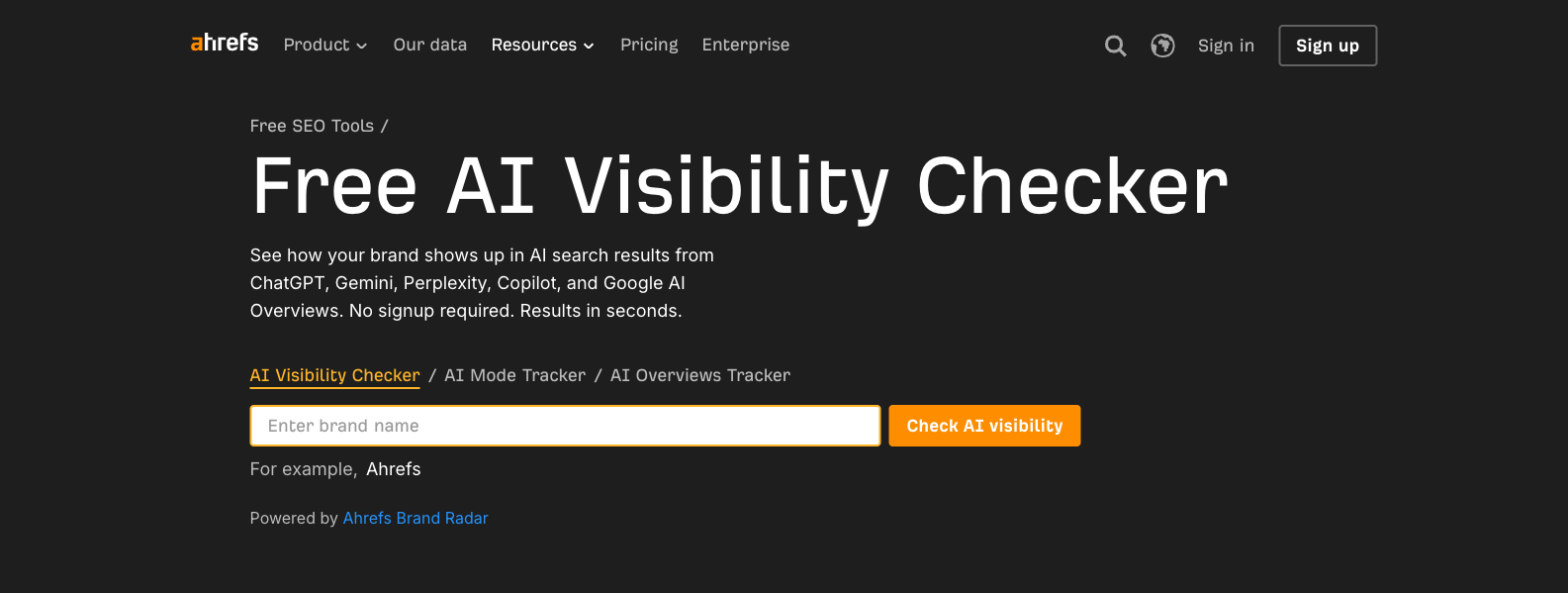
The Ahrefs AI Visibility Checker is a free tool that shows how a brand appears across major AI search platforms.
It draws from Ahrefs’ large database of search-backed prompts to surface information about brand visibility, mentions, citations, and competing brands.
Unlike a conventional SEO rank checker, which monitors a website’s position for specific search keywords, an AI visibility checker examines how a brand is represented in generated answers.
For example, a project management software company might rank well for “project management tool” on Google but appear infrequently when AI assistants answer:
“Which project management software is best for small creative agencies?”
Those are related but different measures of discoverability.
The free Ahrefs checker helps investigate whether a brand appears in its indexed AI search data.
According to Ahrefs, its free checker covers six AI search experiences:
| AI Platform | Included |
| ChatGPT | Yes |
| Google Gemini | Yes |
| Perplexity | Yes |
| Microsoft Copilot | Yes |
| Google AI Overviews | Yes |
| Google AI Mode | Yes |
Ahrefs builds its visibility database using search-backed prompts derived from keyword and search-behaviour data.
Its public checker currently describes a database covering hundreds of millions of monthly prompts across supported platforms.
This is useful for broad competitive discovery because the analysis does not depend exclusively on a handful of questions entered manually by the user.
However, the data is not a census of every possible AI-generated answer. Results depend on the prompts, platforms, coverage, and measurement methodology.
Yes.
Ahrefs offers a free AI Visibility Checker that does not require signing up or entering payment information.
You can investigate brands using the publicly available tool.
However, free access does not include everything available in the full Ahrefs Brand Radar product.
| Feature | Free AI Visibility Checker | Ahrefs Brand Radar |
| Brand visibility lookup | Yes | Yes |
| Account required for initial check | No | Yes, for paid features |
| AI platform coverage | Six supported AI experiences | Broader reporting and additional datasets |
| Results | Limited preview | More extensive data |
| Historical trends | Not full historical tracking | Available |
| Competitive benchmarking | Limited preview | Expanded competitive analysis |
| Custom prompt tracking | Not the main free-checker feature | Available through paid offerings |
| Starting cost | Free | Depends on selected Brand Radar capability |
Ahrefs states that the free checker displays a limited preview, including the top five results per section.
For broader historical analysis, custom prompt tracking, and competitive intelligence, users can explore Brand Radar.
This distinction matters because a free visibility lookup and a full AI monitoring subscription serve different purposes.
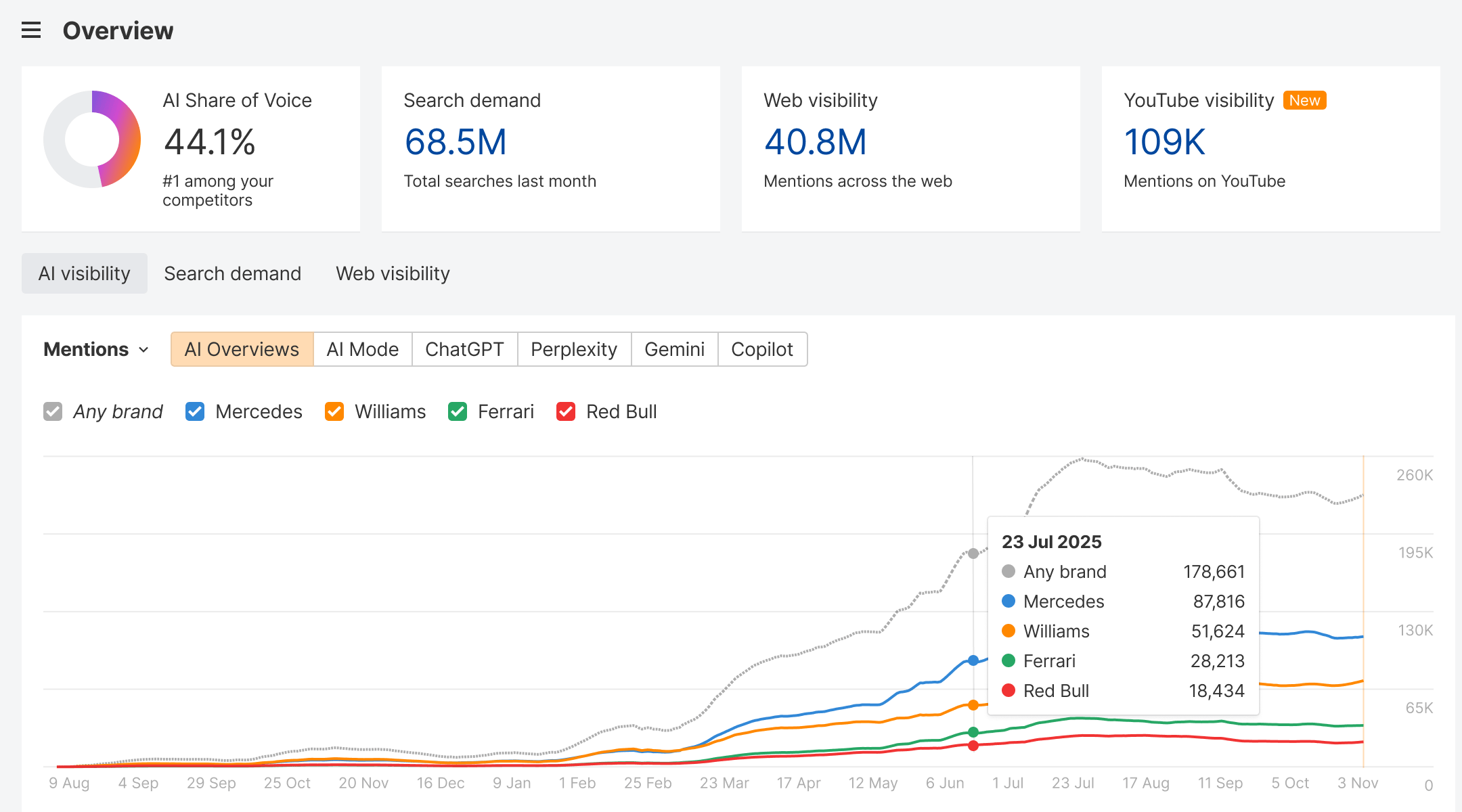
Ahrefs currently separates two major AI visibility capabilities.
Prompt Tracking lets users monitor specific questions relevant to their business.
AI Visibility Index provides access to Ahrefs’ larger indexed dataset for broader brand and competitor discovery.
Published entry points are:
| Ahrefs Capability | Advertised Starting Price | Primary Use |
| AI Visibility Checker | Free | Initial brand visibility snapshot |
| Prompt Tracking | From $50/month | Monitor selected buyer questions |
| AI Visibility Index | From $199/month | Research brands across a large AI visibility dataset |
Ahrefs also advertises broader platform-access configurations with different pricing.
Prices may vary with subscription entitlements, usage, platform selection, and applicable taxes. Check the official Brand Radar pricing before purchasing.
For organisations already using Ahrefs, Brand Radar may fit naturally into their existing SEO research workflow.
For smaller teams primarily interested in a few commercially valuable AI search questions, the important consideration is whether they need the full indexed database or a narrower monitoring workflow.
AI visibility involves more than whether a company name appears in an answer.
Several related metrics help explain the quality and consistency of that presence.
A brand mention occurs when an AI-generated response names a company, product, or service.
For example:
“Popular project management platforms include TaskPilot, WorkFlowly, and PlanDesk.”
In this hypothetical answer, all three products receive a mention.
However, a mention does not automatically mean the assistant recommends the brand.
It could simply be part of a comparison.
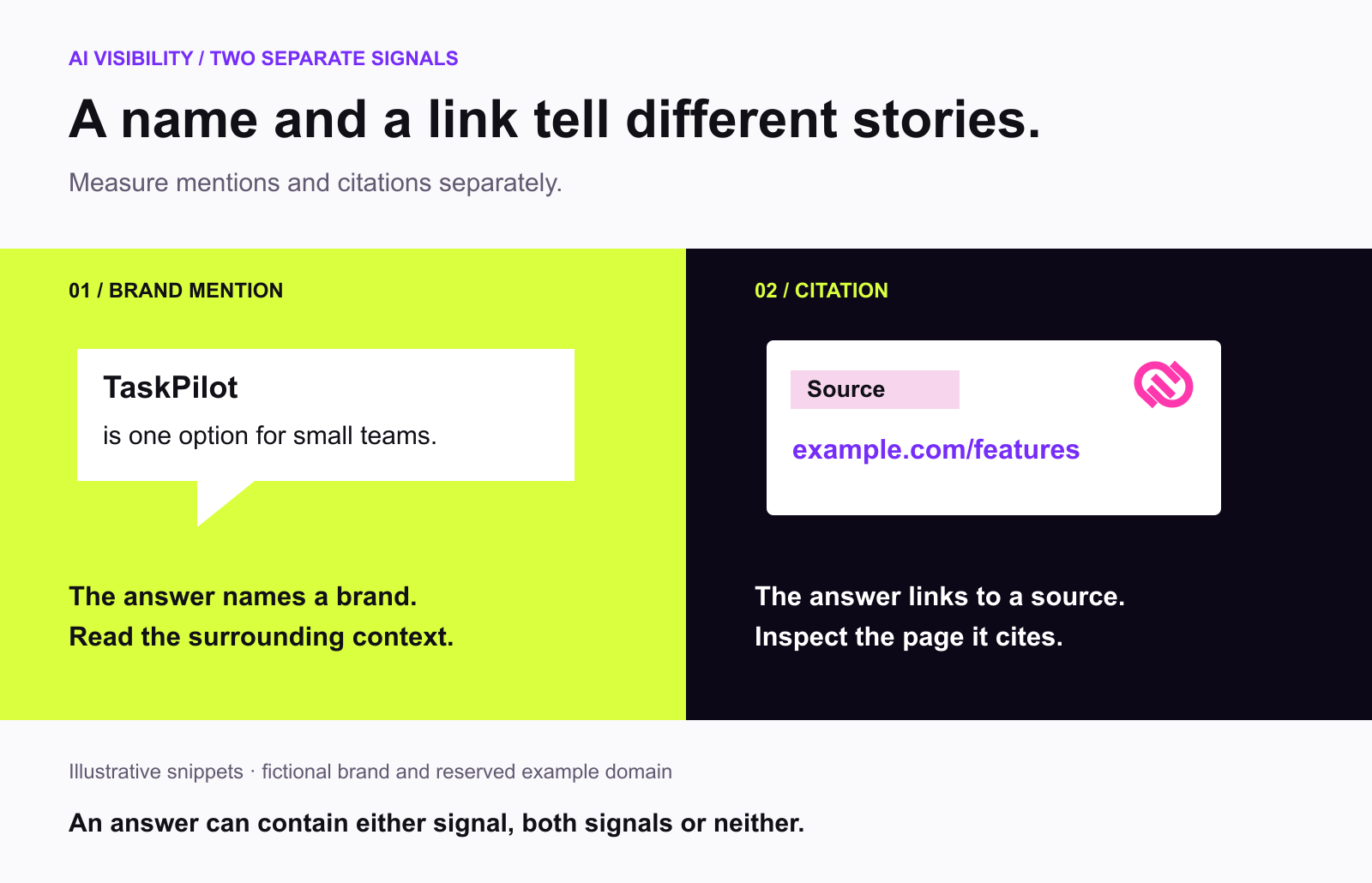
A citation occurs when an AI response links to a source.
A company might be mentioned without receiving a citation to its website.
Conversely, a page from its website might be cited even when the brand itself is not prominently named.
These outcomes should be measured separately.
Competitive visibility compares the presence of different brands within the same category.
For instance, if one accounting software provider regularly appears in AI answers and another rarely appears, the difference may reveal an opportunity to investigate.
However, the comparison is only meaningful when the same platforms, markets, questions, and measurement periods are used.
AI share of voice attempts to estimate a brand’s relative presence across relevant AI-generated answers.
The exact calculation varies by tool.
Some approaches measure the percentage of responses containing a brand, while others compare mentions across competitors or weigh different signals.
Always understand the methodology before comparing scores from different platforms.
A one-time result shows what the measurement system observed at that point.
Repeated measurement helps establish whether visibility changes after content updates, new citations, competitor activity, or other developments.
AI answers are variable, so trends across consistent questions are more informative than isolated screenshots.
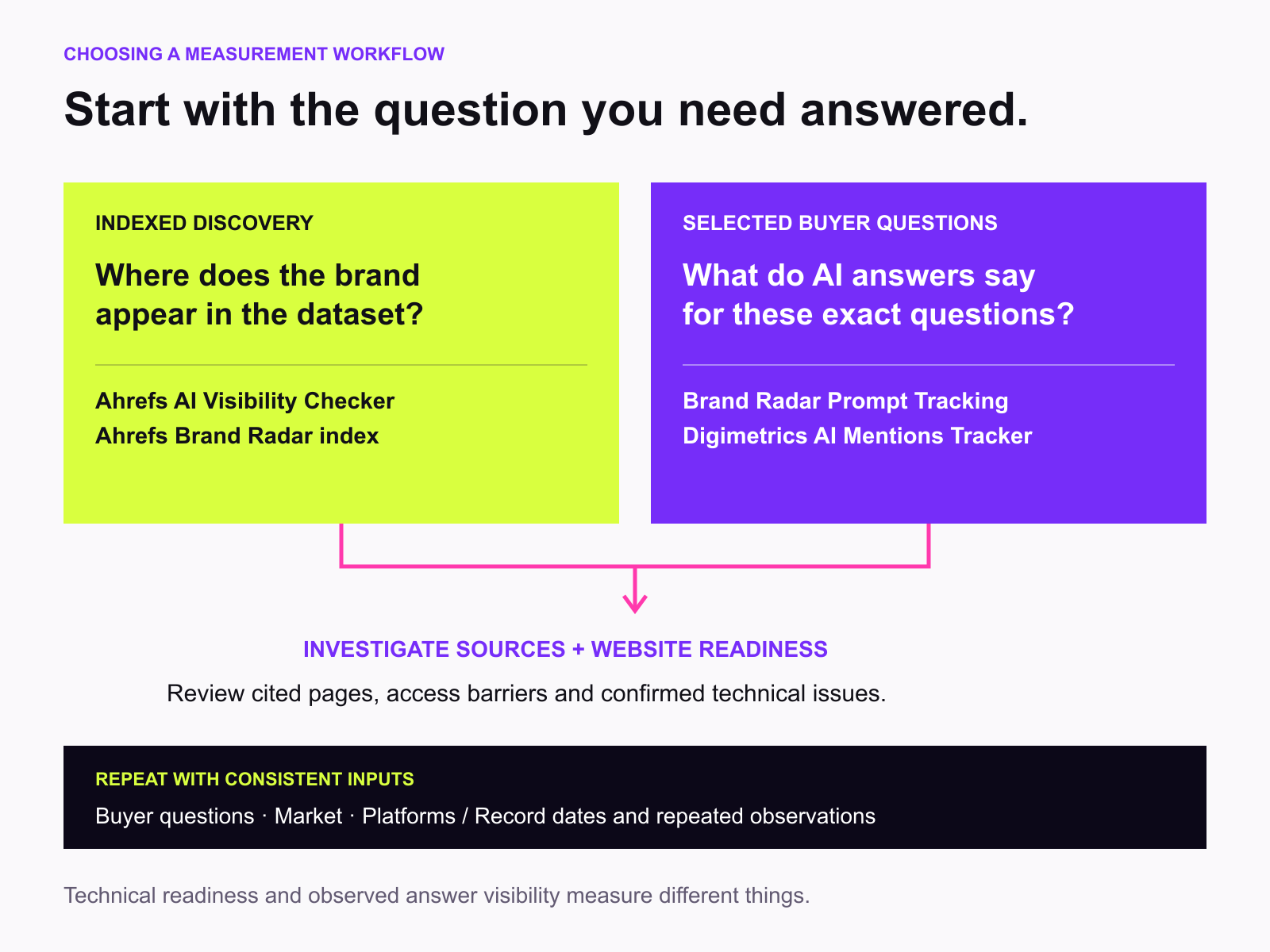
Ahrefs and Digimetrics can both help businesses understand AI search visibility, but their approaches differ.
Ahrefs emphasises broad discovery through a large index of search-backed prompts, alongside ongoing tracking and competitive research in Brand Radar.
Digimetrics provides a workflow built around specific buyer questions, brand mentions, website readiness, and actionable improvement opportunities.
The choice depends on what you are trying to learn.
| Feature | Ahrefs AI Visibility Checker / Brand Radar | Digimetrics |
| Free access | Free limited visibility checker | Seven-day trial of all tools |
| Main approach | Large-scale indexed AI visibility research and prompt tracking | Buyer-question monitoring and website diagnostics |
| AI platforms | Six experiences in the free checker | Five engines in AI Mentions Tracker |
| Brand mention reporting | Yes | Yes |
| Citation reporting | Yes | Yes |
| Competitor visibility | Brand Radar competitive analysis | Compare mentions using consistent buyer questions |
| Custom buyer questions | Available with Prompt Tracking | Up to 10 questions per run |
| Sentiment reporting | Check selected Brand Radar report capabilities | Included in AI Mentions Tracker |
| Website AI readiness audit | Not the primary purpose of the free checker | Dedicated AI Readiness Check |
| Prioritised technical fixes | Requires other diagnostic workflows | Included in AI Readiness Check |
| Starting paid price | Varies by Brand Radar product | $31/month billed annually |
Neither tool is automatically superior for every use case.
Ahrefs is particularly relevant when you need broad market intelligence from an established prompt database. Digimetrics is worth considering when you want to test your own buyer questions, review citations and mentions, then investigate technical readiness.
The free Ahrefs checker also differs from Digimetrics’ seven-day trial. Ahrefs’ free lookup is an ongoing free offering with limited results, whereas Digimetrics provides temporary trial access to its wider toolkit.
Digimetrics separates AI visibility measurement into two important questions:
These questions require different tools.
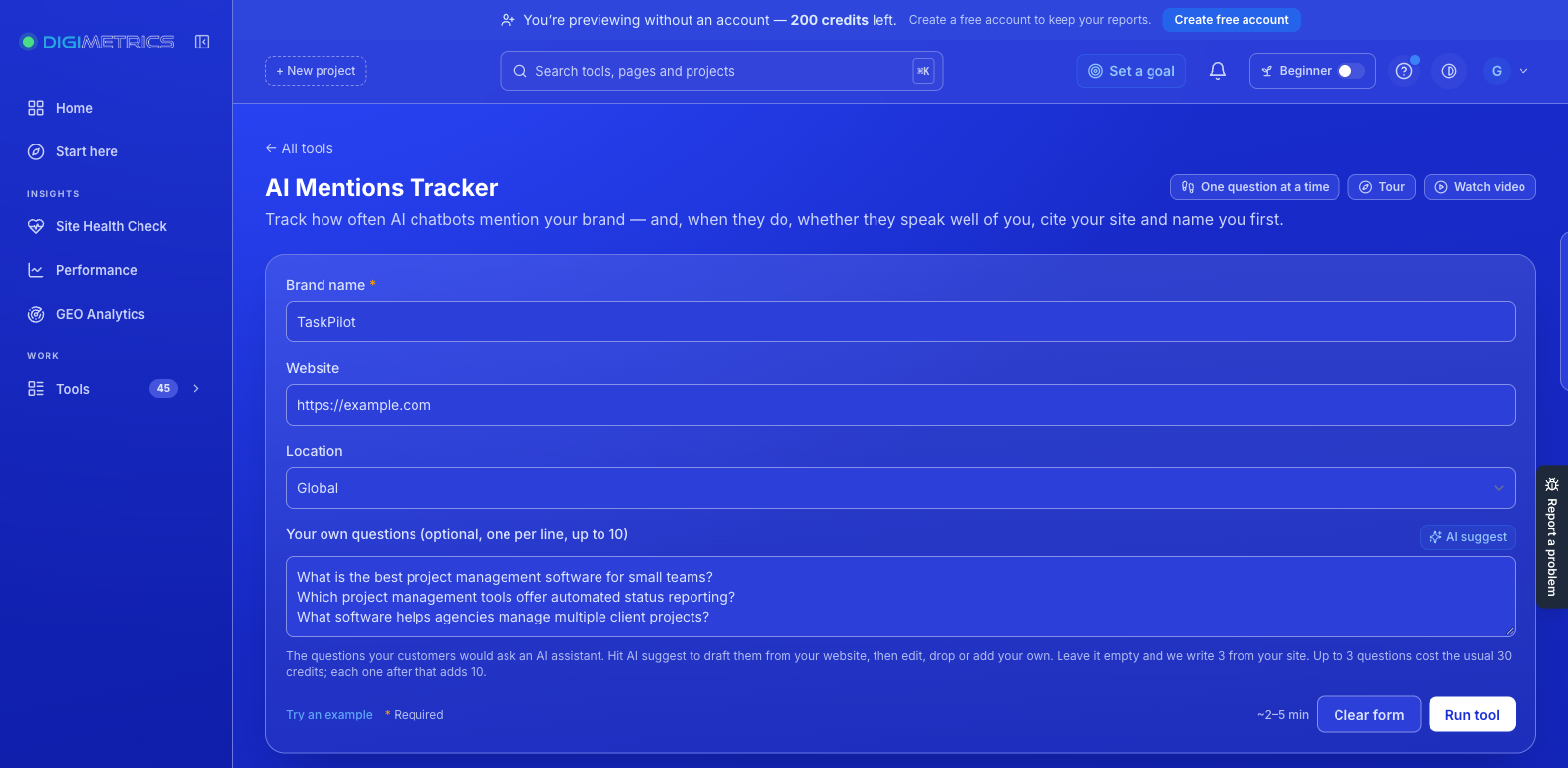
The Digimetrics AI Mentions Tracker checks how your brand appears when AI systems answer questions relevant to your customers.
It covers five engines:
You can enter up to ten questions in one run.
The tool then examines the resulting answers and reports mention rate, sentiment, citation rate, position, and cited sources.
A run typically takes two to five minutes.
Imagine a fictional software brand called TaskPilot.
Its customers frequently ask:
These are illustrative buyer questions, not measured search volumes.
An AI Mentions Tracker report can show which engines name TaskPilot, how prominently it appears, and whether answers cite its website.
If a competitor appears frequently for agency-focused questions while TaskPilot does not, the business has a more specific issue to investigate than a generic low visibility score.
It might need clearer agency-focused product information, better independent coverage, or more relevant supporting content.
The report identifies the gap. It does not prove which change will cause an AI assistant to recommend the brand.
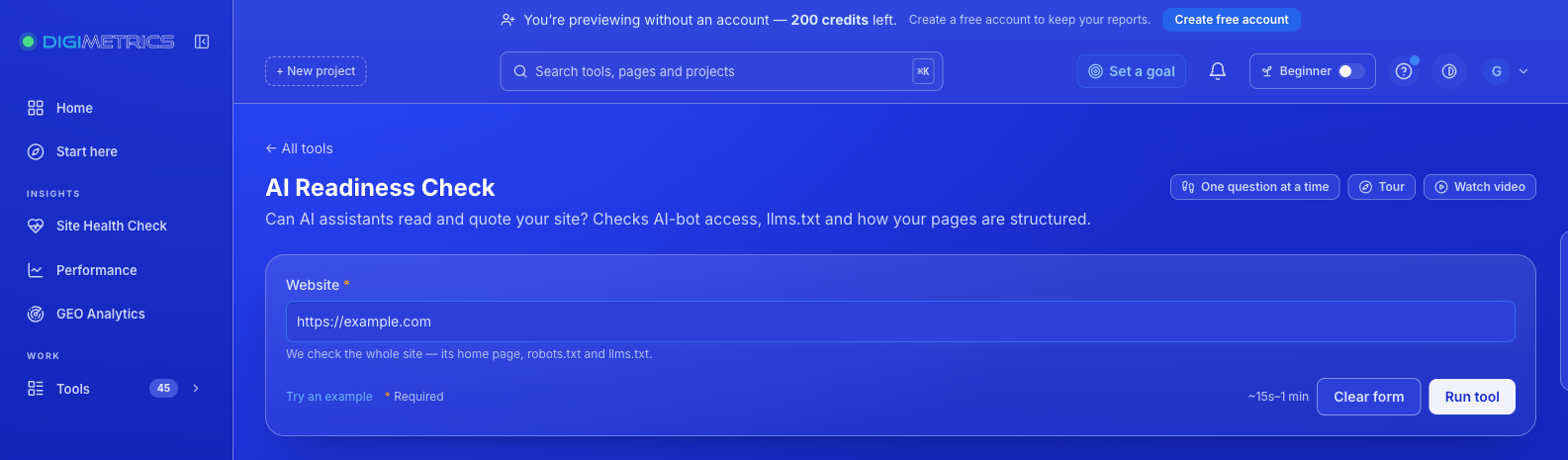
The Digimetrics AI Readiness Check addresses a different problem.
It evaluates whether a website is technically prepared for AI-related discovery.
The tool checks areas including:
It returns a readiness score, individual check results, and a prioritised list of potential fixes.
A check typically takes up to a minute.
Importantly, a high AI readiness score does not guarantee AI recommendations or citations.
Technical accessibility is one prerequisite for some discovery and retrieval processes, not proof that AI systems will choose a website as a source.
An llms.txt file is also not a universal ranking factor. Google has stated that it does not use llms.txt for Google Search or its AI features.
Treat such files as optional, service-dependent aids rather than guaranteed visibility improvements.
A practical AI visibility assessment should combine broad discovery with repeatable measurement.
Visit the Ahrefs AI Visibility Checker.
Search for your brand and review the available visibility information.
Look for relevant mentions, citations, and competitors.
At this stage, your objective is to understand where the brand appears in the tool’s indexed AI results.
The free preview may not provide enough data for deeper historical or competitive analysis.
Create a list of questions potential customers might ask before choosing a provider.
Avoid relying exclusively on branded questions such as “Is TaskPilot good?”
Instead, include non-branded commercial questions:
“What is the best project management tool for a design agency?”
These questions are more useful for investigating whether customers can discover your business before they already know its name.
Start with approximately five to ten high-priority questions.
Enter your brand name, website, market, and selected buyer questions.
Run the tracker to review answers across its supported AI engines.
Examine the mention rate, citation rate, sentiment, and position for each question.
Pay particular attention to differences between platforms.
A brand may appear in Gemini but be absent from Perplexity for the same topic.
A missing mention doesn’t automatically mean your website has a technical problem.
Potential explanations include:
Review the sources cited in the answers before deciding what to improve.
Use the Digimetrics AI Readiness Check to identify possible technical barriers.
Review crawler settings, structured data, and relevant accessibility issues.
Prioritise confirmed problems affecting important pages.
Avoid implementing technical changes solely to increase a proprietary readiness score if they do not serve a legitimate discovery or usability need.
Repeat the monitoring process after publishing improvements.
Keep the questions, market, and platforms as consistent as practical.
This provides a more meaningful basis for comparing results.
Because AI answers can vary, evaluate changes across multiple observations rather than treating one run as definitive proof of improvement.
The best choice depends on your current marketing needs.
| Your Goal | Recommended Starting Point |
| Get a quick, free AI visibility snapshot | Ahrefs AI Visibility Checker |
| Explore a large indexed AI search dataset | Ahrefs Brand Radar |
| Research competitor presence in AI answers | Ahrefs Brand Radar |
| Check whether AI answers name your brand for specific buyer questions | Digimetrics AI Mentions Tracker |
| Measure mentions, sentiment, citations, and position across a defined question set | Digimetrics AI Mentions Tracker |
| Diagnose AI crawler access and website readiness | Digimetrics AI Readiness Check |
| Combine AI visibility, SEO audits, and content improvement tools | Digimetrics |
A larger data index does not automatically produce better decisions for every business.
Likewise, a small set of tracked questions cannot provide the same market-wide coverage as an indexed research database.
The important question is which measurement approach reflects your business goals.
Discovering that competitors appear more frequently is useful only if it leads to a sensible next action.
There is no guaranteed method for making AI assistants mention a particular brand.
However, businesses can investigate several practical areas.
A page saying “we deliver innovative marketing solutions” provides less useful context than a page explaining the services offered, target customers, supported platforms, and implementation process.
Clear facts make it easier for people, and potentially AI systems, to understand the business.
If customers frequently compare features, prices, use cases, or alternative solutions, make that information accessible.
Use descriptive headings, direct explanations, meaningful examples, and transparent comparisons.
Avoid manufacturing unsupported statistics or copying competing pages.
AI-generated answers may reference third-party websites, reviews, industry publications, and company pages.
If a relevant source frequently appears in responses, investigate why.
Accurate business listings, genuinely useful expert contributions, and legitimate independent coverage can help strengthen a brand’s public information footprint.
Do not purchase misleading reviews or attempt to manipulate recommendations through fabricated endorsements.
Ensure important pages are accessible, appropriately indexed, and understandable.
Review robots.txt, rendering issues, canonical URLs, and structured data.
Remember that different AI companies use different crawlers for search, retrieval, and model training.
Crawler permissions should reflect your organisation’s policies rather than an assumption that every bot must be allowed.
AI visibility is only one part of marketing performance.
Where measurement is available, examine referral traffic, qualified enquiries, and customers alongside mentions and citations.
A brand receiving frequent mentions for irrelevant questions may gain less commercial value than a brand appearing consistently for a smaller number of purchase-intent questions.
Yes. The free Ahrefs AI Visibility Checker is a useful starting point for understanding whether your brand appears in its indexed AI search results.
For businesses requiring broad competitive intelligence, historical visibility research, and access to a large prompt database, Brand Radar offers capabilities beyond the free version.
However, not every marketing team needs a large-scale research subscription.
If your immediate questions are whether AI assistants name your business, which buyer questions you’re missing from, and what might prevent your website from being accessed or understood, Digimetrics offers a more focused workflow.
Its AI Mentions Tracker measures brand mentions, citations, sentiment, and position across five engines. Its AI Readiness Check provides a separate technical assessment with prioritised recommendations.
The most useful AI visibility strategy combines measurement with investigation. Know where your brand appears, identify the gaps that matter to buyers, and make improvements you can measure over time.
Find out whether ChatGPT, Claude, Gemini, Perplexity, and Google AI Overview mention your brand when potential customers ask relevant questions.
Review your mentions, citations, sentiment, and answer position, then investigate technical barriers with AI Readiness Check.
Try Digimetrics AI Mentions Tracker
Try all Digimetrics tools free for seven days. No credit card required.
Yes. Ahrefs offers a free checker without requiring a subscription or credit card. The results are limited compared with the full Brand Radar product.
Brand Radar is Ahrefs’ broader AI visibility research and monitoring product. It provides extensive AI search datasets, competitive analysis, historical information, and prompt-tracking capabilities.
Yes. Its free checker includes ChatGPT alongside Gemini, Perplexity, Copilot, Google AI Overviews, and Google AI Mode.
Yes. Ahrefs supports analysis of citations and brand visibility in AI-generated answers. The depth of reporting depends on the product and access level.
Ahrefs advertises Prompt Tracking from $50/month and AI Visibility Index access from $199/month, with additional pricing options depending on platform access and subscription configuration.
Digimetrics provides AI Mentions Tracker for checking brand appearances across five engines and AI Readiness Check for examining website access and technical signals. It offers a seven-day free trial, with paid plans starting at $31/month when billed annually.
Yes. Digimetrics AI Mentions Tracker includes a GPT-4o-based ChatGPT measurement alongside Claude, Gemini, Perplexity, and Google AI Overview.
Not necessarily. Visibility, citations, clicks, and conversions are different outcomes. An AI response can mention your brand without linking to it, and a citation does not guarantee a visit.
Monthly monitoring is a practical starting point for many businesses. Keep the same buyer questions and measurement settings between runs so trends remain more comparable.
No. Checkers measure visibility or diagnose issues; they do not guarantee improvements. Your team must evaluate the findings, implement appropriate changes, and monitor the results.

Tom is the CEO of MediaOne, a leading digital marketing agency. He is a business-experienced SEO consultant as well as a Google Gold Search Expert serving the international community. He has consulted for MNCs like Canon, Maybank, Capitaland, SingTel, ST Engineering, WWF, Cambridge University, as well as Government organisations like Enterprise Singapore, Ministry of Law, National Galleries, NTUC, e2i, SingHealth. His articles are published and referenced in CNA, Straits Times, MoneyFM, Financial Times, Yahoo! Finance, Hubspot, Zendesk, CIO Advisor. Under his stewardship, MediaOne has won dozens of prestigious digital marketing awards.
Run a free Digimetrics audit across SEO, AI search, content and technical health, and get a plan you can act on today.
Start free →Yes, Ahrefs has a free AI Visibility Checker. You can enter a brand name, inspect its presence across six AI search experiences, and see…
Direct answer: To rank in Perplexity and ChatGPT, answer one narrow question clearly, make each claim easy to check, and structure the page so…
To appear in AI Overviews as a local business, make your name, address, phone number and service area match everywhere they appear, answer your…