Writing a good advertisement sounds simple until you have to create 15 different headlines, stay within character limits, communicate your product’s benefits, and make every variation worth testing.
Now repeat that process for Google Ads, Facebook, Instagram, and LinkedIn.
The challenge isn’t just writing enough copy. It’s finding the right message for each audience, platform, and stage of the buying journey without losing what makes your product worth choosing.
That’s where an ad copy generator tool becomes useful.
An AI-powered ad copy generator helps marketers turn product information, audience needs, and campaign keywords into advertising headlines, descriptions, and messaging variations.
Instead of starting with a blank document, you begin with potential advertisements that can be reviewed, refined, and tested.
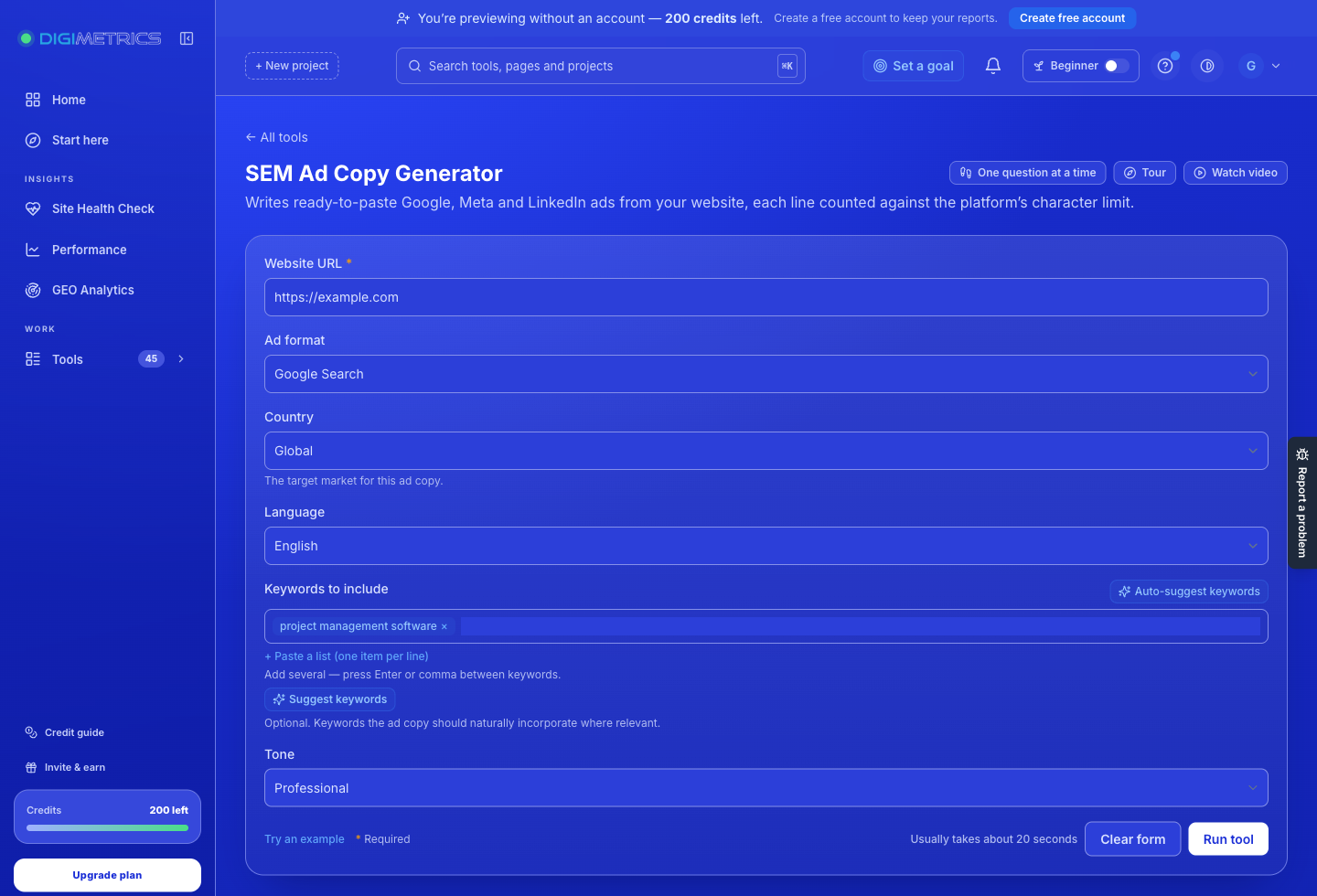
Digimetrics SEM Ad Copy Generator takes this further by examining your website before generating copy. It identifies your selling points and uses them to create platform-specific advertising text for Google, Meta, and LinkedIn.
This guide explains how AI ad copy generators work, what makes effective advertising copy, and how to use generated content without sacrificing accuracy or campaign performance.
An ad copy generator is software that produces advertising text based on information about a product, service, target audience, or campaign.
Depending on the tool, the output may include:
Advertising headlines designed to capture attention
Descriptions explaining a product’s benefits
Calls to action encouraging users to take the next step
Different messaging angles for advertising tests
Platform-specific copy for search and social advertising
Sitelink text and other supporting advertising assets
Traditional copywriting requires marketers to research an offer, identify its selling points, write variations, and check the requirements of each advertising platform.
AI ad copy generators can assist with several of these tasks.
However, the quality of the output depends on the information the tool receives.
A generic instruction such as “write an ad for accounting software” gives the AI little context about the product’s real advantages.
The result may be grammatically correct but commercially weak.
A more useful approach starts with the product’s actual features, target customers, and reasons to buy.
Why Use an AI Ad Copy Generator?
Generating ad copy with AI is not simply about writing faster.
The real advantage is reducing repetitive drafting work while giving marketers more messaging options to evaluate.
1. Create Multiple Advertising Variations
Advertising campaigns frequently require several headlines and descriptions.
A marketer writing Google responsive search ads may need to communicate product features, benefits, promotional offers, and calls to action in short text fields.
Generating enough distinct variations manually can become repetitive.
An AI ad copy generator can produce a starting set of options, allowing marketers to spend more time selecting and refining the strongest messages.
2. Adapt Messaging for Different Platforms
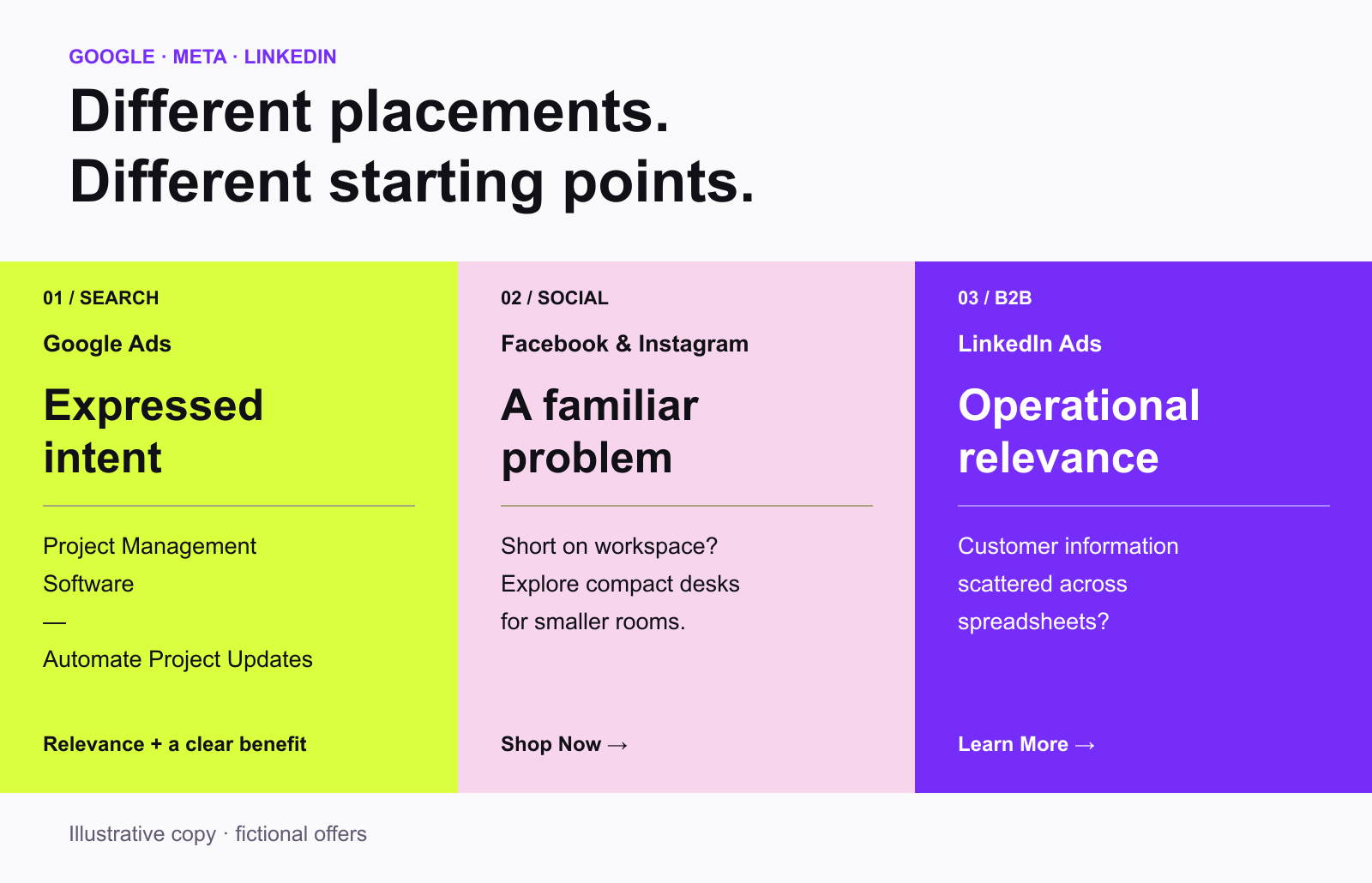
Someone searching Google for project management software is behaving differently from someone scrolling through Instagram.
The first person has expressed an existing interest through their search query.
The second may not be actively looking for a solution.
An effective advertisement should account for that difference.
AI tools can help adapt the same underlying product benefits into different messaging approaches.
3. Explore New Selling Angles
Marketers often return to familiar phrases.
A software company might repeatedly advertise that its product is easy to use.
However, its customers may care more about reducing manual work, simplifying reporting, or coordinating teams.
A generator can help produce copy based on different benefits, provided those benefits are supported by the product.
4. Reduce Manual Formatting
Advertising platforms have different text requirements.
Google responsive search ads, for example, have strict headline and description limits.
A platform-aware generator can reduce the manual work involved in adapting copy to those constraints.
5. Support Faster Campaign Iteration
Advertising is an ongoing process.
A campaign may need new copy when an offer changes, a product launches, or existing messaging no longer performs as expected.
AI-assisted drafting can make it easier to prepare additional variations for review.
The goal is not to automate every advertising decision. It’s to make creative development more efficient without losing strategic judgement.
Meet Digimetrics: An Ad Copy Generator That Starts With Your Website
Most general-purpose AI writing tools depend heavily on the prompts users provide.
Digimetrics takes a more structured approach.
Its SEM Ad Copy Generator examines a website to identify the products, services, and selling points before preparing advertisements.
This helps ground the output in what the business actually offers.
Rather than inventing a sales message from a vague product category, the generator uses information from the website alongside the campaign settings you provide.
What Digimetrics Can Generate
Capability
How It Helps
Website selling-point extraction
Provides product and service context before writing
Google Ads copy
Creates relevant headlines and descriptions for supported formats
Meta advertising copy
Adapts messaging for Facebook and Instagram advertising
LinkedIn advertising copy
Supports professional and B2B campaign messaging
11 advertising formats
Lets marketers select the format needed for a campaign
Market and language settings
Adapts output to the selected market and language
Keyword input or suggestions
Incorporates relevant campaign search terms
Tone selection
Helps match copy to the intended communication style
Headlines, descriptions and sitelinks
Produces advertising text assets for review and use
According to the official product guide, a generated ad set typically takes under a minute.
The generator is included in Digimetrics’ plans and is available during the platform’s seven-day free trial.
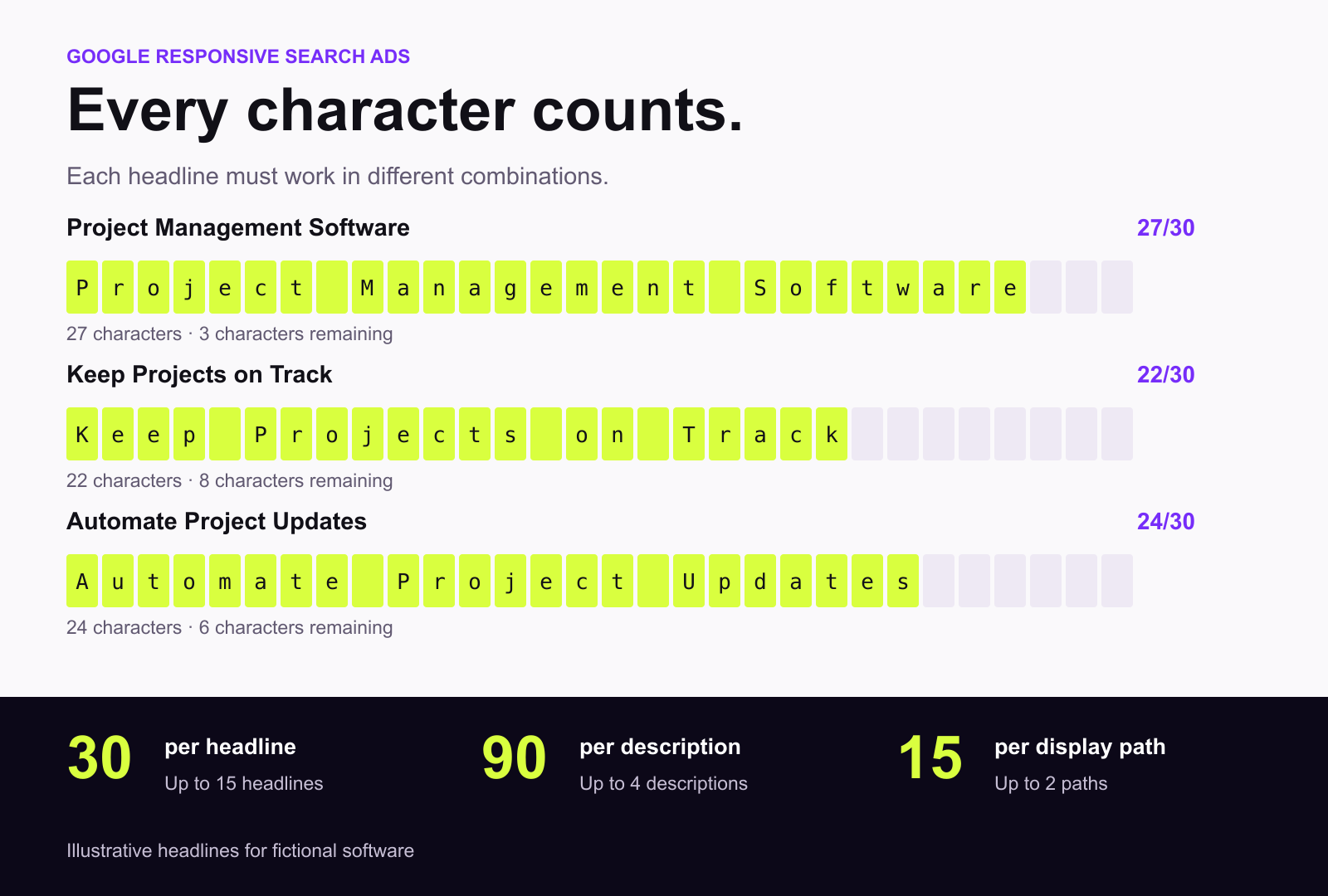
A useful Google Ads headline should communicate search relevance or a meaningful selling point without wasting the limited space.
Example: Project Management Software
Consider a fictional project management platform called TaskPilot.
Its confirmed features include task boards, team dashboards, and automated status reporting.
Potential search ad headlines could include:
Example Headline
Advertising Angle
Project Management Software
Keyword relevance
Keep Projects on Track
Core benefit
Automate Project Updates
Specific feature
Manage Tasks in One Place
Convenience
See Team Progress Clearly
Visibility
These are illustrative examples, not actual Digimetrics-generated results or claims about a real product.
Notice how the headlines communicate different aspects of the offer.
Repeating “Best Project Management Tool” several times would provide fewer useful messaging variations.
What Makes Good Google Ads Copy?
Start with the searcher’s intent.
A person searching for “project management software for small teams” is likely evaluating potential solutions.
The copy should therefore communicate relevant functionality and a reason to explore the product.
Descriptions can provide additional context, but they should avoid unsupported claims about results, customer numbers, or rankings.
For responsive search ads, review headlines individually and in combination because Google can assemble them in different orders.
Facebook and Instagram Ad Copy Generator: Writing for Discovery
Google Ads typically responds to a search query.
Facebook and Instagram advertising often reaches people while they are browsing content.
That changes how the copy should work.
Social advertisements need to establish relevance before asking users to consider a product or service.
A useful structure is:
Audience problem → Relevant benefit → Reason to act → Call to action
Example: Online Furniture Store
Imagine a furniture retailer promoting compact desks to people living in smaller apartments.
A simple advertising concept might be:
Primary text:
“Short on workspace? Explore compact desks designed for smaller rooms, with practical storage options and styles that fit your home.”
Headline:
“Find Your Ideal Home Desk”
Call to action:
“Shop Now”
This example starts with a recognisable problem rather than a generic statement about the retailer.
It also avoids inventing promotional discounts, delivery promises, or customer reviews.
What About Reels and Stories?
For video-focused placements, the advertisement’s visual message and written copy should reinforce each other.
A Reel might demonstrate how a desk fits into a small room, while the accompanying text explains the benefit.
A Story might feature a specific product collection and encourage the viewer to browse.
The text alone is not responsible for every aspect of performance.
Visual creative, audience targeting, placement, and the post-click experience also matter.
LinkedIn Ad Copy Generator: Writing for B2B Decision-Makers
LinkedIn advertising often targets professional audiences researching business solutions, industry information, or potential service providers.
For B2B campaigns, clarity and credibility are generally more useful than exaggerated promotional language.
A business decision-maker may want to understand the problem being addressed, the solution’s relevance, and whether the provider has evidence supporting its claims.
Example: CRM Software
Consider a fictional CRM platform intended for growing sales teams.
Introductory text:
“Customer information scattered across spreadsheets and conversations? Bring contact records, sales opportunities, and follow-up activities into a more organised workflow.”
Headline:
“Make Sales Follow-Ups Easier”
Call to action:
“Learn More”
The example focuses on a specific operational problem rather than vague promises of business transformation.
For a stronger campaign, the advertiser could use actual product demonstrations or approved customer evidence to support the message.
When LinkedIn Copy Needs More Detail
B2B buyers may require information about integrations, security, implementation, or procurement.
The advertisement does not need to explain every detail.
Its role is to establish enough relevance and credibility for the intended audience to take the next step.
The landing page can then provide the deeper information.
How to Write Better AI-Generated Ad Copy
An AI ad copy generator can create variations quickly, but speed does not automatically produce persuasive advertisements.
The following principles can help improve the quality of the final copy.
Focus on a Specific Customer Problem
Generic claims such as “innovative solutions for your business” communicate very little.
A more specific statement identifies what customers are trying to accomplish.
For example, software that consolidates reports from multiple departments could lead with that workflow instead of describing itself as innovative.
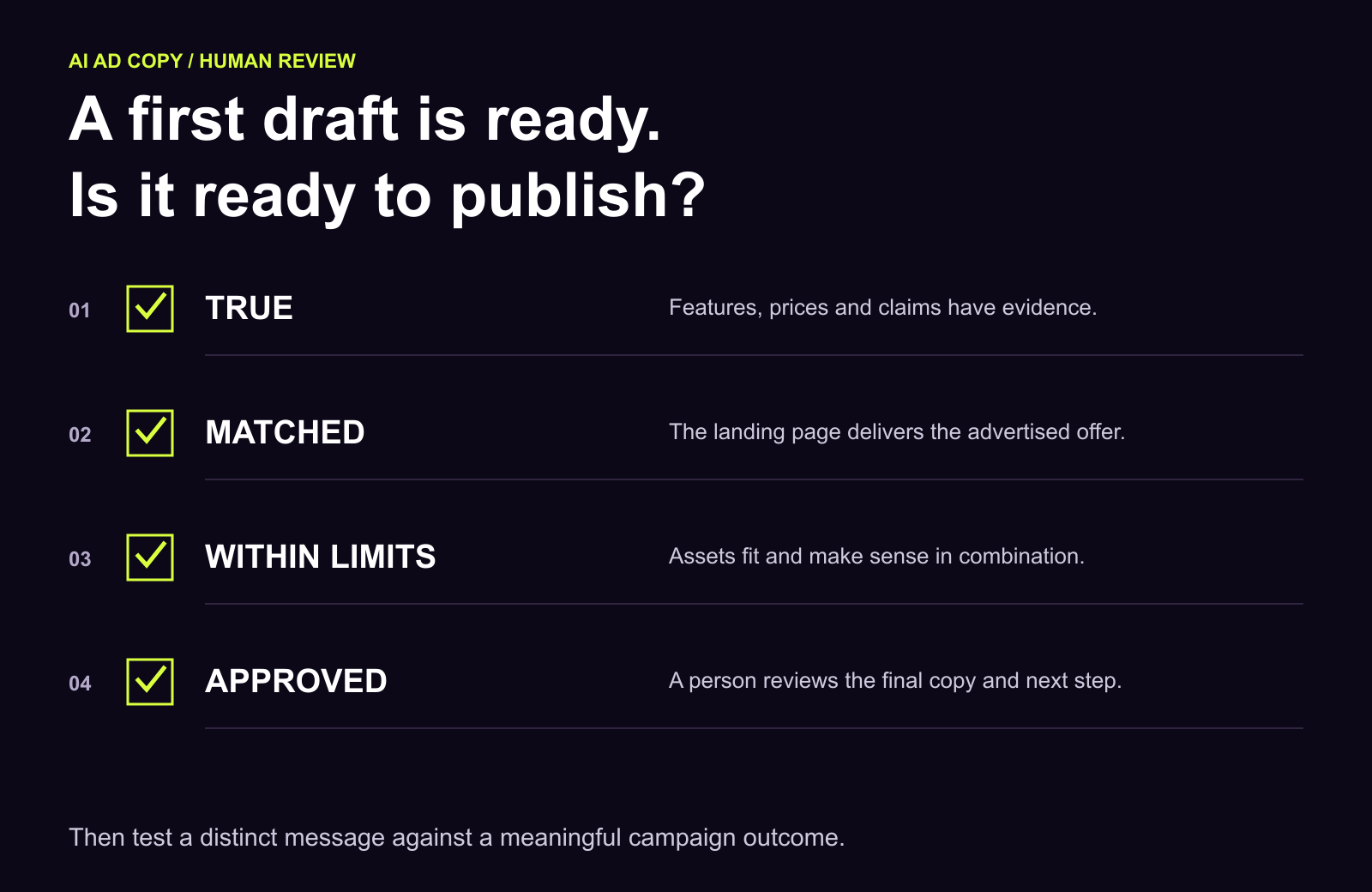
Use Verifiable Selling Points
Actual features, published pricing, supported integrations, and documented service details are stronger foundations than invented superlatives.
If a generated advertisement claims that a product saves 40% of working time, the advertiser should have evidence supporting that figure.
Otherwise, remove or revise the claim.
Match the Copy to the Landing Page
An advertisement promising a free consultation should lead to a page where users can request that consultation.
Likewise, an advertisement promoting a particular product should not send users to an unrelated homepage.
Consistency between the advertisement and landing page improves clarity and reduces unnecessary friction.
Make the Next Step Clear
The call to action should reflect what happens after the click.
Examples include:
Get a Quote
View Pricing
Book a Demo
Explore Products
Download the Guide
Avoid creating urgency that does not exist.
Test Meaningfully Different Messages
Changing one adjective is rarely a particularly informative creative experiment.
Instead, compare advertising concepts built around different customer motivations.
For example, test a time-saving message against a collaboration-focused message for project management software.
Use campaign results to determine which direction deserves further investment.
Ad Copy Generator vs General AI Writing Tool: What’s the Difference?
A general AI writing assistant can produce advertising copy when provided with appropriate instructions.
However, the user may need to supply campaign context, platform requirements, product features, and character limits manually.
A dedicated ad copy generator is designed around the advertising workflow.
Capability
General AI Writing Tool
Digimetrics SEM Ad Copy Generator
Generate advertising text
Yes, with an appropriate prompt
Yes
Extract selling points from a website
Depends on available browsing or URL tools
Built into the workflow
Choose an advertising format
Usually requires prompting
11 supported formats
Choose market and language
Through instructions
Dedicated settings
Provide campaign keywords
Manually or through prompting
User-defined or suggested
Generate headlines and descriptions
Yes
Yes
Generate sitelinks
Requires instructions
Included in generated ad sets
Access additional marketing tools
Depends on the product
Included within the Digimetrics workspace
The advantage of a specialised generator is not that general AI cannot write ads.
It’s that the tool provides a repeatable workflow built around preparing advertising assets.
For teams managing multiple campaigns, consistency in that process can be useful.
Common Mistakes to Avoid When Using AI for Advertising Copy
Publishing Without Fact-Checking
AI-generated copy can misrepresent an offer or introduce claims that the business cannot support.
Always verify prices, guarantees, statistics, product features, and promotional conditions.
Generating Too Many Similar Headlines
A large collection of headlines provides limited value if they all express the same idea.
Prioritise distinct benefits and messages over superficial wording changes.
Ignoring Platform Requirements
Different platforms impose different constraints on advertising formats and content.
Text should be reviewed against the current platform specifications and applicable advertising policies.
Using One Message for Every Audience
A startup founder, enterprise procurement manager, and individual consumer may care about different benefits.
Audience-specific messaging should reflect those differences without inventing personal information or making inappropriate assumptions.
Evaluating Copy Only by Click-Through Rate
A high click-through rate can indicate that an advertisement attracts attention.
It does not necessarily show whether those clicks generate qualified leads or profitable purchases.
The appropriate success metric should depend on the campaign objective.
How to Measure Whether Your Ad Copy Is Working
Ad copy is one part of advertising performance.
Its effectiveness should be evaluated alongside audience targeting, creative, landing-page experience, offer, and budget.
Metric
What It Measures
What to Consider
Click-through rate (CTR)
Clicks relative to impressions
Indicates engagement, not necessarily quality
Cost per click (CPC)
Average media cost per click
Lower cost is not always better
Conversion rate
Conversions relative to the chosen traffic measure
Depends on landing page and offer
Cost per lead (CPL)
Advertising spend divided by leads
Lead quality may vary
Cost per acquisition (CPA)
Spend per defined acquisition
Clarify what counts as an acquisition
Return on ad spend (ROAS)
Attributed revenue divided by media spend
Does not include all business costs
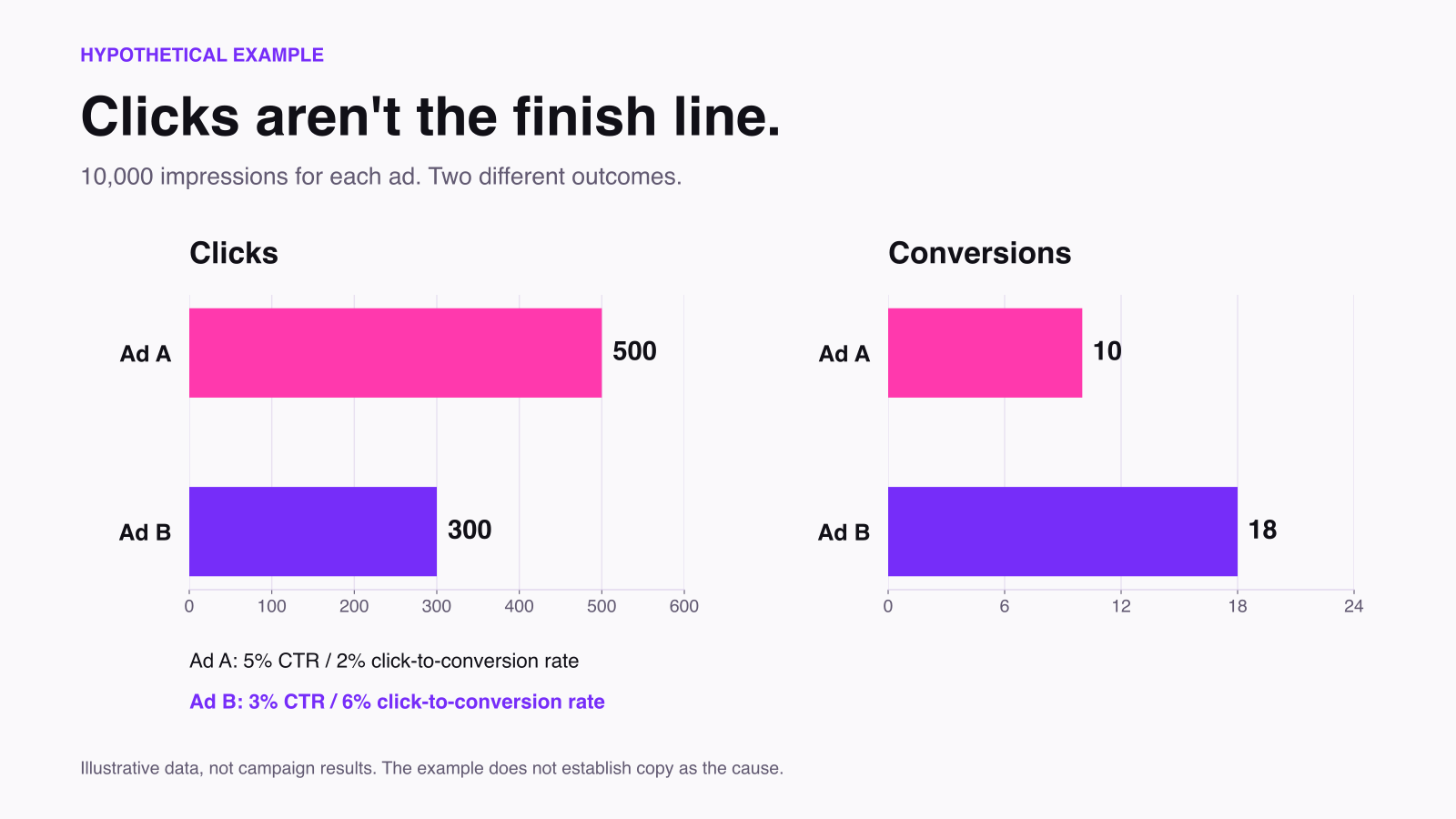
Example: Why More Clicks Don’t Always Mean Better Ads
Consider two hypothetical Google Ads campaigns, each receiving 10,000 impressions.
Metric
Ad A
Ad B
Impressions
10,000
10,000
Clicks
500
300
CTR
5%
3%
Conversions
10
18
Click-to-conversion rate
2%
6%
Ad A attracts more clicks.
However, Ad B generates more conversions despite receiving fewer visitors.
This does not prove that the copy alone caused the difference. Landing-page experience, audience differences, traffic quality, and other factors may influence the results.
It demonstrates why advertisers should evaluate copy using metrics aligned with the campaign’s actual objective.
Go Beyond Ad Copy With Digimetrics
Creating advertisements is only one part of running a successful campaign.
A marketer may also need to understand the audience, decide where to allocate spending, and evaluate whether the landing page supports the advertisement’s promise.
Digimetrics brings related marketing tools into one workspace.
Persona Generator
ThePersona Generator helps develop audience profiles based on website information.
These profiles can support the planning process when identifying potential customer needs and messaging angles.
They should be treated as hypotheses to validate, not as verified customer research.
Media Plan Generator
TheMedia Plan Generator helps marketers prepare channel and budget allocation plans.
This can provide a starting framework for deciding where different advertising messages may be useful.
Estimated results should not be interpreted as guaranteed outcomes.
Landing Page Audit
TheLanding Page Audit evaluates factors such as conversion clarity, user experience, performance, and search readiness.
This is particularly relevant when advertisements generate clicks but the destination page struggles to convert visitors.
This allows marketers to evaluate issues beyond the advertising copy itself.
Connected Advertising Data
Digimetrics also provides integrations for Google Ads, Meta Ads, and LinkedIn Ads, helping teams review campaign performance within the wider workspace.
These tools support a broader workflow:
Understand the audience → Plan the campaign → Generate copy → Review the landing page → Evaluate campaign performance.
Create Better Advertising Copy With Digimetrics
Good advertising copy communicates the right message to the right audience in a format that suits the platform.
It should reflect what your business actually offers, make a specific benefit clear, and give people a meaningful reason to take the next step.
An AI ad copy generator can make this process more efficient by producing advertising variations that marketers can review and test.
Digimetrics makes the starting point more practical by examining your website for selling points before generating headlines, descriptions, and sitelinks.
With support for 11 formats across Google, Meta, and LinkedIn, you can prepare different advertising messages without rebuilding every brief from scratch.
The result isn’t a replacement for advertising strategy.
It’s a faster way to turn your existing product information into copy you can refine and evaluate.
Frequently Asked Questions About Ad Copy Generator Tools
What is the best ad copy generator tool?
The best tool depends on your advertising platforms and workflow. Digimetrics is worth considering if you want a generator that extracts selling points from your website and creates copy for Google, Meta, and LinkedIn, with market, language, keyword, and tone settings.
Is there a free AI ad copy generator?
Digimetrics offers a seven-day free trial with access to its marketing tools, including the SEM Ad Copy Generator. No credit card is required to start the trial.
Can AI generate Google Ads headlines?
Yes. AI can assist with creating headlines and descriptions for Google Ads. Digimetrics supports platform-specific copy generation, including the character constraints used for responsive search ads.
Can an ad copy generator create Facebook and Instagram ads?
Yes. Digimetrics supports Meta advertising formats, allowing marketers to prepare copy for Facebook and Instagram campaign use.
Can I generate LinkedIn advertising copy?
Yes. Digimetrics supports LinkedIn advertising formats and allows users to configure relevant campaign settings such as tone and market.
Does AI-generated ad copy improve conversion rates?
Not automatically. Generated copy provides variations to test, but conversion performance depends on relevance, targeting, landing-page quality, offer, and other factors. No generator can guarantee better results.
Can I customise the tone of generated ads?
Yes. Digimetrics includes tone selection alongside market, language, keyword, and advertising-format settings.
Do I need copywriting experience to use an ad copy generator?
No specialised copywriting background is required to generate a first draft. However, reviewing claims, understanding customer needs, and evaluating campaign performance remain important.
How much does Digimetrics cost?
Digimetrics offers a seven-day free trial. Its Starter plan is advertised at $31 per month when billed annually or $39 with monthly billing. Higher-tier plans offer greater project and usage allowances, while the SEM Ad Copy Generator is included across plans. Check theDigimetrics pricing page for current terms.
About the author
Tom Koh
Tom is the CEO of MediaOne, a leading digital marketing agency. He is a business-experienced SEO consultant as well as a Google Gold Search Expert serving the international community. He has consulted for MNCs like Canon, Maybank, Capitaland, SingTel, ST Engineering, WWF, Cambridge University, as well as Government organisations like Enterprise Singapore, Ministry of Law, National Galleries, NTUC, e2i, SingHealth. His articles are published and referenced in CNA, Straits Times, MoneyFM, Financial Times, Yahoo! Finance, Hubspot, Zendesk, CIO Advisor. Under his stewardship, MediaOne has won dozens of prestigious digital marketing awards.
Your website has 150 published articles. Some attract consistent organic traffic, others haven’t generated a meaningful visit in months, and several cover nearly identical…
Verifiability matters more than speed when publishing AI-generated content. An AI content generator turns a short brief into draft copy, and its usefulness depends…