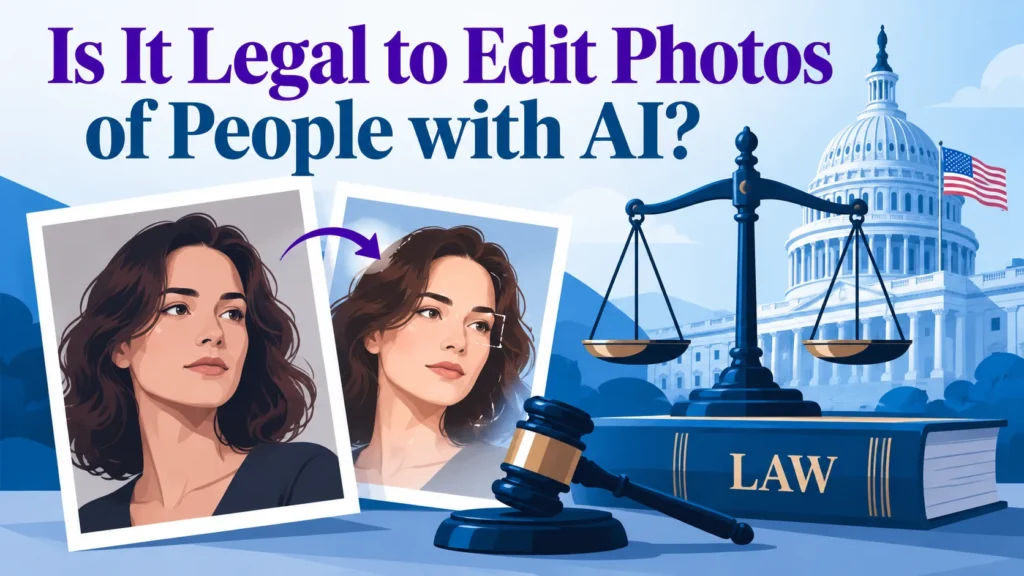
Editing a real person’s photo with AI is not illegal in itself. Routine edits such as background cleanup carry little legal risk. Exposure comes from sexualised or intimate depictions made without consent, commercial use of someone’s likeness or implied endorsement, and altered images presented as a true record of events.
Creators often remain unsure where these lines sit, as a community discussion about AI images of real people shows. Rules differ depending on whether you edit privately, post publicly or sell the result.
Editing a real person’s photo with AI is not illegal in itself. Risk comes from sexualised or intimate depictions made without consent, commercial use implying endorsement, and altered images presented as factual records.
Consent and purpose matter more than the tool used.
Sexual deepfakes of real people can carry criminal penalties, including a five-year jail term in one UK case.
Get written permission naming the exact edits, platforms and duration before commercial use.
Table of Contents
Where the Law Draws the Line on Editing Real People
Enforcement, Platform Accountability and Recourse for Victims
Who Owns an AI-Edited Photo? Copyright and Commercial Use
Is It Legal to Edit Photos of People with AI? A State-by-State Screen
Consent Checklist: Editing Photos of People Safely
Conclusion
Frequently Asked Questions
Where the Law Draws the Line on Editing Real People
Retouching a headshot, changing a background or adjusting lighting raises no special legal problem when the subject consents and the image stays in its intended context. Risk arises from three acts: creating sexualised or intimate depictions without consent, using someone’s likeness commercially or in a way that implies endorsement, and presenting a materially altered image as a factual record.
The main risk sits in publication rather than the edit itself. A private retouch that never leaves your device is low risk. Once posted, shared by email, sold or used in advertising, it can harm the person pictured, and the reach of a story or sports photo edit can multiply that harm quickly.
Ordinary edits versus sexualised or undressed images
Changing a person’s clothing, body or setting in a sexual or humiliating way is where criminal exposure begins. In the UK, The Guardian reported that a man was jailed for five years for posting deepfake pornography of women he knew. Treat any edit that undresses or sexualises a real person as a hard stop.
Partly clothed images posted without permission
Partly clothed images are not safe by default. Posting one of a real person without consent can breach Facebook rules and, depending on content and jurisdiction, the law. Get written permission before sharing any edited image that shows someone’s body, and check the right to publish before it goes to any view beyond your own.
Enforcement, Platform Accountability and Recourse for Victims
Where an edit crosses into sexualised imagery, enforcement is real. In the UK, Brandon Tyler was jailed for five years for posting deepfake pornography of women he knew, according to The Guardian’s explainer. Criminal exposure falls on the person who makes and shares the image, not only the tool.
Ofcom, the UK communications regulator, can fine platforms up to 10% of global revenue for breaching their obligations.
If your likeness is misused, report the image to the platform, then contact the Revenge Porn Helpline.
Who Owns an AI-Edited Photo? Copyright and Commercial Use
Ownership and permission are separate questions. A photo can be copyright-free in part and still carry a person’s likeness rights, so check both. Sharing an AI-edited image on Facebook or a home or sports site carries the same permission checks as any other commercial use.
The human authorship requirement and the Copyright Office registration policy
The US Copyright Office registers only works with human creative input. Purely machine-generated output is unprotected, so protection covers your own additions. Users should review the Office’s AI guidance before registering a work, and any content they publish should reflect their own creative choices.
Thaler v. Perlmutter and court rulings on AI authorship
Courts and the Copyright Office require a human author. Fully autonomous output is settled as unprotected; the open question is how much human input is enough.
Commercial use, infringement risks and model releases
Ownership does not clear commercial use. If a recognisable person appears in an AI-edited image used in advertising, get a signed model release covering AI alteration, channels and duration. Without one, the person may have a claim even where copyright is clear. Fashion and sports imagery are common examples where these rights issues arise.
Is It Legal to Edit Photos of People with AI? A State-by-State Screen
US law has no single rule. Federal law bars false endorsements in advertising, while state publicity rules govern use of a person’s likeness, and many states criminalise sexual deepfakes. The four screen questions map onto these layers. Because states differ, check the rules where the subject lives before you publish, especially when the images involve children or a celebrity.
Consent Checklist: Editing Photos of People Safely
Before you edit a photo of a real person with AI, run it through four questions. This Likeness Risk Screen catches most problems before anything is published. Follow the steps in order: consent, content, purpose, then how a viewer will read the image.
Step-by-step decision framework before you edit
Is the person identifiable, and did they agree to this specific edit? A general photography release does not cover AI alteration. Get written consent naming the planned changes.
Does the edit change their body, clothing or setting in a sexual, intimate or humiliating way? If yes, stop. Do not create it, even privately.
Will the image be used commercially or to imply endorsement? If yes, you need a model release covering AI retouching, platforms and duration.
Could a reasonable viewer take the edit as a true record? If yes, add a clear disclosure label or use a different edit.
Any “yes” to question 2 is a full stop. A “yes” to questions 1, 3 or 4 requires written permission, a label or a different edit before sharing.
How to get a compliant model release in the US
Confirm the subject is an adult able to sign.
Describe the exact AI edits allowed, not a general “retouching” consent.
List the channels, such as a website, print or paid social, including any professional networks like LinkedIn.
State the duration and territory of use, and whether the image may train an AI model.
Include a signature line, a date and the subject’s contact details.
Keep the signed copy for as long as the image is in use.
Red flags that turn an edit into a legal risk
The subject has not seen or approved the change.
The image targets a private individual, not a public-interest subject.
The edit makes the person appear to endorse a product or position.
The image is posted to a platform whose synthetic-media rules you have not read.
Anyone who suspects an image of them is being misused can contact the Revenge Porn Helpline for advice.
Conclusion
Editing a real person’s photo with AI is not illegal in itself. The risk comes from three acts: sexualised or intimate depictions without consent, commercial use that implies endorsement, and altered images presented as factual records. Consent and purpose should drive the decision, not the tool.
Frequently Asked Questions
Is it illegal to edit a photo of someone with AI without their permission?
Not automatically. Routine edits such as colour correction carry little risk. Exposure comes from what the edit depicts and how it is shared. Sexualised or intimate alterations made without consent can be criminal. In the UK, Brandon Tyler was jailed for five years for posting deepfake pornography of women he knew, according to The Guardian. US state laws differ.
Can I edit a photo of a public figure with AI?
Usually yes for commentary, parody or news. Risk rises with commercial use or any suggestion of endorsement, and some US states recognise publicity rights. Treat any edit that humiliates or sexualises a person as a stop, whoever they are.
What should I do if someone posted a manipulated image of me?
Save the URL, a screenshot and the date, then report the image under the platform’s synthetic media or intimate imagery policy. For intimate images, contact the Revenge Porn Helpline, as The Guardian reports. Serious cases may warrant a police report or civil claim.
Can I copyright a photo I edited with AI?
Only human-created parts are protected. The US Copyright Office requires human authorship, so purely AI-generated output cannot be registered, while human edits such as compositing can. Disclose AI-generated portions when you register.
Do I need a model release to use an AI-edited photo commercially?
Yes, if an identifiable person appears in advertising, even in a retouched product shot. The release should state the allowed edits, platforms, duration and whether the image can train an AI model.
What is the penalty for posting non-consensual intimate deepfakes?
Penalties vary by jurisdiction. The UK case above ended in a five-year sentence, according to The Guardian. Many US states now criminalise sexual deepfakes, and civil damages may also apply.
About the author
Tom Koh
Tom is the CEO of MediaOne, a leading digital marketing agency. He is a business-experienced SEO consultant as well as a Google Gold Search Expert serving the international community. He has consulted for MNCs like Canon, Maybank, Capitaland, SingTel, ST Engineering, WWF, Cambridge University, as well as Government organisations like Enterprise Singapore, Ministry of Law, National Galleries, NTUC, e2i, SingHealth. His articles are published and referenced in CNA, Straits Times, MoneyFM, Financial Times, Yahoo! Finance, Hubspot, Zendesk, CIO Advisor. Under his stewardship, MediaOne has won dozens of prestigious digital marketing awards.
Your website has 150 published articles. Some attract consistent organic traffic, others haven’t generated a meaningful visit in months, and several cover nearly identical…
Writing a good advertisement sounds simple until you have to create 15 different headlines, stay within character limits, communicate your product’s benefits, and make…
Verifiability matters more than speed when publishing AI-generated content. An AI content generator turns a short brief into draft copy, and its usefulness depends…