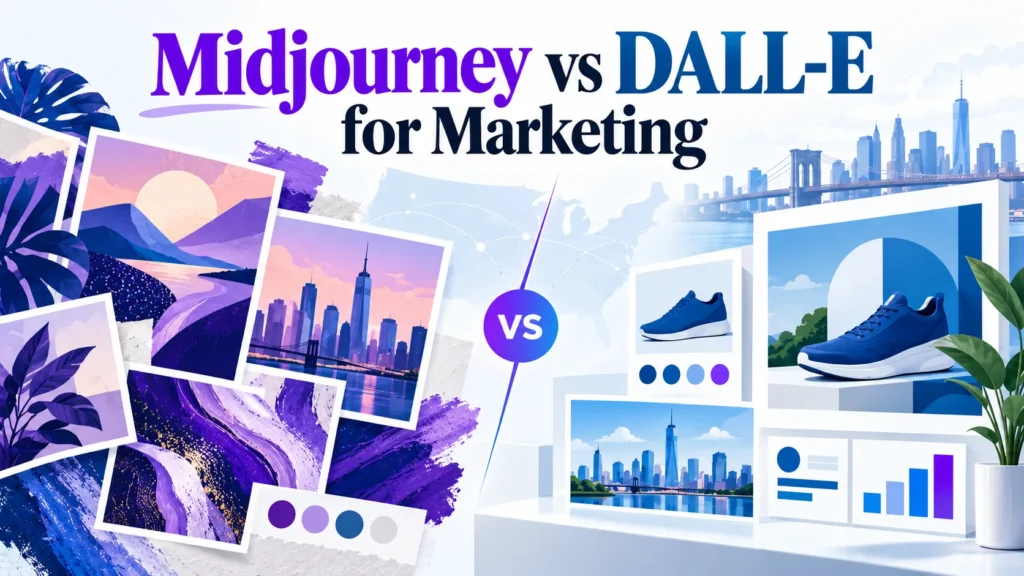
Most comparisons of Midjourney and DALL-E end with a winner. For a marketing team, that verdict usually arrives too late. The best tool on a leaderboard may still be the wrong pick for a paid social campaign, a product catalogue or a set of brand assets that must stay consistent for a year.
For a US marketing team, the right image generator depends on the job. DALL-E, now OpenAI’s GPT Image line, suits fast, prompt-accurate, editable work inside a text-and-image workflow. Midjourney suits art-directed brand imagery where style control matters more than precision. Stable Diffusion-class open models suit teams that need custom control or on-premise generation. Midjourney vs DALL-E for marketing comes down to fit, not a single score.
The job decides the tool, not the leaderboard. Score each option with the Fit Matrix by campaign type before you pick a primary tool.
Build on current model names. OpenAI retired DALL-E 2 and DALL-E 3 from its API on 12 May 2026, and gpt-image-1 retires on 23 October 2026, according to TechieHub.
Discount cross-tool leaderboards. Midjourney does not submit its current models to the Artificial Analysis arena, so V8 to V8.2 are absent from the ranking.
Check resolution early. Midjourney version 8.2 creates HD images at 2048 x 2048 pixels, and Apostle reports DALL-E maxes out at 1024×1792. Resolution decides whether an image suits print or only social.
Plan for copyright gaps. Works solely generated by AI will be refused registration because human authorship is required for copyright protection, so brand assets need human modification and legal review.
Table of Contents
The Marketer’s Fit Matrix
Which Model Should You Build On Today?
Head-to-Head: Midjourney vs DALL-E
Brand Work, Workflow and Editing
Copyright and Asset Ownership
Conclusion: The Practical Verdict for Marketers
Frequently Asked Questions
The Marketer’s Fit Matrix
Which tool is better? The more useful question is which one fits the job in front of you. A campaign that needs readable headline copy, a product shot that must print at billboard size and a mood board for a rebrand each point to a different tool.
Score each tool from 1 to 5 on five criteria: prompt accuracy, text rendering, style consistency, editing and iteration, and total cost of use (subscription, API metering and staff time). Weight the criteria by campaign type, then add the totals. The matrix gives a decision for each use case, not one winner for the whole business.
How to Apply the Matrix Across Campaign Types
Paid social: weight text rendering and iteration speed highest, since these tools are often used for free-to-run tests before committing to paid placements on social media.
Product imagery: weight resolution and prompt accuracy highest. Apostle’s comparison suggests print and billboard work may fail on DALL-E alone.
Editorial and brand mood work: weight style consistency highest.
Keep the scores in a shared sheet so the reasoning survives staff changes. Review the sheet once a month, because tool pricing and features change. The matrix also shows when a tool is wrong for a use case. That warning is often more useful than a ranking, and it is the best way to judge whether a tool is available for commercial work at all.
Which Model Should You Build On Today?
The product name is the least stable part of any image workflow. Ask which OpenAI model your business should build on today.
DALL-E’s Successor: The GPT Image Line
OpenAI turned off DALL-E 2 and DALL-E 3 in its API on 12 May 2026. It had announced the deprecation in November 2025, according to TechieHub. The image capability now sits in the GPT Image family. gpt-image-1 retires on 23 October 2026. gpt-image-1-mini, gpt-image-1.5 and chatgpt-image-latest move to gpt-image-2 on 1 December 2026, per the same source.
A campaign template that calls “dall-e-3” will break. A team that built on gpt-image-1 has weeks, not quarters, to migrate. Before you commit a workflow to any model name, check three things: the retirement date, the migration target, and whether your prompts and style references behave the same on the successor. Read the migration notes and test on real campaign briefs before you switch.
Midjourney’s Current Models: V8 Series
Midjourney moved through V8 quickly. V8 Alpha went live on March 25th, and TechieHub reports later V8.1 and V8.2 releases, with V8.2 made the default on 24 July 2026.
Older assets still matter. Midjourney released a rebuilt V7 in April 2025 and made it the default in June 2025, according to EyeSift. A brand style reference tuned in V7 may not reproduce identically in V8, so re-test any locked campaign look before reusing it. Keep a record of each version’s output for every campaign so the experience of a rollback stays manageable.
Stable Diffusion and Open Alternatives
Stable Diffusion-class models differ from hosted tools in one way that matters: you control the weights. Local generation, custom fine-tuned models and on-premise deployment keep brand imagery and training data inside your own environment. Hosted products give you none of that.
The Flux Dev model is an open-weight 12B model from Black Forest Labs, according to Over The Top SEO. Open models suit teams with technical staff who can run inference and maintain models. A small US marketing team without that capacity will usually get less total effort from a hosted tool, even when a model is free to download.
Head-to-Head: Midjourney vs DALL-E
Overall quality scores miss what matters for marketers. The useful comparison covers fit, resolution, realism and text accuracy for business use. Teams weighing a [free](#) trial or a paid tier should judge each tool on the same campaign brief.
Resolution is a production constraint. A 1024×1792 file works for social feeds and display banners. For print, billboards or large catalogue shots, check whether the Midjourney output meets your size before you plan an upscaling pass.
Image Quality and Realism
Run a blind realism test. Generate 10 images from one brief in each tool, strip the tool names, shuffle the files and ask three colleagues to rank them for realism and brand fit. Record which tool wins for each campaign type. Judge the best output on your own brief, not on a generic showcase.
Public leaderboards help less than they appear to. The Artificial Analysis text-to-image leaderboard gives GPT Image 2 (high) an Elo of 1186, according to its live leaderboard. Midjourney does not submit its current models to that arena, so V8 to V8.2 are absent. Treat arena scores as a rough signal and rely on your own test for brand work.
Prompt Accuracy and Creativity
Test adherence with a multi-element brief, such as “a woman holding a red mug, blue wall behind her, soft window light, space for a headline on the left.” Count how many elements survive. Midjourney’s stylization often adds mood the brief did not request. That helps moodboards but drifts on literal product shots. DALL-E follows instructions more literally, which suits briefs with required elements. A paid [ChatGPT Plus](#) plan gives access to the chat-based DALL-E workflow for this kind of test.
Criterion
What to score (1 to 5)
Adherence
Does the image match every element of the brief
Surprise
Does it add useful creative variation
Consistency
Does the look repeat across a set of images
Control
Can you change one element without rebuilding the image
Text Rendering Accuracy
Text matters for paid social, packaging mockups and banners. Test two cases: a three to five word headline, and a paragraph of body copy. Short headlines render more reliably. Misspelt words are common in longer text.
For anything customer-facing, add the words in Figma or Canva, not in the generator. Use the generator for the scene and the design tool for the copy, keeping the page content consistent with your brand tools.
Brand Work, Workflow and Editing
Editing: Inpainting and Outpainting
Inpainting regenerates a masked area of an existing image. A team uses it to swap a product, change a background or remove a stray logo. Outpainting extends the canvas beyond the original frame. This helps when a hero shot made for a 1:1 feed post must now fit a 9:16 story. Many [image generators](#) offer both functions, so a single approved visual can be reused across formats.
This is where one approved image pays off. A team can adapt a single hero visual into a square post, a landscape banner and a vertical story. There is no need to start from a blank prompt each time. Expect a few correction rounds. Check every edited region for drift in lighting, hands and product detail before it reaches a paid campaign.
Each edit is a fresh generation in the masked area, so colours and textures can shift slightly. Treat edits as a way to adapt a finished visual. Do not treat them as a substitute for a locked asset library.
Style Consistency for Brand Work
A campaign only looks like one family if its images share a style. Reuse a style reference, seed or moodboard. Do not rewrite the aesthetic in every prompt.
To build a brand style baseline:
Generate twenty candidates from one brief and keep the five closest to your brand.
Note the shared traits: palette, lighting, camera distance, texture and mood.
Write those traits into one fixed style block and paste it into every prompt.
Reuse the same reference image or seed across the campaign.
Review ten outputs side by side before approving the style for scale.
Before you generate at volume, lock the palette hex codes, typography rules for on-image copy, subject framing, the approved style reference and your version naming convention. Without them, a campaign drifts within a week.
Speed and Workflow Fit
Generation speed matters most in ideation and A/B variant work. A team may need dozens of options in a single session. In final production, a slower and more controlled pass is usually worth the wait.
Map tools to stages rather than hunting for one winner. Midjourney suits mood boards and art-directed concepts, where style matters more than precision. GPT Image models suit drafts that need accurate objects and text-adjacent layouts. Move finals into design software. The bottleneck decides the choice. If the slow step is getting style right, pick the strongest stylist. If it is revision and accuracy, pick the tool that follows the brief and edits cleanly.
Copyright and Asset Ownership
Commercial use is the easy part. Ownership is harder. The U.S. Copyright Office states that human authorship is required for copyright protection, and it will refuse to register works solely generated by AI. Copyright Alliance explains this position. Whether AI-assisted works can be protected in other cases remains legally unsettled. A business that treats a raw generated hero image as protected property may find it has less protection than it assumed.
Add your own human modifications and keep records of the process. Have counsel review any logo or hero asset before you treat it as protected property.
Conclusion: The Practical Verdict for Marketers
The right image generator depends on the job, not on which model tops a leaderboard. DALL-E, now part of OpenAI’s GPT Image line, fits fast, prompt-accurate work that needs on-image text and iterative editing. Midjourney fits art-directed brand imagery, where style matters more than literal precision. Stable Diffusion-class open models fit teams that need custom models or local generation. Model names will keep changing, so build your process around the criteria rather than the names.
Score each candidate on prompt accuracy, text rendering, style consistency, editing and iteration, and total cost of use. Weight those criteria by campaign type. A paid social campaign leans on text and speed. A product hero image leans on resolution and consistency.
Your next step is a 30-prompt test on your own brief. Use 10 prompts for each of three campaign types. Render every output in each tool and score them blind with a colleague. Check resolution against your print and placement needs. Send any asset you plan to own through a rights review with counsel before launch.
Frequently Asked Questions
Is DALL-E still available for marketing work?
Not under that name in the API. OpenAI switched DALL-E 2 and DALL-E 3 off on 12 May 2026, according to TechieHub. The product now lives in the GPT Image line. gpt-image-1 retires on 23 October 2026. gpt-image-1-mini, gpt-image-1.5 and chatgpt-image-latest fold into gpt-image-2 on 1 December 2026. If your team still refers to “DALL-E” in briefs or scripts, update the model name now, before the deadline breaks a live workflow.
Which is better for marketing, Midjourney or DALL-E?
It depends on the job. Use the Fit Matrix: score each tool on prompt accuracy, text rendering, style consistency, editing and total cost, then weight those scores by campaign type. GPT Image suits prompt-accurate, editable work with on-image text, such as paid social and product mockups. Midjourney suits art-directed brand imagery where mood matters more than precision. Apostle rates DALL-E 7.8/10 against Midjourney’s 7.5/10 for e-commerce. Treat that as one data point, not a verdict.
Can I use AI-generated images commercially and own them?
You can usually use them commercially under the vendor’s terms. Ownership is weaker than most teams assume. The U.S. Copyright Office refuses to register works solely generated by AI, because human authorship is required for copyright protection. Add your own human modifications, keep records of the process and have counsel review any logo or hero asset before you treat it as protected property.
Is Stable Diffusion worth it for a non-technical marketing team?
Usually not on its own. Stable Diffusion-class open models reward teams with technical staff who need local control, custom fine-tuning or data that cannot leave the building. A non-technical team gets more value from a hosted tool with a clear interface. Choose open models only when a specific requirement justifies the setup and maintenance.
Can Midjourney render readable text in ads?
Not reliably enough to ship. Text inside generated images still breaks on longer copy, and Midjourney’s stylization makes it harder to control. For any customer-facing headline, render the text in design software on top of the generated image. Use the generator for the background, mood and composition, and keep the words under your own typographic control.
Should I use Midjourney and DALL-E together?
Yes, if you split the work by task. Use Midjourney to explore mood and visual direction. Then move to a GPT Image model for instruction-heavy edits and anything that needs accurate detail. Name each file by tool and version, and set one approval step before anything goes live. The two-tool workflow adds some overhead, so it only pays off when your campaign volume justifies it.
About the author
Tom Koh
Tom is the CEO of MediaOne, a leading digital marketing agency. He is a business-experienced SEO consultant as well as a Google Gold Search Expert serving the international community. He has consulted for MNCs like Canon, Maybank, Capitaland, SingTel, ST Engineering, WWF, Cambridge University, as well as Government organisations like Enterprise Singapore, Ministry of Law, National Galleries, NTUC, e2i, SingHealth. His articles are published and referenced in CNA, Straits Times, MoneyFM, Financial Times, Yahoo! Finance, Hubspot, Zendesk, CIO Advisor. Under his stewardship, MediaOne has won dozens of prestigious digital marketing awards.
Your website has 150 published articles. Some attract consistent organic traffic, others haven’t generated a meaningful visit in months, and several cover nearly identical…
Writing a good advertisement sounds simple until you have to create 15 different headlines, stay within character limits, communicate your product’s benefits, and make…
Verifiability matters more than speed when publishing AI-generated content. An AI content generator turns a short brief into draft copy, and its usefulness depends…