Verdict: AI ad tools are accurate for creative testing only against a named human or prior-campaign baseline on a live test. They are safe when disclosure, human review and data governance are in place and the advertiser controls them. Pass only if the tool meets five conditions: a live test, a named baseline, a stated sample, a training opt-out and human sign-off. Test on your own account and put these questions to the vendor before buying.
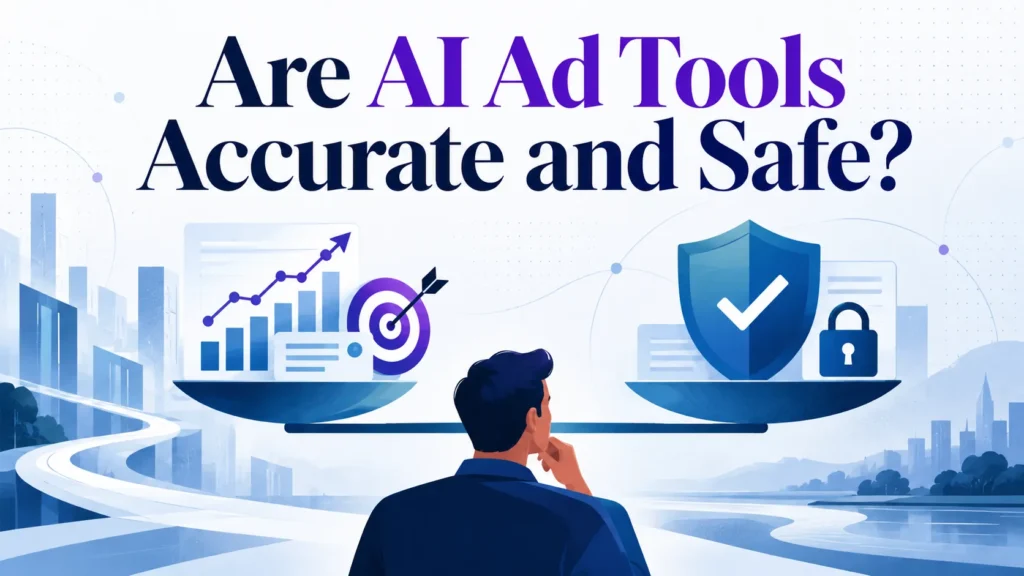
Are AI ad tools accurate and safe? For creative testing, often yes, but only against a named baseline. Safe only when disclosure, human review and data governance are in place, and the brand’s content strategy stays under human control on every platform. AI-generated ads and video creation tools can help teams produce variants faster, but each output still needs the same scrutiny as any other copy.
Written for US marketing teams, small-business owners and agency leads. Treat every headline claim as untested until a live comparison confirms it. Automatically generated claims, email subject lines and video scripts need the same scrutiny as any other copy.
AI ad tools can beat human designs on click-through rate. One test recorded 0.98% for the AI portfolio against 0.65% for a professional designer. Check the vendor’s baseline.
Accuracy is campaign-specific. Run your own split test before scaling.
Disclose upfront. Trust fell from 77% to 65% when consumers learned of AI use afterward.
Require human sign-off on accuracy, bias and brand fit.
Ask vendors about training data, retention and cost.
Table of Contents
How AI Ad Generation Works
Performance Accuracy: Do AI Ads Beat Human Designs?
Consumer Trust and Disclosure
Privacy and Data Governance
Cost of an AI Ad Tool
Accuracy, Privacy and Cost Checklist
Conclusion
Frequently Asked Questions
How AI Ad Generation Works
AI advertising tools cycle through generating creative variants, serving them to audiences, measuring results and feeding winners into the next round. Accuracy depends on how many clean tests run and how well the system reads performance data, so brand teams should check the results carefully.
Vendor headlines often skip the baseline. Plainly claims up to 14x more conversions than manual ad creation. Ask what the manual control was and whether the test was free from confounding factors.
Creative Generators Versus Campaign Optimizers
Tool category
Typical use
What it measures
Creative generators
Producing image and copy variants
Click-through rate on variants
Video ad builders
Turning scripts or assets into videos
Watch time and click-through rate
Campaign-management platforms
Allocating budget and audiences
Cost per result and conversions
Checklist for matching a category to your goal:
If creative volume is the bottleneck, buy a generator.
If spend efficiency is the bottleneck, buy an optimizer.
Confirm the tool reports the metric you will use, and that you can access the data through a free trial before committing.
Accuracy problems hide in the optimization loop. Many tools use bandit allocation, which automatically shifts budget toward the variant that looks best so far. Variant A gets 4 clicks from 200 impressions (2.0%) and variant B gets 2 (1.0%). Budget shifts to A before B has enough data to show whether its lead was chance. Check the impression count per variant.
Performance Accuracy: Do AI Ads Beat Human Designs?
A vendor’s accuracy claim cannot be verified unless it names its baseline. A percentage lift means little without knowing what it was measured against.
In the most cited controlled comparison, an AI portfolio recorded a mean click-through rate of 0.98%, against 0.65% for a professional human designer. The AI system beat the human designer’s batch in 99.59% of samples, according to the study reported here. Against the company’s own contemporary human work, the gap narrowed to 3.38% versus 3.24%. This is a vendor-reported result, so the baseline and sample should be checked before it is used as proof.
The gain came from the optimization loop, not generation alone, and it shrank against a strong in-house team. Click-through rate is only part of the picture: Nielsen attributes 47% of sales to the ad creative, so a click-rate win does not prove a sales win.
How to Test an AI Ad Tool Yourself
Change one variable only, such as the headline or the image.
Hold budget, audience and placement constant across variants.
Define one primary metric before launch, and help your team agree on it before any product spend begins.
Run until the result reaches statistical significance, typically 95% confidence with 80% power. Do not stop early.
Sample size matters more than most teams expect. Comparing two click-through rates near 1% can need tens of thousands of impressions per variant, so calculate the sample size and fix the test length before launch.
Verifying a Vendor’s Accuracy Claim Against a Baseline
Named baseline. The vendor says which human or prior-campaign control was used.
Live test. The result comes from a live campaign, not a simulation.
Stated sample. Impressions, clicks and test length are reported for each variant.
Independent replication. You can reproduce the result on your own account, including through a free trial.
If a vendor cannot meet the first three criteria, treat the claim as marketing.
Consumer Trust, Disclosure and the Cost of Hidden AI
Audiences are growing less comfortable with AI in advertising. A 2023 survey found nearly 60% of consumers were comfortable with brands using AI in ads, a figure that dropped to 46% by 2024, with skepticism rising particularly among older groups.
Disclosure matters most. In the same research, 90% of respondents said disclosing AI use is important. Trust in advertisers fell from 77% when AI use was disclosed upfront to 65% when consumers learned of it afterward. Research cited by BCG found 69% of consumers feel manipulated when brands use AI for advertising without disclosing it.
Unlabelled AI-generated ads can erode trust in the marketing as a whole, even when click-through rates are strong.
Bias in AI Ad Delivery
Ad delivery systems can skew who sees an ad. Facebook has been criticized for biased ad delivery since 2016, according to Hootsuite. Check delivery reports by audience segment, not only the overall average.
Myths Versus Realities
Myth: AI ads always beat human ads. Reality: the lift depends on the baseline and optimization loop.
Myth: a neutral model means neutral delivery. Reality: delivery can skew audiences even when creative looks fair.
Strategies for Balancing Performance and Trust
Choose a disclosure level before launch, not after a complaint. Make human review a standing step, with a named reviewer checking every AI variant for accuracy, bias and brand fit. Confirm disclosure requirements with counsel.
Privacy and Data Governance: A Procurement Question
Privacy belongs in procurement, not just compliance, and it matters more as teams adopt AI tools to create campaigns. A 2025 StackAdapt and Ascend2 study found 32% of agencies cited data privacy and compliance as their biggest AI advertising concern.
Before you sign, ask the vendor:
Does our campaign data train your models, and can we opt out?
How long do you retain our data, and where is it stored?
Who reviews outputs for accuracy and bias before publication?
Cost: The Real Price of an AI Ad Tool
The subscription is the smallest cost. Add review time, any correction or complaint costs, and the cost of the staff who manage the tool. Plans start around $29 to $149 per month; confirm current rates with each provider.
Worked model:
Monthly subscription: a flat fee, as listed on the provider’s current pricing page
Review cost: the hours spent on review, multiplied by the professional’s hourly rate, as set out in the engagement terms
Correction or complaint allowance: a budgeted amount held aside for corrections or complaints
Total: the sum of the subscription, the review cost and the allowance for the month
Compare the total with the expected gain from your marketing and social media content, not the subscription alone.
Scoring Any Tool: The Accuracy, Privacy and Cost Checklist
Score each row pass, conditional or fail before you buy. Teams using AI for email, social, blog and video content should score each tool the same way before it touches client work, and be clear about what a person must approve.
Column
Question to answer
Pass
Conditional
Fail
Accuracy
Do claims come from live tests against a named human baseline?
Live test, named baseline, stated sample
Named baseline, no live test
No baseline or vendor headline only
Privacy
What data is shared, does it train models, and who reviews outputs?
Training opt-out, retention stated, human review
Training opt-out only on request
Data trains models by default, no review
Cost
What do subscription, review hours and correction risk total?
Full cost modeled, review budgeted
Subscription only, review informal
No cost model, no review step
Pause on any data-handling fail or any untested performance claim.
Conclusion
AI ad tools can beat human creative on click-through rate, but only under test conditions you set and verify. Accuracy, privacy and cost depend on decisions you control: baseline, disclosure, human sign-off and vendor data use.
Before buying, use the Accuracy, Privacy and Cost Checklist, then run one controlled test on a single campaign against a named human baseline.
Frequently Asked Questions
Are AI ad tools accurate?
Accuracy depends on the metric and the test. In one vendor-reported comparison, an AI-generated portfolio recorded a mean click-through rate of 0.98%, against 0.65% for a professional human designer (vendor-reported case data). That is the vendor’s own result.
Test any tool on your own campaigns. If the winning ad beats your current best by a small margin or the test is short, the result is not reliable.
Are AI-generated ads safe for user data?
Safety depends on the vendor’s data-handling terms, retention policies and access controls. Check whether your campaign data trains the vendor’s models, how long data is kept, and who at the vendor can access it.
Agencies rank data privacy and compliance as their top concern, per a 2025 StackAdapt and Ascend2 study, in which 32% named it their biggest worry.
Do consumers trust brands that use AI in ads?
Trust falls when AI use is hidden, and disclosure reduces that penalty. In research cited by BCG, trust in the advertiser dropped from 77% among people told upfront to 65% among those who learned afterward.
How much do AI ad tools cost?
One vendor, Plainly, lists startup plans from $29 to $149 per month. Prices change and enterprise pricing differs, so confirm current rates with each provider.
Should I disclose AI use in my ads?
Yes. In the same research, 90% of respondents said disclosing AI use is important, and 88% considered human review important. Disclose upfront where AI shaped the creative and keep a human reviewer in the approval step.
About the author
Tom Koh
Tom is the CEO of MediaOne, a leading digital marketing agency. He is a business-experienced SEO consultant as well as a Google Gold Search Expert serving the international community. He has consulted for MNCs like Canon, Maybank, Capitaland, SingTel, ST Engineering, WWF, Cambridge University, as well as Government organisations like Enterprise Singapore, Ministry of Law, National Galleries, NTUC, e2i, SingHealth. His articles are published and referenced in CNA, Straits Times, MoneyFM, Financial Times, Yahoo! Finance, Hubspot, Zendesk, CIO Advisor. Under his stewardship, MediaOne has won dozens of prestigious digital marketing awards.
Your website has 150 published articles. Some attract consistent organic traffic, others haven’t generated a meaningful visit in months, and several cover nearly identical…
Writing a good advertisement sounds simple until you have to create 15 different headlines, stay within character limits, communicate your product’s benefits, and make…
Verifiability matters more than speed when publishing AI-generated content. An AI content generator turns a short brief into draft copy, and its usefulness depends…