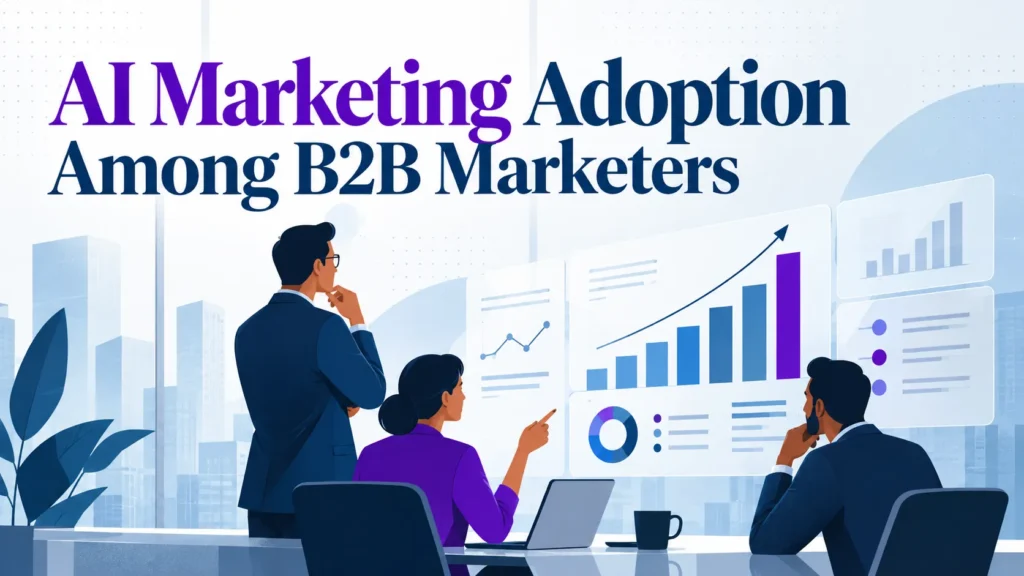
Most B2B marketing teams now use AI in some form, but the harder question is whether they use it where their buyers have already moved.
That gap, between adoption headlines and how buyers actually research vendors, is the subject of this roundup. Most of the figures ranking for “AI marketing adoption statistics B2B” answer one narrow question: how many marketers use AI. This roundup asks a different one, and it treats the adoption data as evidence of a change in buyer behavior, then shows how each business can test whether that change affects its own pipeline.
Figures are cited to their sources. Several come from cross-sector or global surveys rather than US-only research, so check them against your own market before you budget around them. Track how each figure applies to your own website and customer journey, since adoption rates alone say little about user experience.
Buyers are moving first. B2B buyers adopt AI search 3x faster than consumers, according to a LinkedIn analysis.
Budgets are following buyers. Most decision-makers plan to raise AI search spend within 12 months, per the same analysis.
Adoption is not maturity. Only 1% of generative AI adopters believe their investments have reached maturity.
Training is the bottleneck. The workforce is experimenting, but few have had formal training.
Measure value, not usage. Sales-team data links AI use to revenue growth, but test that against your own pipeline.
Score your readiness. Use the AI Marketing Readiness Scorecard, defined below, to decide whether you are experimenting, scaling or lagging.
Table of Contents
Share of marketing teams using AI, and how fast that share has grown
Daily use versus occasional experimentation
Generative AI adoption in B2B marketing and planned investment
How B2B Buyers Are Using AI Search, and Why It Changes Your Strategy
ROI, Budgets and the Maturity Gap
Skills, Training and What Comes Next for AI Marketing
Conclusion: Turning the Data Into a Practical AI Marketing Plan
Frequently Asked Questions
Share of marketing teams using AI, and how fast that share has grown
Adoption has moved from a minority practice to near-universal use in a few years. One widely cited figure puts the share of marketing teams using AI at 91%, up from 63% in 2025, according to Supermetrics. That measures any use at all, not depth of use, so treat it as a directional signal for business leaders and B2B marketing teams weighing their own marketing statistics and impact across their website and companies’ customer touchpoints.
Daily use versus occasional experimentation
Breadth overstates maturity. Daily use is now common, yet the same picture of heavy use sits beside weak returns. A Digital Marketing Institute survey found that 43% of marketers have not fully embraced AI tools because they struggle to get value from them. Wink & Win reports that nearly 88% of marketers use AI daily, but only 26% have worked out how to generate value from it.
These two figures seem to conflict, and that tension is the most useful finding here. Most teams use AI routinely, yet a much smaller share can point to results. The likely explanation is that usage is spread across tasks while value depends on a few well-chosen workflows with a clear owner and a measured outcome, which is where AI’s real impact on a business tends to appear. Adoption is wide, but value is narrow, and most businesses have not yet found the workflows that pay. A written policy on which workflows count as value, and who checks them, is a practical first step for any user team.
Generative AI adoption in B2B marketing and planned investment
Investment intent is broader still. Across sectors, 92% of businesses plan to invest in generative AI tools within three years, per the Digital Marketing Institute. These figures are cross-sector rather than US B2B specific, so check them against your own market before using them in a budget case.
How B2B Buyers Are Using AI Search, and Why It Changes Your Strategy
Buyer behavior is the part of the AI adoption story that should change your plans most. Marketers are experimenting with AI tools, but buyers have already started using AI to research vendors. According to the LinkedIn analysis, B2B buyers adopt AI search three times faster than consumers. Nearly 8 in 10 say AI search has changed how they research vendors, and 29% start their research with AI tools more often than with Google. These figures come from one source and have not been checked against US-only samples, so treat them as directional and test them against your own pipeline. Forrester-style buyer research points the same way, but this figure comes from a single source and should be verified before use in a B2B marketing plan. Every customer who begins research in an AI tool meets your category through that tool’s summary, so the answer they receive shapes whether they ever reach your site.
The share of buyers who meet AI-generated answers during research
The same source reports that 72% of buyers encounter AI-generated responses during research. A buyer may form a shortlist from an AI summary before reaching your website. Your category is being described to buyers whether or not you have written about it.
Marketing strategy implications of AI search, including the traffic outlook for traditional search
The same analysis projects that traditional search engine volume will fall 25% by 2026. That is a forecast, not a measured result, so plan around it rather than treat it as settled. The practical question is whether your brand appears in AI-generated answers, not only in ranked results. Treat AI search optimization as a change to your go-to-market model, with its own owner and measurement, rather than a line item added to existing SEO spend. Teams that run B2B marketing programs should give this shift a named owner, since it affects how the industry reaches buyers.
Digital marketers’ AI tool usage across processes
AI has moved from a side experiment to routine marketing work. According to Supermetrics, 91% of marketing teams now use AI to assist their work, up from 63% in 2025, and 88% of marketers use AI tools daily. These figures show how deeply AI sits inside everyday workflows, not how much it has improved results.
AI in content creation and SEO statistics
Content and search are where most of this usage concentrates, and where the buyer-side shift matters most. The LinkedIn analysis reports that 72% of B2B buyers encounter AI-generated responses during research, and that traditional search volume is expected to drop 25% by 2026. If buyers get answers inside AI tools, a page that ranks but is never cited may lose the visit entirely. Content teams should measure citation presence in AI answers alongside traditional rankings. Check whether AI answers name your brand, cite your pages and describe your category accurately, and record the result each month.
Search teams should also track how AI summaries shape the shortlist: which vendors appear, which sources are cited, and whether your user experience on the site holds up once a buyer arrives. Treat each search stat as a direction to test on your own website and analytics, not a fixed benchmark.
Sales and lead generation results from AI-guided selling
Sales is where the revenue case is clearest, though the evidence is vendor-influenced. Scout’s 2026 sales statistics roundup reports that 75% of B2B sales organizations will augment traditional playbooks with AI-guided selling by the end of 2026, and that companies using AI for lead generation see a 50% increase in qualified leads per month. Only 37% of sales organizations have fully implemented AI across their sales process. Treat these as directional figures and test them against your own pipeline. Sales teams in most industries can use the same test, since the services they sell should be checked against real pipeline data.
ROI, Budgets and the Maturity Gap
AI marketing ROI and performance statistics
Adoption numbers say little about payoff, and the payoff evidence is uneven. Scout reports that 83% of sales teams with AI saw revenue growth in 2025, against 66% of teams without AI. This is vendor-reported correlation, not proof that AI caused the growth. Teams that already perform well may be more likely to buy tools. The same source reports a 50% lift in qualified leads a month for companies using AI for lead generation, a figure worth testing against your own pipeline rather than copying.
The sharpest signal is maturity. The Digital Marketing Institute reports that only 1% of businesses already using generative AI believe their investments have matured. Most spend is still unproven.
Budget and spending intentions for the next 12 months
Budget intent is moving faster than results. According to LinkedIn data shared by Ion Alexandru Secara, 83% of B2B marketing decision-makers plan to increase investment in AI search optimization over the next 12 months. Treat that as a signal of direction, not a benchmark for your own budget.
Why most adopters have not reached maturity, and what to do about it
The maturity gap looks like a measurement and skills problem more than a tooling one. Before approving new AI spend, ask three questions: which pipeline metric will move, who owns the baseline, and what result would make us stop. If you cannot answer them, you are funding experimentation, not a go-to-market change.
Skills, Training and What Comes Next for AI Marketing
AI marketing skills and training gaps
Capability is the weakest link in most B2B teams. According to the Digital Marketing Institute, 70% of marketing professionals say their employer does not provide AI training. The result shows up in behavior: 39% avoid generative AI tools because they do not know how to use them safely. Teams that skip training do not reach maturity. They simply stop experimenting.
AI marketing predictions for 2026 and beyond
Market size forecasts are bullish, but they say little about your own pipeline. The more useful signal is buyer behavior. LinkedIn data on B2B buyers projects that traditional search volume will fall 25% by 2026. This is a vendor-reported observation, not an audited forecast. Plan for a shift in where buyers start their research, not just a larger AI budget.
A practical checklist for turning these AI marketing adoption statistics B2B into a 2026 plan
Score your team on the five readiness dimensions: buyer exposure, search footprint, investment intent, capability and value realization, each from 0 to 2.
Ask sales which AI-generated answers prospects quote back to them.
Confirm a funded training plan covering safe, approved tool use.
Set one measurable value target per AI workflow before buying more tools.
Re-run the scorecard every quarter against your own pipeline data, not only industry averages.
Conclusion: Turning the Data Into a Practical AI Marketing Plan
The statistics in this roundup point in one direction. Adoption is near universal, with 91% of marketing teams now using AI in some form. Yet only 1% of businesses that have adopted generative AI believe their investments have matured. The gap between using AI and gaining value from it is the problem to solve in 2026.
Start by scoring your own function on the AI Marketing Readiness Scorecard. Rate buyer exposure, search footprint, investment intent, capability and value realization from 0 to 2 each. A total under 4 means you are experimenting, 5 to 7 means you are scaling, and 8 to 10 means you are ahead of most peers.
Then treat AI search as a change to your go-to-market model, not a line item. B2B buyers are adopting AI search three times faster than consumers, according to vendor-reported LinkedIn data, and 83% of B2B decision-makers plan to increase AI search investment within 12 months. A plan that does not say how your brand appears in AI-generated answers is missing the channel your buyers already use. Your B2B marketing content should be written so AI systems can cite it, and your website should give buyers clear, quotable answers. Professional services organizations in particular should check how their expertise appears in AI-generated answers.
Finally, test every figure against your own pipeline. Much of this data is global or cross-sector rather than US-specific, so ask whether your customers and buyers behave the same way. Check each marketing statistics claim against your own pipeline before committing budget.
Frequently Asked Questions
What percentage of B2B marketers use AI?
Adoption is now close to universal among marketing teams. According to The Stacc’s review of the state of AI in marketing, 91% of marketing teams use AI to assist with their work, and 88% use AI tools daily. These are cross-sector marketing figures rather than US-only B2B numbers, so check them against your own market before using them in a budget case.
How much faster are B2B buyers adopting AI search than consumers?
B2B buyers are adopting AI search about three times faster than consumers, according to Ion Alexandru Secara’s LinkedIn analysis. He reports that nearly 8 in 10 B2B buyers say AI search has changed how they research vendors, and 29% start research with AI tools more often than Google. Treat these as vendor-reported observations.
Why do so many marketers fail to get value from AI tools?
The gap is mostly about maturity and skills, not access to tools. Per Digital Marketing Institute, only 1% of businesses that have adopted generative AI believe their investments have reached maturity, and 39% avoid generative tools because they do not know how to use them safely. Training is the usual missing piece: 70% of marketing professionals say their employer provides no AI training.
Is AI marketing spending expected to increase?
Yes. According to Ion Alexandru Secara, 83% of B2B marketing decision-makers plan to increase investment in AI search optimization over the next 12 months. Across sectors, the Digital Marketing Institute reports that 92% of businesses plan to invest in generative AI tools within three years. Treat these as intent figures, not forecasts of return.
What skills do B2B marketers need to use AI effectively?
Teams need safe-use guidance, prompt and workflow skills, and the ability to measure results. Start with a short internal policy on data handling and output checks, then train staff on the workflows they run every week, such as content drafts, SEO research and lead qualification. Track one measurable outcome per workflow so you can tell whether the skill is producing value.
About the author
Tom Koh
Tom is the CEO of MediaOne, a leading digital marketing agency. He is a business-experienced SEO consultant as well as a Google Gold Search Expert serving the international community. He has consulted for MNCs like Canon, Maybank, Capitaland, SingTel, ST Engineering, WWF, Cambridge University, as well as Government organisations like Enterprise Singapore, Ministry of Law, National Galleries, NTUC, e2i, SingHealth. His articles are published and referenced in CNA, Straits Times, MoneyFM, Financial Times, Yahoo! Finance, Hubspot, Zendesk, CIO Advisor. Under his stewardship, MediaOne has won dozens of prestigious digital marketing awards.
Your website has 150 published articles. Some attract consistent organic traffic, others haven’t generated a meaningful visit in months, and several cover nearly identical…
Writing a good advertisement sounds simple until you have to create 15 different headlines, stay within character limits, communicate your product’s benefits, and make…
Verifiability matters more than speed when publishing AI-generated content. An AI content generator turns a short brief into draft copy, and its usefulness depends…