SEO Audit
Free White Label SEO Audit Tool: What Agencies Actually Get
You’ve found a potential SEO client, reviewed their website, and identified several problems worth fixing. Now you need a professional audit report that explains…

Teams often ask how often they should run an SEO audit and expect one answer, such as “every quarter.” A fixed calendar says when to look, not what is at risk. A small blog and a 50,000-product store should not run the same cycle, and a site that loses half its organic traffic overnight needs an immediate diagnosis.
The better question is what an audit should find. An SEO audit diagnoses why a website does or does not earn organic visibility, covering crawlability, indexing, on-page signals, content quality, backlinks and user experience. A content audit examines whether each page still serves its target keyword and reader intent.
The stakes are high. According to FirstPageSage, the top three organic Google results capture 68.7% of all clicks on search engine results pages. Losing a top-three position is a revenue event, so your audit frequency should follow your exposure to search traffic, and the riskier your site, the more often you should check for issues.
This guide offers a decision framework, the Audit Cadence Matrix, rather than a universal calendar. For tool selection, see our seo tools guide, and for what a tool report can and cannot tell you, see our seo audit tool overview.
Most teams run one of three cadences, each doing a different job.
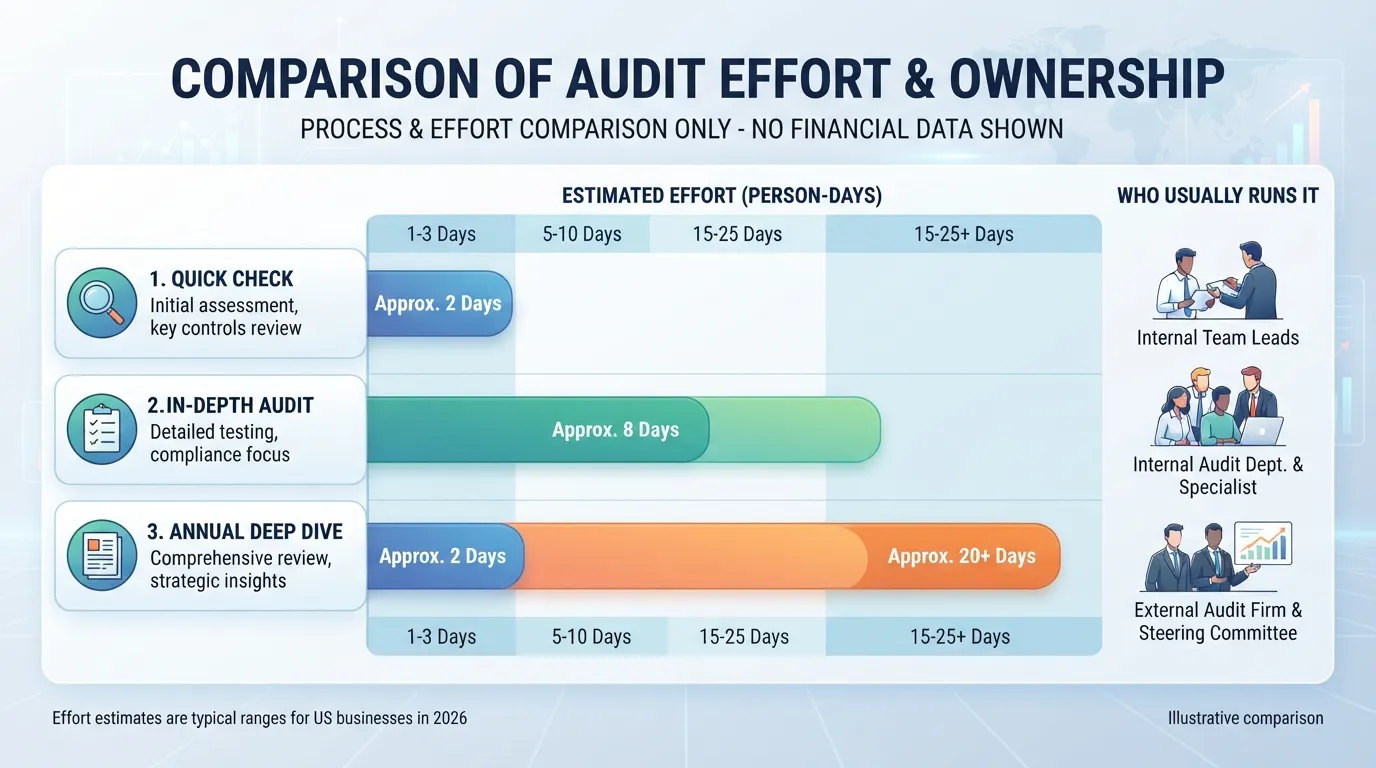
A quick check scans known numbers: keyword rankings, indexed pages, crawl errors and traffic. It shows whether something has moved, not why. A light monthly review of key pages helps spot challengers climbing from page two, as Portent notes.
Escalate to a full audit when organic clicks fall 20% or more across priority pages and the drop persists for two consecutive checks. A single noisy week is not enough.
A deep audit diagnoses crawlability, on-page structure, internal linking, backlinks and content performance, ending in a prioritized fix list. Run it quarterly if you change templates often, and twice a year if your site is stable. A full content audit fits well into this cycle, since it surfaces the issues that have accumulated over several months.
An annual review re-examines architecture, competitors and strategy, including which keywords still match what buyers search for. For many sites this is the ceiling, not the floor, because most damage comes from changes nobody noticed in between.
| Cadence | Scope | Typical effort | Who should run it |
|---|---|---|---|
| Quick check | Rankings, indexing, traffic, crawl errors | 1 to 2 hours | Marketing owner or in-house SEO |
| In-depth audit | Technical, on-page, links, content | 1 to 3 days | Experienced SEO, in-house or agency |
| Annual deep dive | Full site, competitors, strategy | Several days or more | Senior SEO or external specialist |
Not every ranking drop calls for a full audit, but some do. The clearest trigger is a sudden loss of organic traffic, especially a drop of 50% or more, often caused by toxic backlinks, content structure problems or technical gaps. Waiting for the next scheduled review costs real money, so start diagnosing the same day. Search engines may be excluding or devaluing affected pages, so a sharp drop in keyword rankings calls for a content audit or SEO audit without delay.
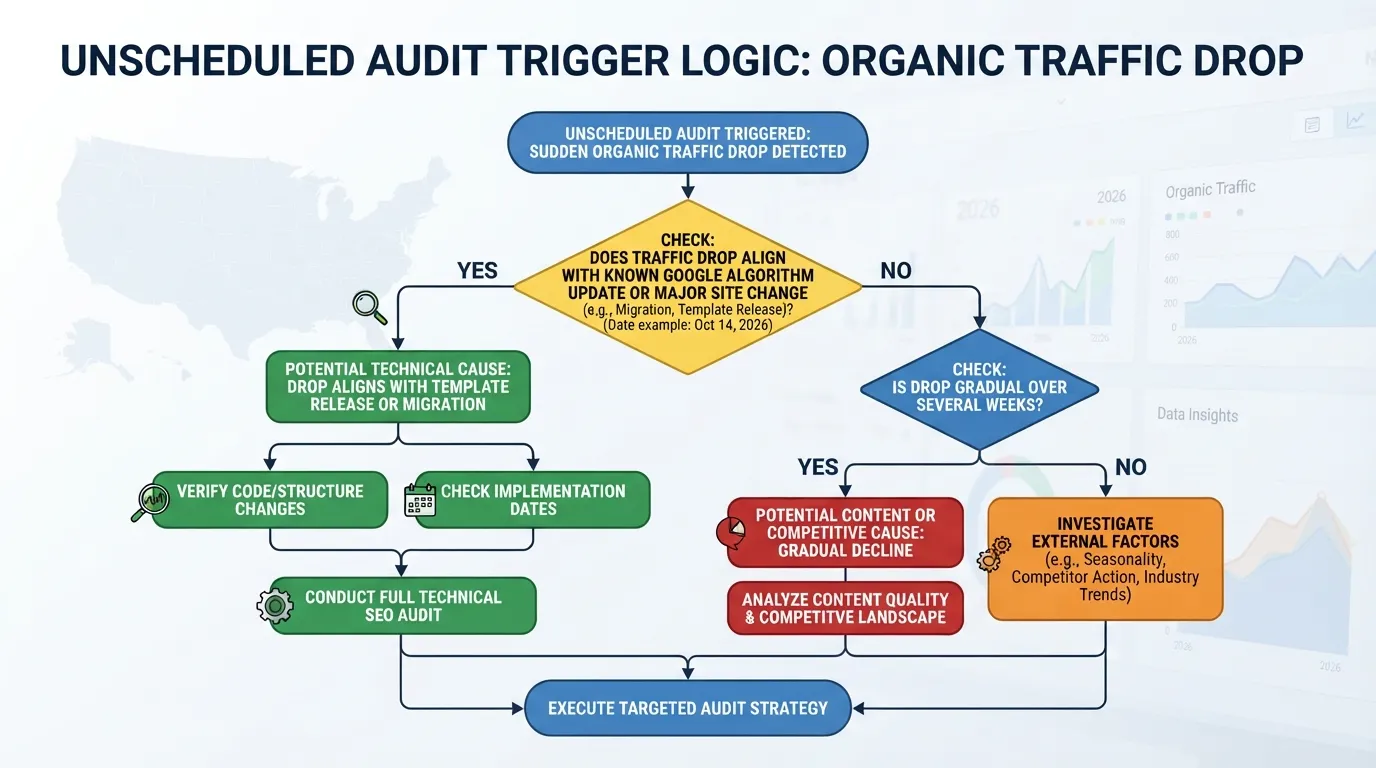
Start with timing. A drop that begins on the day of a template release points toward a technical cause, while a slow decline over several weeks usually points toward content quality or competitive pressure. Check Search Console’s coverage report for a sudden fall in indexed pages or a rise in excluded pages, then compare the drop date against your release log. Tracking performance by page over the same window shows which URLs account for the decline.
Any change to URLs, templates, navigation or hosting should trigger an audit before and after launch. Migrations often break redirects, canonical tags (the page-level signal naming the preferred version of a page) and internal links. Check site speed and crawl errors on launch day, since these issues often surface within the first few weeks.
Major updates can reshuffle results for weeks, or even months. Track your top keywords daily, wait for the update to settle, then run a diagnostic audit focused on the pages that moved, not the whole site.
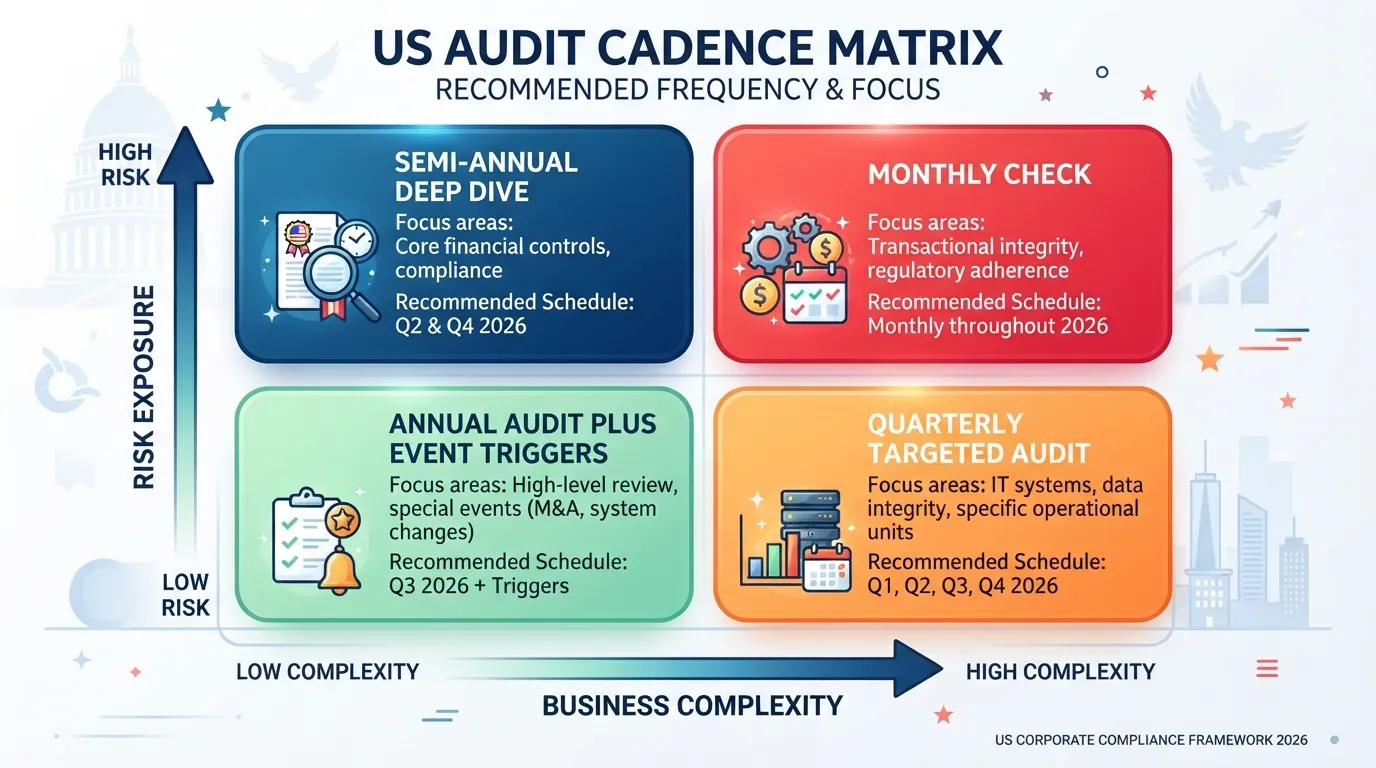
Start with a default: a quarterly in-depth audit with monthly checks in between. Most sites with regular template or content changes fit that cycle, then adjust once you have scored your site. Time spent on a regular content audit pays off faster than most fixes.
Score your site on two axes:
Place the site in one of four cells:
By site type, brochure and small service sites usually run monthly checks with a quarterly targeted audit. Stores and large catalogs run monthly checks with a quarterly deep audit and event triggers. Publishers run monthly checks and quarterly content reviews to flag thin pages and outdated keyword targeting. Slow pages and weak technical SEO also show up quickly in these reviews, so check site speed alongside them.
The matrix does not fit every case. Sites under active migration, or recovering from a penalty, should follow their project plan.
Service sites depend on local visibility, so a monthly review of your Google Business Profile and local rankings matters more than a deep technical review. Local listings also drive traffic from social media and search engines alike. US e-commerce and lead-generation businesses should run a pre-season audit before Black Friday, back-to-school or tax season, since template and inventory changes often break internal links and indexation. Log issues at each checkpoint, and keep a record of past SEO audits to compare results over time.
In crowded niches, a regular content review defends pages sitting just outside the top three, which together take a large share of organic clicks, according to FirstPageSage.
Separate a check from an audit. A check is a fast scan of metrics you already track, such as rankings, indexing and crawl errors. An audit is a diagnosis: you look for the cause of a change. A report full of numbers with no interpretation is an export, not an audit.
Check this at every level. Confirm that key pages are indexable, that robots rules have not blocked anything important, that sitemaps are current, and that Core Web Vitals (Google’s measures of loading speed, responsiveness and visual stability) have not slipped. The robots.txt documentation explains crawl rules, and the Core Web Vitals guidance explains the metrics. Use Google Search Console for crawl and index data. Speed problems often surface here first, so a monthly glance at the performance report catches them early.
Review titles, meta descriptions, headings and internal links on priority pages. Look for pages that have lost their target keyword, that compete with each other for the same query (keyword cannibalization), or that have drifted off-topic.
Monitor new and lost referring domains. Sudden spikes of low-quality links can signal spam or a negative SEO attempt. Deep backlink reviews belong in the annual cycle.
Check which pages earn impressions but few clicks, and which pages hold visitors. Regular content audits help defend ranking pages against challengers on page two, as Portent notes.
Run competitor reviews quarterly if your niche moves fast. For local businesses, check your Google Business Profile and local pack position monthly.
Technical SEO audits typically cost between £500 and £10,000, depending on site complexity, audit depth and provider expertise. Judge that spend against the organic revenue the site generates, and check that the findings translate into measurable search performance.
Recurring reporting has a hidden cost. If your retainer covers 20 to 40 hours a month, five hours of reporting consumes up to 25% of billable time. Before paying for frequent audits, check whether the report diagnoses causes or only exports data. A useful report surfaces the real issues affecting search visibility and points to the keywords and pages driving them, including how those pages perform across social media channels.
A monthly check costs little and catches problems early. Treat the frequency answer to how often should you run an seo audit as a starting point, and adjust it when a site’s risk profile changes over several months. A content audit can run alongside the technical review to help prioritize pages that underperform.
Place your website in one cell of the Audit Cadence Matrix, based on traffic volume and how often the site changes, not size alone. A high-traffic store with frequent promotions belongs in a different cell from a five-page brochure site. Matching your audit cadence to real performance data helps you avoid wasted effort, and a content audit can show which pages drive that traffic.
Map each cell to a cadence and a named owner. A light monthly check suits an in-house marketer, while deeper diagnosis needs someone who can read crawl logs. Ask any provider which issues their SEO audits will diagnose before you buy, and whether they cover keywords and off-page SEO.
Define events that override the calendar, such as a site migration, a major template release or a core algorithm update. As a starting point, treat a 25% or greater week-on-week fall in organic sessions, sustained over two weeks, as a trigger for an immediate audit. Review the calendar every six months, since a growing site may need to move cells and the data you collect will show when that happens. Track how your site performs in each search engine you target, not only in Google.
Use the Audit Cadence Matrix to place your site by risk exposure and complexity, then run the checks for your cell. A stable brochure site can run a light monthly check and an annual deep dive. A large store launching products weekly needs more frequent audits, plus event-triggered reviews. Schedules that burn hours without finding issues waste money.
For most small businesses, a light monthly check and one full audit a year is enough. The monthly check covers rankings, broken links, indexing errors and Google Business Profile accuracy. Run a full audit sooner after a website change, a platform switch or an unexplained traffic drop.
Usually not on its own. E-commerce sites change templates, stock levels and promotions often. Check site health monthly, and again a week before a major campaign.
Costs range from a few thousand to tens of thousands, depending on scope. Technical audits sit between £500 and £10,000 in this article’s pricing guidance. Judge the price against the organic revenue the site generates, and confirm whether the fee covers prioritised fixes or only a report.
A quick check scans metrics you already track to spot changes. A full audit finds the cause of a problem and ranks fixes by impact. If organic sessions fall 25% or more week-on-week and stay down for two weeks, escalate to a full audit.
Not a full audit, but verify the update. Check that key pages return the right status codes, that titles and canonical tags (the tag naming a page’s preferred address) are intact, and that important pages remain indexed. Save full audits for larger changes such as a redesign or migration.
Yes, for a monthly check and a basic review. Google Search Console and a crawling tool will show indexing errors, broken links and slow pages. Bring in a specialist when losses are large or the cause is unclear. Our guide to seo tools and our seo audit tool overview can help you choose where to start.

Tom is the CEO of MediaOne, a leading digital marketing agency. He is a business-experienced SEO consultant as well as a Google Gold Search Expert serving the international community. He has consulted for MNCs like Canon, Maybank, Capitaland, SingTel, ST Engineering, WWF, Cambridge University, as well as Government organisations like Enterprise Singapore, Ministry of Law, National Galleries, NTUC, e2i, SingHealth. His articles are published and referenced in CNA, Straits Times, MoneyFM, Financial Times, Yahoo! Finance, Hubspot, Zendesk, CIO Advisor. Under his stewardship, MediaOne has won dozens of prestigious digital marketing awards.
Run a free Digimetrics audit across SEO, AI search, content and technical health, and get a plan you can act on today.
Start free →You’ve found a potential SEO client, reviewed their website, and identified several problems worth fixing. Now you need a professional audit report that explains…
Your website has hundreds of pages, organic traffic is declining, and you’re not sure what’s causing the problem. Is Google struggling to crawl important…
The best SEO software for a small business is not necessarily the product with the most features. It is the tool that tells you…