Knowing how to find guest post opportunities is only half the job. The other half is deciding which sites are worth pitching. Most guides stop at long lists of tech websites. This one starts with the vetting decision, so you pitch only publications your audience reads and that hold to real editorial standards.
Here is the sequence in short. Build a search string that targets contributor pages. Pull referring domains from competitor backlinks. Run each candidate through five gates. Pitch only the sites that pass. The rest of this guide explains each step, and the vetting decision sits at the centre of every one.
The method is a Five-Gate Vetting Matrix. You will learn how to build search strings, mine competitor backlinks, and judge each candidate against five gates before you send a single pitch.
Guest posting remains a strong link-building option. Digital PR is rated the most effective tactic, with guest posting close behind, according to recent link-building research.
A site must pass the first three gates (audience fit, editorial standards, restrained linking) before it is worth pitching.
Use the authority and contributor gates to set priority among the sites that pass.
Moz’s Spam Score bands run from 1% to 30% low, 31% to 60% medium and 61% to 100% high. Treat it as a risk indicator alongside other checks.
Send pitches from a branded, domain-matched address. Generic free addresses are often ignored.
A curated directory such as PlacesToGuestPost.com is a starting point, not a finished target list.
The Five-Gate Vetting Matrix
Every candidate, whatever its source, is tested against the same five gates. The first three are pass/fail: a site that fails any of them is dropped. The last two set priority among the sites that pass. Use this matrix when you find guest blogging opportunities, so that every website is judged on the same criteria.
Gate
Test
Pass threshold
Fail signal
1. Audience fit
Who reads the site?
Readers are your buyers, in your market, on the same topic
Global or unrelated readership, or a topic far from yours
2. Editorial standards
Does the site run a real editorial process?
Published guidelines, named editors, bylined articles with varied authors
Generic form only, identical author bios, thin or AI-generated posts
3. Outbound link count
How many outbound links does a typical article carry?
A few relevant links per article
Dense links to unrelated sites, or a stated ban on your link
4. Authority signals
How strong is the site’s reputation and profile?
Consistent traffic and a clear subject focus; Spam Score below 31%
Spam Score of 61% or more, or no visible traffic or subject focus
5. Contributor pattern
Does the site publish outside work repeatedly?
Several contributed articles over time, with a visible contact route
A single one-off placement with no contributor page
Gates 1 to 3 are the filter. Gates 4 and 5 rank what remains.
Scoring Rubric for Gates 4 and 5
Gates 1 to 3 are pass/fail. Gates 4 and 5 are scored, so you can rank the sites that pass. Score each gate from 0 to 5 and weight them as follows:
Gate
Weight
What a 5 looks like
4. Authority signals
60%
Steady traffic, a clear subject focus, Spam Score in the low band
5. Contributor pattern
Confirmed on enquiry
Many contributed articles over time and a named editor’s contact route
Multiply each score by its weight, then add the two results. A site scoring 4 on authority and 2 on contributor pattern gets (4 × 0.6) + (2 × 0.4) = 3.2 out of 5. Pitch the highest scorers first. The weights favour authority because a strong, relevant site is worth more than a frequent contributor on a weak one. Adjust them if your goal is repeat placements rather than single links.
Building Search Strings That Surface Real Guest Post Pages
Most people start with a single phrase such as “guest post” and get a page full of content mills and paid-placement sellers. Better results come from pairing a phrase editors use on their own pages with an operator that narrows the index. A well-built search string is one of the most practical tools for finding real guest blogging opportunities in link building, and it works best when the phrase matches how real tech blog editors label their own pages.
These patterns work well on Google:
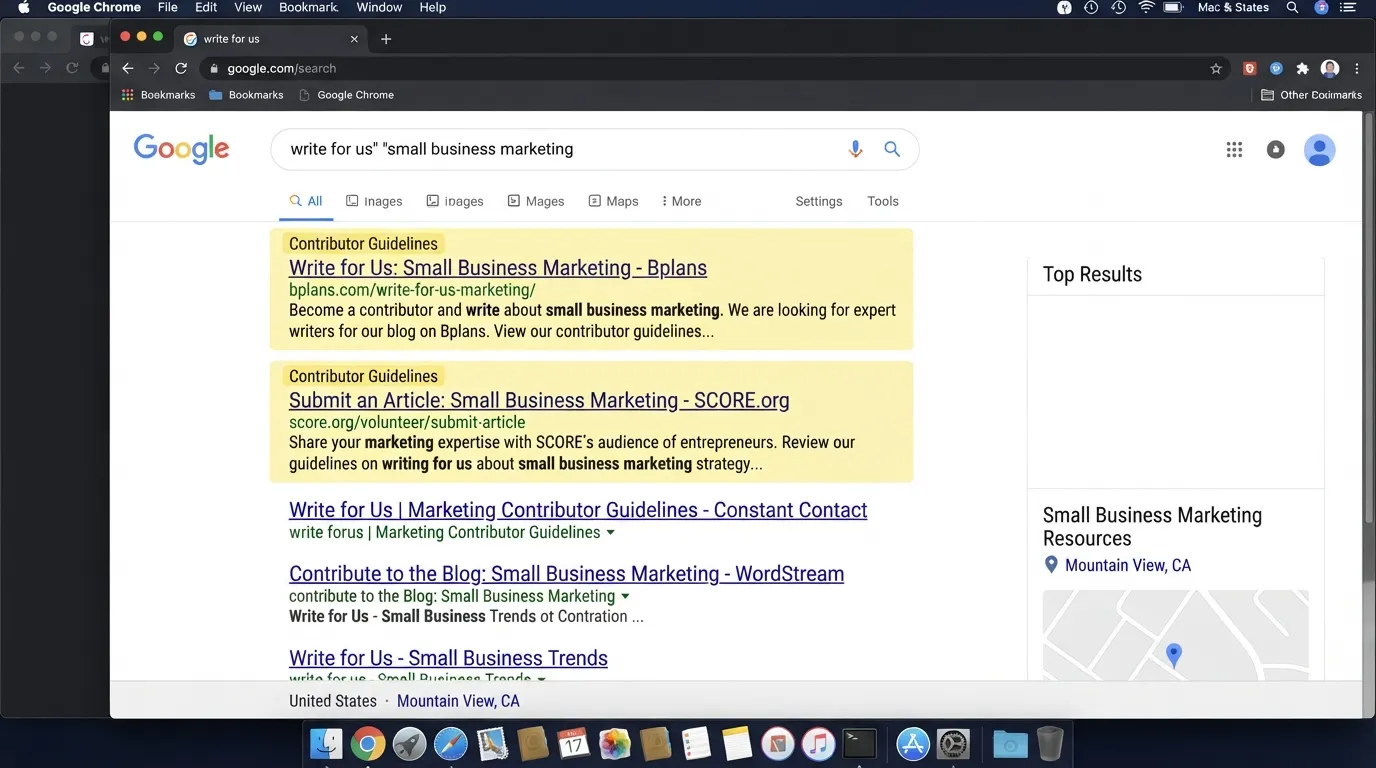
“write for us” + topic, for example “write for us” “digital marketing”. Editors often label contributor pages this way.
“guest post guidelines” + topic, which surfaces author instructions. A site that publishes guidelines is usually running a real editorial process.
“contribute” + topic + “submit”, useful for finding publications that describe a submission route.
inurl: operators such as inurl:write-for-us or inurl:guest-post, which match the URL structure many sites use. Google’s Search Central documentation describes how search operators behave. Operator behaviour can change, so check current behaviour there before relying on one.
Put the phrase in quotation marks so Google matches it exactly. Use the site: operator to test a single domain before you spend time on it. A site you expected to accept guest posts that shows no contributor page is a useful negative signal, and it helps you spot the best blogging opportunities in your industry worth your time. Strong authority sites in your niche often publish these pages openly, so a few well-targeted websites can be more valuable than a long list of weak ones.
Combining Operators with Niche Keywords
Generic strings return generic sites. Narrowing comes from pairing an operator with a specific topic, audience or location. Use the same website search approach each time so results stay comparable.
Build your strings in three layers:
Operator layer: “write for us”, “guest post guidelines” or inurl:contribute
Topic layer: the subject your business covers, such as “ecommerce analytics” or “small business accounting”
Audience layer: signals of who reads the site, such as “for US small business owners” or “for working professionals”
Audience fit is Gate 1, so the audience layer matters most. A query like “write for us” “small business marketing” “United States” will surface publications whose readers are closer to your buyers than a global list will.
Run the same string several times with different topic words. Each variation reaches a different set of pages. Keep the domains that appear more than once across queries, since repeat appearances suggest a site with a sustained contributor program.
Filtering Out Link Farms and Content Mills in Your Results
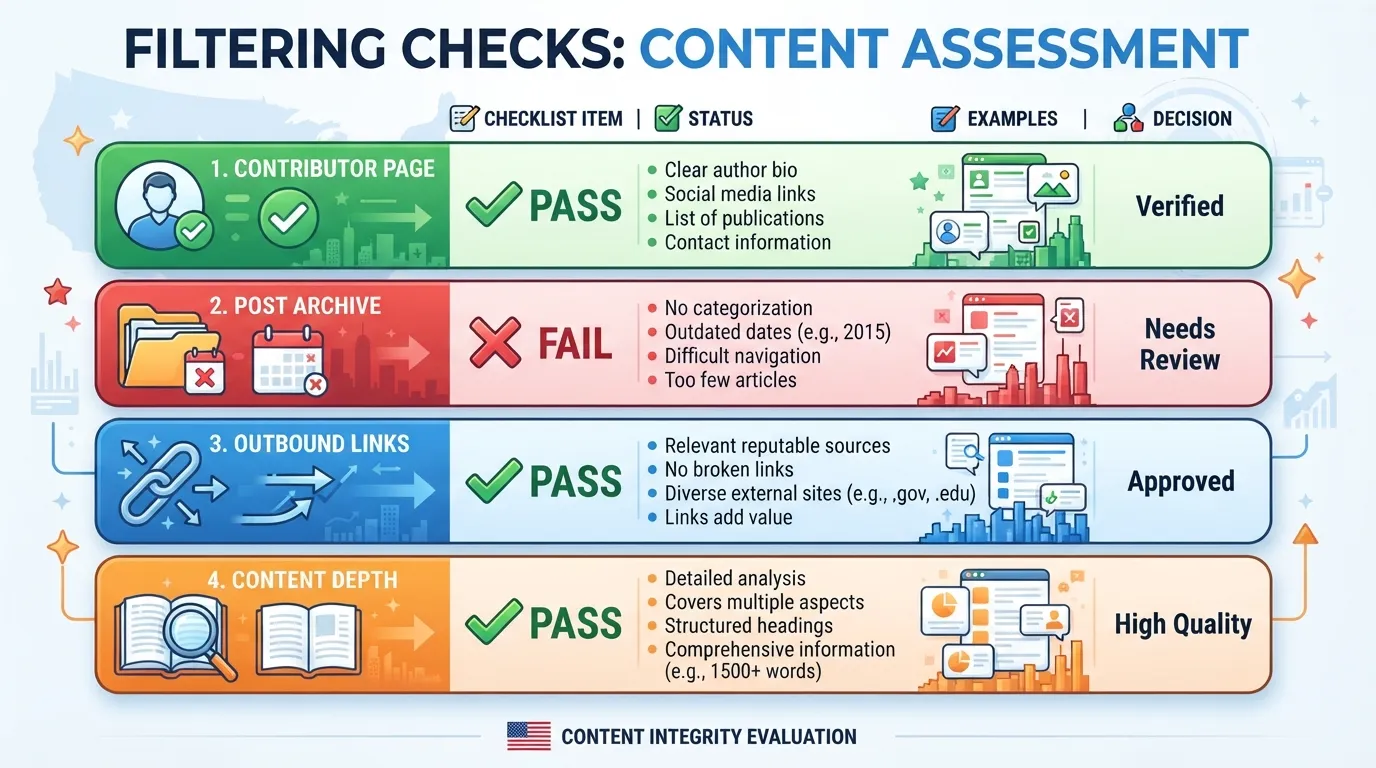
Raw results include many sites you should never pitch. Check each one against the first two gates before you open a contact form:
Check
Pass
Fail
Contributor page
Real guidelines, named editor
Generic form, no guidelines
Post archive
Bylines, varied authors
Identical author bios across topics
Outbound links
A few relevant links per article
Dense links to unrelated sites
Content depth
Articles with original analysis
Thin, spun or AI-generated pages
Content mills often reuse one author profile across hundreds of unrelated subjects, a pattern marketing teams should flag early in any guest blog search. Link farms, which are networks of sites that exist mainly to pass links, tend to show many outbound links per post and sell “sponsored” placements without disclosure. Some tech and industry websites show these traits too, so the same scrutiny applies to every candidate. These are indicators, not proof. A site can show one of them and still be a legitimate publisher, so look at the pattern across several checks. If a site fails any two of these checks, drop it. This step separates a usable prospect list from a spreadsheet of noise, and it keeps your best guest posting opportunities in view.
Mining Competitor Backlinks for Guest Post Targets
Your competitors have already done part of the sourcing work. A site that links to a competitor has shown it will publish outside links, which makes it a better starting point than a generic keyword search. A link is only a signal, though, not a green light. Every prospect still has to pass the five gates.
Identifying the Sites That Already Link to Your Competitors
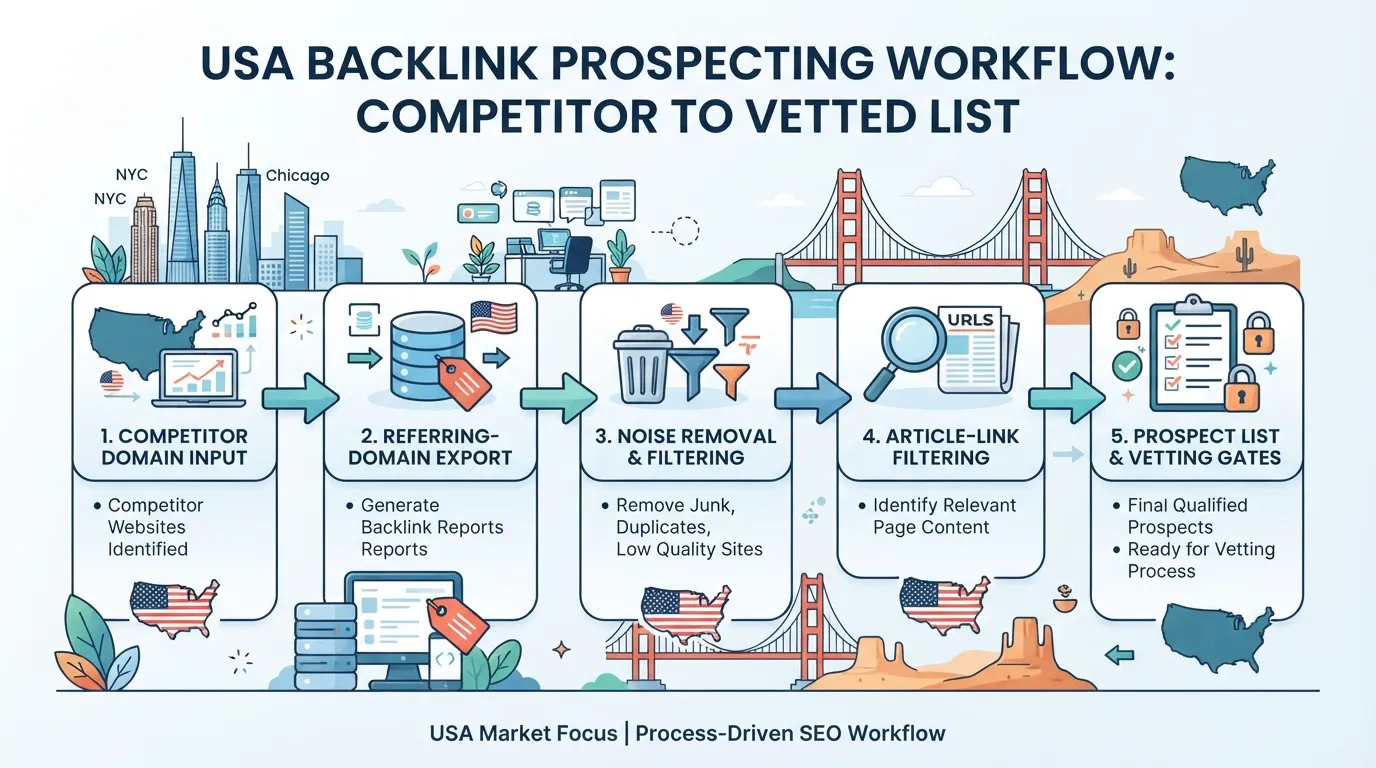
Pick three to five competitors that rank for the terms you care about. Run each domain through a backlink tool and export the referring domains. Then remove the obvious noise: social profiles, directories, and sites that link to a competitor only through a product listing or a press mention.
What remains is the useful list. Look for referring pages that are articles, not sitewide footers or sidebars, because an article link means an editor chose to include a resource. A single contributed article that links to a competitor is worth more attention than twenty directory listings. Industry blogs that publish contributed pieces are often the strongest leads on this list, including many digital publications that accept outside contributors in the tech space.
Spotting Sites That Accept Contributed Content
A site that links to a competitor is not automatically open to guest posts. Check for these signals:
A “write for us”, “contribute” or “guest post guidelines” page linked from the footer or navigation.
Bylines on existing articles that name authors from outside the in-house team, and author pages that list several unrelated topics.
Contributor posts that carry a disclosure or a bio box, which is normal for a site that publishes outside work.
A contact route for pitches, such as a named editor’s email rather than a generic inbox.
If none of these appear, treat the link as a one-off editorial placement, not a repeatable channel. Log the site, but do not build a campaign around it.
Using Backlink Tools to Build a Prospect List
Turn the raw export into a prospect list you can score. A simple spreadsheet with these columns works well:
Column
What to record
Domain
The referring site
Linking page
The exact article that links to the competitor
Contributor signal
Yes or no, with the evidence
Audience fit
Gate 1 of the vetting matrix
Outbound links
Rough count on the linking article
Priority
Set only after the site passes gates 1 to 3
Work through the list in that order. Competitor backlinks show where a site is willing to link, but the matrix tells you whether a placement is worth the effort. A quick check of the linking article often ends a prospect early. A page carrying a dozen unrelated outbound links points to a link-selling pattern rather than an editorial one. Sites with real traffic and a clear subject focus make the strongest guest blog targets, so a site with that profile deserves a closer look before you pitch.
Using Networks, Communities and Social Media to Source Opportunities
Some of the best guest post placements never appear in a search result. They come from a warm introduction, a question answered in a niche forum, or an editor who posts a call for contributors on social media. These channels take more effort to monitor than a search operator, but they surface sites the open web hides. Editors you reach this way often respond faster, because someone they trust already vouches for you. Finding guest blogging opportunities through people you know is often the quickest route to a credible placement on quality websites.
Tapping Your Professional and Personal Network
Start with the people you already know. Colleagues, past clients, former employers and conference contacts often write for, edit or know someone who runs a publication in your field. Send a short, specific message asking whether they know a site that accepts outside contributions in your area. Name the topic you would cover so they can judge the fit quickly.
Keep a simple log of who you asked, what they suggested and whether the lead passed the vetting gates described earlier. A referral does not skip vetting. A site recommended by a friend still needs a real audience, real bylines and restrained outbound linking before you pitch it.
Finding Niche Communities Where Editors Post Requests
Editors and site owners often post contributor requests where their readers already gather. Look in these places:
Niche subreddits and Slack or Discord groups for your industry, where moderators sometimes allow “looking for contributors” threads.
Industry forums and Q&A boards, where editors ask for expert input and sometimes invite a bylined piece in return.
Professional associations and newsletters, which frequently run member-written columns.
Community sites with an open submissions page, which you can find by searching the community name with “write for us” or “submit an article”.
A request for contributors shows the site is recruiting. It does not show the site has good editorial standards. Run the same vetting checks before you reply. Treat each request as a lead to vet, not a placement to pursue.
Monitoring Social Media for Contributor Calls
Editors announce openings on social platforms, especially LinkedIn and X. Search these platforms for phrases such as “accepting guest posts”, “contributor wanted” or “pitch us” alongside your niche term. Save the searches so they run again. Follow a short list of editors and publications in your field so new calls reach your feed.
When you respond, reference the specific call and propose a headline plus a one-paragraph summary. Avoid mass-replying to every open call. A selective, relevant reply is more likely to be read, and it keeps your name off sites you have not vetted.
Using Curated Directories and Niche Blogs to Build a First List
Curated directories are a quick way to build a first list of guest post sites. PlacesToGuestPost.com is one example. It lists a large number of publishers that accept guest posts, far more than most people would find by searching manually. That scale is the reason to use it, and also the reason to be careful with it.
A directory tells you a site has said it accepts contributions. It does not tell you whether the site’s readers are the people you want to reach, whether its editors are still active, or whether its link practices are sound. Treat each listing as a candidate, not a target. Run every entry through the vetting checks described earlier before you spend time on a pitch. Those checks cover audience fit, editorial standards, outbound link count and contributor signal. Traffic is one signal of reach, but weigh it alongside editorial quality rather than treating it as proof of value.
Niche-specific blogs often produce better placements than broad directories. Start with a seed list of three or four publications your audience already reads, plus the sites that cover your industry’s core topics. Then look at who they link to, who they quote and which blogs appear in their comments and social shares. A blog devoted to your vertical, with a stable author roster and a steady publishing rhythm, is usually a stronger prospect than a large generalist site that accepts almost anything.
Build the list in three passes:
Directory pass: Pull every site from the curated list that matches your topic, and discard those with obvious mismatches in subject matter.
Niche pass: Add specialist blogs found through seed publications and industry roundups, recording the URL and the main topics covered.
Consolidation pass: Merge duplicates, drop dead or inactive sites, and note which entries came from which source.
The output is a long candidate list, and it should stay long at this stage. Filtering comes next. Only sites that pass the vetting checks should move forward to pitching.
Conclusion: Build a Shortlist, Not a Spreadsheet
Sourcing gives you volume and vetting gives you quality. Most wasted effort happens when people stop after sourcing and send pitches to a spreadsheet of unchecked domains. The workflow is simple: find guest blogging candidates with google search operators, competitor backlinks and networks, vet each one, and pitch only the sites that pass. Guest post opportunities are only worth the time if the placement reaches readers who matter to your business.
Set a fixed cadence to keep the process repeatable:
Source a fixed batch of candidates each month using Google operators and competitor backlinks.
Run every candidate through the early vetting checks and discard failures.
Rank the survivors on audience fit and contributor signal, and keep no more than a dozen active prospects.
Pitch from a branded domain address, track replies, and log what each placement earns in traffic.
Review the log quarterly. Your best sources will become clear within a few cycles.
Frequently Asked Questions
How do I find guest post sites in my niche?
Start with the sites your readers already use, then check which of them publish contributed work. Search for the topic plus terms such as “write for us” or “contributor guidelines,” and review the bylines on the results. A niche site that runs bylined articles from outside writers is a stronger lead than a generic directory entry. Once you have a list, vet each candidate before you pitch anyone.
What Google search operators work best for finding guest post opportunities?
The most useful pattern pairs a quoted contributor phrase with your niche keyword, for example “your topic” + “write for us” or “guest post guidelines.” Adding intitle: or inurl: narrows results to pages built around contributions. Operator behaviour can change as search engines update, so check results again periodically. Treat the output as a long list of candidates, not a finished target list. Many hits will be link farms or content mills, so filter those out before you spend time on them.
How can I tell if a guest posting site is low quality?
Look for pay-to-post offers, vague or missing author guidelines, and posts with no named authors. Check whether outbound links look irrelevant or appear in every paragraph, and whether the site’s traffic has been falling. These characteristics are indicators, not proof, so judge the whole picture rather than any single signal. Moz has warned that a site with many manipulative signals deserves caution. If a site’s guidelines ban in-article links but accept a bio link, the placement is likely built for SEO rather than readers.
Is guest posting still worth doing for link building in 2026?
Yes, but only for well-chosen placements. Guest posting remains a strong link-building tactic, though digital PR is now ranked by many link builders as the most effective approach. Among link builders, 73.2% believe backlinks influence AI search visibility. A link from a credible, editorially sound site has value beyond ranking. Weak placements carry the opposite risk, because they can look like manipulation once search systems reassess them.
Should I pay to publish a guest post?
Be cautious. Paying for a placement is a sponsored post, not a contributed one, and it should be disclosed as sponsored. Reputable publications rarely sell editorial links, so a pay-to-post offer is a warning sign in itself. If you do pay for sponsored content, label it clearly as paid, as FTC disclosure guidance expects for paid promotion, and treat the placement as advertising rather than a link-building win.
About the author
Tom Koh
Tom is the CEO of MediaOne, a leading digital marketing agency. He is a business-experienced SEO consultant as well as a Google Gold Search Expert serving the international community. He has consulted for MNCs like Canon, Maybank, Capitaland, SingTel, ST Engineering, WWF, Cambridge University, as well as Government organisations like Enterprise Singapore, Ministry of Law, National Galleries, NTUC, e2i, SingHealth. His articles are published and referenced in CNA, Straits Times, MoneyFM, Financial Times, Yahoo! Finance, Hubspot, Zendesk, CIO Advisor. Under his stewardship, MediaOne has won dozens of prestigious digital marketing awards.
Your website has 150 published articles. Some attract consistent organic traffic, others haven’t generated a meaningful visit in months, and several cover nearly identical…
Writing a good advertisement sounds simple until you have to create 15 different headlines, stay within character limits, communicate your product’s benefits, and make…
Verifiability matters more than speed when publishing AI-generated content. An AI content generator turns a short brief into draft copy, and its usefulness depends…