Link building is slow, costly and hard to defend in a budget meeting. The harder question is whether a specific campaign paid for itself, which link counts and domain authority scores cannot answer.
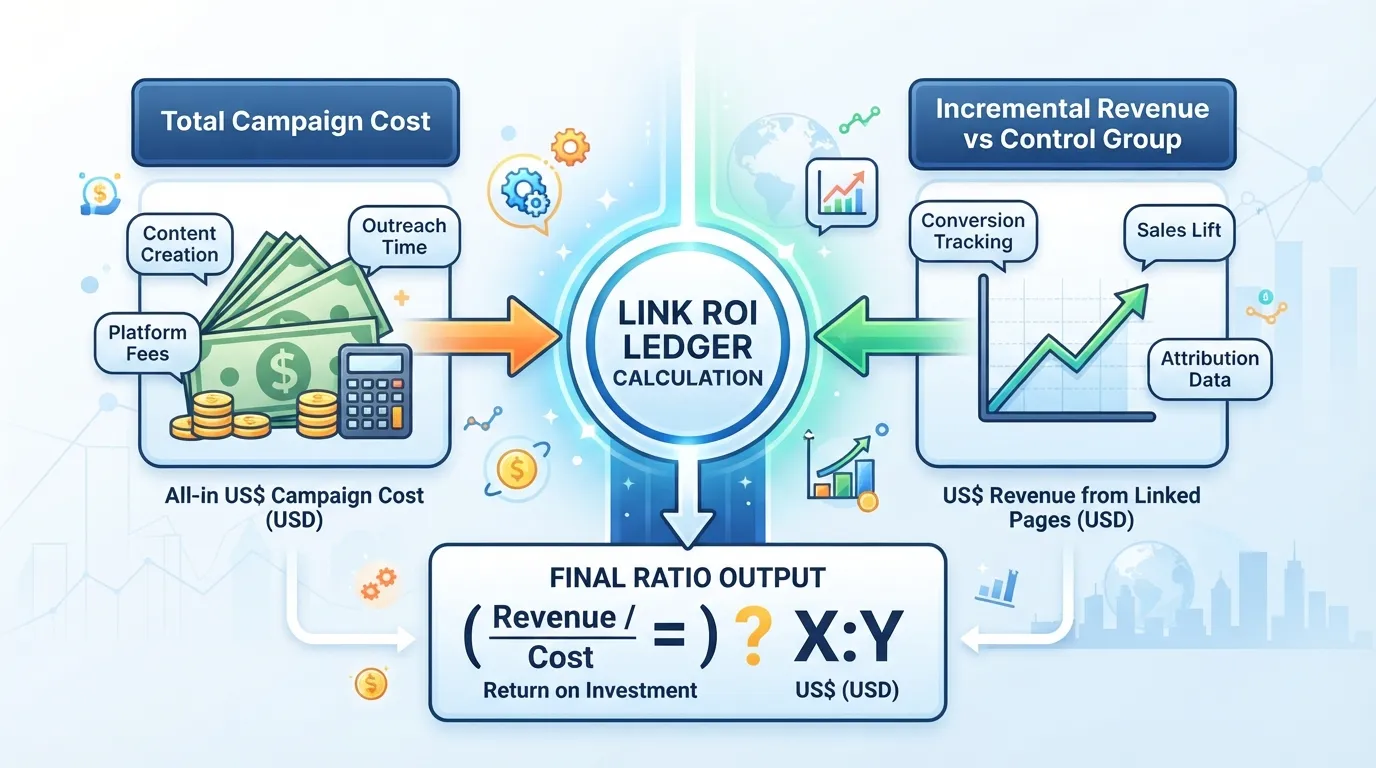
Link building ROI is the incremental organic revenue or lead value produced by a defined group of quality links, measured over a realistic window against total campaign cost: (incremental revenue minus total campaign cost) divided by total campaign cost. Multi-touch conversions make attribution imperfect, so treat the result as a well-supported estimate.
Worked example: a campaign costs $10,000 and its supported pages generate $18,000 in incremental revenue against a control group. Net gain is $8,000, so ROI is 0.8, or 80%.
This guide sets out a method for answering that question. The result is only as reliable as the tracking behind it, so check each step before trusting the figures. Keep in mind that the value of each step depends on how well the tracking is set up, and that the search engine and site analytics data behind it should be reviewed against the campaign’s own success metrics before the figures are trusted.
Link counts and domain authority scores do not measure ROI on their own.
Measure incremental revenue or lead value from the pages your links support, net of total cost.
Wait three to six months before judging results, because early readings mislead.
Count distinct referring domains, not raw backlinks, when comparing campaigns.
Table of Contents
Why Link Building ROI Is Hard to Pin Down
Calculating Link Building ROI Step by Step
Link Building Metrics That Signal Progress
Link Building Timelines: When to Expect Returns
Conclusion: A Repeatable Link Building ROI Process
Frequently Asked Questions
Why Link Building ROI Is Hard to Pin Down
Link building shapes how search engines judge a website. A link rarely produces a sale on its own. It helps a page rank, that page earns visits, and some of those visits convert weeks or months later.
Teams often count links or cite domain authority, but neither says much about revenue. A modest link from a niche publication may send exactly the customers you want.
Backlink Value Beyond Numbers
Google has moved away from rewarding link volume. Since the Penguin update, the emphasis has shifted to link quality, and manipulative tactics are penalised. A campaign can look impressive in a link count and still be worth little.
The more useful unit is the referring domain. Measure how many distinct, relevant domains link to you, and which pages they point to. Track these important metrics alongside your revenue data.
Referring Domains and Backlinks: Why Quality Beats Volume
Count referring domains, not raw backlinks. Ten backlinks from one site are, in effect, one vote repeated. Use seo tools that show referring domains and their target pages, then tie each cluster of links to the revenue-generating page it supports across your websites.
Calculating Link Building ROI Step by Step
Link building ROI is a ratio: the value a campaign returns, divided by what it cost. Most teams can calculate the cost side easily. The return side takes more work, and this is where the link ROI ledger helps. The link ROI ledger is a tracking sheet with one row per link cluster, recording cost, baseline, control group results and net ROI. A search engine ranks pages on signals like links, so log each backlink as its own row to trace its contribution, noting the anchor text used for each link.
Cost per Link and Total Campaign Cost
Start with the all-in campaign cost, not the invoice total. Include outreach hours, content creation, data or design work, tooling subscriptions and agency fees. Divide that total by the number of links placed on live pages. Treat the result as a diagnostic rather than a target, since a cheap link on an irrelevant page can cost more in lost opportunity than an expensive one on a converting page. Every dollar of this total is an investment in future organic visibility, so count it all.
Monthly marketing retainers range from $3,000 to $15,000 for seemingly similar services, so use your own invoices as the baseline.
Attribution in Link Building: Tying Links to Traffic and Revenue
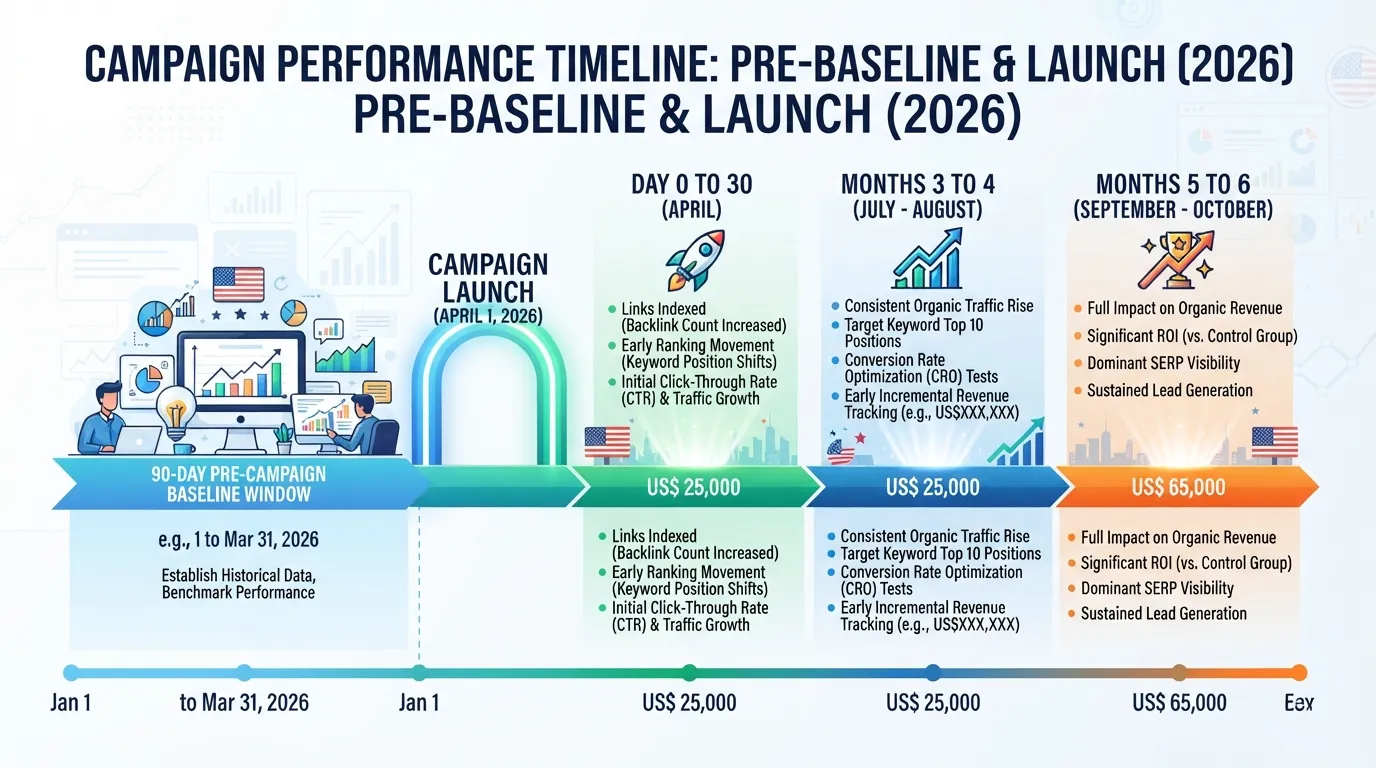
Links rarely produce a clean last-click conversion. Track the target page’s organic clicks and conversions in Google Analytics 4 and Google Search Console for 90 days before the campaign, then compare the same metrics three to six months after launch. Understand that this window gives an important read on the campaign’s real effect, and the best attribution comes from consistent measurement across all of your building efforts.
Use a control group of comparable pages that received no new links. This separates campaign effects from seasonal or algorithmic movement.
To isolate branded search lift, pull branded query impressions from Search Console for the campaign and control pages over the same window. If linked pages gain 1,200 branded impressions while control pages gain 300, the net lift is 900 impressions. Report that figure alongside revenue, not in place of it.
Revenue per Visit and Buyer-Intent Keywords
Traffic value estimates show what a ranking might be worth on paper. Revenue per visit shows what it is actually worth. Divide revenue from the target pages by their organic sessions, then apply that figure to the incremental traffic. Pages targeting buyer-intent keywords, such as “agency pricing” or “buy” queries, usually earn more revenue per visit than informational pages with higher traffic estimates. Weight your ROI calculation accordingly, and track each building metrics result against the cost of the links behind it.
Link Building Metrics That Signal Progress
Most teams reach for domain authority first, but it is a weak proxy for revenue. Track it as a directional signal, then move to metrics tied to the pages your links support.
Domain Authority and Authority Score (AS)
Authority Score (AS) is Semrush’s metric that evaluates backlink strength, organic traffic and backlink quality, on a scale from 1 to 100. Use it to compare candidate referring sites before outreach. A rise in AS shows the profile looks stronger, not that the campaign earned money.
Count distinct trusted domains per cluster, not raw backlinks.
Link Types and Their ROI Differences
Editorial mentions, relevant industry publications and resource pages usually drive more qualified traffic than directories or sitewide footers. Compare clusters by cost and revenue per linked page, not by volume.
Review your seo tools output for toxic links before scoring a cluster. Check the anchor text mix too, since repetitive exact-match anchors can look like manipulation. Assess the full backlink profile, not just the newest links, before drawing conclusions about a cluster’s ROI.
Decision rule: continue a cluster if net ROI is positive at the month-six checkpoint and shows a clear lift against the control group. Pause it if the lift is within normal variation. Drop it if net ROI is negative after six months and the links are indexed and healthy.
Tracking Before-and-After Rankings and Traffic
Record rankings and organic clicks for each target URL in Google Search Console at least 90 days before outreach begins. Compare the same URLs three to six months after links land, against a control group of similar pages without new links. Judge each keyword’s movement against the control group, not in isolation. If you also need a structured check of your site’s health, an seo audit tool can flag issues that would blunt link gains on your website.
Link Building Timelines: When to Expect Returns
Most teams judge a link building campaign too early. Meaningful ranking improvements typically take three to six months, according to Google’s guidance on link quality. A day 30 reading mostly shows whether links were indexed, not whether they earn money. Set your measurement window before the campaign starts, and hold to it. Judge the full backlink profile against the metrics you agreed on, not against early impressions. Keep in mind that building efforts in digital marketing rarely pay back on a short schedule.
Return on Investment Checkpoints for Link Building
Use three checkpoints in the link ROI ledger:
Days 0 to 30: confirm backlinks are live, indexed and tied to the right target URLs. Check that each anchor text matches the page it points to.
Months 3 to 4: look for early movement in rankings and clicks on target pages.
Months 5 to 6: calculate incremental revenue against a control group of comparable pages with no new links.
Only the third checkpoint supports an ROI figure. Earlier readings can justify continuing a campaign, but they cannot prove it has paid back.
Measuring Traffic Growth Over Time
Track the 90-day baseline recorded before the campaign. Use Google Search Console for impressions and clicks, and Google Analytics 4 for conversions on each website in the campaign.
Check whether new visits come from buyer-intent queries, because rising informational traffic can leave revenue flat. Revenue, not raw traffic, is the outcome that counts when you measure link building ROI. Compare content pages against the same example pages used as a control group.
Setting Realistic Milestones for a Three- to Six-Month Window
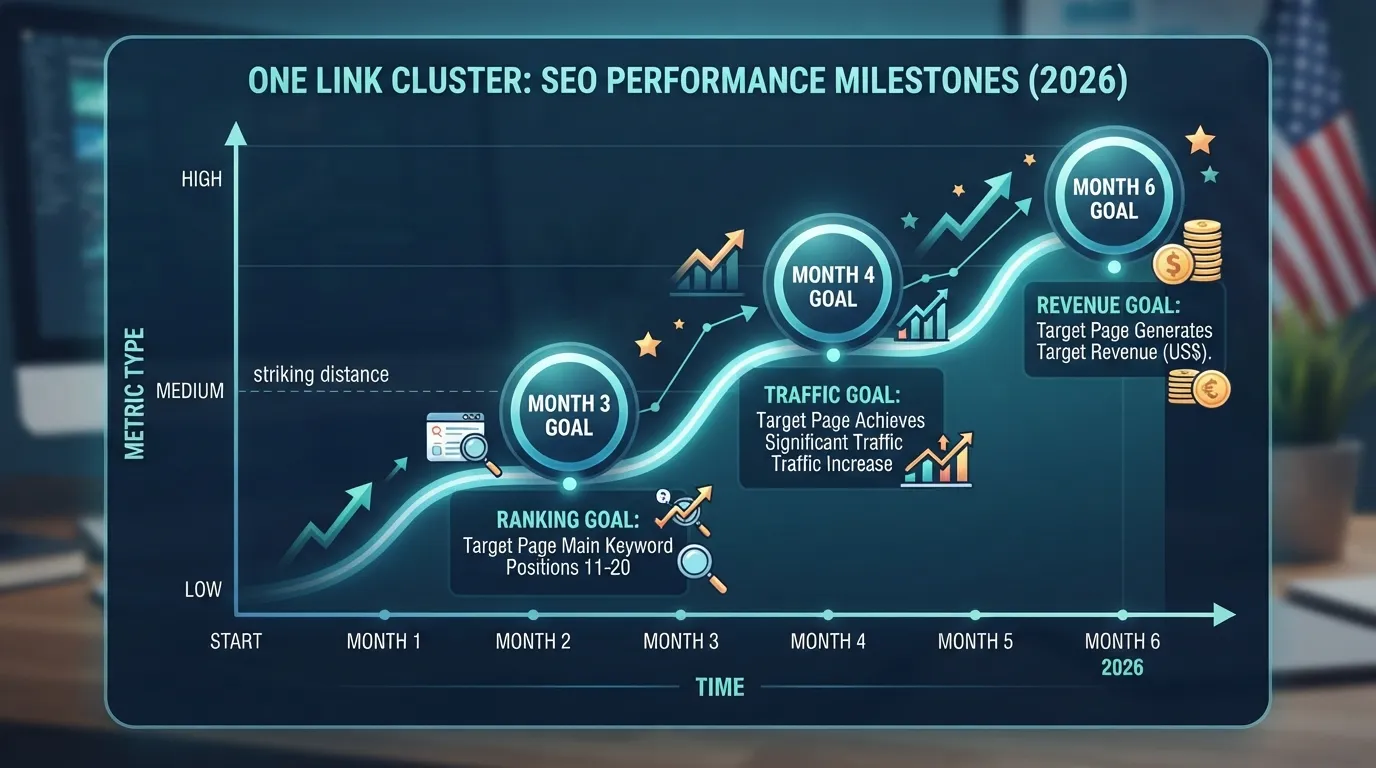
Set milestones per link cluster, not for the whole programme: one ranking milestone at month three, one traffic milestone at month four, and one revenue milestone at month six. Write these down with baseline figures so each review is a comparison, not a debate.
Conclusion: A Repeatable Link Building ROI Process
Add one row per campaign to the link ROI ledger, reviewed quarterly. Over time, the rows show which link types, target pages and topics produce revenue, guiding where the next budget goes.
Run the same four steps each time: record the all-in cost, pull the 90-day baseline, measure organic traffic uplift against a fixed control group after three to six months, then calculate net ROI with a confidence note. Flag low-confidence clusters as hypotheses to test, not results to report.
Consistency makes the number trustworthy. A team that keeps the same windows and revenue definition can compare campaigns honestly; one that changes its method when results disappoint cannot.
Frequently Asked Questions
How long does it take to see ROI from link building?
Expect a wait. Meaningful ranking improvements from link building typically take three to six months. Judge a campaign against a 90-day baseline, comparing results three to six months after the links go live.
What is a good cost per link?
There is no universal figure. Quality and relevance drive price far more than volume. Divide your all-in campaign spend, including outreach, content and tooling, by the number of distinct referring domains you earned, then judge that number against revenue per link cluster. A few costly links that move a high-value page can beat dozens of cheap ones.
Is domain authority a reliable ROI metric?
No. Domain authority helps compare prospects but does not measure revenue. Semrush’s Authority Score runs from 0 to 100 and describes a domain’s profile, not the commercial outcome of your links. Use authority to shortlist sources, then measure incremental organic revenue on the target pages.
How do I attribute revenue to a specific backlink?
You usually cannot tie one link to one sale. Instead, compare each link cluster’s target pages against a control group of similar pages that received no new links. Track assisted conversions, branded search lift in Google Search Console, and revenue growth in your CRM or ecommerce platform. Record your confidence level with every result.
Should I count toxic links in my ROI calculation?
Exclude them. Toxic or spammy links carry risk rather than value. Audit your profile first, disavow where needed, and calculate ROI only on relevant, editorially placed links from genuine sites.
Which link types deliver the best return?
Links from relevant, editorially earned pages on trusted sites usually return the most, since they send referral visitors and support rankings for buyer-intent keywords. Compare guest posts, resource page links and digital PR placements by revenue per cluster, and repeat the link type that earns the most per dollar spent.
About the author
Tom Koh
Tom is the CEO of MediaOne, a leading digital marketing agency. He is a business-experienced SEO consultant as well as a Google Gold Search Expert serving the international community. He has consulted for MNCs like Canon, Maybank, Capitaland, SingTel, ST Engineering, WWF, Cambridge University, as well as Government organisations like Enterprise Singapore, Ministry of Law, National Galleries, NTUC, e2i, SingHealth. His articles are published and referenced in CNA, Straits Times, MoneyFM, Financial Times, Yahoo! Finance, Hubspot, Zendesk, CIO Advisor. Under his stewardship, MediaOne has won dozens of prestigious digital marketing awards.
Your website has 150 published articles. Some attract consistent organic traffic, others haven’t generated a meaningful visit in months, and several cover nearly identical…
Writing a good advertisement sounds simple until you have to create 15 different headlines, stay within character limits, communicate your product’s benefits, and make…
Verifiability matters more than speed when publishing AI-generated content. An AI content generator turns a short brief into draft copy, and its usefulness depends…