Your brand gets mentioned 100 times across social media, forums, and online communities. Your social listening dashboard finds 65 of them.
Is that good performance?
It depends on which 35 mentions were missed.
If most were irrelevant reposts or conversations on sources the software never claimed to support, the result may be understandable. But if the missing mentions include a customer complaint gaining traction on Reddit, a product recommendation on TikTok, or an influential creator criticising your service, the gaps become much more important.
This is the problem with evaluating social listening tools based on their advertised coverage.
A vendor might claim to monitor millions of sources, dozens of social platforms, or billions of online conversations. Those figures tell you something about the scale of its data collection, but they don’t answer the question that matters to your business:
When someone talks about your brand on a source the tool claims to monitor, will you actually find out?
That question is about recall.
In information retrieval, recall measures how many relevant items a system successfully identifies from the set it should be able to find.
For social listening, it provides a way to evaluate whether a platform captures relevant brand mentions instead of merely generating an impressive-looking dashboard.
But recall isn’t the entire story. A tool that retrieves every occurrence of a common brand name may generate hundreds of false positives. Another might find the correct mention but notify your team two days after a customer complaint becomes a larger problem.
That’s why useful social listening needs to balance coverage, accuracy, speed, and actionability.
In this guide, we’ll compare six social listening platforms, explain where platform data restrictions create blind spots, and show how to run a controlled mention-recall test before committing to a subscription.
We’ll also examine what different teams should prioritise, from small businesses managing customer feedback to enterprises monitoring brands across multiple markets.
The goal isn’t to find the tool with the longest supported-platform list. It’s to identify the one that reliably finds the conversations you actually need to act on.
True positives: Relevant mentions the tool correctly finds.
False negatives: Relevant mentions the tool should have found but misses.
Imagine your company has 80 relevant public mentions on sources included in your monitoring setup.
Your social listening platform finds 64 of them.
Its observed recall is:
64 ÷ 80 × 100 = 80%
That means the tool identified 80% of the relevant mentions in your defined test set.
It doesn’t mean the platform finds 80% of every conversation about your brand across the internet.
That broader claim would require knowing all relevant conversations, including those you cannot access or observe.
For this reason, a credible comparison should report recall within a documented set of eligible sources, languages, content types, and collection conditions.
Why Recall Matters More Than Total Mention Volume
Suppose two listening platforms monitor the same brand for one week.
Metric
Platform A
Platform B
Total mentions reported
1,400
850
Verified relevant mentions
600
750
Irrelevant or duplicate results
800
100
Illustrative example, not measured vendor results.
Platform A found more total mentions, but Platform B returned more relevant ones.
That doesn’t automatically prove Platform B has better recall. We still need a verified reference set showing how many relevant mentions existed.
However, the example illustrates why total mention count alone is inadequate.
A larger report can simply contain more noise.
Recall vs. Precision: Why You Need Both
Recall answers how many relevant mentions the tool found.
Precision answers how many of the retrieved results were actually relevant.
False positives include irrelevant posts that match your search query but aren’t actually about your business.
For example, a monitoring query for a company named Apple might retrieve discussions about the fruit.
A software company named Mercury may appear in results about the planet or unrelated businesses sharing the same name.
A tool might have broad coverage while still producing an overwhelming amount of irrelevant information.
This creates operational problems.
If a customer-service team receives hundreds of false alerts, important messages can become harder to identify.
What Good Social Listening Looks Like
Measurement
What It Tells You
Why It Matters
Recall
Share of relevant eligible mentions retrieved
Reveals missed conversations
Precision
Share of retrieved mentions that are relevant
Reveals alert noise
Alert latency
Time between a mention becoming available and the notification
Measures how quickly the team can respond
Source coverage
Which networks and content types are actually monitored
Reveals platform blind spots
Sentiment accuracy
Whether the tool correctly interprets the context of mentions
Helps avoid misleading brand-perception reports
Actionability
Whether retrieved mentions can be assigned, investigated, or addressed
Connects monitoring to business operations
A useful platform should perform adequately across these areas rather than excelling at only one.
Six Social Listening Tools Worth Comparing in 2026
Different platforms serve different organisations.
Some focus on brand monitoring and alerts. Others combine listening with social media management, customer engagement, traditional media monitoring, or enterprise consumer intelligence.
Social listening combined with news, PR, and media intelligence
Communications, PR, and multi-market teams
Data coverage and package requirements need to be confirmed
These are use-case distinctions based on official product documentation, not measured recall rankings.
Let’s examine what each product offers and where a buyer should concentrate their testing.
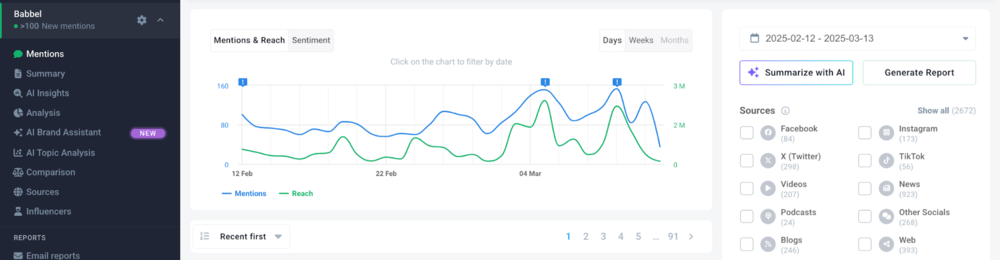
1. Brand24: Best for Dedicated Brand Mention Monitoring
Best suited for: Businesses and agencies that want ongoing visibility into brand conversations without building a complex enterprise research operation.
Brand24 is a dedicated media monitoring and social listening platform.
Its core workflow involves creating monitoring projects around selected keywords, brand names, competitors, or topics.
The tool then collects matching mentions from supported social networks and other online sources.
Brand24 also provides sentiment analysis, filters, alerts, and reporting features.
What Makes Brand24 Useful?
Imagine you’re monitoring a new consumer product.
You want to identify when customers discuss it on social platforms, mention it in blog articles, or ask for recommendations in online communities.
Brand24’s source filtering can help separate different types of conversations.
For example, you might investigate whether a sudden increase in mentions came from TikTok, Reddit, news publications, or another monitored source.
Its documentation also distinguishes owned and earned mentions, which can help separate brand-controlled communications from independent conversations.
What Should You Test?
Start with the platforms most relevant to your audience.
If your business receives customer conversations on TikTok and Reddit, don’t assume a broad “social media” coverage claim automatically means every post, comment, or video transcript is available.
Check exactly which content types the current product collects and how they appear in the monitoring feed.
Brand24’s documentation explains that its source filters cover categories such as Facebook, Instagram, X, TikTok, Reddit, and other social or web sources.
However, the actual material available may depend on platform permissions, integrations, and collection methods.
Pricing and Limitations
Brand24 offers multiple subscription tiers with allowances based on factors such as monitored keywords, mention volume, and other features.
Its published pricing and plan structure can change, so verify the current subscription before budgeting.
Our assessment: Brand24 is a relevant starting point for dedicated brand mention monitoring. Test its ability to retrieve the specific types of conversations your team receives rather than treating its overall source count as proof of completeness.
2. Agorapulse Listening: Best for Connecting Monitoring With Social Engagement
Best suited for: Social media teams that want to move from identifying conversations to managing responses within a broader social workflow.
Agorapulse combines social publishing, engagement, reporting, and listening capabilities.
Its Advanced Listening product provides broader keyword and conversation monitoring beyond direct mentions of owned social accounts.
This is particularly relevant for businesses where social listening feeds directly into community management or customer care.
An Important 2026 Change: Mention Is No Longer Sold Separately
Mention, a long-established social listening product, became part of Agorapulse.
As of July 1, 2026, Mention stopped being sold as a standalone product.
Agorapulse Listening is now an important option for buyers evaluating capabilities previously associated with Mention.
This matters because older comparison articles may still treat Mention as a separate new subscription choice.
For an October 2026 buyer, that can create confusion about product availability, pricing, and support.
What Makes Agorapulse Useful?
Imagine a customer posts a complaint about your brand.
A listening tool identifies the message, but someone still needs to investigate it, decide whether a response is appropriate, and coordinate with the relevant team.
Agorapulse’s broader social management environment may help reduce the gap between listening and customer engagement.
Its Advanced Listening documentation describes monitoring keyword-based conversations across multiple social and web sources.
Users can investigate mentions, relevant topics, and competitive conversations.
What Should You Test?
Check whether the conversations that matter to your business can be discovered and handled within the same workflow.
For example, you might need to monitor direct mentions, public posts about your product, and relevant industry discussions.
These may require different listening configurations.
Also verify whether your chosen plan includes Advanced Listening or requires a separate purchase.
Pricing and Limitations
Agorapulse’s Advanced Listening is a paid add-on.
Its October 2026 support information describes a sales-assisted purchase process with pricing tied to quota requirements.
The base social management subscription should therefore not be treated as the full cost of advanced listening.
Our assessment: Agorapulse is worth evaluating when monitoring and community management are closely connected. Its value depends on both the mentions it retrieves and how efficiently the team can act on them.
3. Sprout Social: Best for Social Listening Alongside Customer Care
Best suited for: In-house marketing, customer experience, and social customer-care teams.
Sprout Social combines publishing, analytics, engagement, and social listening.
Its Listening product allows organisations to monitor relevant keywords, brands, industries, and conversations across supported sources.
One useful characteristic is the ability to combine listening reports with wider social analytics.
That may be valuable for teams responsible for both brand intelligence and day-to-day customer engagement.
What Makes Sprout Social Useful?
Suppose your organisation manages Facebook, Instagram, LinkedIn, and TikTok accounts.
Your customer experience team monitors incoming messages while your marketing team investigates broader public conversations about the brand.
Sprout’s social management environment can support these related workflows.
Its Listening reports also provide topic information and metrics involving conversation volume, sentiment, and engagement.
Where Source Coverage Becomes Complicated
Sprout provides unusually useful documentation about data availability and limitations.
For example, its Listening support materials distinguish public data from information collected through connected profiles.
Some LinkedIn listening access is limited to pages the organisation owns.
YouTube availability can also depend on whether the relevant data involves titles, descriptions, or comments.
This is exactly why a platform logo isn’t sufficient evidence of full listening coverage.
A product may support YouTube as a source without retrieving every comment on every video.
Likewise, connecting a business profile may enable certain owned-account data without granting access to unrelated private conversations.
Pricing and Limitations
Sprout Social sells Listening as an add-on to its social management subscriptions.
Its official pricing and support materials don’t establish one universal public price for every listening configuration.
Request a quotation covering the exact features, sources, seats, and monitoring requirements.
Our assessment: Sprout Social is worth considering when listening needs to integrate with social analytics and customer care. Its detailed source documentation also makes it easier to identify which coverage assumptions need testing.
4. Brandwatch: Best for Enterprise Consumer Intelligence
Best suited for: Enterprise brands, market researchers, agencies, and analysts investigating large volumes of online conversation.
Brandwatch Consumer Research provides social listening and consumer intelligence across multiple data sources.
Its platform supports detailed queries, segmentation, sentiment analysis, historical research, and audience-related investigation.
Brandwatch’s documentation describes access to broad social and web data, including official relationships with major platforms.
For example, its data-source documentation identifies its X data access through an official partnership.
What Makes Brandwatch Useful?
Imagine a multinational consumer brand wants to understand how attitudes toward a product category differ across countries.
The research team may need to examine millions of conversations, segment them by topic, investigate historical patterns, and compare markets.
Brandwatch is designed for this kind of work.
Its research environment offers more flexibility than a basic mention-alert service.
Where Recall Testing Matters
Enterprise data access doesn’t eliminate the need to measure retrieval quality.
A complex Boolean query can exclude relevant discussions even when the underlying data source is available.
For example, a narrowly configured brand search might find the official product name but miss abbreviations, common misspellings, or nicknames.
That’s a query-design problem rather than necessarily a source-access problem.
A proper test should evaluate both the vendor’s data availability and the search configuration.
Pricing and Limitations
Brandwatch’s enterprise consumer research products generally require commercial discussions about the intended package and data requirements.
Request written confirmation of the sources, history, export capabilities, and usage limits included.
Our assessment: Brandwatch is worth evaluating for advanced consumer research, but its extensive capabilities require carefully designed queries and a clear research process.
5. Hootsuite Lumen by Talkwalker: Best for Broad Enterprise Listening
Best suited for: Enterprise marketing, reputation management, and consumer intelligence teams.
Talkwalker became part of Hootsuite in 2024.
In 2026, the listening product was rebranded as Lumen by Talkwalker, bringing its research capabilities into Hootsuite’s evolving product environment.
This is an important distinction because buyers may encounter older references to Talkwalker, Hootsuite Listening, and Lumen.
The current product configuration should be confirmed rather than assuming all historical offerings are identical.
What Makes Lumen Useful?
Lumen supports social listening and analysis across multiple online sources.
Its capabilities include topic monitoring, sentiment, historical information, dashboards, and other consumer intelligence features.
Hootsuite also describes image, video, and audio-related monitoring capabilities across its wider listening offering.
This can be relevant when important brand mentions don’t appear only as ordinary text.
For example, a customer may mention a brand in a video description or other supported media content.
Where the Restrictions Matter
Hootsuite’s September 2026 documentation provides source-specific limitations.
For example, certain TikTok monitoring configurations require connecting an account and adding channels to the listening project.
Its documentation also describes restrictions on historical data availability and monitored-channel limits.
Hootsuite’s October 2026 product documentation lists limits such as a maximum of 100 monitored channels for relevant Lumen configurations.
These details have practical consequences.
A vendor may support TikTok broadly while a particular monitoring workflow still requires additional configuration or permissions.
Pricing and Limitations
Lumen’s full enterprise listening features depend on the selected Hootsuite subscription and relevant product arrangement.
Request confirmation of the required package, channel allowances, integrations, and historical data availability.
Our assessment: Lumen is relevant for enterprise teams requiring broad listening and advanced analysis. Buyers should evaluate the precise product configuration rather than relying on historical Talkwalker feature lists.
6. Meltwater: Best for Combining Social Listening With Media Intelligence
Best suited for: PR teams, communications departments, enterprise marketing teams, and organisations monitoring social and traditional media coverage.
Meltwater combines social listening with wider media monitoring and consumer intelligence capabilities.
Its platform covers social networks, news publications, blogs, forums, reviews, and other supported information sources.
This can be useful when reputation issues move between social media and mainstream media.
What Makes Meltwater Useful?
Imagine a customer complaint starts on Reddit.
A technology publication reports on the issue, and additional discussion appears on X and LinkedIn.
A communications team may need to investigate the complete sequence rather than only the original social post.
Meltwater’s combination of social and media monitoring can support this broader view.
Its documentation describes global source coverage and analysis involving online conversations and news content.
Where to Pay Attention
Media coverage and social listening are related but different datasets.
A product may have strong news-monitoring capabilities without offering identical access to every type of content on every social network.
For example, access to a public Instagram caption doesn’t automatically imply access to all replies or private messages associated with the post.
When evaluating Meltwater, separate social platform coverage from news, blogs, and traditional media sources.
Pricing and Limitations
Meltwater’s commercial packages depend on the data sources, features, markets, and requirements selected.
A company focused on basic brand mentions may not need the same package as an enterprise PR team conducting international media intelligence.
Our assessment: Meltwater is worth evaluating when social conversation monitoring needs to connect with wider reputation and media reporting.
Why Social Listening Coverage Claims Are Difficult to Verify
A platform may advertise support for Facebook, Instagram, LinkedIn, TikTok, Reddit, YouTube, and X.
But what does support actually mean?
It could mean the tool monitors public posts containing selected keywords.
It might mean you can connect owned accounts to retrieve comments or mentions.
It could also mean only certain content fields are searchable.
These are not equivalent.
Public Posts vs. Private Conversations
A social listening platform generally cannot retrieve arbitrary private conversations from social networks.
Private groups, direct messages, restricted content, and access-controlled communities may be unavailable.
A tool missing those conversations shouldn’t automatically be penalised for failing to collect material it never had permission to access.
Posts vs. Comments
A network integration might support public posts but not every comment.
This difference matters for customer-service and reputation monitoring.
Complaints often appear in replies rather than original posts.
If comments are central to your listening strategy, verify their availability separately.
Captions vs. Spoken Video Content
Video monitoring is another important distinction.
A tool might search video titles and descriptions but not the actual speech within recordings.
Another may offer transcription or other media-analysis features.
If your brand is frequently discussed in creator videos, this can materially affect which mentions are discoverable.
Historical Data vs. New Monitoring
Some platforms allow historical backfills. Others collect primarily from the moment monitoring begins.
A tool may therefore find new mentions successfully but fail to retrieve older posts during a retrospective search.
This isn’t necessarily the same as poor live-monitoring recall.
A fair comparison should evaluate each relevant source and content type separately.
How to Run a Controlled Social Listening Recall Test
The strongest way to evaluate mention retrieval is to work from a verified reference set.
Rather than comparing how many results different tools report, you establish which relevant mentions should be available under the conditions being tested.
Then you check which ones each product retrieves.
A seeded-mention test can help, although it should be supplemented by real, naturally occurring brand conversations.
Here’s how to structure one.
Step 1: Define the Sources You Actually Need
Start with the platforms relevant to your business.
For example, a consumer retailer might care most about Instagram, TikTok, Facebook, and Reddit.
A B2B software company may prioritise LinkedIn, X, Reddit, and specialist forums.
Don’t create a benchmark containing dozens of platforms your audience rarely uses merely to make the test look comprehensive.
Step 2: Build a Verified Mention Set
A practical pilot could use 60 verified examples distributed across the relevant sources.
These can include authorised test posts, existing public content you have permission to evaluate, or genuine discussions manually confirmed by reviewers.
For a controlled set, include different types of mentions.
Mention Type
Suggested Examples
What It Tests
Exact brand name
“Northline Analytics released a new dashboard.”
Basic keyword retrieval
Brand with punctuation or spelling variation
“Northline-Analytics”
Query flexibility
Common abbreviation
“NLA reporting”
Alias detection
Brand in a comment
A reply mentioning the company
Comment coverage
Brand in a product recommendation
“Try Northline Analytics for reporting.”
Context and competitor monitoring
Brand in a criticism
“Northline Analytics lacks the export we need.”
Negative-context detection
Examples are fictional.
Make sure the posts comply with each platform’s rules. Don’t create spam, impersonate customers, manufacture fake reviews, or publish misleading recommendations merely to test a tool.
If you already have a substantial set of genuine, publicly accessible mentions, that may provide a more representative basis for evaluation than creating large numbers of artificial posts.
Step 3: Record Source Eligibility
Before scoring a missed mention, determine whether it was eligible for retrieval under the tested tool’s documented capabilities and settings.
For example, suppose a platform can’t access comments from a particular network under the current plan.
It would be misleading to treat that limitation as proof that its comment-recognition algorithm failed.
The better approach is to separate:
Coverage gap: The source or content type isn’t available under the configuration.
Retrieval miss: The source should be available, but the tool didn’t return the relevant mention.
Both matter to the buyer, but they describe different failures.
Step 4: Use Equivalent Monitoring Queries
Set up the same intended search logic across the products.
Include brand names, recognised aliases, and appropriate exclusions.
For example, a brand sharing its name with a common word might require additional terms to reduce irrelevant results.
Not every product uses identical Boolean syntax, so record the actual query configuration rather than assuming the settings are equivalent.
Allow legitimate onboarding assistance, but document the configuration changes.
Step 5: Collect the Results
Run the tools across the same observation period and record which eligible mentions appear.
For each mention, retain the source URL or identifier, publication timestamp, discovery time, and relevant search settings.
Don’t count duplicates as separate successful detections if they refer to the same underlying mention.
If a platform returns the same post through several feeds, that is still one source item for the purposes of this recall test.
Step 6: Verify False Positives
Examine irrelevant results returned by the tools.
For example, a brand named Orange might generate false positives involving the colour or fruit.
A classifier that repeatedly confuses unrelated subjects could create unnecessary review work.
Record the false positives separately from genuine mentions.
Step 7: Measure Time to Alert
Finding a mention isn’t always enough.
If a critical complaint is discovered 48 hours after publication, the marketing team may have already missed its opportunity to respond effectively.
Record when the post became available and when the platform detected it.
If your workflow depends on notifications, also measure how long it takes for the alert to reach the responsible person.
Worked Example: How to Calculate Recall Fairly
Suppose a hypothetical test contains 120 verified mentions.
After reviewing the vendors’ documented source coverage and the configured access conditions, you determine that 20 are outside the eligible monitoring scope.
That leaves 100 eligible mentions.
Your listening tool retrieves 80 of those eligible mentions.
It also returns ten unrelated posts that are confirmed as false positives.
Measurement
Hypothetical Result
Total verified mentions
120
Outside tested source coverage
20
Eligible mentions
100
Correctly retrieved eligible mentions
80
Missed eligible mentions
20
False positives
10
Total retrieved results in evaluated set
90
Eligible-Source Recall
80 ÷ 100 × 100 = 80%
The tool retrieved 80% of the relevant mentions it was expected to find within the defined eligible source set.
Precision
80 ÷ 90 × 100 = 88.9%
Approximately 89% of the retrieved results were genuine relevant mentions.
Coverage of the Entire Reference Set
80 ÷ 120 × 100 = 66.7%
The tool retrieved about two-thirds of all verified mentions in the broader reference set.
This last calculation helps reveal the practical impact of source limitations.
However, it shouldn’t be called eligible-source recall because the denominator includes items outside the supported monitoring scope.
These are hypothetical calculations, not benchmark results from Brand24, Agorapulse, Sprout Social, Brandwatch, Hootsuite, or Meltwater.
Why Per-Platform Results Matter
An overall recall percentage can conceal important gaps.
For example, a tool might retrieve nearly every eligible mention on X but miss a substantial share of relevant comments on another platform.
If your customers primarily discuss your products in those comments, the high overall score may create a false sense of security.
Report recall by source, content type, and market where your reference set is large enough to make the breakdown useful.
Time to First Useful Alert: The Metric That Connects Listening to Action
Recall tells you whether a mention was found.
Alert latency tells you whether the information arrived soon enough to matter.
These aren’t the same thing.
Consider two hypothetical platforms.
Both retrieve 80 of 100 eligible brand mentions.
Platform A finds most within 15 minutes.
Platform B retrieves the same items but frequently takes several hours.
For historical market research, that delay might be acceptable.
For a customer-service team responding to fast-moving complaints, it may not be.
Measure the Entire Notification Workflow
Record the time between publication, detection, notification, and human review.
Stage
Example Timestamp
Mention becomes publicly available
10:00 AM
Tool detects the mention
10:12 AM
Notification reaches the team
10:16 AM
Team begins reviewing it
10:25 AM
Relevant action is taken
10:40 AM
Illustrative example.
The first 12 minutes reflect detection latency.
The next four minutes reflect notification delivery.
The remaining time involves the organisation’s internal workflow.
A listening vendor should not receive credit or blame for every delay after a notification has already reached the team.
This distinction can help companies understand whether they need better software, better alert configuration, or simply clearer response ownership.
Sentiment Accuracy: Finding a Mention Isn’t the Same as Understanding It
Many social listening products offer sentiment analysis.
This can help identify negative conversations, track brand perception, and prioritise important issues.
However, sentiment classifiers can misunderstand context.
Consider this hypothetical post:
“I thought Northline Analytics was terrible last year, but the latest update completely changed my mind.”
A keyword-based classifier could focus on the negative wording and miss the positive conclusion.
Another example:
“Unlike Northline Analytics, Competitor X doesn’t make reporting unnecessarily complicated.”
The post contains the brand name, but correctly interpreting its sentiment requires understanding the comparison.
How to Test Sentiment
Choose a representative sample of retrieved mentions.
Have human reviewers classify each one using consistent categories, such as positive, negative, neutral, and mixed.
Then compare those decisions with the platform’s labels.
Include sarcasm, slang, local languages, and code-switching where relevant.
For businesses serving the Philippines or other multilingual markets, a tool’s performance on standard English shouldn’t automatically be assumed to represent its performance on Tagalog, Taglish, or regional languages.
A useful listening platform should also allow users to inspect the original conversation rather than relying entirely on the sentiment summary.
The Five Social Listening Buying Questions That Matter
Before signing a subscription, ask the vendor to demonstrate the following.
1. Which Exact Content Types Can You Monitor?
Don’t stop at a list of supported social networks.
Ask whether the product monitors posts, captions, comments, video descriptions, spoken video content, or other relevant material on each platform.
Also distinguish public monitoring from access to connected owned accounts.
2. How Can We Verify a Missed Mention?
Ask whether the platform can investigate a specific public URL that should be included in the monitoring configuration.
This is one of the most useful parts of a trial.
If you provide a verified mention and the tool can’t retrieve it, support should be able to explain whether the problem involves source access, indexing delay, search configuration, or another limitation.
3. How Are False Positives Filtered?
A tool that returns every occurrence of a common brand word may be unsuitable without more advanced search logic.
Check Boolean operators, exclusion rules, aliases, and filtering capabilities.
A cleaner dataset can save substantial human review time.
4. How Quickly Are New Mentions Available?
Ask about source-specific collection schedules and alert frequency.
Avoid treating a general “real-time monitoring” claim as a guarantee that every network provides instant data.
Collection speed can depend on platform restrictions and the type of content being monitored.
5. What Happens When Platform Access Changes?
Social platforms can change permissions, APIs, policies, and data availability.
A responsible vendor should explain material coverage changes and how customers are informed.
Ask whether monitoring interruptions appear in reporting or whether unavailable data is silently treated as zero mentions.
The distinction matters because no new mentions recorded is not always the same as no relevant mentions existed.
What Should Social Listening Software Actually Cost?
A fair pricing comparison should consider the monitoring workload and how the team will use the information.
Some products use published subscription tiers. Others require custom quotes or charge separately for advanced listening capabilities.
Tool
Commercial Model
What to Confirm
Brand24
Tiered subscription
Keywords, mention allowances, users, sources, history, and alerts
Agorapulse Listening
Social management subscription with Advanced Listening add-on
Listening quotas, supported sources, and add-on price
Sprout Social Listening
Social management subscription plus listening add-on
Seats, topic access, source coverage, and total subscription cost
Brandwatch
Enterprise commercial arrangements
Data access, historical coverage, query limits, and exports
Hootsuite Lumen
Plan-dependent enterprise listening
Product tier, monitored channels, historical access, and integrations
Meltwater
Custom commercial packages
Social and media coverage, markets, alerts, and reporting
The lowest-priced tool isn’t necessarily the least expensive choice.
For example, a small business may benefit from simple alerts and a manageable dashboard.
An enterprise may need historical research, advanced Boolean queries, multiple teams, integrations, and monitoring across several countries.
These requirements affect the cost.
A Better Cost Metric: Cost per Verified Actionable Mention
Instead of dividing subscription fees by every detected mention, consider the number of genuinely useful mentions that reach your team.
For example, suppose a business pays $250 per month for monitoring.
The platform returns 1,000 results, but only 200 are relevant.
Of those, 25 require an actual response, escalation, or business decision.
The subscription cost per actionable mention would be:
$250 ÷ 25 = $10
This is a simplified monitoring-cost measure, excluding labour and other operating expenses.
It doesn’t prove that each action generated $10 of value, but it provides a more useful operational perspective than cost per raw mention.
A more complete analysis would add time spent reviewing alerts and coordinating responses.
Which Social Listening Tool Should You Choose?
The right choice depends on the conversations you need to monitor and the team responsible for acting on them.
Your Primary Requirement
Tools Worth Evaluating
Reason
Dedicated brand mention monitoring
Brand24
Focused listening, source filtering, sentiment, and alerts
Listening alongside social engagement
Agorapulse, Sprout Social
Connection between monitoring and ongoing social management
Detailed consumer and market research
Brandwatch
Advanced querying, segmentation, and historical intelligence
Enterprise social listening
Hootsuite Lumen
Broad source analysis and enterprise workflows
Social and traditional media intelligence
Meltwater
Combines digital conversations with wider PR and news monitoring
These are recommendations based on documented use cases, not independently measured recall winners.
If you primarily need scheduling, approvals, and social inbox management, you may not need an expensive dedicated listening platform.
This article evaluates six social listening products using publicly documented capabilities, data-source information, and current product arrangements.
The controlled recall test is a proposed evaluation protocol.
We haven’t published platform-specific recall percentages because the verified reference dataset, collected exports, and test logs needed for such a comparison are not available for this article.
A completed benchmark should document the tested product versions, subscription tiers, source permissions, keyword configurations, eligible mentions, retrieved results, false positives, and alert timestamps.
It should also distinguish content that was inaccessible under the monitoring conditions from eligible content that the tool failed to retrieve.
Where a result can’t be independently verified, it should be labelled as a limitation rather than converted into a numerical rating.
Final Verdict: Buy the Tool That Finds the Conversations You Cannot Afford to Miss
Social listening tools can provide valuable information about customers, competitors, brand reputation, and emerging conversations.
But the number of monitored sources or displayed mentions doesn’t necessarily tell you how reliable the software is.
A platform can return thousands of results while missing a small number of important conversations.
Another may find fewer mentions but provide cleaner, faster, and more actionable information.
That’s why recall is a useful starting point for evaluation.
Before buying, identify the platforms your audience uses, create a verified reference set of relevant mentions, and test whether the software retrieves them under documented conditions.
Then check false positives, alert speed, sentiment quality, and how efficiently the team can act on the results.
Don’t confuse limitations imposed by the underlying social networks with failures of the monitoring algorithm, but don’t ignore those limitations either. A source the tool cannot access is still a gap in what your business can observe.
The best social listening tool isn’t necessarily the one that monitors the most networks. It’s the one that reliably finds the important conversations available to it—and makes the gaps clear when it cannot.
Frequently Asked Questions
What Is the Best Social Listening Tool in 2026?
The best option depends on your monitoring requirements.
Brand24 is worth evaluating for dedicated brand monitoring, Agorapulse and Sprout Social for listening combined with engagement workflows, Brandwatch for enterprise consumer research, Hootsuite Lumen for broad enterprise listening, and Meltwater for social and media intelligence.
A controlled test using your relevant sources provides better evidence than a generic ranking.
What Does Recall Mean in Social Listening?
Recall measures the percentage of relevant eligible mentions that a monitoring tool successfully identifies.
It’s calculated by dividing correctly retrieved relevant mentions by the total relevant mentions in the defined test set.
Higher recall means fewer relevant mentions were missed under those conditions.
What’s the Difference Between Recall and Precision?
Recall measures how many relevant mentions the tool found.
Precision measures how many of the retrieved results were actually relevant.
A platform can have high recall but low precision if it returns large numbers of irrelevant matches.
Can Social Listening Tools Find Every Brand Mention?
No.
Data access varies across platforms, content types, privacy settings, and vendor agreements.
Private conversations, restricted communities, and some comment or video content may not be accessible.
No vendor’s source list should be interpreted as guaranteed access to every conversation.
How Can I Test Social Listening Accuracy?
Create a verified reference set of relevant mentions, determine which are eligible under the tool’s source coverage, and compare the retrieved results.
Calculate recall and precision, investigate missed items, and record alert delays.
For a meaningful comparison, document the monitoring queries and conditions.
Does Social Listening Include Reddit and TikTok?
Many platforms advertise support for Reddit and TikTok, but the accessible data can differ.
For example, a tool may monitor certain public posts or captions without supporting every comment or spoken-video mention.
Check the exact source capabilities before subscribing.
Can Social Listening Detect Negative Brand Mentions?
Many social listening tools offer sentiment classification.
However, automated sentiment can misinterpret sarcasm, comparisons, regional languages, and mixed opinions.
Important negative findings should be reviewed in their original context.
Is Social Listening the Same as Social Media Monitoring?
The terms overlap.
Social media monitoring often focuses on collecting and responding to specific mentions, messages, or keywords.
Social listening is generally broader, involving analysis of conversations, sentiment, competitors, and audience trends.
Different vendors may use these terms differently.
Are Social Listening Tools Worth Paying For?
They can be valuable when important conversations occur across multiple sources and your team needs reliable monitoring, timely alerts, and useful analysis.
However, the value depends on the quality of the retrieved information and the work it supports.
A more expensive platform isn’t necessarily better for every business.
Why Do Different Social Listening Tools Show Different Mention Counts?
Platforms may use different data sources, search queries, indexing schedules, historical windows, deduplication rules, and access permissions.
A difference in mention count doesn’t automatically establish that one product is inaccurate.
Investigating the underlying source URLs and query configuration is more informative.
About the author
Tom Koh
Tom is the CEO of MediaOne, a leading digital marketing agency. He is a business-experienced SEO consultant as well as a Google Gold Search Expert serving the international community. He has consulted for MNCs like Canon, Maybank, Capitaland, SingTel, ST Engineering, WWF, Cambridge University, as well as Government organisations like Enterprise Singapore, Ministry of Law, National Galleries, NTUC, e2i, SingHealth. His articles are published and referenced in CNA, Straits Times, MoneyFM, Financial Times, Yahoo! Finance, Hubspot, Zendesk, CIO Advisor. Under his stewardship, MediaOne has won dozens of prestigious digital marketing awards.
Your website has 150 published articles. Some attract consistent organic traffic, others haven’t generated a meaningful visit in months, and several cover nearly identical…
Writing a good advertisement sounds simple until you have to create 15 different headlines, stay within character limits, communicate your product’s benefits, and make…
Verifiability matters more than speed when publishing AI-generated content. An AI content generator turns a short brief into draft copy, and its usefulness depends…