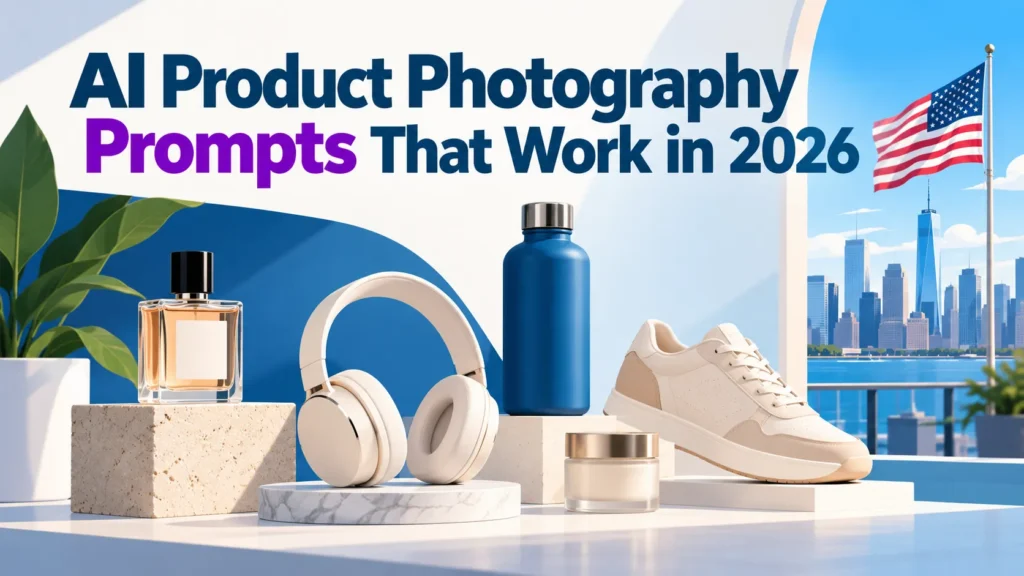
Most sellers get one good AI product photo, then struggle to match the next nine. Fixed shooting constraints applied to every image solve this. This guide gives you a spec sheet, a catalogue run and copy-ready ai product photography prompts that professional ecommerce teams can reuse.
Fix camera angle, aspect ratio, lighting and background; vary only the product and one scene element.
Log model version and parameters (for example –v 5.2 –ar 16:9) with every prompt.
Run a pass/fail check on each test batch before listing.
Table of Contents
Why Most AI Product Photography Prompts Fail
A Worked Catalogue Run: Ten Products, One Spec Sheet
Anatomy of a Product Photography Prompt
Starting Values by Product Category
Copy-Ready Product Prompts
Conclusion
Why Most AI Product Photography Prompts Fail
Most failed AI product images do not come from weak wording. They come from a prompt that never pinned down what the camera should see. A prompt built on “beautiful,” “premium,” or “stunning” gives the model no fixed point, so each generation drifts in angle, light and framing. Sellers often rewrite the same prompt many times and still end up with a catalogue where no two mugs share a background. The fix is a set of constraints that stay constant across every image, which is the core of professional results.
Our thesis is that a prompt is a repeatable specification, not a creative description. Fixed prompts produce a consistent catalogue; varied prompts do not. A working prompt names the angle (close-up, front view, overhead, macro or wide-angle, as Lyndium’s guide to AI product prompts lists them), the aspect ratio and the lighting. A top-down cappuccino shot in a published Midjourney prompt collection works because the angle is fixed in the wording.
Single-prompt collections, such as Stockimg AI’s 20 e-commerce samples, show what is possible but rarely explain how to keep a 10-product set consistent. A prompt that works once is not a system.
Copy-Ready Product Prompts
Each prompt fixes five fields and changes only the product and one scene element. These prompts suit ecommerce sellers and professional photography teams who want to create consistent [product images](#) without booking a studio. Each one is a starting point for [midjourney](#) generation, and the output still needs a human check before publishing.
Prompt 1 (ceramics): A ceramic mug on a wooden table, 45-degree angle, soft window light from the left, plain white background, folded linen, –ar 4:5 –s 150.
Prompt 2 (apparel): A knitted wool scarf draped over a chair, front view, soft window light, plain white background, a single leaf, –ar 4:5 –s 100.
Prompt 3 (food): A jar of artisan honey on linen, overhead angle, soft window light, plain white background, a sprig of thyme, –ar 1:1 –s 200.
A Worked Catalogue Run: Ten Products, One Spec Sheet
Before writing any prompt, fill in a one-page spec sheet with five fixed fields: camera angle, aspect ratio, stylisation, lighting and background. Only the product and one scene variable change between images.
For this run, the sheet reads: 45-degree angle, –ar 16:9, –s 200, soft window light from the left, plain white background.
Test three products side by side first. Pass only if angle, background and product proportion stay within the sheet’s limits. Record the model version, since parameter behaviour changes between releases.
Anatomy of a Product Photography Prompt
Five fields stay constant. Each prompt adds the product and one variable.
Subject, Material and Surface
Name the product, its material and its surface. “Ceramic mug on a wooden table” gives the model more to work with than “nice mug.”
Camera Angle, Framing and Aspect Ratio
Pick one angle per catalogue. A Midjourney food prompt in a published collection used –ar 16:9.
Lighting, Depth of Field and Output Quality
Lighting and depth of field set the premium feel. Lyndium’s premium example pairs dramatic studio lighting with shallow depth of field. Keep both identical across a set.
Stylisation and Parameter Settings
Stylisation (–s in Midjourney) controls how far output drifts from realism. Hold one value across the catalogue.
Starting Values by Product Category
These are starting points, not fixed rules. Values were tested on Midjourney v5.2, so re-test on your current version. Tie each value to your own test batch, and mark unverified values as.
Ceramics and drinkware: 45-degree angle, –ar 4:5, –s 150. Shows body, rim and glaze texture.
Apparel and textiles: Front view, –ar 4:5, –s 100. Shows fit without invented folds.
Jewellery and small accessories: Macro, –ar 1:1, –s 250. Shows detail and controlled sheen.
Conclusion
Small sellers lose time because every image starts from a blank page. A fixed spec sheet ends that: lock the camera angle, aspect ratio, stylisation, lighting and background, then change only the product and one scene variable. A shared prompt library lets every team member start from the same approved spec.
Which AI image tool works best for ai product photography prompts?
Compare tools on constraint stability: the one that holds your angle, lighting and background steady across a catalogue wins. Midjourney is widely used for stylised hero shots, and God of Prompt shows its flags in practice. Record each tool’s model version, since prompts drift between models.
How long should an ai product photography prompt be?
Long enough to fix the angle, lighting, aspect ratio, background and product, and no longer. Most run one to three sentences, with fixed fields identical across images.
About the author
Tom Koh
Tom is the CEO of MediaOne, a leading digital marketing agency. He is a business-experienced SEO consultant as well as a Google Gold Search Expert serving the international community. He has consulted for MNCs like Canon, Maybank, Capitaland, SingTel, ST Engineering, WWF, Cambridge University, as well as Government organisations like Enterprise Singapore, Ministry of Law, National Galleries, NTUC, e2i, SingHealth. His articles are published and referenced in CNA, Straits Times, MoneyFM, Financial Times, Yahoo! Finance, Hubspot, Zendesk, CIO Advisor. Under his stewardship, MediaOne has won dozens of prestigious digital marketing awards.
Your website has 150 published articles. Some attract consistent organic traffic, others haven’t generated a meaningful visit in months, and several cover nearly identical…
Writing a good advertisement sounds simple until you have to create 15 different headlines, stay within character limits, communicate your product’s benefits, and make…
Verifiability matters more than speed when publishing AI-generated content. An AI content generator turns a short brief into draft copy, and its usefulness depends…