SEO Audit
Free White Label SEO Audit Tool: What Agencies Actually Get
You’ve found a potential SEO client, reviewed their website, and identified several problems worth fixing. Now you need a professional audit report that explains…
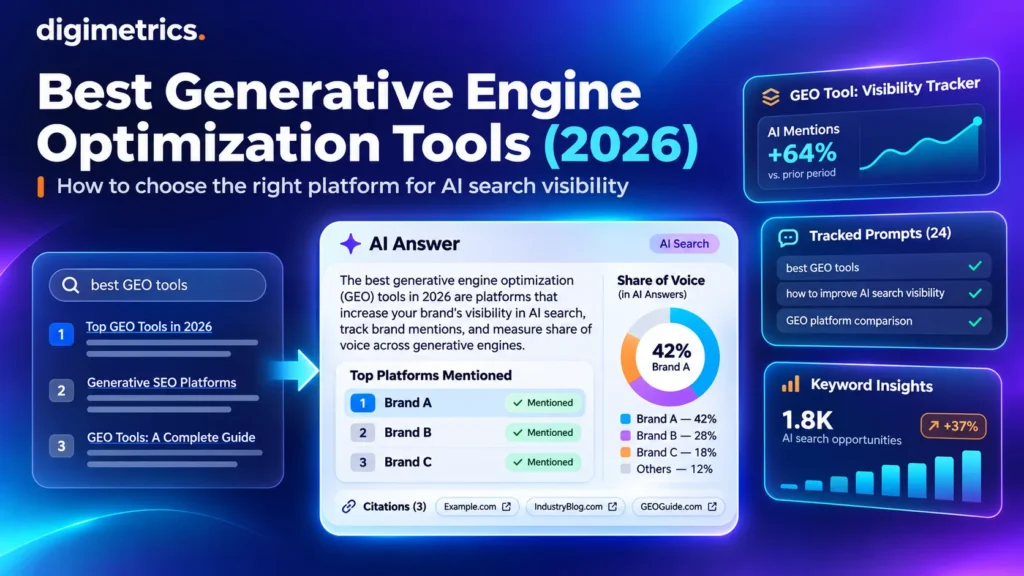
AI-generated answers are becoming another way buyers discover and evaluate brands. For marketing teams, that raises a new question: Is your company being named, accurately described, and cited when potential customers ask AI assistants for recommendations?
Traditional rank trackers cannot answer that question on their own. Generative engine optimization (GEO) tools fill the measurement gap by tracking brand mentions, competitor visibility, cited sources, and, in some cases, opportunities to improve content.
This guide compares 10 GEO tools, explains how to evaluate them, and provides a practical testing method before you commit to a subscription. Pricing information is in U.S. dollars (USD), reflects publicly accessible vendor pages checked in November 2026, and may change.
Google’s AI Overviews and conversational AI platforms present information differently from a conventional list of search results. An answer may recommend only a few brands, summarize their strengths, and sometimes cite the pages it relied on. A business can have a strong presence in ordinary search results even if a particular AI-generated answer does not mention it.
The shift is measurable, but it should be described precisely. In a Semrush analysis of more than 10 million keywords, Google AI Overviews appeared for 6.49% of studied queries in January 2025 and 15.69% in November 2025, after reaching 24.61% in July. These figures describe the study’s keyword sample, not every search worldwide.

For SEO leaders, content teams, and brand managers, the challenge is not simply to secure a higher ranking. It is to understand which buyer questions trigger a brand mention, what the answer says, and which third-party or first-party sources appear alongside it.
Platforms such as Digimetrics are part of the wider movement toward measuring AI search visibility. Regardless of the vendor you use, choose your metrics before comparing dashboards.
The tools below cover different priorities, from affordable prompt monitoring to enterprise reporting and content workflows. The order is a comparison sequence, not a claim that one vendor outperforms every other vendor in independent testing.
| GEO tool | Public entry price (USD) | Trial or free option | Best starting point |
|---|---|---|---|
| Otterly AI | $29/month (Lite) | Check signup terms | Budget-conscious prompt monitoring |
| Profound | Enterprise pricing: custom | Free 7-day trial listed | Enterprise AI answer analytics |
| Cognizo | $499/month (Growth) | Request a demo | Measurement plus content workflows |
| Semrush AI Visibility | $99/month per domain, billed annually | Confirm current trial terms | AI insights alongside broader SEO |
| Goodie | $295/month (Core) | 7-day trial listed | AI visibility and optimization actions |
| Scrunch AI | $250/month (Core, brands) | 7-day trial listed | AI visibility plus site audits |
| Peec AI | $95/month (Starter, published reference) | Trial advertised; check terms | Focused visibility analytics |
| AthenaHQ | $295/month (Starter) | Free Essential credits listed | Tracking and prioritized content actions |
| Promptwatch | $95/month (Essential) | Free trial advertised | Prompt and citation monitoring |
| Rankscale | $99/month (Pro) | 7-day trial advertised | Multi-engine, credit-based analysis |
Pricing note: Entry plans may not cover every engine, location, seat, or feature. Some quoted rates require annual billing. All plan details should be confirmed on the linked vendor pages before purchase.
Otterly AI is a practical option for smaller teams that want scheduled tracking without starting with a large enterprise contract. Its Lite plan lists 15 search prompts and covers ChatGPT, Google AI Overviews, Perplexity, and Microsoft Copilot.
Profound focuses on understanding how brands and competitors appear in AI answers. Its offering includes answer-engine analytics, source and sentiment research, and enterprise capabilities such as integrations and expanded reporting.
Cognizo combines AI search monitoring with content creation and publishing workflows. Its published Growth plan lists 150 tracked prompts, five platforms, and eight AI-optimized articles per month.
Semrush AI Visibility can appeal to teams already using Semrush for keyword research, competitor intelligence, and website audits. Its published base plan includes tracking for 25 custom prompts and brand visibility reporting across several AI surfaces.
Goodie positions itself as an AI search optimization platform that connects monitoring with research, content, and other recommended actions. Its published core plan lists coverage for five AI models and a seven-day trial.
Scrunch AI combines AI visibility monitoring with technical analysis of how a site can be accessed and understood by AI-driven systems. Its published Core plan for brands includes 125 unique prompts, five site audits monthly, and four AI platforms.
Peec AI emphasizes clear visibility reporting across AI platforms. Its Starter documentation describes 50 tracked prompts, three selected models, daily tracking, and unlimited users.
AthenaHQ combines cross-platform visibility measurement with recommendations for content and brand improvement. Its public site lists a free Essential credit allocation and a Starter subscription.
Promptwatch offers prompt monitoring, competitor comparisons, and AI citation data. Its Essential plan lists 50 prompts, four tracked models, and API or MCP access.
Rankscale uses credits to track AI answers across a broad set of models and search experiences. Its Pro plan lists 1,200 monthly credits, and its pricing page provides a calculator to estimate consumption.
Generative engine optimization (GEO) is the practice of improving the accuracy, relevance, and discoverability of a brand or website in AI-generated answers. It overlaps with answer engine optimization (AEO) and traditional search engine optimization (SEO), but the performance measures are not identical.
Traditional SEO examines rankings, indexed pages, search impressions, and organic traffic. GEO adds questions such as: Was the brand mentioned? Was the description favorable and accurate? Which sources were cited? How did the answer compare with competitors? Does AI-driven referral traffic lead to useful business outcomes?
SEO still matters. Helpful content, accurate product information, accessible page structure, and credible references support discovery in multiple search experiences. But there is no simple one-to-one relationship between an organic ranking and the position of a brand inside a generated answer. Some AI answers provide citations; others do not.
Begin with the data you need for decisions, then check how each vendor produces it. A useful dashboard should make its scope and methodology understandable rather than offering a score without context.

Confirm which versions or experiences are tracked, including ChatGPT, Gemini, Perplexity, Claude, Google AI Overviews, and Google AI Mode as applicable. Ask whether geography, language, device, or account state affects sampling. Do not assume that a tool’s list of supported platforms is included in every subscription.
Look for the ability to enter and organize your own exact prompts, assign them to categories, and view the original response. Vendor-generated suggestions can help with discovery, but your core tracking set should reflect real customer questions.
At a minimum, the platform should distinguish a brand being named from a website being cited. Additional signals, such as favorable or unfavorable descriptions, answer placement, and competitor overlap, are useful when their definitions are clear.
Daily tracking can expose change, but frequent runs also increase cost and variation. You need a stable history and clear records of when and where each answer was collected. If the vendor changes the models or prompts being tracked, that change can affect trend comparisons.
Compare total cost for the same number of prompts, models, locations, and reporting intervals. Ask about CSV exports, API access, full answer text, cited URLs, user seats, and cancellation conditions. A low headline price may be less economical after add-ons or overage charges.
Run the same buyer-relevant prompts through two or three shortlisted tools during the same period. Where possible, use the same country, language, and AI model selection. Manually validate a selection of results instead of assuming the dashboards will agree perfectly.
For a mid-sized B2B marketing team, the following example weights make prompt quality the leading decision criterion. Adapt the weights to your actual priorities.
| Criterion | Weight | What a score of 5 means |
|---|---|---|
| Prompt control | 35% | Create, edit, group, and export the exact prompts being tracked. |
| AI engine coverage | 30% | Covers the engines and regions your buyers actually use. |
| Cost per tracked prompt | 20% | Transparent total cost at your intended tracking frequency. |
| Data export | 15% | Download historical responses and the cited URLs you need. |
Illustrative scoring example: Tool A scores 4, 3, 4, and 2 on the criteria above, for a total of 3.40 out of 5. Tool B scores 2, 5, 3, and 5, for a total of 3.55 out of 5. Tool B ranks slightly higher under these weights, but Tool A could still suit a team that prioritizes prompt control. These are fictional scores, not live test results.
Replace the bracketed terms with your category, audience, and market. Use the same finished wording for each vendor.
For a more meaningful baseline, expand this list to 20–30 genuine customer questions. Record the date, location, engine, full response, mention status, and citations. Repeat each prompt several times to understand variability, especially before reporting changes as performance gains.
Tracking visibility identifies a gap; it does not automatically solve it. Improvements should begin with clearer, more helpful content and trustworthy supporting evidence rather than attempts to force a brand mention into every answer.

Lead with a direct answer. When a page targets a specific question, answer it near the start of the relevant section. Follow with useful context, comparisons, examples, and limitations. Organize headings around user intent rather than repeating the same keyword.
Support claims with evidence. Verify statistics against primary sources, give their dates, and distinguish your own research from outside claims. Update facts that can change, such as product features, pricing, regulatory requirements, and service coverage.
Use structured data where it accurately matches the page. Article and other relevant schema types can help search engines understand content. However, Google limits FAQ rich results primarily to authoritative government and health websites. Adding FAQPage markup is not a guaranteed route into Google AI Overviews or other AI answers.
Monitor the results over time. After meaningful page updates, rerun a fixed prompt set and review changes in mentions, source citations, accuracy, and AI referral traffic. A single response is not enough evidence of a sustained improvement.
The best GEO tool measures what your team can act on. A focused team may need a small set of prompts and reliable exports; a multinational business may require extensive engine coverage, localization, integration, and governance.
Start with a clear baseline: write 20–30 customer questions, shortlist two or three tools, inspect sample answers by hand, and compare the full cost at the same tracking volume. Preserve historical data so you can distinguish a meaningful trend from normal variation in AI responses.
Most importantly, keep the SEO fundamentals in place. GEO should add a new measurement and optimization layer, not replace technical quality, helpful content, or credible brand building.
Generative engine optimization (GEO) is the process of improving how accurately and prominently a brand, product, or website is represented in AI-generated answers. It includes content quality, discoverability, citations, brand accuracy, and measurement.
Yes. Technical accessibility, useful pages, and credible sources remain important. Traditional SEO measures rankings and organic search performance, while GEO tools add visibility into AI-generated mentions, citations, and competitor presence.
They typically run or collect responses to a set of prompts, identify whether brands appear, and analyze supporting details such as citations, sentiment, or competitors. Tracking methods differ, so you should check prompt selection, model coverage, and sampling during a trial.
Entry plans in this comparison range from roughly $29 per month to several hundred dollars per month, with custom enterprise pricing at the upper end. Plan allowances and annual-billing requirements can be more important than the headline fee. Confirm the latest price directly with the vendor.
Several providers advertise limited trials, free credits, or demonstrations. Use your own buyer prompts to evaluate coverage, outputs, and export options. Trial conditions may change, so confirm what is included before registering.
No. Accurate, relevant structured data may help search engines interpret a page, but it does not guarantee an AI citation or mention. Google also restricts FAQ rich-result eligibility primarily to well-known government and health websites.

Tom is the CEO of MediaOne, a leading digital marketing agency. He is a business-experienced SEO consultant as well as a Google Gold Search Expert serving the international community. He has consulted for MNCs like Canon, Maybank, Capitaland, SingTel, ST Engineering, WWF, Cambridge University, as well as Government organisations like Enterprise Singapore, Ministry of Law, National Galleries, NTUC, e2i, SingHealth. His articles are published and referenced in CNA, Straits Times, MoneyFM, Financial Times, Yahoo! Finance, Hubspot, Zendesk, CIO Advisor. Under his stewardship, MediaOne has won dozens of prestigious digital marketing awards.
Run a free Digimetrics audit across SEO, AI search, content and technical health, and get a plan you can act on today.
Start free →You’ve found a potential SEO client, reviewed their website, and identified several problems worth fixing. Now you need a professional audit report that explains…
Your website looks fine. The pages load, the navigation works, and visitors can contact your business. But does that mean your website is healthy?…
Your website has 150 published articles. Some attract consistent organic traffic, others haven’t generated a meaningful visit in months, and several cover nearly identical…