SEO Audit
Competitor SEO Analysis Tool: How to Choose One and Use It to Outrank Rivals
Contents hide 1 Key Takeaways 2 How to Choose a Competitor SEO Analysis Tool 3 Introduction: Why a Competitor SEO Analysis Tool Matters in…
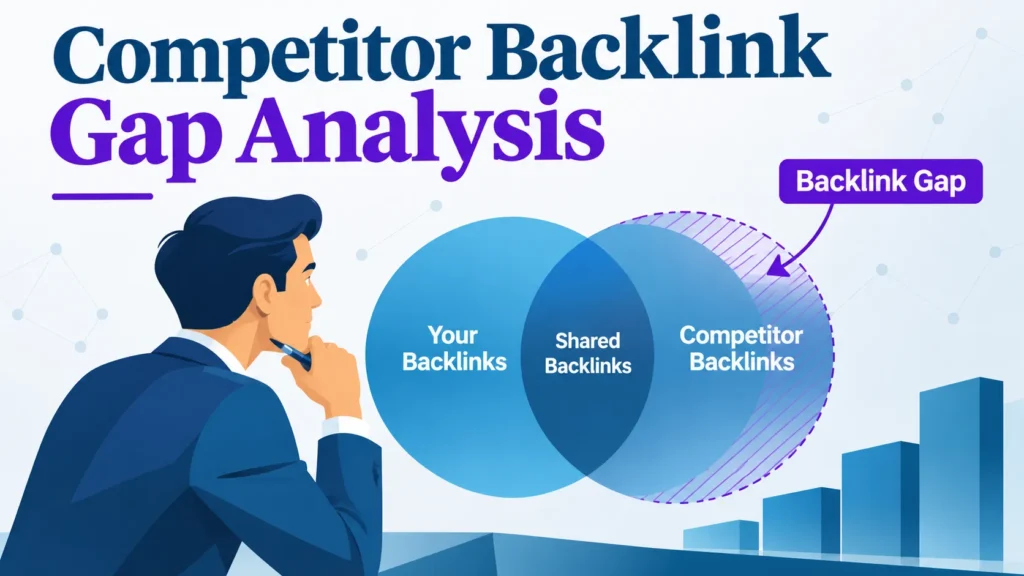
A competitor backlink gap analysis finds domains that link to your competitors but not to you, turning “get more links” into a ranked list of sites worth contacting.
Backlinks help separate pages that earn search traffic from those that do not. According to the Ahrefs study of ranking pages, 96.55% of web pages get no traffic from Google.
The process: confirm real competitors, export their referring domains, remove domains that already link to you, then score what remains. Referring-domain diversity matters more than raw link volume.
Use the best SEO tools to run the analysis.
Your real competitors are the sites that rank for the same searches as you, which may not be the businesses you think of as rivals. Build a list of domains that compete for your US search visibility before pulling link data. Use a competitor analysis tool to surface domains ranking for your priority queries, then confirm them by hand.
Most backlink tools offer a shortcut. SEMrush provides up to six formulae for finding main competitors, and four are relevant for backlink and keyword discovery. Use them to build a shortlist, then check each domain against your target queries.
Keyword research is the most reliable discovery method. Search your priority terms in US Google results and treat domains that appear repeatedly on the first page as primary competitors. Domains that surface only occasionally are domain-level competitors.
Segment the list. Primary competitors drive your main gap report, while domain-level competitors help you spot niche link opportunities.
Export referring domains for each competitor, not just backlinks, because the domain is the unit that matters. Fifty referring domains can produce 5,000 backlinks. When most come from a few sites, the profile carries concentration risk rather than real strength.
Next, identify referring domains that link to competitors but not to you. Note how many competitors each one links to and whether it links to several distinct pages or one repeated page. This separates editorial interest from a single sponsored placement or directory listing.
Work through candidate domains in batches. Score each one using the criteria in the next section, record the result, and flag the strongest prospects first.
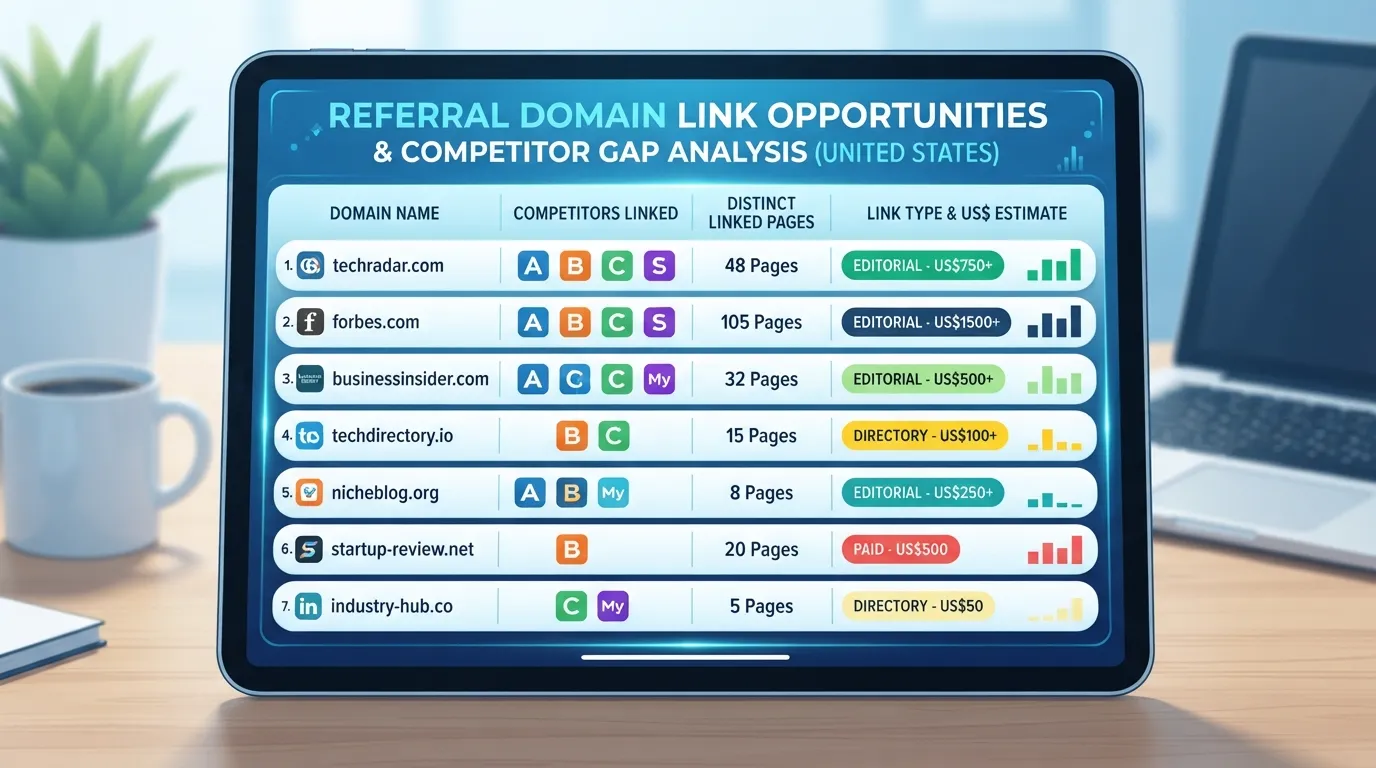
A gap list is only useful once it is ranked. Score each candidate referring domain on the four criteria below, then apply the decision rules that follow.
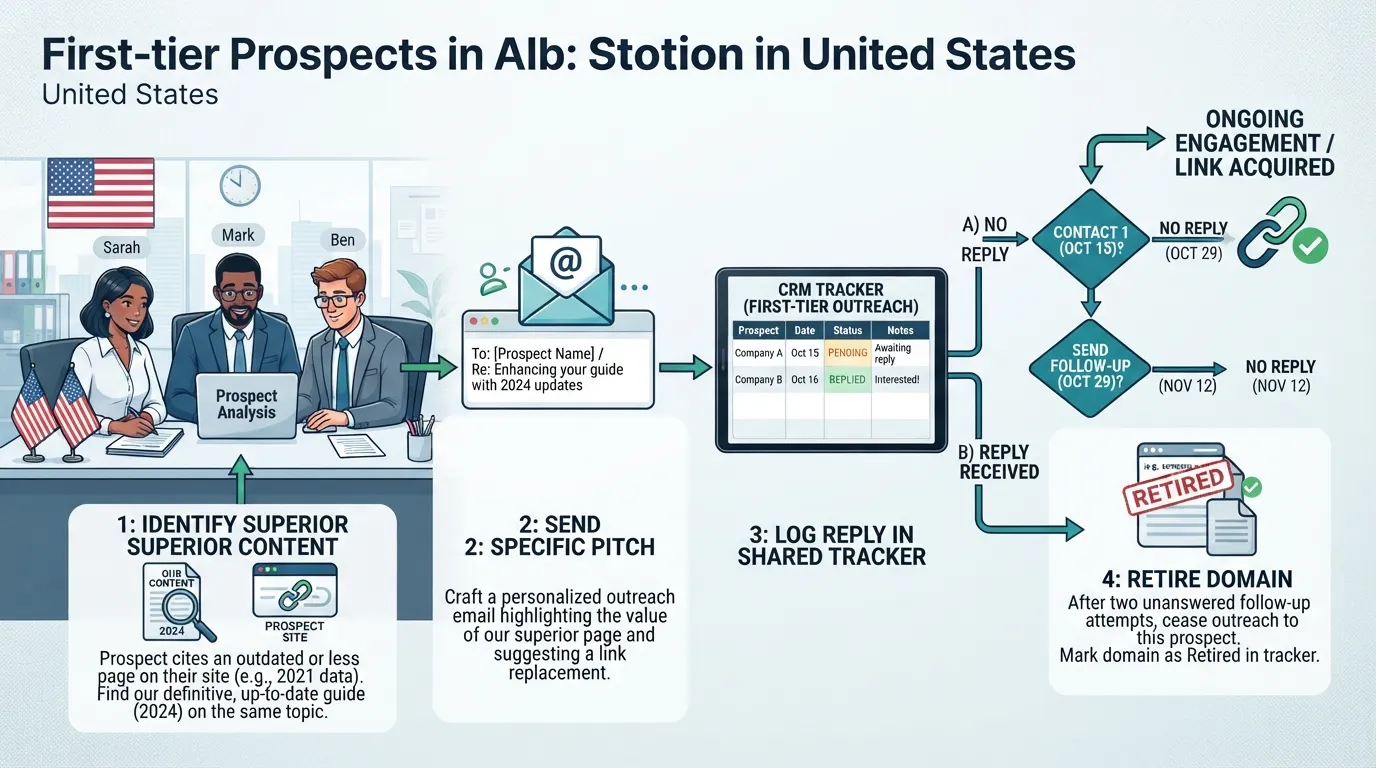
Domains that pass all four form your first outreach tier. Domains that fail two or more move to the bottom of the list. Domains that pass only three go to the second tier, reviewed once the first tier has been contacted.
Treat these thresholds as starting points. In a small niche, a domain linking to one competitor may still merit the second tier. In a large niche, require stronger overlap before a domain reaches the first tier.
A concentrated profile is acceptable when the links are editorial and point to a strong, relevant page, such as a well-cited study. It is a warning sign when they come from one sponsored placement or a template-driven directory.
Weight each competitor by how closely it matches your target queries, then use the weights to decide which domains count as a gap.
For example, suppose competitors X, Y and Z carry weights of 3 (strong match), 2 (partial match) and 1 (weak match). A domain linking to X and Y scores 5. A domain linking only to Z scores 1. With a first-tier cut-off of 4, the X and Y domain qualifies and the Z-only domain does not.
Drop a competitor when it ranks for fewer than a handful of your priority queries, or when its link profile is mostly directories. Weak competitors inflate the gap list with domains that would never have linked to you.
Working down an export of referring domains for competitors X, Y and Z:
On a real export, expect the shortlist to be a fraction of the raw total, with the first tier far shorter still.
A common approach ranks gaps by total backlink count. Imagine a competitor with 800 backlinks, 700 from one reseller network and a sponsored blog. A volume report would flag it as the top gap, yet reaching that site yields a single placement rather than the broad editorial coverage the count implies. Count referring domains and distinct pages first, and let volume be the tiebreaker.
Gaps that could reach page one deserve priority. Industry data cited by digitalmarketingtools.ai suggests around 90% of Google users never go beyond page one, so a link that lifts a page into the top results is worth far more than one that lifts it to page three.
A backlink gap shows where competitors earn links you lack, and calls for outreach. A content gap shows topics competitors cover and you do not, and calls for writing. Mixing them produces topics you cannot promote and links you cannot earn.
Pitch each first-tier domain with a specific reason to link, usually a page that is clearly better or more current than the one it already cites. Track replies in a shared sheet, and retire a domain after two unanswered contacts.
A competitor backlink gap analysis is only as good as the decisions it produces. Filter competitor links on quality and relevance, score each referring domain, and send outreach to the domains that pass. An SEO audit tool helps you track progress. Treat vendor growth claims as hypotheses until your own data confirms them.
A competitor backlink gap analysis compares domains linking to your competitors with those linking to your site. Domains that link to competitors but not to you are your link gaps. Filter out repeat and low-relevance sources, then rank the rest so outreach starts with the strongest prospects.
Start with your top five competitors for your chosen keyword. Fewer than three gives a narrow view; more than five dilutes results.
Run a full analysis quarterly and check high-value gaps monthly.
No. Links are only one ranking signal. Link quality, content relevance and search intent also matter.

Tom is the CEO of MediaOne, a leading digital marketing agency. He is a business-experienced SEO consultant as well as a Google Gold Search Expert serving the international community. He has consulted for MNCs like Canon, Maybank, Capitaland, SingTel, ST Engineering, WWF, Cambridge University, as well as Government organisations like Enterprise Singapore, Ministry of Law, National Galleries, NTUC, e2i, SingHealth. His articles are published and referenced in CNA, Straits Times, MoneyFM, Financial Times, Yahoo! Finance, Hubspot, Zendesk, CIO Advisor. Under his stewardship, MediaOne has won dozens of prestigious digital marketing awards.
Run a free Digimetrics audit across SEO, AI search, content and technical health, and get a plan you can act on today.
Start free →Contents hide 1 Key Takeaways 2 How to Choose a Competitor SEO Analysis Tool 3 Introduction: Why a Competitor SEO Analysis Tool Matters in…
Multi-location businesses can get a misleading picture from a rank tracker that checks keywords from one central point. Customers in other neighborhoods may see…
Most small and mid-sized US sites do not need a paid rank tracker. Google Search Console is free and reports real data on your…