SEO Audit
Competitor SEO Analysis Tool: How to Choose One and Use It to Outrank Rivals
Contents hide 1 Key Takeaways 2 How to Choose a Competitor SEO Analysis Tool 3 Introduction: Why a Competitor SEO Analysis Tool Matters in…
Multi-location businesses can get a misleading picture from a rank tracker that checks keywords from one central point. Customers in other neighborhoods may see different results. This guide explains how to compare local rank tracker tools by sampling density, since how a tool samples location determines whether its numbers are meaningful. Many firms overbuy keyword volume and general reporting when they need dense, place-specific sampling. For the wider toolkit, see the best local SEO tools guide.
A local rank tracker measures where a business appears for a search term from a specific place, not one global position. It shows what a nearby customer sees in the map pack and organic results, so it samples results from many points around a business rather than one city centre.
A standard rank tracker records one position per keyword, usually from a fixed location. A local rank checker reports how rankings shift by location, showing where visibility drops off. Use a standard tracker for broad informational pages, and a local tool when customers search near a physical address.
Local results depend on the Google Business Profile, reviews, proximity and the map pack, which often sits above organic listings. A page can rank well nationally and still be absent from the local pack where the business earns revenue. Judge tools in the best local SEO tools category on whether they reproduce that map-pack view, not keyword volume alone.
A single rank number tells you little about a multi-location business. A listing can rank near the top for a search at the front desk and fall far down the results a few miles away. What matters is what a customer sees from where they stand, so a tool’s value depends on how it samples location, not on how many keywords it tracks. Tools built for local seo reporting should show that spread, not one figure.
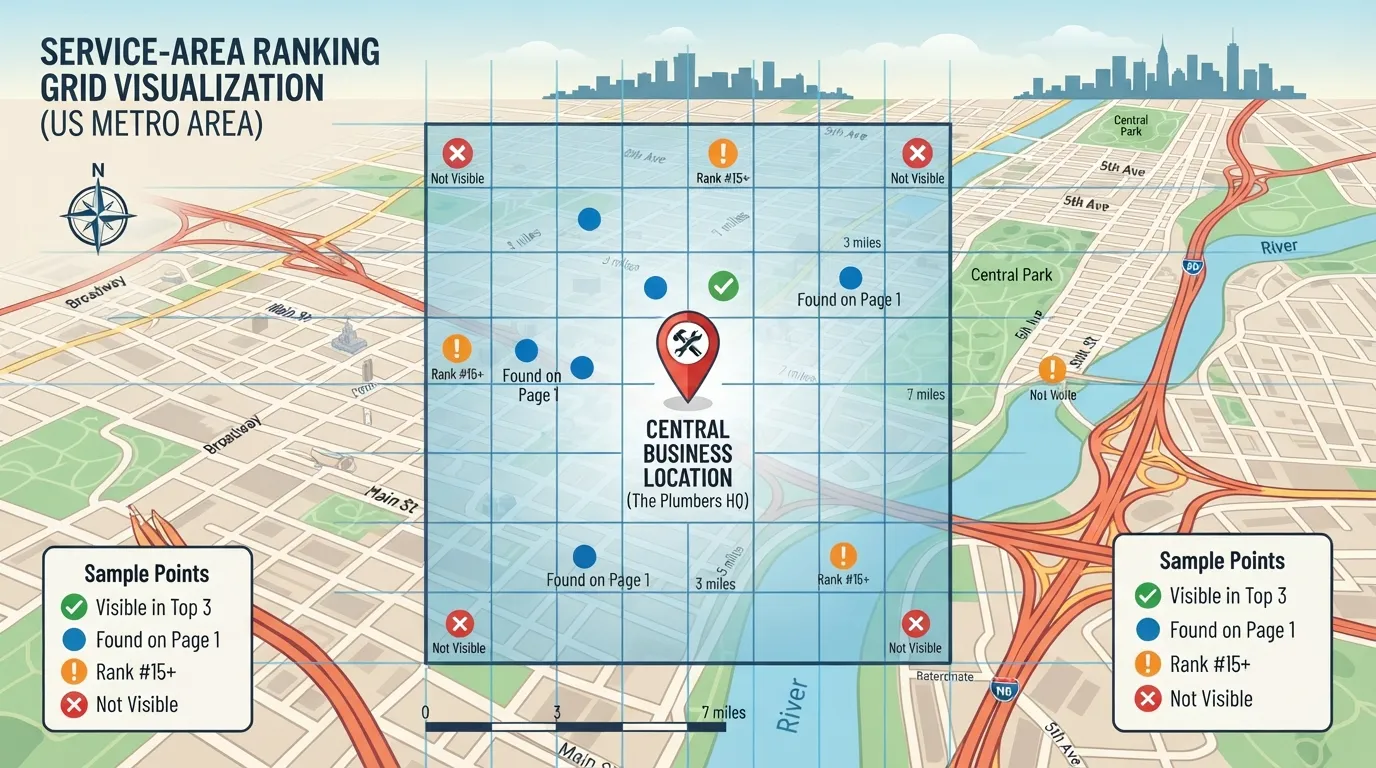
A tool that searches from one central point reports the view from that point only. Ask any candidate tool whether it uses true device location or a city-level proxy, and whether it separates the local pack from organic results. The best tools make that distinction clear in their documentation and reports. Free tools often sample fewer points, so check what a free plan actually covers before you rely on it.
A geo grid samples rankings at many points around a business. Before trusting one:
Track that visibility percentage over time. In a hypothetical example, a move from 30 to 60 percent of points tells you more than one position moving from 6 to 4. Review the performance of each location against its own grid, since a single average hides weak areas.
Map pack results differ from organic results and change with proximity and the strength of your Google Business Profile. Google’s Business Profile help documentation explains how profile information is used, and its local search guidance explains how nearby results are shown. Track mobile and desktop results separately, because the local pack often varies between them. Profile reviews also influence placement, so note any changes alongside your ranking data. Insights from the Business Profile dashboard can help you explain shifts in these results.
Decide what each feature must answer before comparing vendors. The key question is whether a tool shows what a customer sees in a specific place, and tools differ mainly in how they sample location. Insights into local visibility depend on that sampling, so check it first.
Grid density matters more than keyword count. Points spaced too far apart can miss the neighbourhoods where a plumber or dentist actually wins work. A 5-mile area sampled at 2-mile intervals gives only a handful of readings. Confirm the tool covers the Google Maps local pack, not just the organic list.
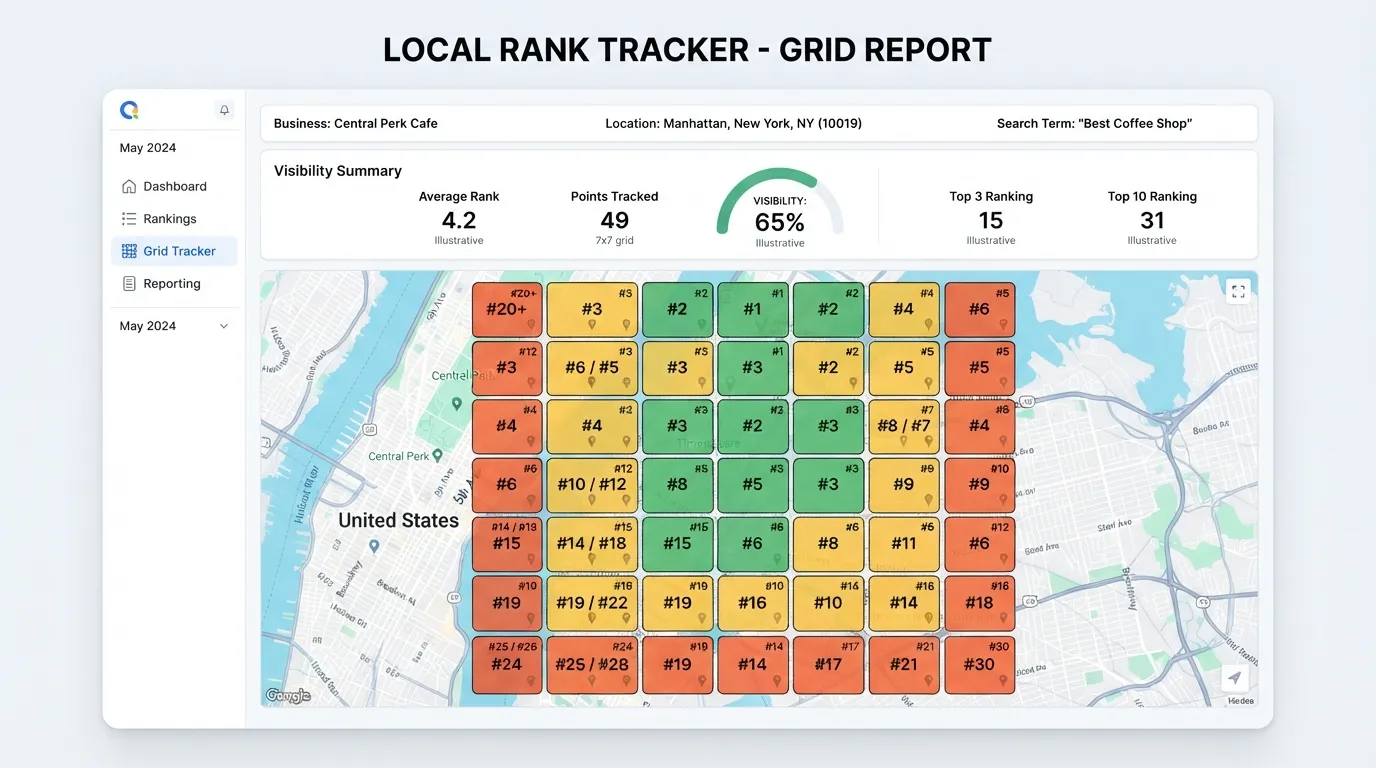
Google holds 86.1% of the US search market and Bing 8.92%, according to Statcounter’s August 2026 US reading. Confirm each engine is tracked separately, since google search results are not the same as Bing’s. Mobile and desktop map results often differ, so a tool that merges them can hide a weak mobile position.
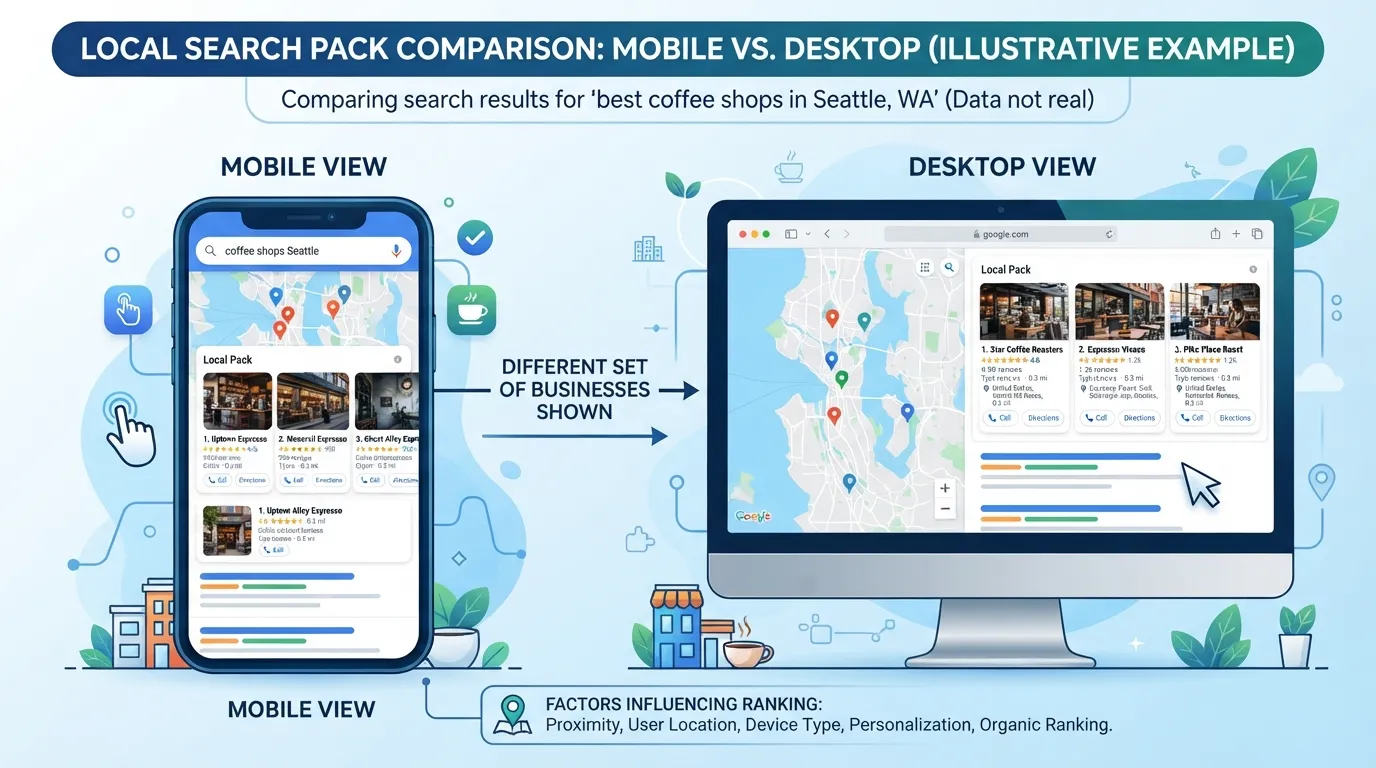
Score each tool from 1 to 5 on five criteria during trials. This guide does not include vendor ratings.
| Criterion | What to check | Score 1 | Score 3 | Score 5 |
|---|---|---|---|---|
| Geo-grid granularity | Sample points and radius covered | Few points, coarse spacing | Mid-density grid over the main service area | Dense grid across the full service radius |
| Maps and local pack coverage | Map pack placements captured, not just organic | Organic only | Local pack for some terms | Local pack and organic for every term |
| Multi-engine support | Google, Bing and Yahoo tracked separately | One engine | Two engines, reported together | Each engine tracked and reported separately |
| Desktop vs. mobile separation | Separate results per device type | Devices merged | Side by side for some terms | Separate for every term and location |
| Frequency and change reporting | Check schedule and change history | Manual or irregular | Scheduled, basic change view | Scheduled, with change history per location |
Weight the total by the number of locations you serve. A tool that scores well in one city may fall short across several.
“A business with locations in several cities can use a tool like Local Falcon to sample a grid of points spaced a short distance apart across each service area. Over a set period, it can track how often it appears in the local pack at each point on mobile compared with desktop, using the performance data to judge local search visibility. The gap shows where competitors outrank it in Google Maps and search results. Run the same grid for every location, then compare the mobile and desktop reviews and ranking data side by side to find the areas where visibility drops most.”
A single-location business usually needs only a standard local tracker covering one metro. Multi-location operators, such as dental groups or restaurant chains, need fine grids around each service area and per-location reporting. Google Business Profile Manager supports bulk management for 10 or more locations, so match the tracker to that footprint. Use a generic rank tracker for one city and a few terms. Use a local-specific tool for several neighborhoods or ZIP codes.
Local rank tracking earns its cost only when it measures what a customer actually sees: the map pack and organic results for a specific place. A tool’s worth comes from how it samples location, not from how many keywords it watches. Businesses with 10 or more locations can manage them in bulk through Google Business Profile Manager.
Run the scorecard against a trial before committing, weighting results by how many locations you serve. The guide includes no vendor ratings, so base scores on your own trial results.
Start with one service term, one metro and one grid, and review results for a month before expanding.
No. A standard rank tracker usually checks a site’s position from one central point and reports a single number. A local rank tracker samples results across a geo grid of points around a business, because map pack and local organic results shift with the searcher’s location. Confirm any tool you evaluate samples location, not just keywords.
Check high-intent service terms weekly, and check the full grid monthly or after a major change such as a category edit, an address change or a surge of new reviews. Compare results over a fixed window, such as four weeks, so normal fluctuation is not mistaken for a trend.
Not exactly. Grid tracker outputs are simulated approximations based on chosen points, devices and search engines. Personalisation and real-time changes can shift a live result. Treat the tracker as a consistent measuring instrument rather than a perfect mirror, and judge changes over time rather than from single readings.
Google should come first, since it sends 87.63% of all search referrals. In the United States, Google holds 86.1% of the search market and Bing 8.92%, according to Statcounter’s August 2026 reading. Track Bing only if your analytics show your customers use it in meaningful numbers. Confirm the tool reports mobile and desktop results separately.
Limits vary by product and plan, so check each vendor’s current figures during a trial. Businesses with 10 or more locations can manage them in bulk through Google Business Profile Manager, so confirm your tool can group locations, set a separate grid for each, and export results per site.
Free checkers are useful for a quick spot check of one keyword from one point. They rarely offer grid sampling, historical reporting or multi-engine coverage. Use them to sanity-check a single result, then move to a trial or paid version when you need trend data.

Tom is the CEO of MediaOne, a leading digital marketing agency. He is a business-experienced SEO consultant as well as a Google Gold Search Expert serving the international community. He has consulted for MNCs like Canon, Maybank, Capitaland, SingTel, ST Engineering, WWF, Cambridge University, as well as Government organisations like Enterprise Singapore, Ministry of Law, National Galleries, NTUC, e2i, SingHealth. His articles are published and referenced in CNA, Straits Times, MoneyFM, Financial Times, Yahoo! Finance, Hubspot, Zendesk, CIO Advisor. Under his stewardship, MediaOne has won dozens of prestigious digital marketing awards.
Run a free Digimetrics audit across SEO, AI search, content and technical health, and get a plan you can act on today.
Start free →Contents hide 1 Key Takeaways 2 How to Choose a Competitor SEO Analysis Tool 3 Introduction: Why a Competitor SEO Analysis Tool Matters in…
A competitor backlink gap analysis finds domains that link to your competitors but not to you, turning “get more links” into a ranked list…
Most small and mid-sized US sites do not need a paid rank tracker. Google Search Console is free and reports real data on your…