Most link outreach emails go unanswered because they are written to a list rather than to a person with a reason to care. A platform-wide average reply rate of 3.43% shows how common that is, and a good link outreach email template fixes targeting before it fixes wording.
This guide takes a decision-first approach. Rather than sorting by email type, it helps you match each prospect to the right message based on the signals you can find about them. It covers copy-ready templates, why cold email fails, what earns a reply, and the follow-up habits most senders skip.
Signal-triggered emails earn far more replies than generic templates; persona-based sends trail by about 5x.
Keep the first email between 50 and 125 words for about 50% higher reply rates.
Average reply rate is 3.43%; signal-based segments reach 15% to 25%.
Follow-ups generate 42% of replies, yet 48% of reps never send one.
Keep bounce rates below 3% by cleaning your list first.
Judge results by reply rate, not open rate.
Table of Contents
Copy-Ready Link Outreach Email Templates
Why Most Cold Outreach Fails
The Anatomy of an Email That Earns a Reply
Personalization That Actually Scales
Follow-Ups, Bounces and List Hygiene
Conclusion and Next Steps
Frequently Asked Questions
Copy-Ready Link Outreach Email Templates
Use each link outreach email template as a starting point, not a script. Keep every email between 50 and 125 words, since shorter emails earn roughly 50% higher reply rates than longer formats. Choose the template that matches the signal you have found about the prospect, then fill in the details. Cold email outreach works best when the template fits the specific reason you are writing.
Reply rates cluster by segment, so pick the template by the signal you found first. The matching rules are below.
Broken Link Outreach Email
Use this when a page on the prospect’s site links to a resource that no longer loads. Lead with the dead link, not your content.
Subject: Broken link on your SaaS pricing guide
Hi Maya, the link to your CRM tool comparison on your pricing guide returns a 404. We published a current guide on the same topic at digitalmarketingtools.ai/crm-pricing, covering monthly costs and onboarding time. Thanks, Sam
Signal to look for: a 404 on a page that already links to a topic you cover. Follow-up step: none needed if they fix the link; otherwise send one note with the new URL four to six days later.
Resource Page Outreach
Show that your page belongs on that specific list.
Subject: An addition for your CRM resources page
Hi Maya, your CRM resources page is one of the most useful lists we have found. We recently published digitalmarketingtools.ai/crm-pricing, which compares tool costs and onboarding time side by side. Would you consider adding it? Thanks, Sam
Signal to look for: a resources page on a topic you cover, with no link to a newer or more specific page. Follow-up step: if there is no reply, send one short note with a new angle four to six days later.
Unlinked Mention Outreach
When a site has written about your brand or study without linking to it, the ask is small. Thank them first.
Subject: Thanks for mentioning our CRM study
Hi Maya, thanks for including our CRM study in your piece on tool pricing. Would you link to the original source at digitalmarketingtools.ai/crm-study so readers can check the figures? Thanks, Sam
Signal to look for: a named mention of your brand or study with no hyperlink. Follow-up step: none required; a thank-you usually settles it.
Guest Post Pitch
Guest post pitches fail most often because they propose a topic the editor has already covered. Name a specific angle and offer an outline, not a finished draft. Check the editor’s archive before pitching, since editors accept guest posts more readily when the angle is clearly new to their readers.
Subject: Guest article idea on onboarding time
Hi Maya, I read your recent piece on CRM pricing and liked how you handled monthly costs. I would like to pitch “How Long CRM Onboarding Really Takes”, covering the setup steps most buyers underestimate. I can send a 200-word outline if useful. Thanks, Sam
Signal to look for: the editor has published on a neighboring topic but not this angle. Follow-up step: if there is no reply, send one short note with a new angle four to six days later.
Data Pitch to Journalists
Journalists respond to exclusive, specific findings. Lead with the finding, not the request for coverage.
Subject: New data: onboarding time in CRM tools
Hi Maya, we analyzed onboarding times across the CRM tools in our comparison and found that most teams need longer than the vendors suggest. The methodology and charts are at digitalmarketingtools.ai/crm-study. I can share the raw figures or arrange a short call. Thanks, Sam
Signal to look for: a journalist who covers your topic and has written about a related problem. Follow-up step: if there is no reply, send one short note with a single new figure from the same data.
Podcast or Interview Pitch
Hosts want guests who will give their audience something specific. Suggest a concrete topic and show you have listened to the show.
Subject: Guest idea for your marketing podcast
Hi Maya, I have listened to several episodes of your show, especially the one on pricing pages. I would be glad to talk about how marketing teams can evaluate tool costs before they sign, which your listeners would likely find useful. I can send a short bio and talking points. Thanks, Sam
Signal to look for: a recent episode on a related theme or a host who asks for guest ideas. Follow-up step: if there is no reply, send a short note with one new talking point.
Link Reclamation Outreach for Lost SEO Value
Reclamation targets pages that once linked to you but no longer do, often after a redesign or a removed article. Check the page first, then ask.
Subject: Link to our guide removed from your resources page?
Hi Maya, your resources page used to link to our CRM pricing guide, but the link no longer appears. The guide is still live and updated at digitalmarketingtools.ai/crm-pricing. Would you be open to restoring the reference? Thanks, Sam
Before sending, confirm the removal was not deliberate. A reclamation request to a site that removed the link on purpose is the fastest way to lose a contact. Post outreach follow-ups should wait at least four days, so a single reminder does not come across as pressure.
Why Most Cold Outreach Fails
Most cold emails fail before the prospect reads past the first line, and the reason is rarely the offer. A 2026 analysis found that 65% of decision-makers say cold emails feel too sales-focused. A clear value proposition in the opening line can change that perception, because prospects decide quickly whether a message is relevant to their work and whether the sender has taken the time to learn their name.
Platform-wide average reply rates sit at 3.43%, a figure that blends generic outreach with researched campaigns. Top performers consistently exceed 10%, and signal-based segments reach 15% to 25%.
If your reply rate sits at 4%, check the segment before rewriting your email outreach template. A campaign built on prospects who recently engaged with your topic will outperform a scraped list, even with identical copy. Signal-triggered emails outperform persona-based templates by roughly five times, so targeting usually matters more than wording. Free tools can help you find those signals without a large budget.
Most advice on this topic starts with the template and treats the list as a given. That order produces the 3.43% average. Start with the signal instead, and the same wording earns a different result.
The Anatomy of an Email That Earns a Reply
Length: Why 50 to 125 Words Outperforms Longer Formats
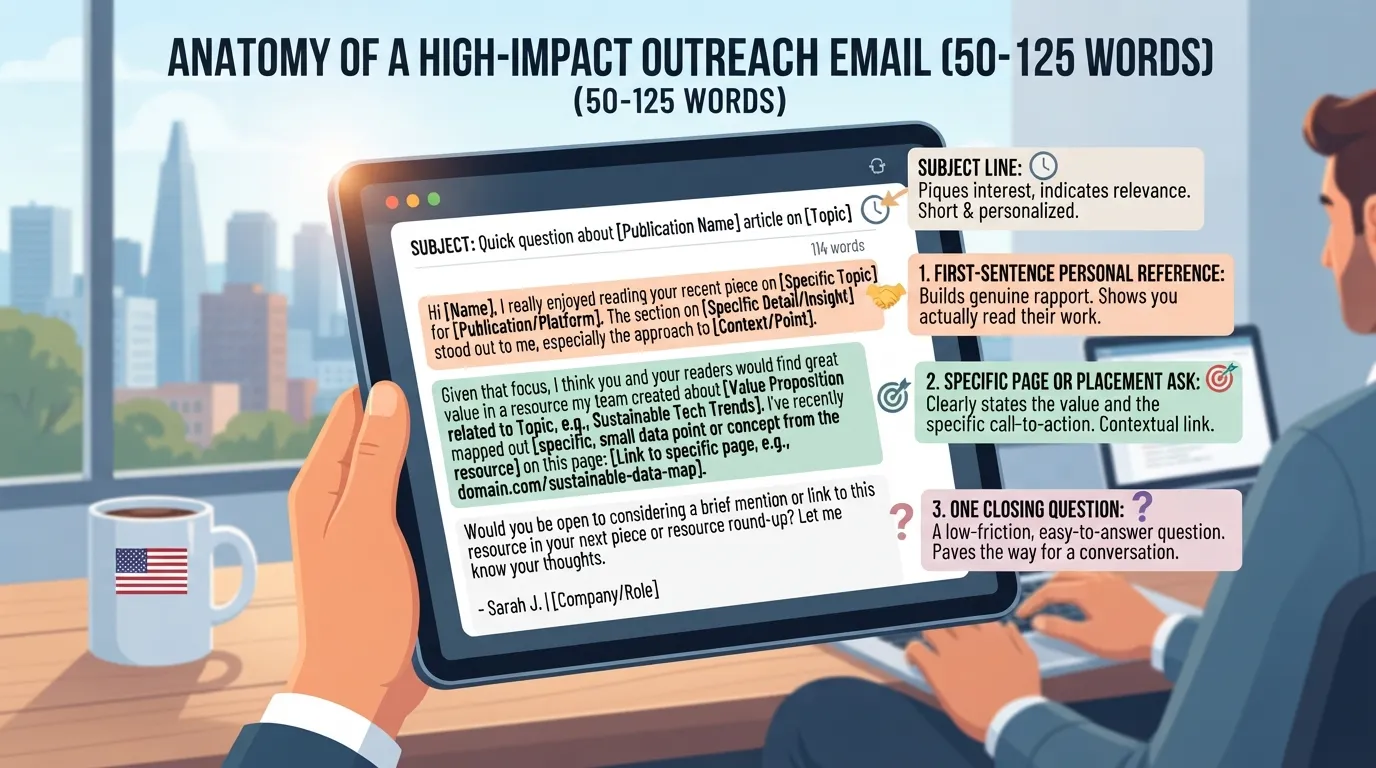
Most outreach templates run 200 to 300 words, and recipients skim them and move on. Emails of 50 to 125 words achieve roughly 50% higher reply rates than longer formats, according to the Respona link building outreach guidance. A short cold email that gets to the point gives busy readers a reason to reply. Well-built email templates keep this length, so each one stays concise enough to read in a single pass.
A 100-word email leaves room for three things: a reason you chose this recipient, the specific page or mention you found, and one clear ask. Delete any sentence that does none of these jobs.
Subject Lines That Earn the Open
Keep the subject line short, specific and plain. Name the page, the topic or the broken link. Avoid clickbait, urgency and anything that looks like a newsletter. Campaigns using simple, specific subject lines of this kind report open rates of 60% to 80%, per Respona’s link building outreach guidance.
Outreach type
Example lines
Broken link
“Broken link on your SaaS pricing guide”
Resource page
“An addition for your CRM resources page”
Unlinked mention
“Thanks for mentioning our CRM study”
Guest post
“Guest article idea on onboarding time”
Data pitch
“New data: onboarding time in CRM tools”
Podcast
“Guest idea for your marketing podcast”
Reclamation
“Link to our guide removed from your resources page?”
Test each subject line against the recipient’s inbox, not your own sense of cleverness.
The Opening Line: Earning the Second Sentence
The first sentence gets the reader to the second, so make it about them. Refer to something they published, a problem they solved or a gap on their page. Do not open with “I hope this finds you well” or a description of your company. Keep the same personal opening whether you send a cold email or a guest post pitch, and adapt that opening to fit each set of email templates you use.
Weak: “My name is Sam and I work at a company that helps teams grow.”
Stronger: “Your guide to choosing a CRM covers pricing well, but it does not mention onboarding time, which is the question most of our customers ask first.”
Relevance matters more than polish, which is why signal-triggered emails outperform persona-based templates by 5x on reply rate, per the same benchmark source.
The Ask: Making a Link Request Easy to Say Yes To
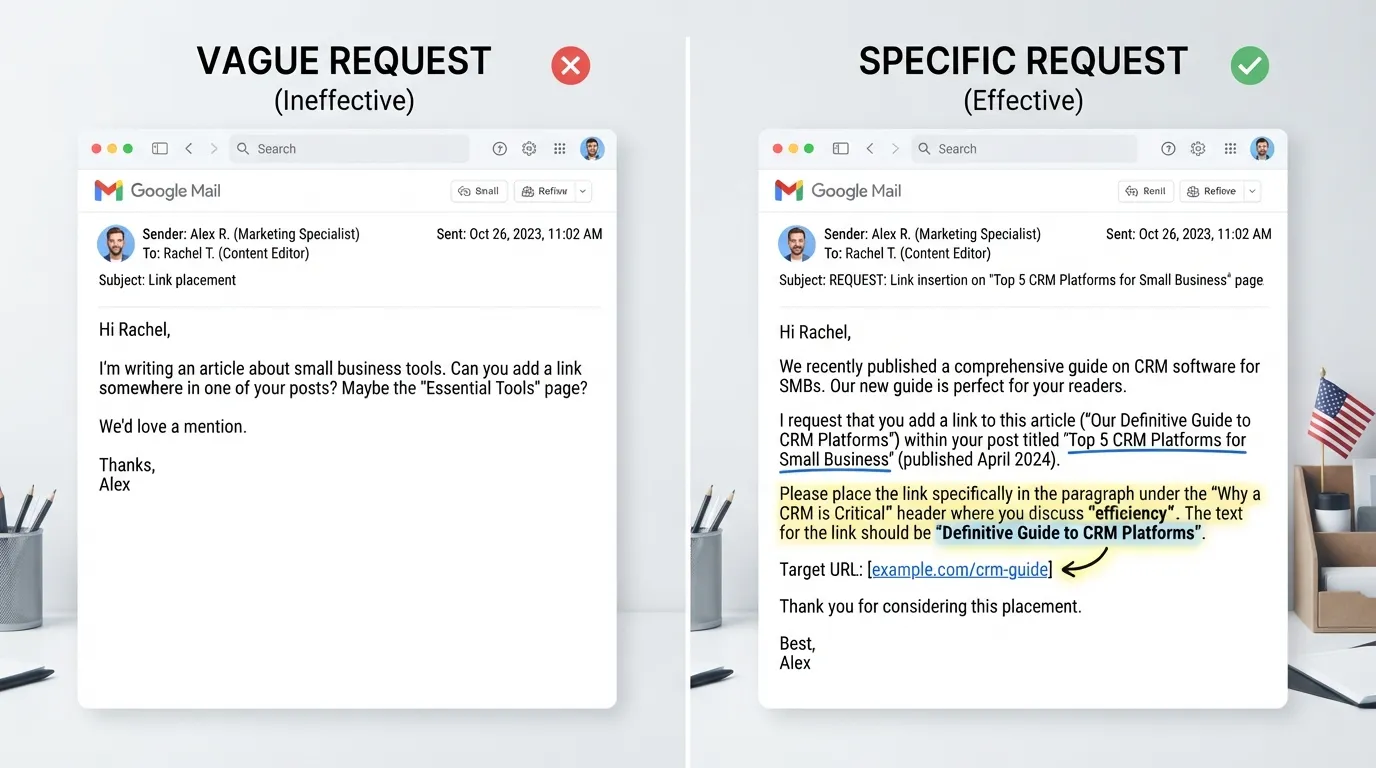
A link request fails when it asks the recipient to do too much. Name the exact page, placement and link, then make the reply easy. Compare these two asks:
Vague: “Would you be open to including a link to our site somewhere in your content?”
Specific: “Would you consider adding a link to our pricing comparison in the section on tool costs, next to your existing list of options?”
The specific version tells the recipient what to change and why it helps their reader. Close with one question, not two. If the recipient declines, thank them and move on, since a polite close is more likely to earn a future link than a pushier follow-up.
Sending From a Custom Domain and Why Open Tracking Can Backfire
Two technical choices affect reply rates more than most writers expect. The first is the sending address. Campaigns sent from a custom domain deliver a 108% higher reply rate than those sent from a freemail account. Results vary by list and sender reputation.
The second is open tracking. Tracking pixels are small invisible images that report when an email is opened. Many mailbox providers block images by default, so open counts undercount some readers and overcount others. In one comparison, campaigns without open tracking saw a 68% higher reply rate (7.4% against 4.4%). Turn tracking off for first-touch emails and judge the campaign on reply rate instead.
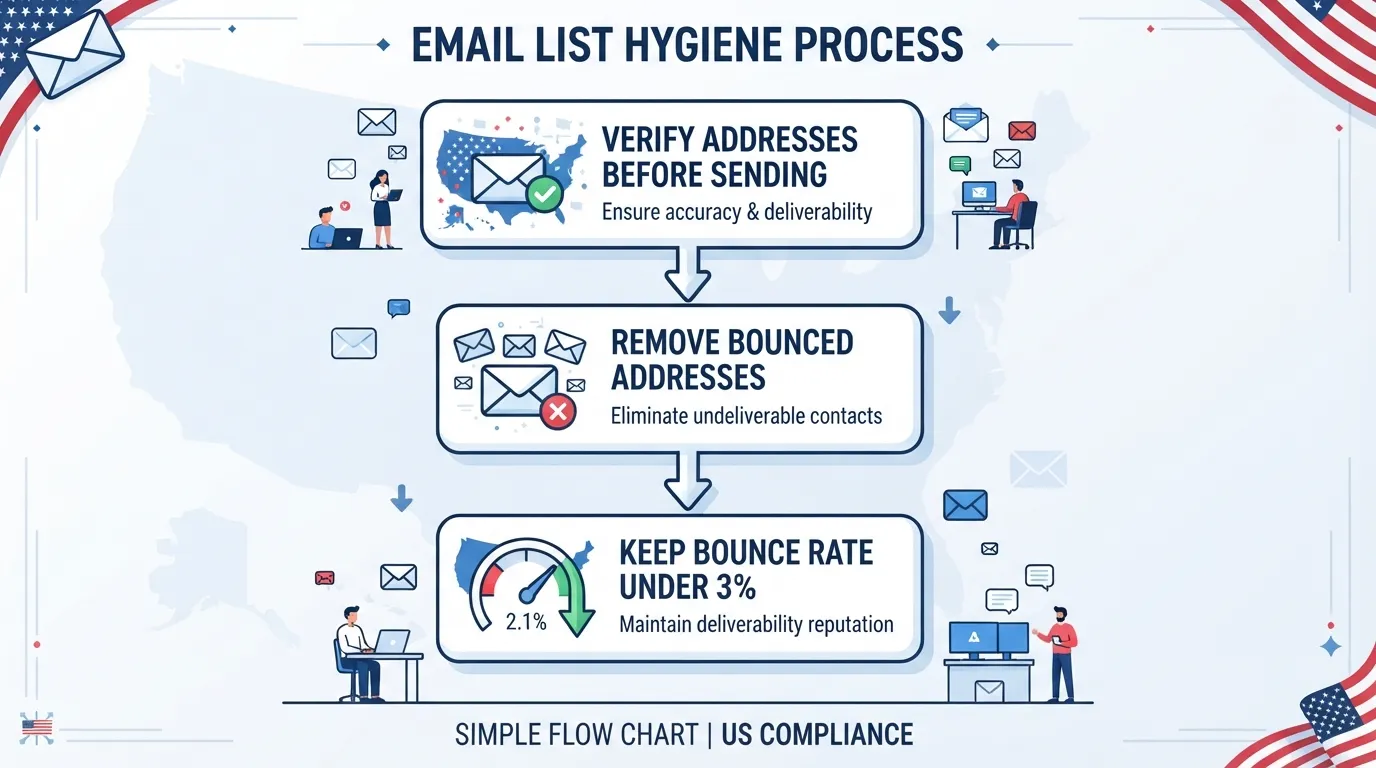
Deliverability, meaning the chance your email reaches the inbox rather than spam, connects to both choices. Keep your bounce rate under 3%. As a practitioner heuristic, treat anything above that as a warning sign, since higher rates are widely read by email providers as a signal of guessed addresses. Check Google’s bulk sender requirements for current limits, and verify addresses before you send.
Personalization That Actually Scales
Most link outreach fails because the email could have been sent to anyone. Readers spot a generic message within a sentence, and a generic template is the default advice that underperforms. Bespoke emails for every prospect do not scale, so personalize where a real signal exists and deprioritize the rest. An outreach template works only as well as the research behind it. Name the specific article or broken link, then explain in one line why your page helps the reader. A well-researched value proposition in that line makes a cold email feel relevant rather than random.
Signal-Triggered Versus Persona-Based Outreach
Persona-based outreach sends the same message to everyone in a job title or industry group. Signal-triggered outreach waits for a specific event, such as a new article, a broken link or an unlinked mention, and writes the email around that event. The Respona guide to link building outreach reports that signal-personalized outreach reaches 15 to 25 percent replies, against a 3 to 5 percent industry average. Use persona lists for research, and send each email only when a signal gives the content a reason to exist.
Most advice starts from a template and then hopes a name is enough to lift the result. The evidence points the other way: the template is the weak part, and the signal is what earns the reply. Choose the prospect first, then choose the email that fits that prospect’s signal.
Research Checklist: Five Signals to Find Before You Write
Spend five to ten minutes per prospect and look for these signals, in order of strength:
A recent, specific publication that touches your topic.
A broken link on their page that points to a resource you can replace.
An unlinked mention of your brand or study.
A resource page in your niche that accepts additions.
A stated editorial need, such as a call for guest post contributors.
If none appear, deprioritize the prospect. If one or more appear, write a tailored email of 50 to 125 words. Emails of that length achieve roughly 50 percent higher reply rates than longer formats, according to the same Respona guide.
Each signal suits a different kind of pitch. A broken link fits a link reclamation or replacement email, an unlinked mention fits a simple request for a link, and a stated editorial need fits a guest post pitch. Matching the signal to the pitch type keeps the email short and specific.
Personalizing Without Faking It
Compliments that could apply to any site read as a template with a name inserted. Personalization works when it proves you did the work: name the exact article, quote the broken link, or reference the section that makes your resource relevant. Avoid unverifiable praise, and keep every template free of anything you cannot back up.
Use the signal to set up the ask, then stop. One specific observation, one reason your page fits their readers, and one clear request is enough. Make post-outreach notes reflect what each prospect actually responded to.
Follow-Ups, Bounces and List Hygiene
Most link outreach campaigns are won or lost after the first email. Follow-ups generate a large share of replies, yet most people never send one.
The Two-Email Follow-Up Sequence
Send the first email, then two follow-ups, and stop there:
Day 0: the initial email. A tailored message built around a specific signal and a clear value proposition.
Day 4 to 6: the first follow-up. Add a new angle, such as a fresh data point or a correction to a broken link on the same page.
About Day 14: the closing follow-up. A short note saying you will not write again unless they want you to, which keeps your post outreach respectful.
Keep both follow-ups to about three sentences. A new reason to reply works better than “just bumping this.” The closing note removes pressure, and recipients often answer a graceful exit they would have ignored earlier.
Why 48% of Reps Stop After One Email
According to Respona, follow-up emails generate 42% of campaign replies, yet 48% of reps never send a second message. The gap is a process problem, not a writing problem. Schedule all three touches before you send the first cold email, and build each one from a reusable email template.
Email Decay, Bounce Rates and Keeping Your List Clean
Email lists age quickly. According to Respona, the yearly decay of an email database can be as high as 22.5%. A common practitioner heuristic is to treat a bounce rate above 3% as a warning sign, since it suggests guessed addresses. This is a rule of thumb, not a published provider threshold, and deliverability also depends on your sender reputation.
Use this checklist before each campaign:
Verify addresses before sending, and remove any that fail.
Check the bounce rate after each send, and pause the campaign if it rises above 3%.
Remove hard bounces immediately, and never retry them.
Re-verify contacts older than six months before reusing them.
Drop guessed addresses such as firstname@, since they are a deliverability risk.
Log every outcome so you never re-contact someone who has declined or already replied.
When bounce rates are high, fix the list before judging the wording.
Conclusion and Next Steps
Recipient selection and timing matter more than template wording. Signal-personalized outreach reaches 15 to 25% reply rates against a 3 to 5% industry average, according to figures reported by Respona.
Start this week:
Score each prospect against the five-signal checklist and send only to those with a clear signal, and give each prospect a name-specific reason for the email.
Remove bouncing addresses and keep bounce rate under 3%.
Schedule follow-ups: a new angle at days four to six, then a polite close around two weeks.
Measure reply rate rather than open rate across every email outreach campaign, and treat each reply as something to learn from. For tools, see the seo tools guide and the seo audit tool overview.
Frequently Asked Questions
How long should a link outreach email be?
Aim for 50 to 125 words. Emails in that range earn roughly 50% higher reply rates than longer formats. Cut anything that describes your company or product, and keep the ask short enough to read in seconds. The link outreach email template examples earlier in this article show what that length looks like in practice.
What is a good reply rate for link outreach?
Judge results against your own segment, not the platform average of 3.43%. Signal-based segments reach 15 to 25%, while the wider industry average sits at 3 to 5%. A relevant prospect who reads the message and replies is a better measure than a raw count of sends.
How many follow-ups should I send?
Send two follow-ups, three emails in total. The first adds a new angle four to six days after the original. The second is a polite close about two weeks later. Both are three sentences, and the second gives the prospect a clear way to say no.
What subject lines work best for link outreach?
Short, specific subject lines that name the page or content perform better than clever ones. Open rates for link building campaigns using this approach range from 60% to 80%, according to Respona’s link building outreach guide. Test a plain version of your own subject line against a named-page version before you scale.
How do I personalize outreach at scale?
Start from a signal, not a persona. Score prospects on signal strength, email those with a clear signal, and deprioritize the rest. Research from 2024 indicates personalized emails get a response rate of around 8.9% to 17.4%, while non-personalized ones only get 0.4%.
Should I use open tracking in outreach emails?
Probably not. Email clients can block tracking pixels, making open data unreliable. Judge campaigns by replies instead.
About the author
Tom Koh
Tom is the CEO of MediaOne, a leading digital marketing agency. He is a business-experienced SEO consultant as well as a Google Gold Search Expert serving the international community. He has consulted for MNCs like Canon, Maybank, Capitaland, SingTel, ST Engineering, WWF, Cambridge University, as well as Government organisations like Enterprise Singapore, Ministry of Law, National Galleries, NTUC, e2i, SingHealth. His articles are published and referenced in CNA, Straits Times, MoneyFM, Financial Times, Yahoo! Finance, Hubspot, Zendesk, CIO Advisor. Under his stewardship, MediaOne has won dozens of prestigious digital marketing awards.
Your website has 150 published articles. Some attract consistent organic traffic, others haven’t generated a meaningful visit in months, and several cover nearly identical…
Writing a good advertisement sounds simple until you have to create 15 different headlines, stay within character limits, communicate your product’s benefits, and make…
Verifiability matters more than speed when publishing AI-generated content. An AI content generator turns a short brief into draft copy, and its usefulness depends…