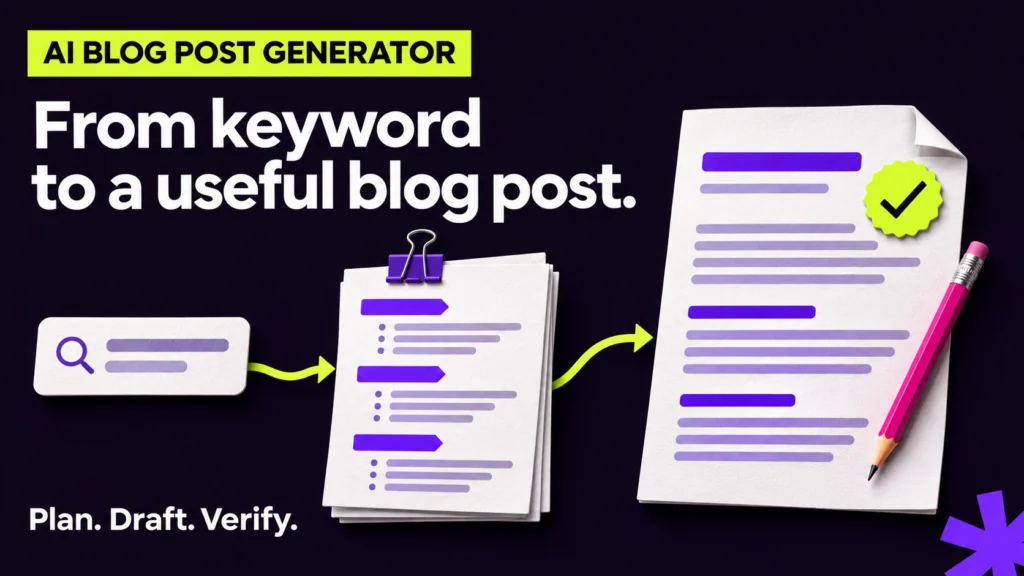
You have a keyword worth targeting, but turning it into a useful blog post takes more than writing an introduction and filling the page with headings.
You need to understand the search intent, research the topic, organise the information, write the draft, verify claims and make sure the finished article provides something readers can’t find in every competing result.
An AI blog post generator can speed up several of those steps.
Instead of starting with a blank document, you can generate a structured article from a topic, target keyword and writing brief. More advanced tools also analyse existing search results, create outlines and check the draft for quality issues before handing it over for editing.
But generating a complete article in minutes doesn’t automatically make it ready to publish.
The difference between a useful AI writing tool and a generic text generator comes down to the research, structure and editorial controls built into the workflow.
Digimetrics AI Content Generator researches pages ranking for your keyword, prepares an outline, writes the article section by section and grades the result against 44 quality criteria.
This guide explains how AI blog post generators work, what to look for when choosing one, and how to turn AI-generated drafts into accurate, useful content designed around your audience’s needs.
What Is an AI Blog Post Generator?
An AI blog post generator is software that uses artificial intelligence to create blog articles from instructions such as a topic, target keyword, audience or short content brief.
Depending on the platform, it may assist with several stages of content production:
- Topic research: Identifying relevant questions and subjects.
- Outline creation: Organising headings and sections.
- Article drafting: Writing introductions, explanations, examples and conclusions.
- SEO alignment: Incorporating target keywords and relevant subtopics.
- Editing: Improving grammar, clarity and readability.
- Quality checking: Identifying possible errors, repetition or unsupported claims.
Some generators handle only the writing stage.
Others combine research, planning and quality checks into a more structured process.
For example, a basic generator might receive the instruction “write a blog post about email marketing” and produce 1,500 words immediately.
A research-focused generator may first examine the target keyword, identify important questions and develop an outline before drafting.
The second approach provides more context, although it still cannot guarantee factual accuracy or originality.
An AI blog post generator should reduce repetitive production work while leaving important editorial decisions under human control.
How Does an AI Blog Post Generator Work?
Most AI blog generators follow a process involving inputs, drafting and revision.
The sophistication of those steps varies between tools.
1. You Provide a Topic or Keyword
The process begins with the subject you want to cover.
For SEO content, the target keyword helps define the article’s intended search audience.
Consider the keyword “email marketing for small businesses.”
An article targeting this phrase should probably explain practical strategies for smaller teams rather than focus entirely on enterprise email automation systems.
Providing the keyword gives the generator direction, but the topic still requires appropriate research.
2. The Tool Plans the Article
Some generators create an outline before writing.
This may include the introduction, major sections, supporting headings and frequently asked questions.
An outline helps reduce unnecessary repetition and makes it easier to assess whether the planned article answers the reader’s question.
3. AI Generates the Draft
Once the structure is established, the tool writes the content.
The output may contain explanations, examples, tables and other material depending on the instructions and supported features.
4. Quality Checks Identify Issues
More advanced tools evaluate the output for readability, keyword placement and other quality conditions.
These checks can make editing easier, but they cannot independently confirm every claim or replace original research.
5. An Editor Prepares the Final Version
The draft should be reviewed for accuracy, usefulness and appropriate search intent before publication.
Add firsthand experience, verify factual claims, improve weak explanations and remove unnecessary material.
Our guide on where AI writing tools fit into editorial workflows explains why generation speed matters less than the quality of the research, verification and editing surrounding the draft.
What Should You Look for in an AI Blog Post Generator?
The best AI blog writer isn’t necessarily the one that produces the longest article.
Evaluate the features that make the final content easier to publish.
| Feature | Why It Matters |
|---|---|
| Keyword research context | Helps align content with search demand |
| Search-result analysis | Shows which questions and formats are relevant |
| Outline generation | Creates a logical article structure |
| Word-count settings | Controls the intended level of detail |
| Tone settings | Supports consistent communication |
| Readability checks | Identifies difficult or awkward writing |
| Claim verification support | Flags information requiring review |
| Visible edits | Helps editors inspect automated changes |
| Content optimisation | Supports improvements to existing articles |
| Transparent pricing | Makes production costs easier to estimate |
A blog generator that creates an impressive-looking article may still require hours of editing if the research is weak.
When comparing tools, measure how much useful work they complete rather than how many words they generate.
Digimetrics AI Blog Post Generator: From Keyword to Graded Draft
Digimetrics provides a structured article-writing workflow through its AI Content Generator.
Rather than relying only on a general writing prompt, it uses the target keyword to research existing ranking pages before preparing the article.
The generator then builds an outline, writes the draft section by section and evaluates its output against a 44-point quality checklist.
Key Features
| Capability | What Digimetrics Provides |
|---|---|
| Keyword-focused research | Examines pages already ranking for the target keyword |
| Automatic outline | Organises the article into sections |
| Section-by-section drafting | Produces long-form content using the planned structure |
| Word-count controls | Lets users specify the intended length |
| Tone controls | Adjusts the writing style |
| Market selection | Adds geographic context |
| 44-point quality check | Evaluates the generated content |
| Quality grade | Reports a score out of 100 |
| Visible corrections | Lists the changes made during quality checks |
| Typical generation time | 1–5 minutes |
| Free trial | Seven days without a credit card |
The important distinction is that Digimetrics doesn’t stop after producing the text.
Its quality review provides feedback about the draft, allowing editors to see which issues were identified and what was changed.
What Does the 44-Point Quality Check Do?
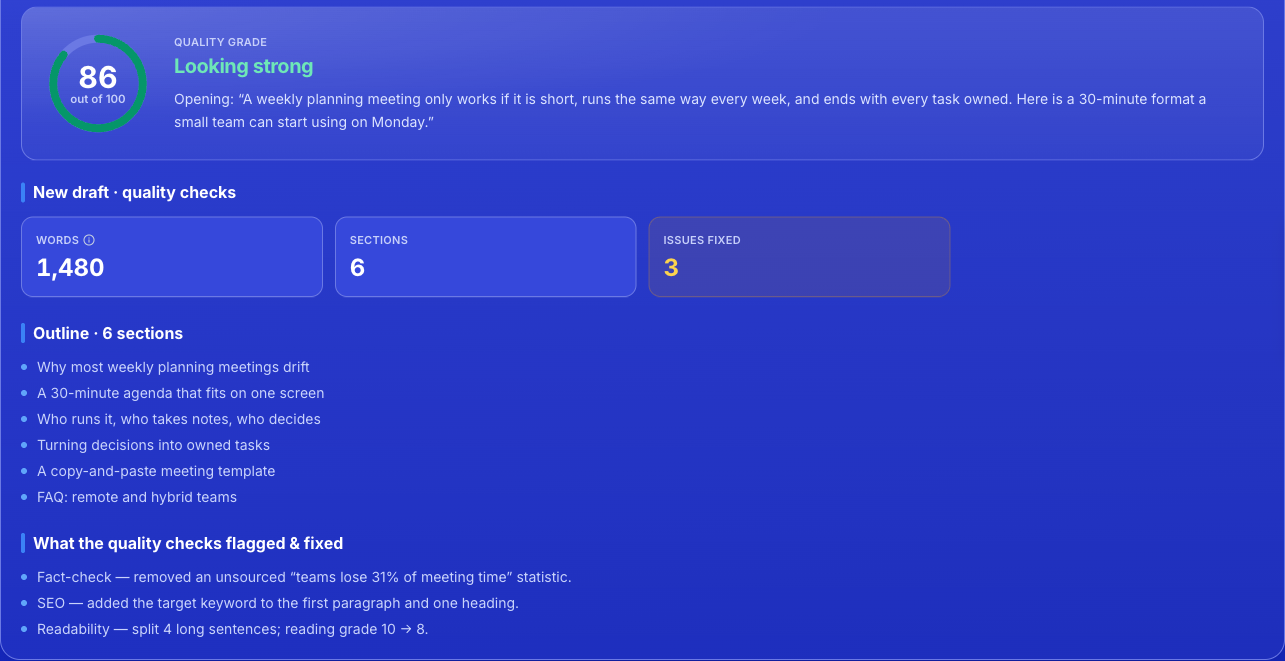
Digimetrics evaluates generated articles against 44 criteria and returns a numerical quality grade.
Its published example shows a 1,480-word article organised into six sections, with a grade of 86 out of 100.
The tool reports three corrections in that sample:
- Removing an unsupported statistic.
- Adding the target keyword to important locations.
- Simplifying long sentences to improve readability.
These examples demonstrate the type of quality feedback the system provides.
However, an automated grade is not the same as editorial approval.
An article scoring 86 does not have an 86% probability of ranking on Google. The score reflects Digimetrics’ internal criteria rather than a search engine ranking metric.
Editors should still verify important information and assess whether the article offers genuine value.
How to Generate a Blog Post With Digimetrics
You can create an initial SEO blog post in three main steps.
Step 1: Enter Your Topic and Target Keyword
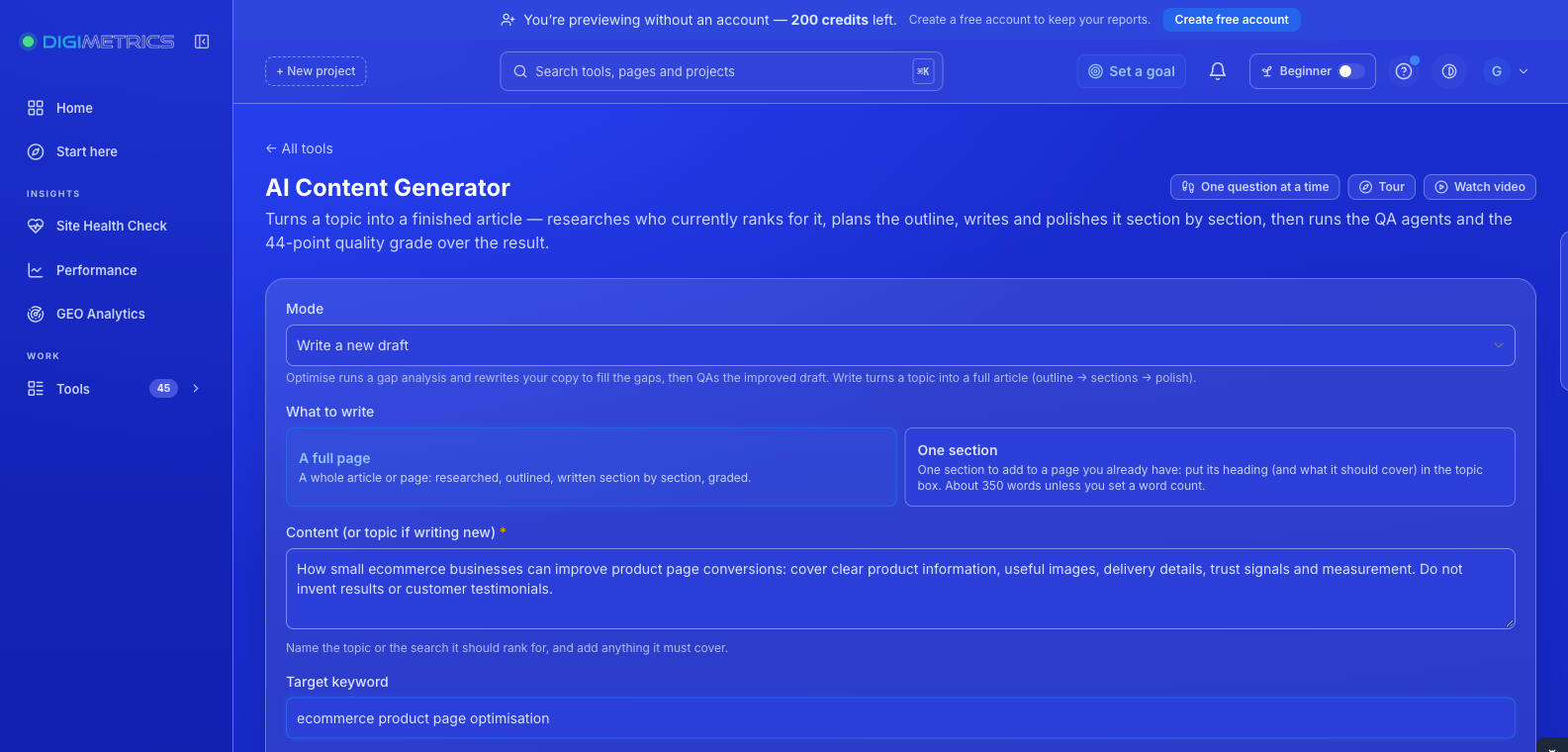
Open the Digimetrics AI Content Generator and provide a short brief.
For example:
Topic: How small ecommerce businesses can improve their product pages.
Target keyword: ecommerce product page optimisation.
Market: Singapore.
The topic describes what the article should cover, while the keyword establishes its primary search focus.
If you haven’t chosen a keyword yet, start with Digimetrics Keyword Research to compare search volume, keyword difficulty, CPC and search intent.
Our seven-step keyword research guide also explains how to identify relevant searches before committing to a new blog post.
Step 2: Set the Article Length and Tone
Choose the intended word count and writing style.
For example, a straightforward tutorial may need 1,200 words, while a detailed comparison covering several products may require considerably more.
These are planning examples rather than fixed SEO requirements.
A longer article isn’t automatically better.
Choose a length that allows the content to answer the reader’s questions thoroughly without unnecessary repetition.
Step 3: Generate and Review the Draft
Digimetrics researches the target keyword, prepares an outline and produces the article.
It then runs its quality checks and returns the draft, its grade and a record of the corrections.
Review the structure before editing individual sentences.
Check whether each section serves a purpose and whether the article answers the main question directly.
Then verify facts, improve examples and add original insights before publication.
Example: Creating a Blog Post From One Keyword
Imagine an ecommerce business targeting the keyword “how to choose running shoes.”
The company wants to create an educational blog post that helps customers understand basic buying considerations.
A content brief might look like this:
| Setting | Example Input |
|---|---|
| Primary keyword | how to choose running shoes |
| Audience | Beginner runners |
| Content type | Educational buying guide |
| Target length | 1,500 words |
| Tone | Clear and helpful |
| Main objective | Explain the factors involved in selecting running shoes |
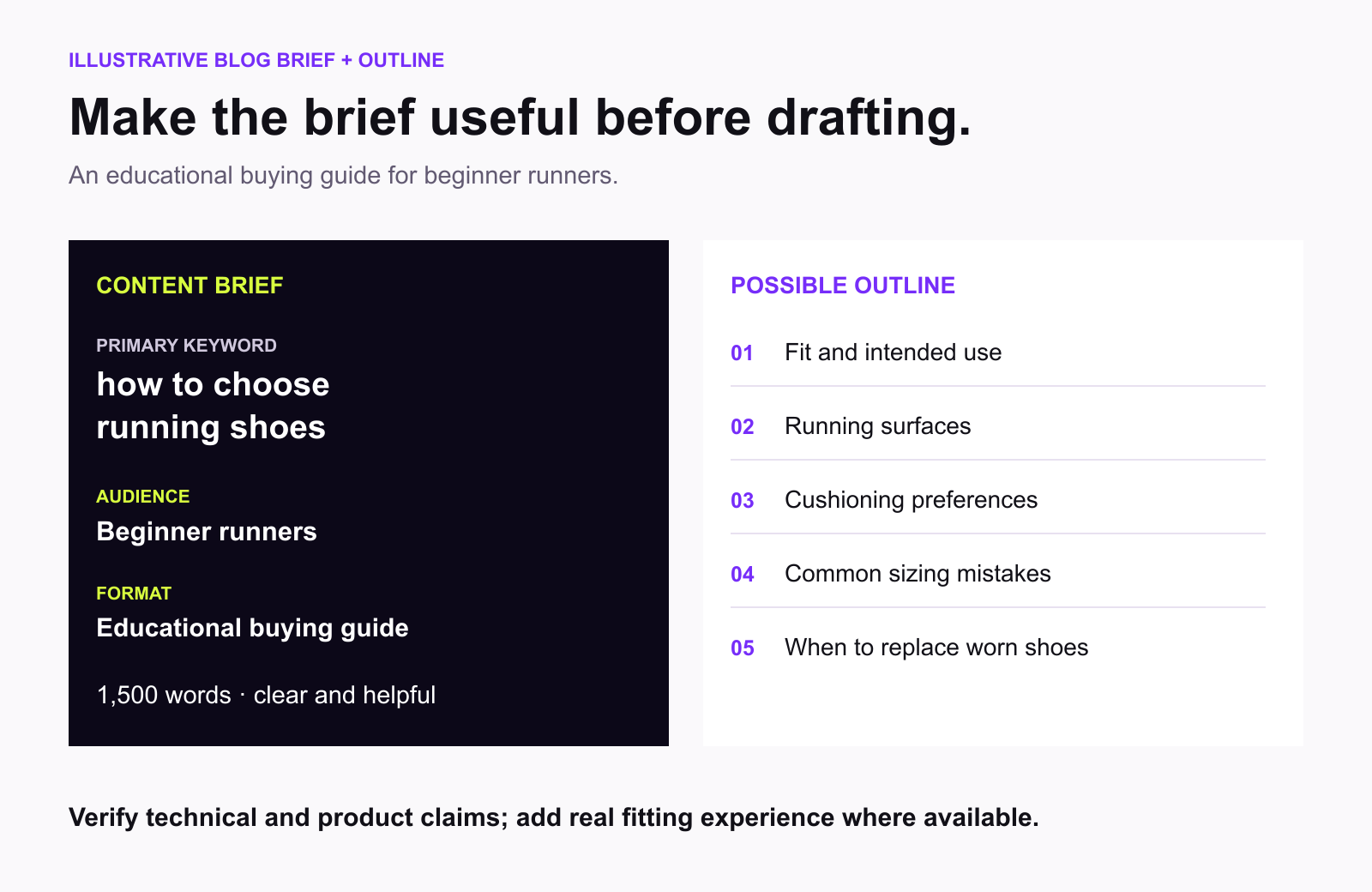
These are hypothetical inputs, not results from an actual Digimetrics run.
A useful outline might cover fit, intended running surfaces, cushioning preferences, common sizing mistakes and when to replace worn shoes.
The generator can help organise those subjects and produce introductory explanations.
However, the editor should still verify technical claims and product information.
If the retailer has experience helping customers select footwear, it could add practical examples or observations from actual fitting sessions.
Those original details can make the article more informative than a generic AI-written buying guide.
AI Blog Post Generator vs General AI Writing Assistant
General-purpose AI assistants can draft blog posts when given appropriate instructions.
Dedicated blog generators provide a more structured workflow.
| Capability | General AI Assistant | Digimetrics AI Content Generator |
|---|---|---|
| Generate long-form text | Yes | Yes |
| Research search results | Depends on available tools | Built into the workflow |
| Create an outline | Can be requested | Built in |
| Target a keyword | Through instructions | Dedicated input |
| Set tone and length | Through instructions | Dedicated settings |
| Run a 44-point quality check | Not necessarily | Yes |
| Return a numerical quality grade | Depends on workflow | Yes |
| List quality-check revisions | Depends on workflow | Yes |
A general writing assistant can be useful for exploratory research, rewriting and unusual content assignments.
A dedicated SEO blog post generator is more convenient when you want a repeatable process for keyword-focused articles.
Neither approach guarantees better rankings.
The quality of the finished post depends on research, accuracy, usefulness and the decisions made during editing.
Can AI-Generated Blog Posts Rank on Google?
Yes. Google does not automatically penalise content simply because AI helped create it.
According to Google’s guidance on generative AI content, AI can assist with research and content structure.
However, generating large volumes of pages without adding value may violate its scaled content abuse policies.
This distinction matters for businesses using AI writing software.
A useful article answers the reader’s question, includes reliable information and offers something relevant beyond the common explanations already available online.
An unhelpful article may repeat existing content, contain unsupported claims or be created primarily to target search terms without satisfying visitors.
What Makes an AI Blog Post Useful?
Focus on four areas.
Accuracy: Confirm statistics, prices, product features and other factual claims using reliable sources.
Relevance: Answer the question behind the keyword rather than forcing unnecessary sections into the article.
Original value: Include practical experience, original evidence, genuinely useful examples or informed analysis.
Editorial quality: Remove repetition, clarify explanations and maintain consistent terminology.
For a deeper discussion of these requirements, our guide to whether AI-generated content can rank on Google explains the distinction between AI-assisted writing and low-value automated publishing.
How to Edit an AI-Generated Blog Post Before Publishing
The fastest-generated article is not necessarily the fastest article to publish.
A useful editing workflow focuses on the problems that matter most.
Verify Important Claims
Start with factual accuracy.
AI-generated drafts may include outdated information, invented statistics or unsupported recommendations.
For example, if an article claims that a marketing technique increases conversions by 35%, the claim needs reliable supporting evidence.
If none is available, remove or qualify it.
Improve the Introduction
A blog post should establish the reader’s problem and explain what the article will help them accomplish.
Avoid long introductions filled with generic observations about the importance of the topic.
Move toward the useful information quickly.
Remove Repetition
AI-generated content sometimes restates the same idea in several sections.
Combine overlapping explanations and remove paragraphs that add little information.
Make the Article Easier to Read
Use descriptive headings, logical transitions and paragraphs that group related ideas together.
Avoid turning every simple sentence into a separate paragraph.
Add Relevant Internal Links
Connect the article to other useful resources on your website.
For example, a post about keyword research might link to a guide explaining ranking difficulty or another article covering search intent.
Links should support the reader’s next question rather than appear solely to satisfy an SEO checklist.
Complete a Final Quality Check
The Digimetrics Content Checker can review grammar, readability, keyword usage, tone and potentially risky claims.
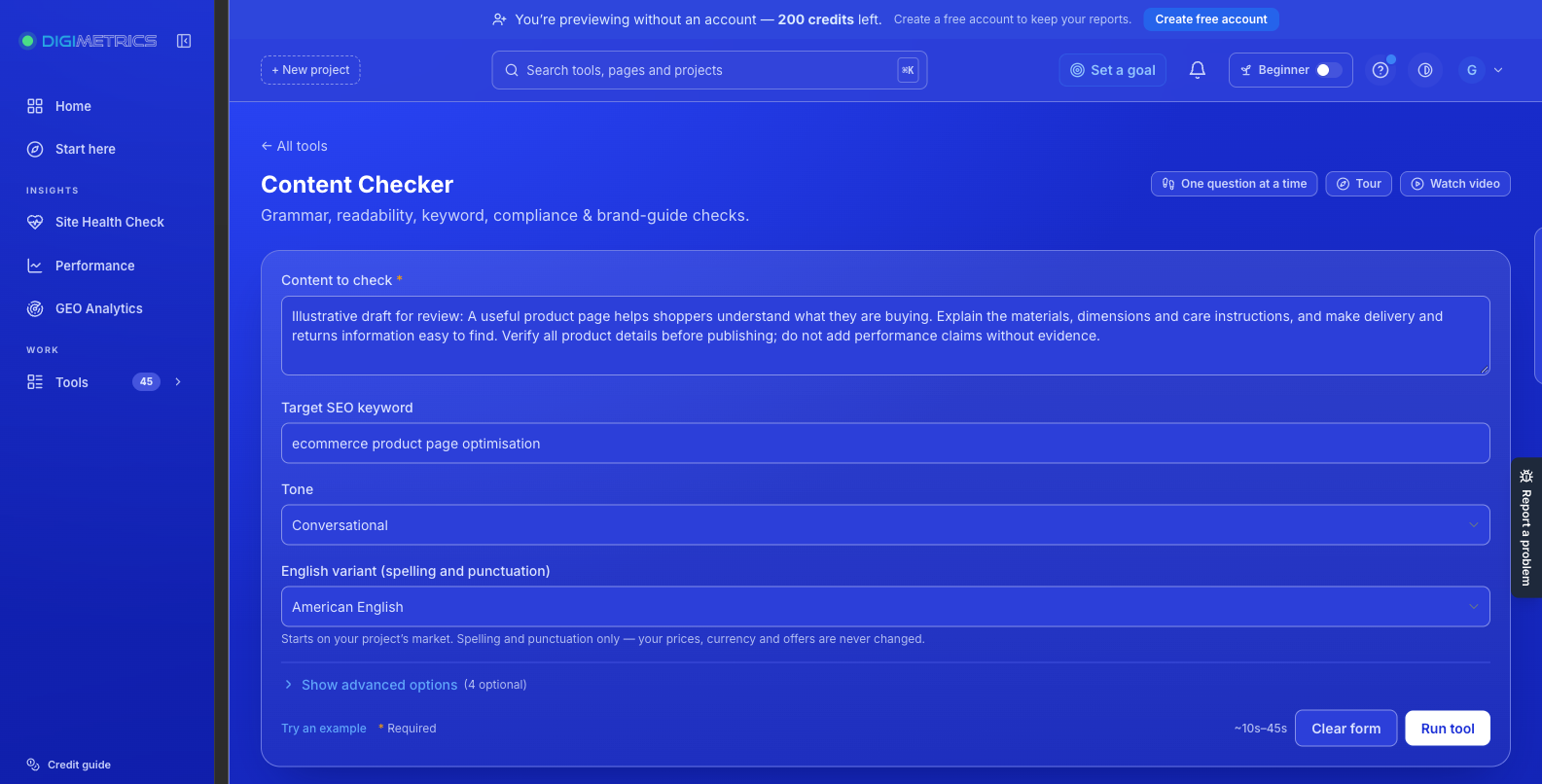
Use it as an additional editorial check rather than a replacement for verifying the underlying facts.
For teams managing several writers and publishing stages, our guide to building an AI-assisted content workflow provides a more detailed process for assigning research, drafting, fact-checking and final approval responsibilities.
Should You Generate a New Blog Post or Update an Existing One?
Before creating another page, check whether your website already has content targeting the same search intent.
For example, these keywords are closely related:
- best email marketing platforms
- top email marketing software
- best email marketing tools
They may justify one comprehensive comparison rather than three nearly identical articles.
Publishing separate pages for every variation can create unnecessary overlap and ongoing maintenance work.
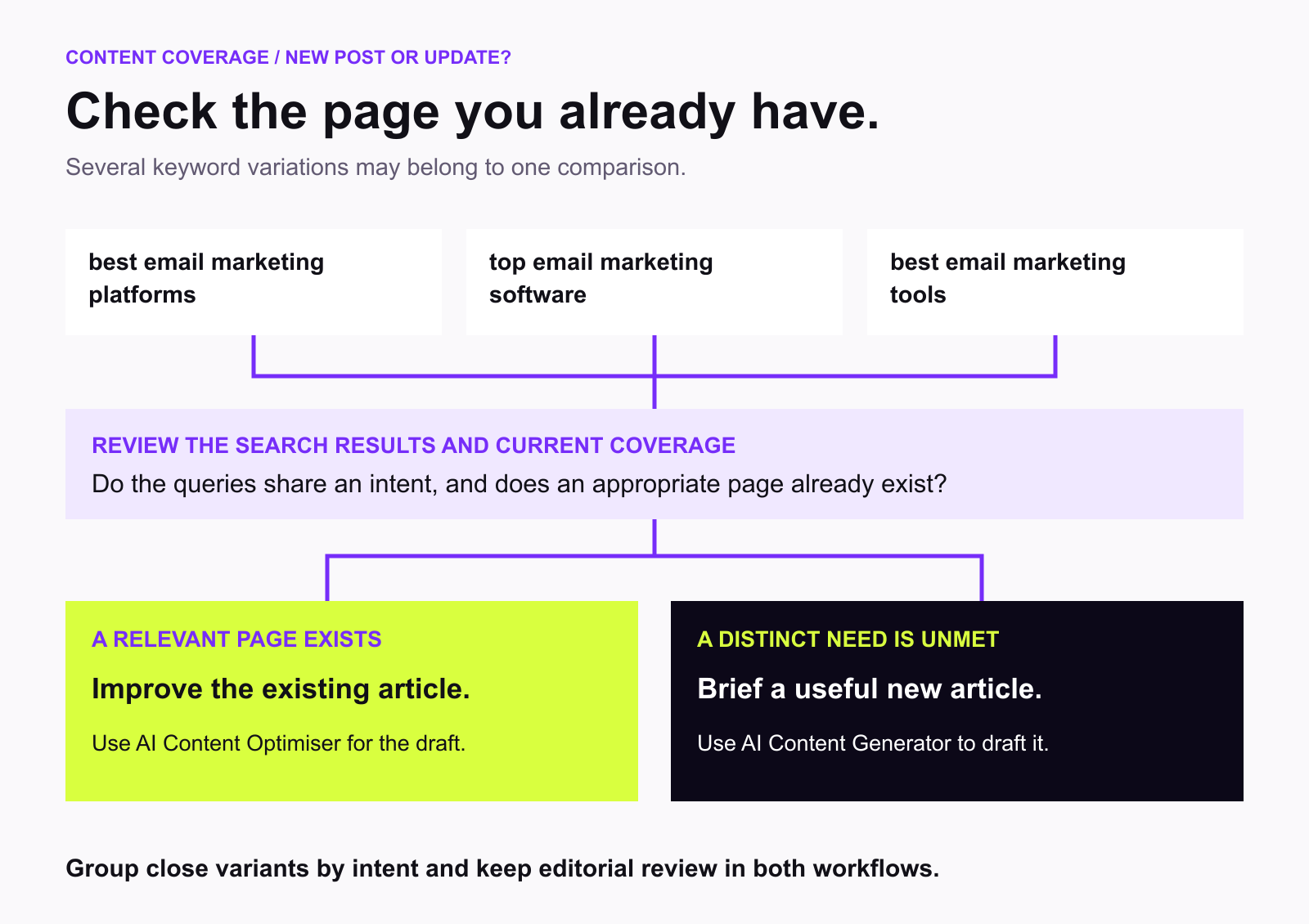
If you already have an appropriate article, consider improving it instead.
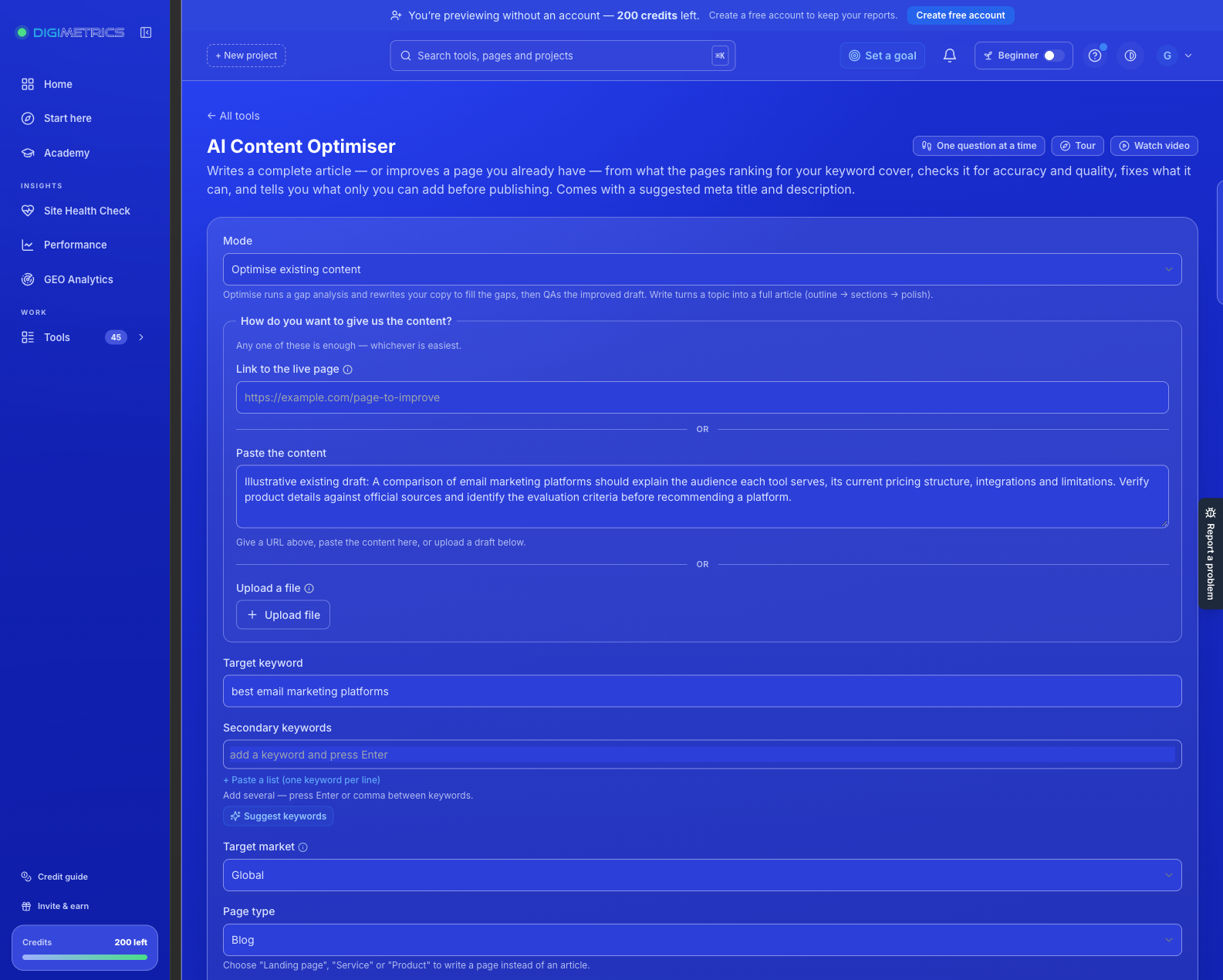
The Digimetrics AI Content Optimiser evaluates an existing page against a target keyword, checks readability and keyword placement, and suggests improvements.
This can be more appropriate than generating another article that competes with the page already published.
For a broader approach to existing content, our website content audit guide explains how to decide which articles to refresh, merge, retain or consider removing.
How Much Does Digimetrics AI Blog Post Generator Cost?
Digimetrics offers a seven-day free trial with access to its tools and no credit card requirement.
After the trial, three paid plans are available.
| Plan | Annual Billing, Monthly Equivalent | Monthly Billing | Monthly Credits | Projects |
|---|---|---|---|---|
| Starter | $31 | $39 | 500 | 3 |
| Pro | $87 | $109 | 2,000 | 10 |
| Expert | $159 | $199 | 6,000 | 25 |
Prices are in USD.
Every paid plan includes access to Digimetrics’ 52 tools. The higher tiers provide more monthly credits, projects and additional allowances.
The AI Content Generator isn’t priced separately; it is included across the plans.
However, your actual article capacity depends on the credits consumed by each generation and related tool runs.
Check the current details on the Digimetrics pricing page before choosing a subscription.
How to Evaluate the Real Cost of AI Blog Writing
Subscription price is only one part of production cost.
Consider a hypothetical marketing team generating ten blog posts monthly.
If each draft requires two hours of editing and fact-checking, that’s 20 hours of editorial work after generation.
A tool that reduces drafting time but creates more verification work may not deliver as much value as expected.
Track the total time from brief to approved article, not just the time needed to generate a draft.
Common AI Blog Post Generation Mistakes
Choosing Keywords Without Understanding Search Intent
A keyword with strong volume may not match the content your business needs to publish.
Research the searcher’s goal before writing.
Publishing the First Draft Unchanged
AI drafts can contain inaccurate or repetitive information.
Always complete an editorial review.
Treating Content Scores as Ranking Predictions
An automated quality grade is useful for identifying issues, but it cannot guarantee search visibility.
Generating Too Many Similar Articles
Closely related keywords may belong on the same page.
Check existing coverage before generating a new URL.
Inventing Expertise or Customer Examples
Do not create fictional tests, customer results or firsthand experiences and present them as real.
Use examples transparently and distinguish hypothetical scenarios from evidence.
Measuring Success by Word Count
Generating thousands of words quickly isn’t meaningful if the content doesn’t answer readers’ questions or support a business objective.
Measure usefulness and outcomes instead.
Final Verdict: Is an AI Blog Post Generator Worth Using?
An AI blog post generator can make SEO content production more efficient when it’s part of a structured editorial process.
It can help with research, outlines and first drafts, reducing repetitive work before the editing stage.
But producing content faster doesn’t automatically make that content more useful.
A reliable workflow still needs fact-checking, original information, appropriate search intent and final editorial approval.
Digimetrics combines ranking-page research, outline generation, section-by-section drafting and 44-point quality grading in one article-generation workflow.
It also offers related tools for keyword research, content checking and improving existing pages.
For bloggers, marketers and content teams producing regular SEO articles, these capabilities provide a structured starting point.
The best AI blog post generator isn’t the one that produces the most words. It’s the one that helps you turn an idea into a useful, accurate and publishable article with less unnecessary work.
Create Your Next Blog Post With Digimetrics
Have a keyword or article idea but don’t want to start from an empty document?
Digimetrics AI Content Generator researches relevant ranking pages, creates the outline, drafts the article and evaluates it against 44 quality criteria.
You receive the article, quality grade and reported corrections to review before publication.
Try Digimetrics AI Content Generator and explore the workflow through its seven-day free trial.
No credit card required. Trial usage limits apply.
Frequently Asked Questions
What is the best AI blog post generator?
The best choice depends on your workflow. Digimetrics is worth considering for SEO-focused blogging because it combines ranking-page research, outline generation, article drafting and a 44-point quality check.
Can AI generate a full blog post?
Yes. AI blog generators can produce complete drafts from a topic, keyword or brief. Human review is still important for factual accuracy and editorial quality.
Is Digimetrics AI Blog Post Generator free?
Digimetrics provides a seven-day free trial of its AI Content Generator with no credit card requirement. Usage limits apply.
How long does it take to generate a blog post?
Digimetrics advertises a typical generation time of one to five minutes, depending on the article and selected settings.
Can I choose the blog post’s length?
Yes. Digimetrics provides controls for the intended word count, writing tone and quality-check thoroughness.
Does Digimetrics generate SEO-optimised blog posts?
The tool researches ranking pages, drafts around a target keyword and checks the generated article against its quality criteria. However, it cannot guarantee rankings or traffic.
Can AI-generated blog posts rank on Google?
Yes. AI-assisted content can rank when it satisfies relevant quality and search requirements. Google’s policies do not prohibit AI writing itself, but scaled low-value content created to manipulate rankings can violate its spam policies.
Does Digimetrics check grammar and readability?
Its AI Content Generator performs quality checks on generated articles. Digimetrics also provides a separate Content Checker for more focused reviews of grammar, readability, tone, keywords and claims.
Should I use AI to rewrite existing blog posts?
It can be useful when an existing page needs improvement. Digimetrics AI Content Optimiser is designed for reviewing and improving existing content rather than generating an entirely new article.
Can AI replace professional blog writers?
AI can assist with research, outlining and drafting. However, professional writers and editors remain valuable for expertise, original reporting, fact-checking and editorial judgement.

Tom Koh
Tom is the CEO of MediaOne, a leading digital marketing agency. He is a business-experienced SEO consultant as well as a Google Gold Search Expert serving the international community. He has consulted for MNCs like Canon, Maybank, Capitaland, SingTel, ST Engineering, WWF, Cambridge University, as well as Government organisations like Enterprise Singapore, Ministry of Law, National Galleries, NTUC, e2i, SingHealth. His articles are published and referenced in CNA, Straits Times, MoneyFM, Financial Times, Yahoo! Finance, Hubspot, Zendesk, CIO Advisor. Under his stewardship, MediaOne has won dozens of prestigious digital marketing awards.
See what your site needs next
Run a free Digimetrics audit across SEO, AI search, content and technical health, and get a plan you can act on today.
Start free →