Content
Free AI Article Writer: How to Write Better Blog Posts With AI
Writing a blog post isn’t usually the hardest part of content marketing. The real work happens before and after the first draft. You need…
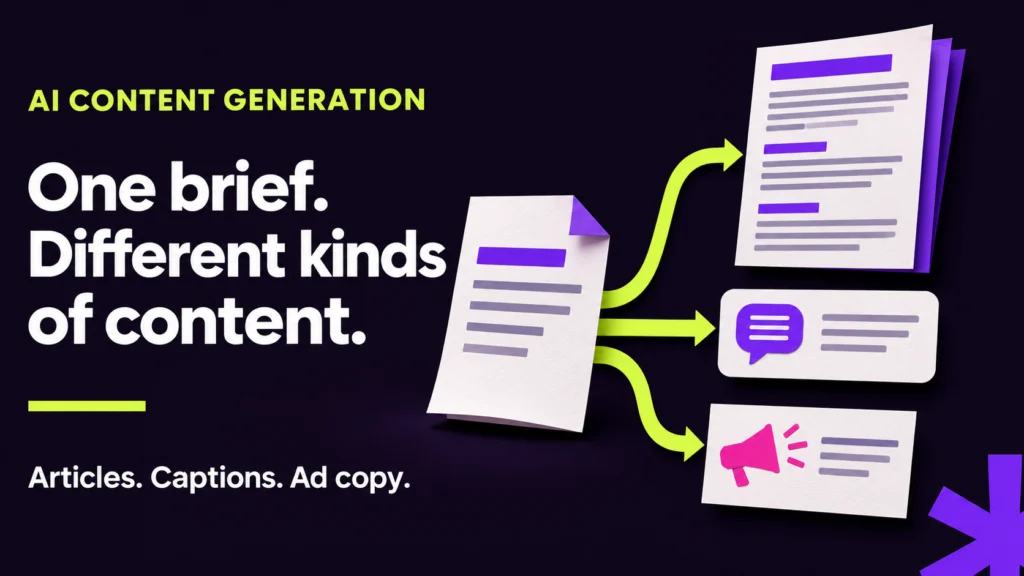
You have a blog post to publish, three social media updates to prepare, and a paid advertising campaign that needs fresh copy.
Each task requires a different message, format, and level of detail.
Writing everything from scratch takes time. But using the same generic AI prompt for every assignment can produce repetitive content that lacks the information your audience actually needs.
A free AI content generator can help reduce that workload by turning topics, keywords, and marketing briefs into written drafts.
Depending on the tool, you can generate SEO articles, social media captions, advertising headlines, content outlines, and other marketing materials.
However, not every AI content generator works the same way.
Some simply produce text from a short prompt. Others include keyword research, competitor analysis, formatting controls, and quality checks that help you evaluate the output before publishing.
Digimetrics AI Content Generator focuses on long-form SEO content. It researches ranking pages, creates an outline, drafts an article section by section, and evaluates the result against 44 quality criteria.
Digimetrics also provides separate tools for captions, advertising copy, content optimisation, and proofreading.
This guide explains how free AI content generators work, what they can create, how to evaluate their output, and how to build a content workflow without relying on generic AI writing alone.
A free AI content generator is software that uses artificial intelligence to produce written or visual content based on user instructions.
For written content, the inputs may include a topic, target keyword, audience, tone, or short creative brief.
The tool processes those instructions and generates material that can be reviewed, edited, and published.
Depending on its capabilities, an AI content generator may help create:
Some tools specialise in one format. Others provide multiple content-generation workflows.
For example, a dedicated article generator may research search results before writing, while a social caption generator may focus on the platform, accompanying image, and intended audience.
Neither approach is universally better.
The right AI content generator depends on what you’re creating and how much work remains after the first draft.
Yes. Several AI content tools offer free access, but the conditions vary.
Some provide permanently free plans with limited usage. Others give new users a fixed number of credits or temporary access to premium features.
It’s important to distinguish these models before choosing a tool.
| Free Access Type | What It Means | Potential Limitation |
|---|---|---|
| Permanently free plan | Ongoing access without a subscription | Limited monthly prompts or features |
| Free credits | A fixed amount of usage | Credits eventually run out |
| Free trial | Temporary access to the product | Access ends after the trial |
| Limited free generator | Basic generation at no cost | Restricted length or formats |
| Free preview | Sample results before subscribing | Full generation may require payment |
Digimetrics offers a seven-day free trial with access to its marketing tools.
New accounts receive 200 trial credits, and no credit card is required.
The trial includes the AI Content Generator, along with tools for keyword research, content editing, advertising copy, and other marketing tasks.
This allows users to evaluate the workflow before choosing a subscription.
However, it is not a permanently free, unlimited content-generation service.
When comparing tools, consider how many useful drafts you can produce within the available allowance—not simply whether the website displays the word “free.”
AI content generation covers several types of marketing work.
Each requires different inputs and quality standards.
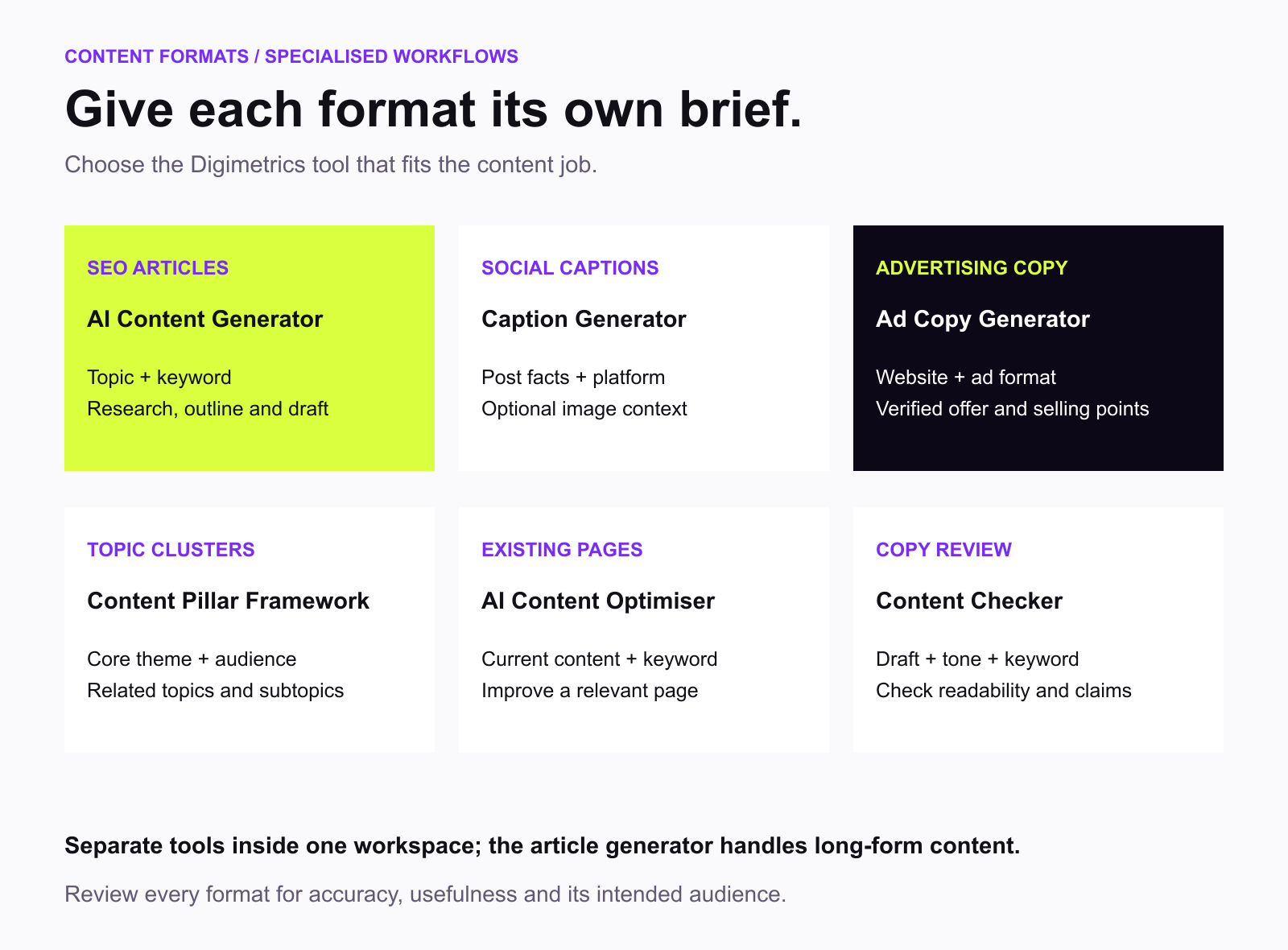
An AI article generator can help turn a target keyword into a structured draft.
For example, a business targeting “how to choose accounting software” may need an article explaining essential features, implementation requirements, pricing considerations, and common mistakes.
A useful generator should help organise these topics before producing the final text.
Digimetrics AI Content Generator is designed for this workflow, combining ranking-page research, outlining, drafting, and quality checks.
Social content often requires shorter, more conversational writing.
A product announcement on LinkedIn may need a professional explanation, while an Instagram post may benefit from a more concise message that complements the accompanying image.
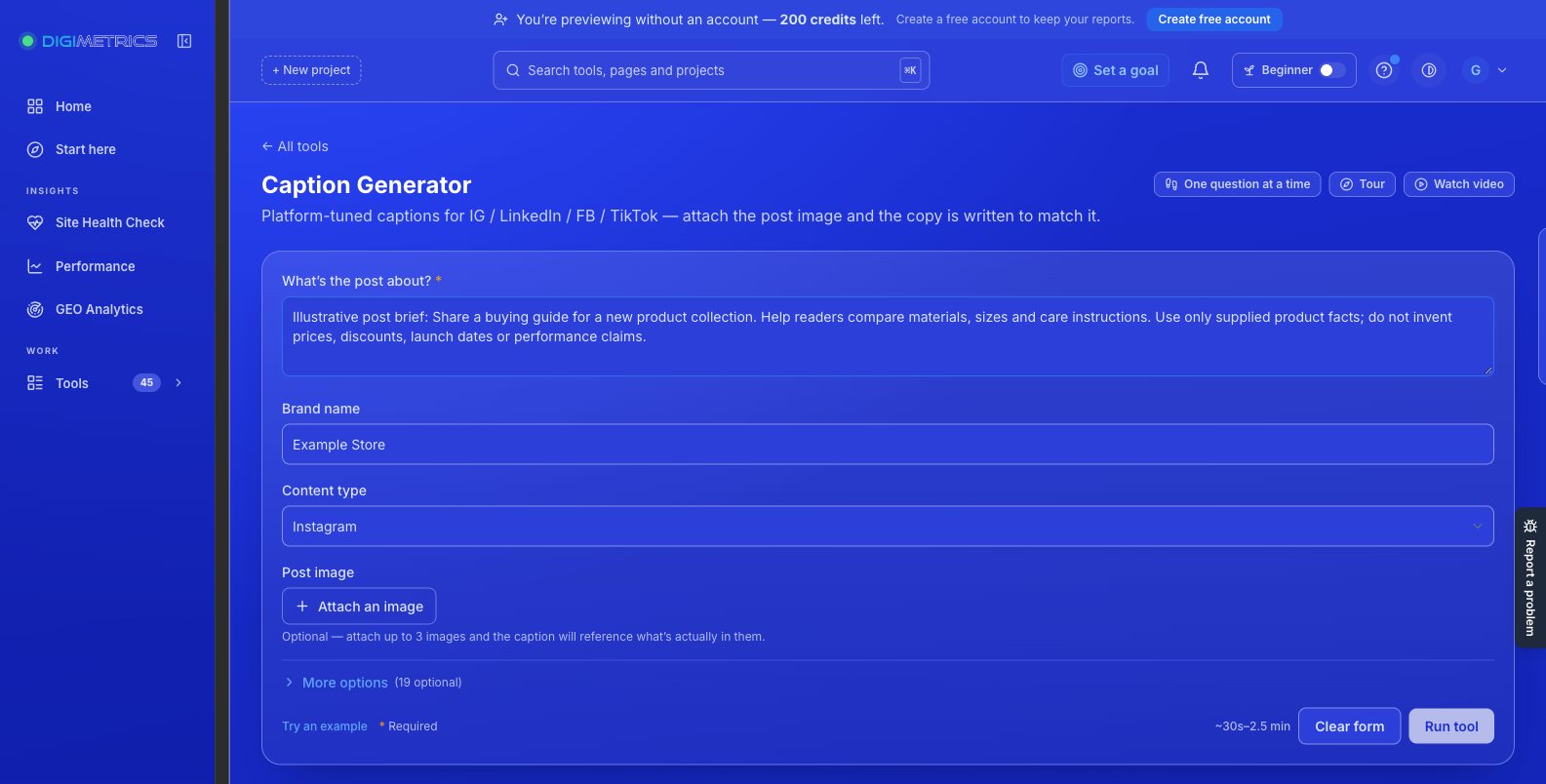
The Digimetrics Caption Generator supports captions for Instagram, Facebook, LinkedIn, and TikTok.
It can use a social post’s image as context, helping the generated copy reflect what the audience will actually see.
Advertising content has a different purpose from an educational article.
It needs to communicate a specific benefit and encourage an appropriate action within the format’s requirements.
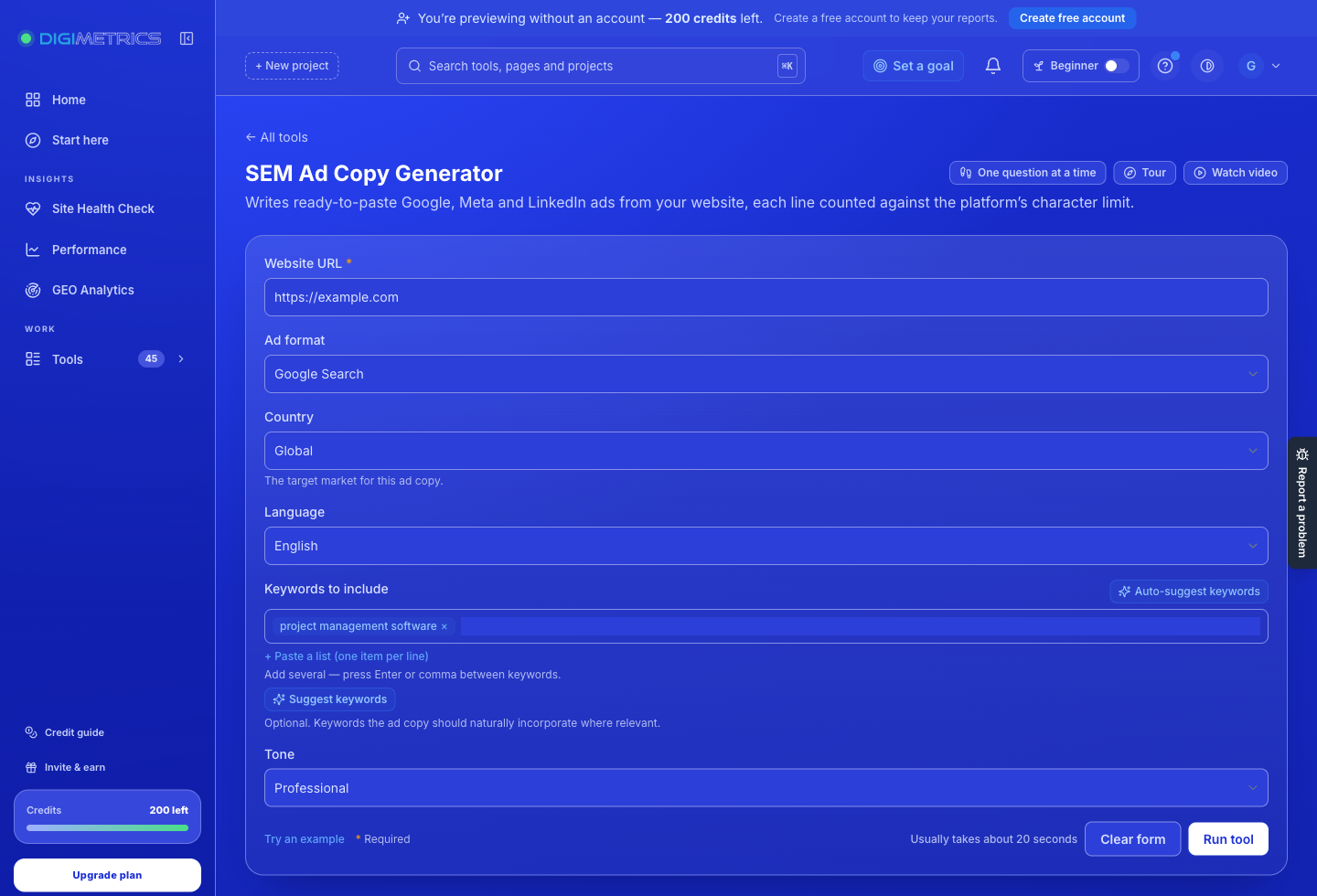
The Digimetrics Ad Copy Generator extracts selling points from a website and generates headlines, descriptions, and sitelinks for supported advertising formats across Google, Meta, and LinkedIn.
Its workflow includes market, language, keyword, and tone settings.
AI can also help plan what to publish before writing begins.
For example, a business offering payroll software may need a collection of related articles covering payroll compliance, employee records, reporting, and software comparisons.
The Digimetrics Content Pillar Framework helps organise topics into larger themes and supporting subtopics.
This is useful for creating a more coherent publishing plan instead of generating disconnected articles.
Not every content task requires a new draft.
If an article already exists, revising it may be more appropriate than creating another page targeting the same keyword.
The Digimetrics AI Content Optimiser evaluates existing content against a target keyword and provides suggestions for improving its structure, readability, and keyword alignment.
This can help reduce unnecessary duplication and keep the focus on improving the pages you already have.
Digimetrics’ main Content Generator focuses on creating SEO articles through a structured process.
Rather than generating a long article immediately from a single instruction, it separates research, planning, drafting, and quality review.
Start with a short description of the article you want to create.
For example:
Topic: How small ecommerce businesses can improve product page conversions.
Primary keyword: ecommerce product page optimisation.
Target market: Singapore.
The topic provides direction, while the keyword and market help establish the content’s search context.
Digimetrics then examines pages already ranking for the keyword to inform the draft’s structure.
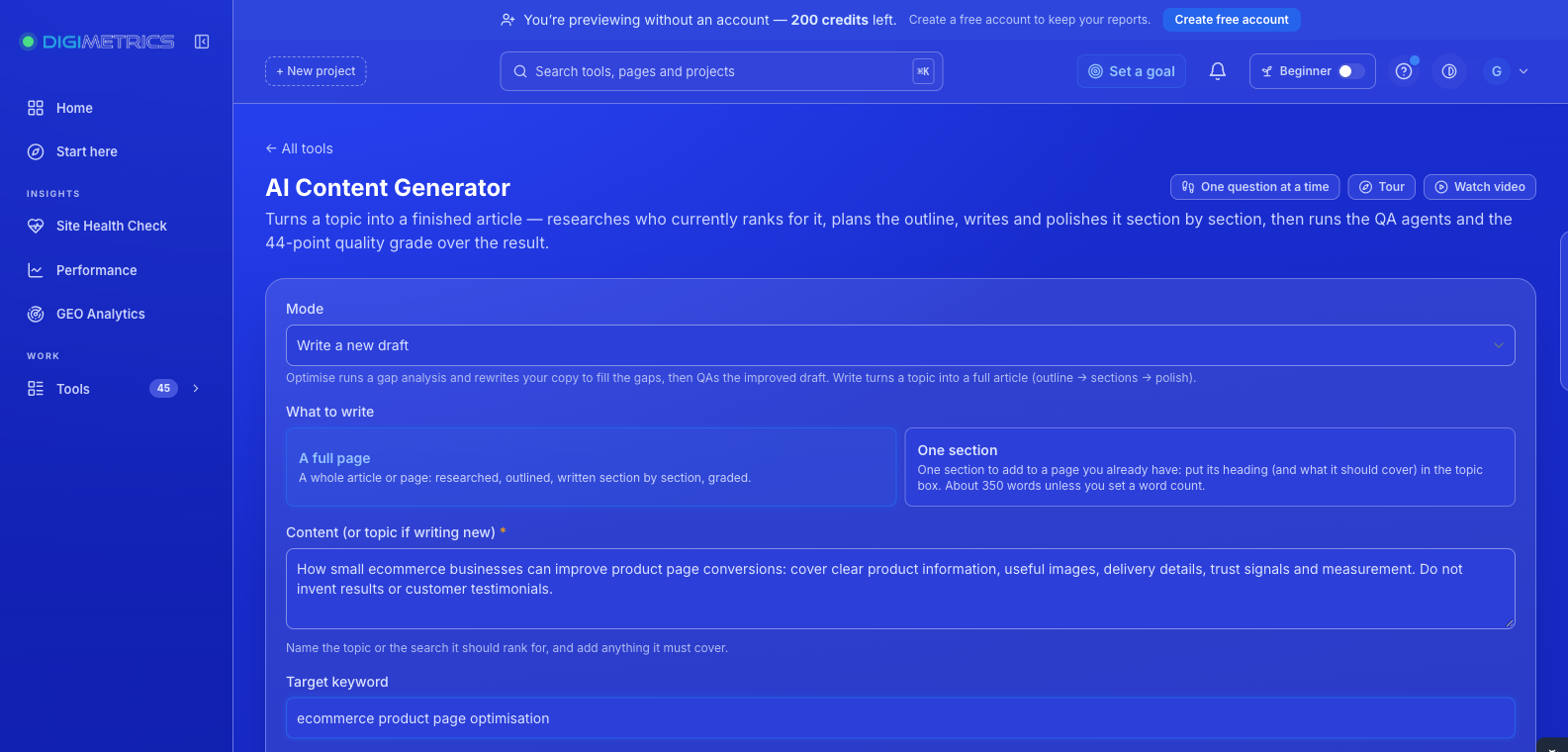
Use the available settings to choose the desired length and writing style.
A short beginner’s guide may require less detail than a comprehensive technical tutorial.
The appropriate word count depends on the information readers need, not an arbitrary target.
Tone also matters.
An article for small business owners may benefit from straightforward explanations, while a technical audience may expect more detailed terminology.
Digimetrics prepares an outline informed by its search-result research.
It then writes the article section by section.
This helps establish a more consistent structure than generating disconnected paragraphs without an editorial plan.
The workflow typically takes between one and five minutes.
After drafting, Digimetrics evaluates the content against a 44-point checklist and returns a quality grade out of 100.
It also identifies corrections made during the review.
For example, its published sample demonstrates checks that removed an unsupported statistic, improved keyword placement, and simplified overly long sentences.
A quality grade provides useful diagnostic information, but it is not a prediction of Google rankings.
Review the finished article for accuracy, relevance, and usefulness.
Add your own examples, verify product details, check important claims, and remove unnecessary repetition.
Digimetrics recommends using its Content Checker for an additional proofreading and compliance review before publishing.
AI generation provides the draft. Editorial judgement determines whether the content is ready for readers.
The most useful features depend on how the tool fits into your workflow.
A platform that produces large volumes of text may still create unnecessary work if those drafts require extensive rewriting.
Here are the capabilities worth evaluating.
| Feature | Why It Matters |
|---|---|
| Topic and keyword inputs | Helps align content with its intended subject |
| Search-result research | Provides context about existing coverage |
| Structured outlines | Reduces repetition and improves organisation |
| Tone controls | Supports consistent communication |
| Length controls | Helps match the level of detail to the assignment |
| Readability checks | Identifies unnecessarily complex writing |
| Factual-claim warnings | Flags statements requiring verification |
| Visible revisions | Makes automated changes easier to review |
| Existing-content optimisation | Reduces unnecessary new-page creation |
| Pricing transparency | Helps estimate actual production costs |
One consideration deserves particular attention: the tool’s output should be reviewable.
If a generator silently introduces new claims, changes important information, or produces an unexplained score, editors may struggle to determine whether the content is suitable for publication.
Digimetrics’ approach of showing its quality grade and reported corrections helps make that process more transparent.
A general AI chatbot can help brainstorm, draft, edit, and reformat marketing content.
A dedicated content generator packages specific tasks into repeatable workflows.
For example, a chatbot can produce an SEO article when given appropriate instructions and access to relevant research.
Digimetrics AI Content Generator provides dedicated settings and an established workflow for ranking-page research, outlining, section-by-section drafting, and quality checking.
| Capability | General AI Chatbot | Digimetrics AI Content Generator |
|---|---|---|
| Generate article text | Yes | Yes |
| Brainstorm content ideas | Yes | Through relevant Digimetrics tools |
| Research ranking pages | Depends on research capabilities | Built into the article workflow |
| Generate outlines | With instructions | Built in |
| Target a keyword | Through prompting | Dedicated keyword input |
| Adjust word count and tone | Through prompting | Dedicated settings |
| Run a structured 44-point check | Not necessarily | Yes |
| Report quality-check changes | Depends on workflow | Yes |
| Generate social and ad copy | Can be prompted | Separate specialised tools available |
The main advantage of a dedicated generator is consistency.
For teams producing recurring articles, having a defined process can reduce the need to write detailed instructions for every assignment.
However, a general-purpose assistant may offer greater flexibility for exploratory research, unusual formats, or collaborative writing.
The best choice depends on the task rather than the tool category.
Using AI effectively requires more than generating text.
A practical workflow includes topic planning, drafting, editing, publishing, and measuring performance.
Identify the questions your customers actually ask.
A software provider might discover that prospects frequently ask about implementation time, integrations, pricing, and data migration.
Those questions can form the basis of useful content.
Avoid choosing topics solely because an AI tool can generate them quickly.
Use Digimetrics Keyword Research or another suitable research tool to investigate search demand and related topics.
Assess whether the keyword aligns with your products, services, and intended audience.
A high-volume keyword isn’t necessarily the best choice if it attracts people who have little interest in your offering.
Decide what the article needs to accomplish.
An informational guide may need examples and practical steps.
A software comparison may require pricing, features, limitations, and clear recommendations.
A product landing page needs a different structure again.
Use the AI Content Generator for SEO articles or the appropriate specialist tool for shorter formats.
Give the generator enough information about the audience and objective to produce a relevant starting point.
Check factual claims, current prices, product features, and external references.
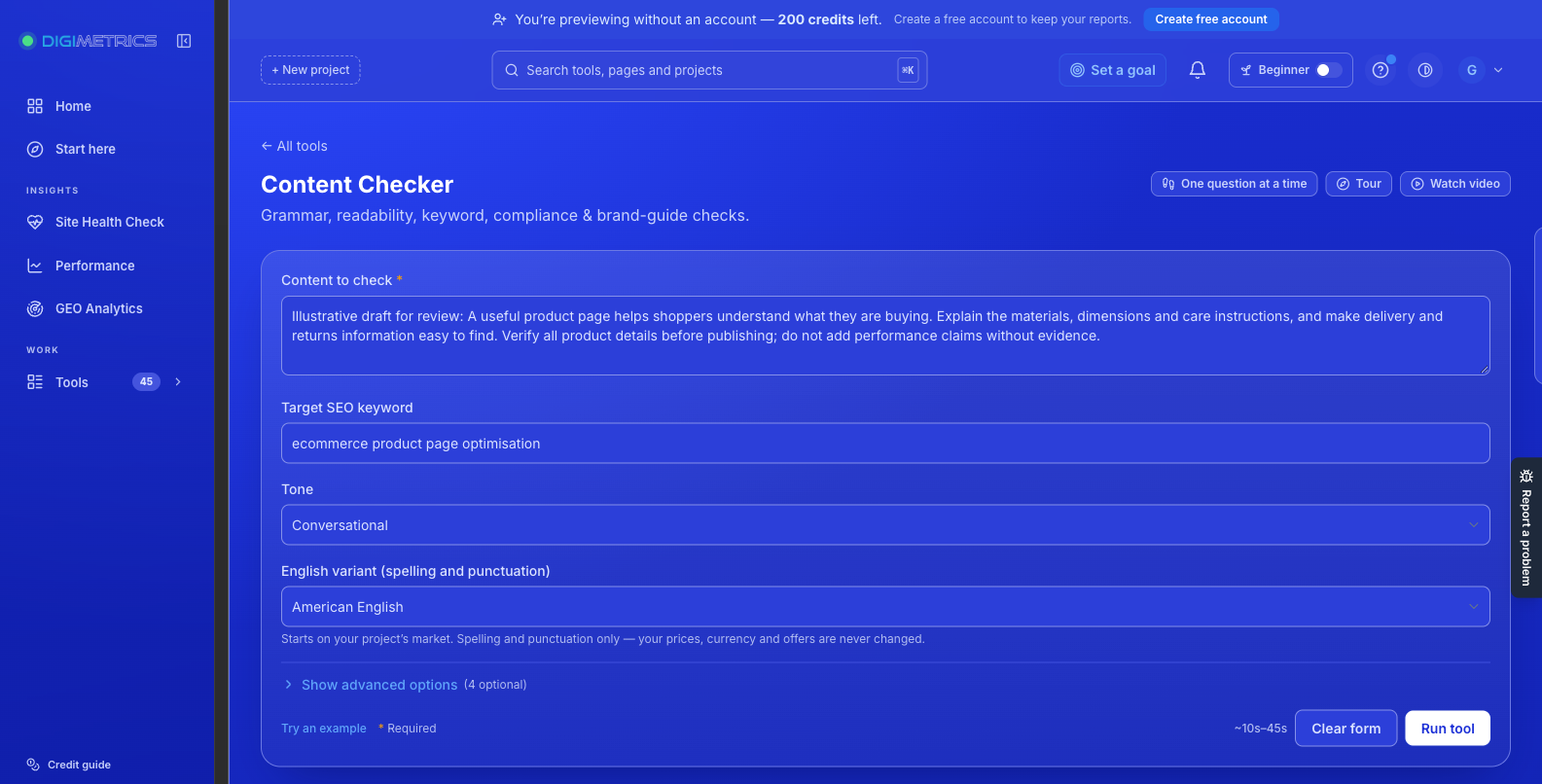
The Digimetrics Content Checker can help identify issues involving grammar, readability, keyword usage, brand tone, and risky claims.
Automated checks support editorial review, but they don’t establish that every fact is correct.
Include information that isn’t easily reproduced from existing search results.
Examples include firsthand experience, original research, product demonstrations, customer questions, and properly supported comparisons.
This step often provides the greatest opportunity to distinguish the finished content from generic AI output.
After publishing, monitor search visibility, engagement, and relevant business outcomes.
Use the results to decide whether the page needs improvement.
If the content already exists but requires changes, consider updating it rather than publishing another article with substantially the same search intent.
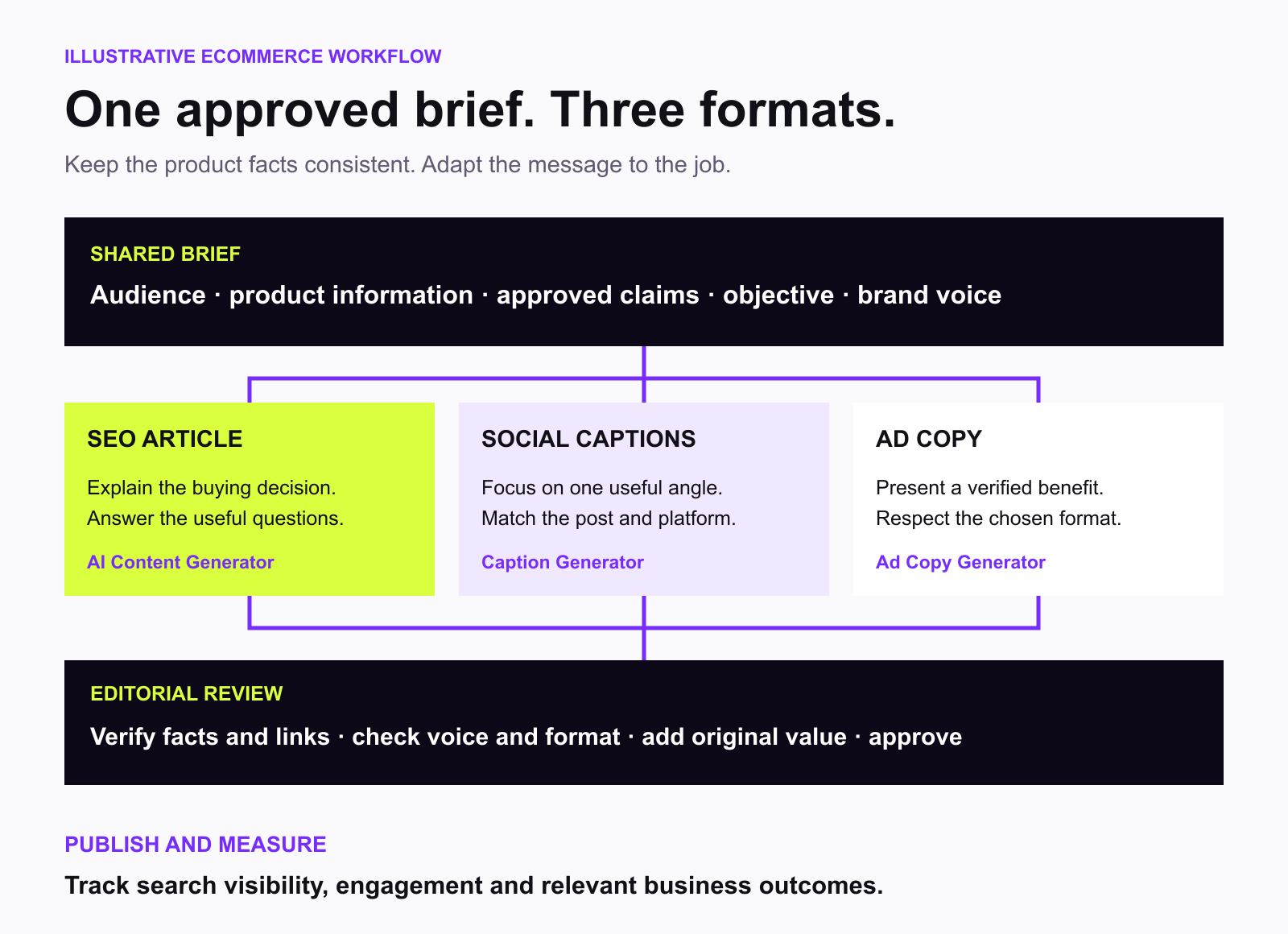
Consider a hypothetical small ecommerce business launching a new product collection.
The business needs an educational article, several social media posts, and advertising messages.
Instead of preparing each item from scratch, it could use a structured workflow.
| Content Task | Suggested Digimetrics Tool | Intended Output |
|---|---|---|
| Research the topic | Keyword Research | Relevant keyword ideas |
| Organise supporting content | Content Pillar Framework | Related topics and content angles |
| Draft the main guide | AI Content Generator | Structured SEO article |
| Create social captions | Caption Generator | Platform-specific posts |
| Draft advertisements | Ad Copy Generator | Headlines and descriptions |
| Review the writing | Content Checker | Identified issues and corrections |
For example, the main article might explain how customers can choose the appropriate product.
Social posts could highlight individual buying considerations, while advertisements would focus on the collection’s verified selling points.
The important part is consistency.
All content should reflect the same product information, brand positioning, and approved claims.
These are suggested uses of the tools, not results from an actual campaign.
An AI-generated draft can look polished while containing inaccurate or unhelpful information.
Use a quality-control process before publishing.
Verify statistics, dates, prices, guarantees, and product capabilities.
Don’t assume that confident wording indicates a reliable claim.
If an article says a product reduces operating costs by 40%, the business should have evidence supporting that figure.
Otherwise, remove or revise the statement.
Make sure the content answers what the reader was looking for.
If the target keyword implies a comparison, provide meaningful comparisons rather than a generic explanation of the category.
Remove sections that repeat the same points under different headings.
Longer articles are not automatically more useful.
Combine related one-sentence paragraphs into more natural explanations.
Use descriptive headings and maintain a logical progression between sections.
Check that internal and external links lead to the intended pages.
Avoid placeholder URLs, broken references, and links inserted solely to satisfy an arbitrary quota.
AI-generated content is not automatically guaranteed to be original.
Check for inappropriate similarities, unsupported quotations, and missing attribution.
Every section should help the reader understand something, make a decision, or complete a task.
If a paragraph adds no useful information, consider removing it.
Yes. AI-assisted content can appear in Google Search.
However, using AI does not create an automatic ranking advantage.
Google’s guidance on generative AI content explains that generative AI can help with research and structure, but publishing large amounts of content without adding value can violate its spam policies.
The central considerations remain accuracy, usefulness, relevance, and the purpose of the content.
Google does not guarantee better rankings because an article:
A strong quality grade can help identify potential improvements, but it doesn’t replace genuine content value.
For example, a generic article about choosing accounting software may explain standard features.
An experienced accountant could improve it by explaining how specific workflows affect small businesses and which requirements are commonly overlooked.
That additional expertise makes the article more valuable to readers.
AI can accelerate content production, but the information you contribute determines whether the finished piece offers something worth reading.
Digimetrics provides seven days of free trial access with 200 initial credits.
No credit card is required.
The trial includes the AI Content Generator and other tools, subject to usage limits.
After the trial, the published paid plans are:
| Plan | Monthly Price With Annual Billing | Monthly Billing | Monthly Credits | Projects |
|---|---|---|---|---|
| Free trial | $0 for seven days | — | 200 trial credits | 1 |
| Starter | $31 | $39 | 500 | 3 |
| Pro | $87 | $109 | 2,000 | 10 |
| Expert | $159 | $199 | 6,000 | 25 |
Prices are in USD, and annual prices require annual billing.
All paid plans include access to Digimetrics’ 43 tools, with different project and credit allowances.
The number of articles or other content assets you can generate depends on the credits consumed by individual tool runs.
A marketer creating occasional blog articles may find Starter sufficient.
An agency or content team using multiple tools across several websites may need a higher allowance.
Review the current terms on the Digimetrics pricing page before choosing a plan.
A free AI content generator can be useful for marketers, bloggers, and businesses that need to create content without starting every assignment from scratch.
It can help turn ideas into outlines, generate initial drafts, and produce different content formats more efficiently.
However, the amount of text generated isn’t the best measure of success.
Good content still needs accurate information, a clear purpose, useful examples, and an editorial process that catches problems before publication.
Digimetrics combines a structured AI article-writing workflow with related tools for keyword research, captions, advertising copy, and content quality checks.
Its main AI Content Generator researches ranking pages, creates an outline, writes the draft section by section, and evaluates the result against 44 criteria.
That makes it particularly useful for teams that want a repeatable process rather than a blank prompt box.
The best AI content workflow is not the one that publishes the most content. It’s the one that helps you consistently produce useful material with less repetitive work.
Have a topic or keyword but don’t want to start from a blank page?
The Digimetrics AI Content Generator researches existing ranking pages, plans a structured outline, writes the article, and checks the result before handing it back for review.
You can also access other content, SEO, and marketing tools within the same workspace.
Try Digimetrics AI Content Generator and explore the workflow with a seven-day free trial.
No credit card required. Includes 200 trial credits, subject to usage limits.
Even a well-structured draft can contain factual errors or unsupported claims.
Review it before publication.
Creating articles around unrelated keywords may increase publishing volume without improving the overall content programme.
Start with audience needs and clear objectives.
An SEO guide, social caption, and advertising headline have different purposes.
Use appropriate instructions or specialised tools.
A 2,500-word article isn’t automatically better than a 1,200-word article.
Include the information needed to answer the reader’s questions without unnecessary repetition.
Quality grades can support editing, but they aren’t search engine ranking predictions.
Before creating another page, check whether an existing article already serves the same intent.
Updating a relevant page may be more useful than publishing a near-duplicate.
Yes. Some tools offer ongoing free plans, while others provide temporary trials or limited credits. Digimetrics offers a seven-day free trial with 200 credits and no credit card requirement.
Yes. New users can access the AI Content Generator during the seven-day trial, subject to the available credits and other usage limits.
The AI Content Generator creates keyword-focused articles. Other Digimetrics tools support social captions, advertising copy, content ideas, and improvements to existing content.
Yes. AI can assist with keyword-focused research, outlines, drafting, and editing. However, rankings are not guaranteed, and human review remains important.
Digimetrics advertises a typical generation time of one to five minutes, depending on the article and selected settings.
Yes. Its AI Content Generator uses a 44-point checklist and returns a grade out of 100, alongside a list of changes made during the quality checks.
AI-assisted content can be published and may appear in Google Search. Google’s policies focus on content quality and manipulative practices rather than banning AI-assisted writing outright.
Yes. Its separate Caption Generator supports Instagram, Facebook, LinkedIn, and TikTok content.
Yes. Its Ad Copy Generator supports formats across Google, Meta, and LinkedIn, using selling points extracted from a website.
Not automatically. AI-generated drafts should be checked for inappropriate similarities, accuracy, and source attribution before publication.
AI can help with research, planning, and drafting, but it cannot reliably replace original reporting, subject expertise, fact-checking, or editorial judgement.
The trial ends after seven days. Digimetrics states that users are not charged unless they actively choose a paid subscription.

Tom is the CEO of MediaOne, a leading digital marketing agency. He is a business-experienced SEO consultant as well as a Google Gold Search Expert serving the international community. He has consulted for MNCs like Canon, Maybank, Capitaland, SingTel, ST Engineering, WWF, Cambridge University, as well as Government organisations like Enterprise Singapore, Ministry of Law, National Galleries, NTUC, e2i, SingHealth. His articles are published and referenced in CNA, Straits Times, MoneyFM, Financial Times, Yahoo! Finance, Hubspot, Zendesk, CIO Advisor. Under his stewardship, MediaOne has won dozens of prestigious digital marketing awards.
Run a free Digimetrics audit across SEO, AI search, content and technical health, and get a plan you can act on today.
Start free →Writing a blog post isn’t usually the hardest part of content marketing. The real work happens before and after the first draft. You need…
Your website has 150 published articles. Some attract consistent organic traffic, others haven’t generated a meaningful visit in months, and several cover nearly identical…
Writing a good advertisement sounds simple until you have to create 15 different headlines, stay within character limits, communicate your product’s benefits, and make…