Content
AI Blog Post Generator: How to Create Better SEO Blog Posts
You have a keyword worth targeting, but turning it into a useful blog post takes more than writing an introduction and filling the page…
An AI writing tool can generate a 1,500-word article in minutes. But if your editor spends another three hours fixing unsupported claims, repetitive paragraphs and missing information, how much time have you actually saved?
That’s the problem businesses should consider when choosing an AI content writing tool.
Generating text is no longer the difficult part. The challenge is producing content that’s accurate, useful, relevant to its audience and ready for publication without extensive rework.
Basic AI writing tools can turn a short prompt into an article. More specialised platforms include research, keyword targeting, outline generation, readability checks and feedback that helps editors review the result.
Digimetrics AI Content Generator follows a research-first workflow. It examines pages already ranking for a target keyword, creates an outline, writes the article section by section and evaluates the draft against 44 quality criteria.
This guide explains what AI content writing tools actually do, which features are worth evaluating and how to use AI to reduce writing time without sacrificing editorial quality.
An AI content writing tool is software that uses artificial intelligence to generate, revise or improve written content based on instructions.
Those instructions may include a topic, target keyword, audience, intended length, writing style or existing draft.
Depending on its capabilities, the tool can assist with:
Some products focus on generating new text, while others specialise in editing or optimisation.
For example, creating a new article about email marketing requires a different process from updating an existing article that already ranks but contains outdated recommendations.
A useful content workflow should recognise that difference.
The purpose of AI writing software isn’t simply to produce more words. It’s to reduce the work required to create accurate, useful content.
Not every AI writing platform provides the same level of support.
A basic generator may be adequate for brainstorming or rewriting a short paragraph. Producing SEO articles at scale requires additional capabilities.
| Feature | Why It Matters |
| Search-result research | Helps identify the questions and topics readers expect |
| Keyword targeting | Keeps the article focused on its intended search query |
| Outline generation | Improves organisation and reduces repetition |
| Word-count controls | Helps match the depth of the assignment |
| Tone settings | Supports consistent brand communication |
| Quality checks | Identifies potential writing and optimisation problems |
| Claim warnings | Flags information requiring verification |
| Visible corrections | Makes automated revisions easier to inspect |
| Existing-content optimisation | Reduces unnecessary duplicate articles |
| Usage transparency | Helps estimate the actual cost of production |
The most important consideration is whether the tool makes its output easier to evaluate.
An article that looks polished can still contain mistakes.
Our guide to AI writing tools in editorial workflows explains why research quality, source verification and editing requirements deserve as much attention as generation speed.
The Digimetrics AI Content Generator combines research, article planning, drafting and quality review.
Rather than starting with a lengthy prompt that tries to specify every requirement, users provide a short topic brief, target keyword and market.
The generator then works through a structured process.
Start with the subject you want to cover.
For example:
Topic: How small businesses can improve email marketing results.
Target keyword: email marketing tips for small businesses.
Market: Singapore.
The topic establishes the article’s purpose, while the keyword and market provide context for the research.
If you haven’t selected a keyword yet, use Digimetrics Keyword Research to evaluate search volume, competition and intent before writing.
This helps prevent spending time on an article that targets the wrong audience.
Digimetrics allows users to adjust the intended word count, tone and thoroughness of its quality checks.
A beginner-focused tutorial may benefit from concise explanations, while a technical guide may require more detailed information.
Choose a word count based on the questions the article needs to answer.
There is no universal SEO requirement that every article must contain 2,000 words.
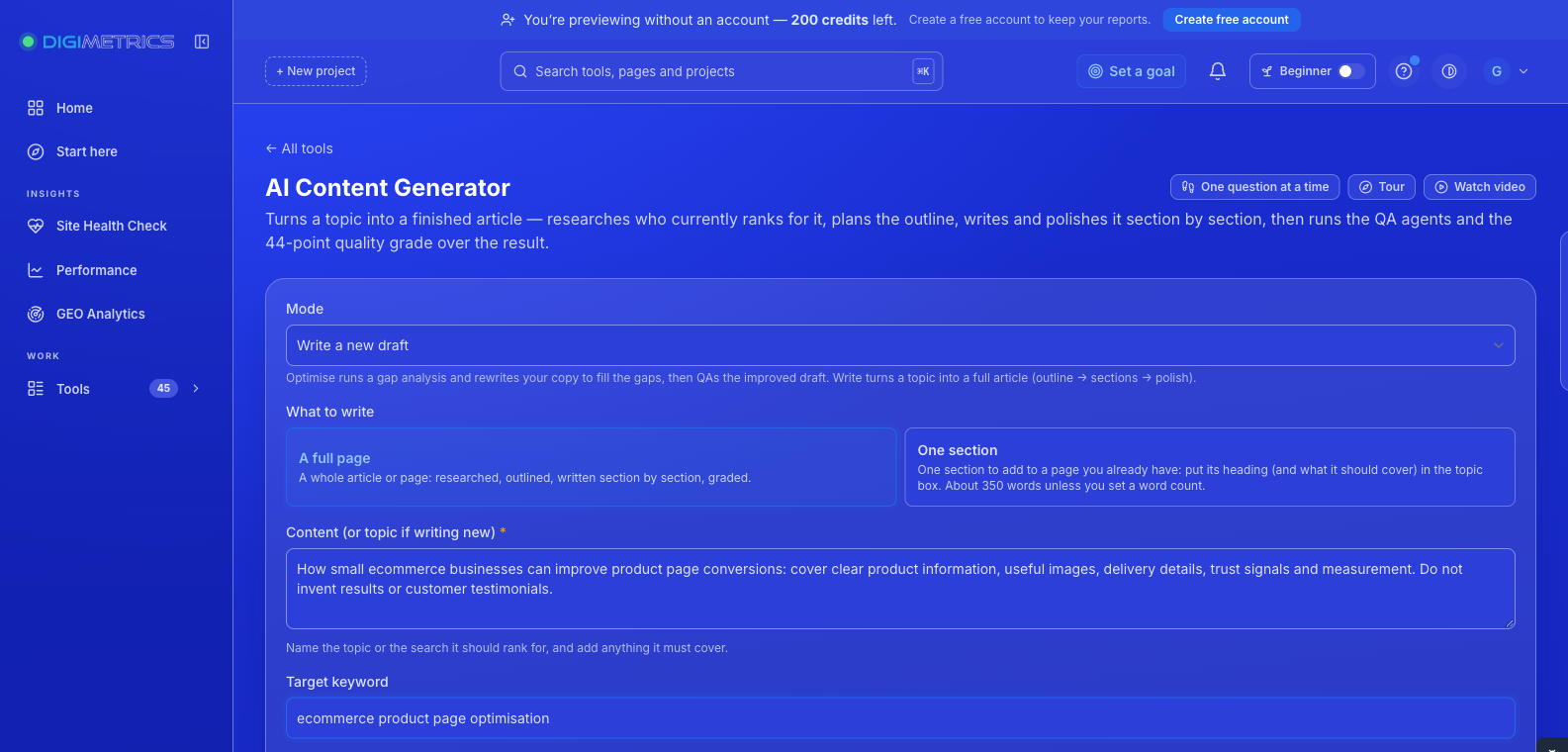
Digimetrics researches pages currently ranking for the target keyword.
It uses this research to prepare an outline and writes the article section by section.
The published product page describes a typical generation time of one to five minutes.
That can reduce the time spent preparing a first draft, although it doesn’t eliminate the need for editorial review.
After generation, Digimetrics returns the article, outline, quality grade and list of corrections.
Its 44-point quality check evaluates the draft and produces a grade out of 100.
Editors can inspect the reported changes rather than accepting unexplained revisions.
Review the finished draft before publishing.
Confirm important claims, add original examples, check the structure and remove unnecessary repetition.
If the article includes product comparisons, ensure the features and pricing are supported by current information.
A generated draft is a starting point, not automatic publication approval.
Automated content scores are common in SEO writing software, but they don’t all measure the same things.
Digimetrics evaluates its generated articles against 44 quality criteria and reports the result on a 100-point scale.
Its official demonstration uses a fictional brand called Brightpath.
The sample output contains:
| Metric | Published Sample |
|---|---|
| Article length | 1,480 words |
| Sections | 6 |
| Quality grade | 86/100 |
| Issues corrected | 3 |
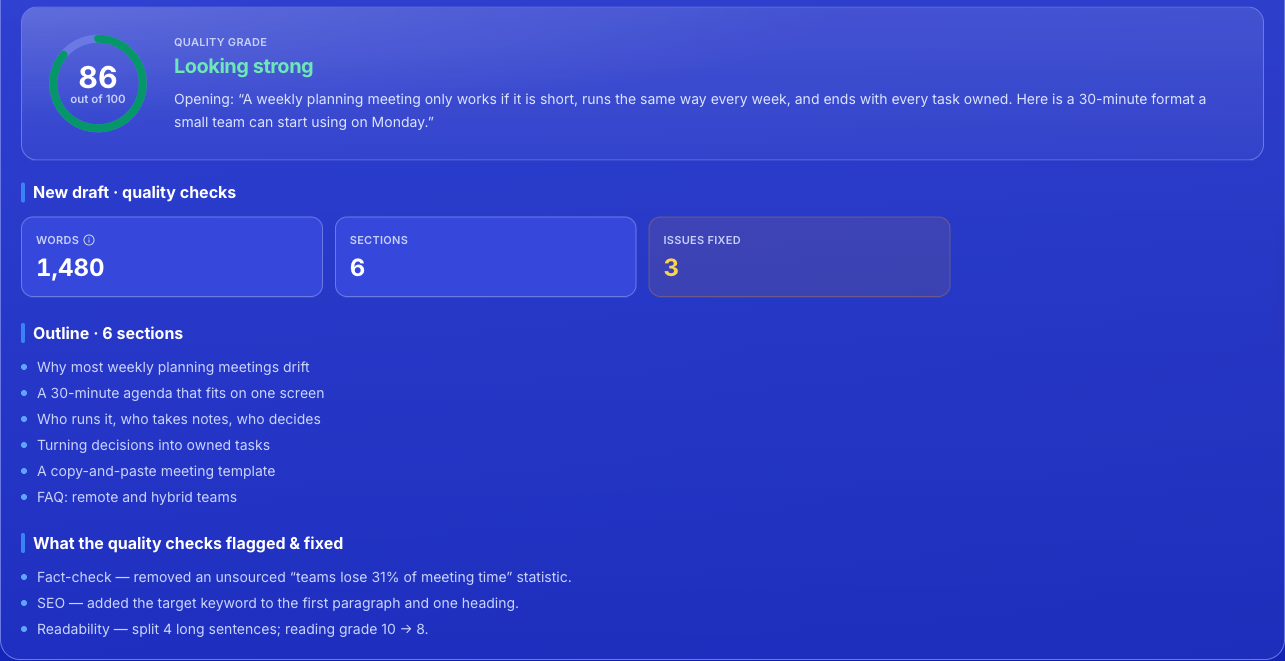
The reported corrections include removing an unsupported statistic, improving target keyword placement and simplifying long sentences to improve readability.
Those are practical editing improvements.
However, a content grade of 86/100 does not mean the article has an 86% chance of ranking on Google.
The score reflects the software’s internal evaluation criteria.
It cannot independently establish that an article is factually correct, genuinely original or better than every competing page.
A useful quality check should help the editor identify problems, not replace editorial judgement.
General-purpose AI chatbots can assist with writing, research and editing.
Dedicated SEO content tools package these tasks into a more structured process.
| Capability | General AI Chatbot | Digimetrics AI Content Generator |
|---|---|---|
| Generate article drafts | Yes | Yes |
| Create outlines | With instructions | Built into the workflow |
| Research ranking pages | Depends on available tools | Included |
| Target a search keyword | Through prompting | Dedicated input |
| Set tone and length | Through instructions | Dedicated settings |
| Evaluate content quality | Can be requested | 44-point check |
| Provide a numeric quality grade | Depends on configuration | Included |
| Report automatic corrections | Depends on workflow | Included |
A general chatbot may offer greater flexibility for exploratory research, unusual formats or collaborative drafting.
A dedicated content writing tool can be more convenient for recurring SEO assignments requiring similar research and quality-control steps.
Neither approach guarantees publication-ready content.
The deciding factor should be how much editorial work remains after generating the draft.
A content writing tool should save time without introducing unnecessary risk.
That requires checking more than grammar.
AI-generated articles can include outdated statistics, inaccurate product features or unsupported performance claims.
Suppose an article states:
“Businesses using automated email marketing increase conversions by 45%.”
Without credible supporting evidence, this is not a claim you should publish.
An editor should locate a reliable source, qualify the statement or remove it.
The article needs to answer the question behind the keyword.
For example, someone searching for “best accounting software for freelancers” likely wants comparisons, costs and limitations.
An article consisting mostly of a general definition of accounting software would not fully satisfy that intent.
Researching competing articles helps establish expected coverage.
However, copying their topics doesn’t automatically create a better article.
Look for missing explanations, outdated recommendations or questions that competing pages do not adequately answer.
Then add useful information supported by evidence.
AI-generated drafts sometimes restate the same point under several headings.
Review whether each section adds new information.
Combine overlapping explanations and remove unnecessary paragraphs.
The article should match the audience’s level of knowledge.
Avoid excessive jargon for beginners and oversimplified explanations for specialist readers.
Use clear transitions and cohesive paragraphs rather than separating every sentence into its own paragraph.
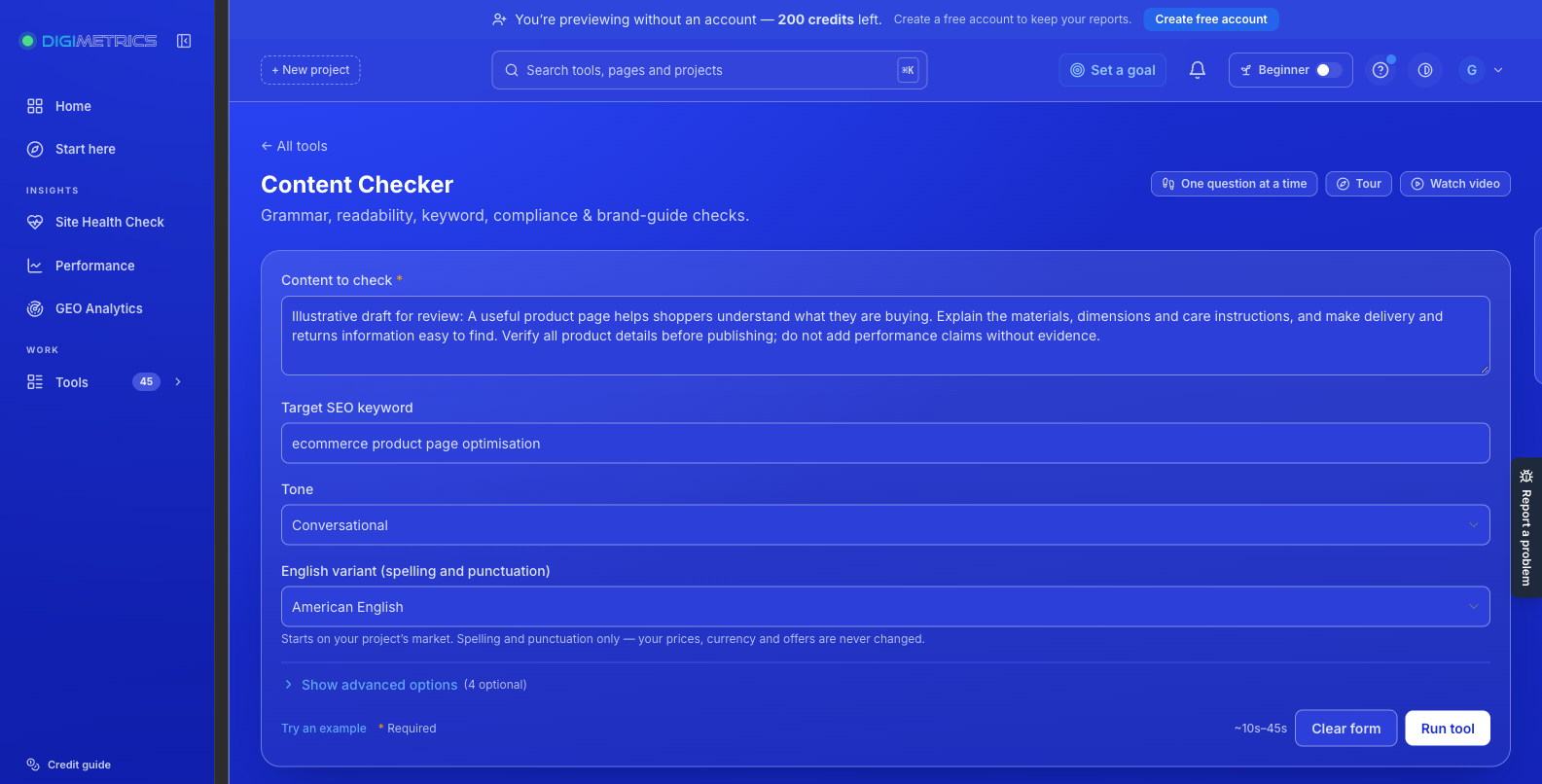
The Digimetrics Content Checker can examine grammar, readability, keyword usage, tone and potentially risky claims.
It also supports optional brand guidance, reference material and compliance rules.
This makes it useful as a final review step, whether the original draft was written by AI or a person.
However, Content Checker is not a plagiarism detector, and its warnings should not be considered a substitute for independent fact-checking.
Content quality becomes more consistent when each stage has a clear purpose.
A useful workflow separates planning, drafting, review and publication.
| Stage | Main Task | Responsible Role |
|---|---|---|
| Research | Choose the topic, keyword and audience | SEO specialist or content lead |
| Brief | Define structure, required information and sources | Editor |
| Draft | Produce the initial article | Writer assisted by AI |
| Fact-check | Verify important claims and examples | Editor or subject expert |
| Quality control | Review readability, tone and SEO alignment | Editor |
| Publication | Approve and publish the final version | Publisher |
| Performance review | Evaluate results and improvement opportunities | SEO or content team |
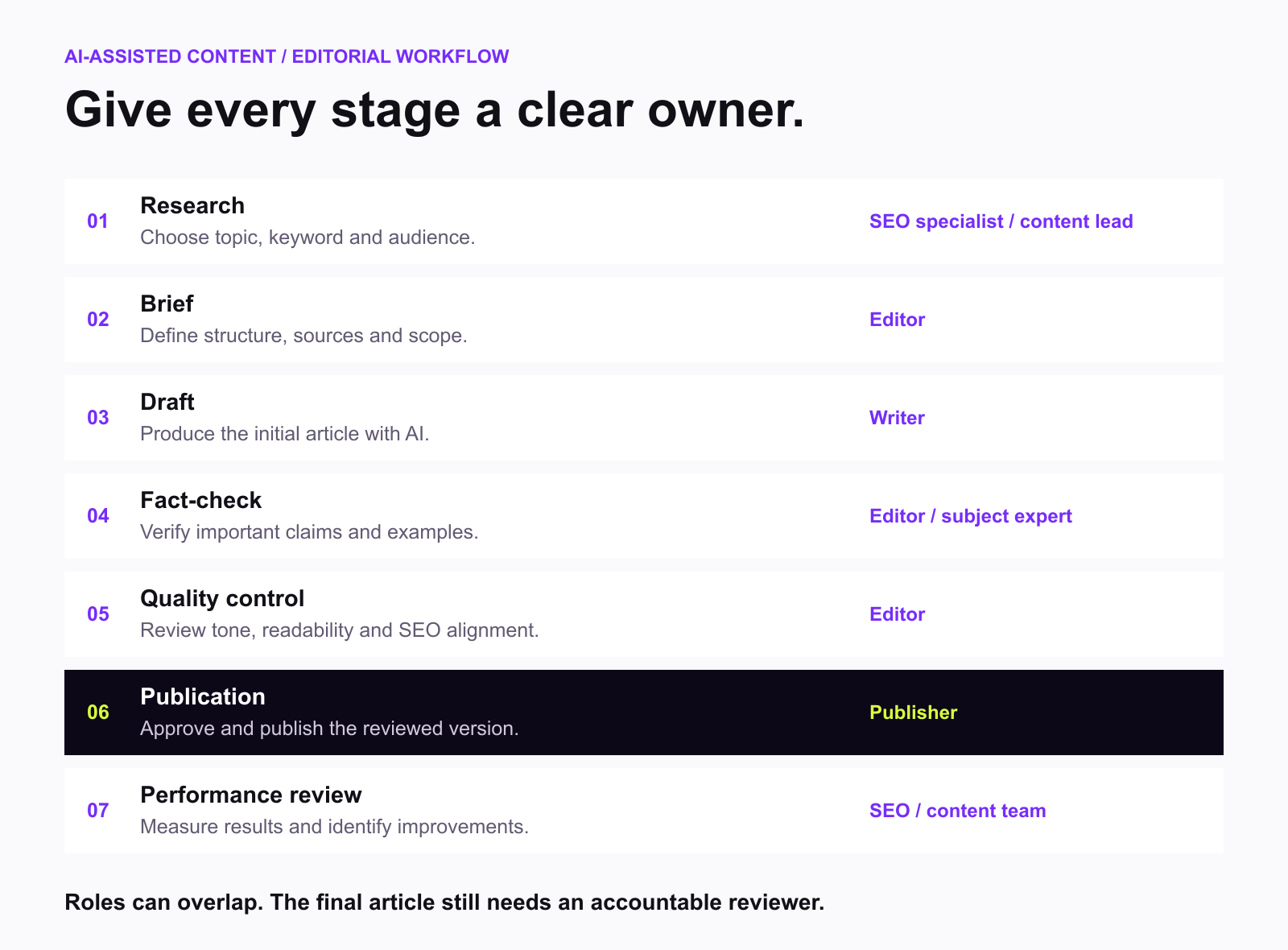
These responsibilities can overlap in smaller businesses.
The important point is that the final article should have an accountable reviewer.
For a more detailed process, our guide to building an AI-assisted content workflow explains how teams can organise editorial checks from keyword research to publication.
Imagine a marketing team responsible for publishing eight articles per month.
Before adopting AI, the team spends significant time preparing outlines and first drafts.
An AI writing tool could reduce those repetitive stages, allowing writers to spend more time on research, interviews and examples.
But the team should measure the full process.
If each generated draft requires extensive factual corrections, the expected productivity improvement may not materialise.
The objective should be fewer total hours per approved article while maintaining quality, not simply more drafts per month.
One frequently overlooked issue with AI writing software is unnecessary duplication.
Because creating another article is easy, teams may publish multiple pages targeting nearly identical search intent.
For example:
These keywords may overlap substantially.
Depending on the current search results, one comprehensive page could address several variations more effectively than three separate articles.
Before generating a new page, check whether an existing article already serves the same audience.
The Digimetrics AI Content Optimiser is designed for improving existing content.
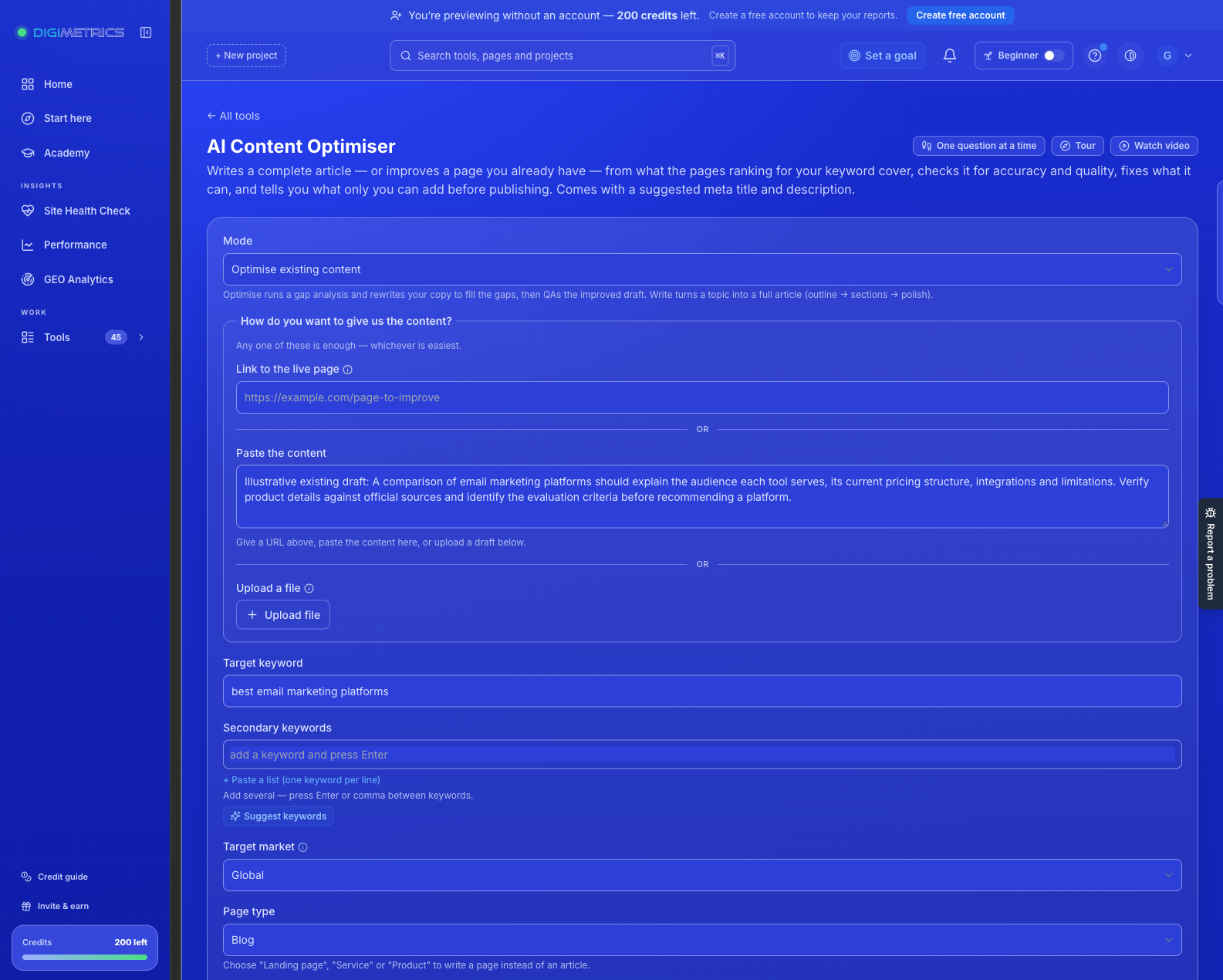
It examines keyword alignment, readability and other issues, then provides suggested changes, including a rewritten opening.
If you’re managing a larger content library, our guide to conducting a website content audit explains how to identify pages that should be refreshed, consolidated, retained or reviewed for removal.
Generating new content should be a deliberate choice, not the default response to every keyword variation.
Yes. AI-assisted content can appear in Google Search.
Google does not automatically penalise an article simply because artificial intelligence helped produce it.
However, Google’s guidance on generative AI content emphasises accuracy, quality and relevance.
It also explains that generating large numbers of pages without adding value may violate its scaled content abuse policy.
That distinction matters for businesses using AI content writing software.
A page should offer information that helps the reader accomplish something.
Useful additions might include original research, firsthand observations, verified product comparisons, expert explanations or practical examples.
AI can assist with organising this information, but it cannot legitimately invent a company’s experience or customer results.
An article that repeats generic advice without supporting evidence may be less useful regardless of whether a human or AI wrote it.
Our guide to how AI content generators work and what they cost also explains why verifiability and editorial review should influence software selection.
Digimetrics provides a seven-day free trial with access to its AI Content Generator and other tools.
No credit card is required.
After the trial, three paid subscription plans are available.
| Plan | Monthly Equivalent, Annual Billing | Monthly Billing | Monthly Credits | Projects |
|---|---|---|---|---|
| Starter | $31 | $39 | 500 | 3 |
| Pro | $87 | $109 | 2,000 | 10 |
| Expert | $159 | $199 | 6,000 | 25 |
Prices are in USD. Annual rates require annual billing.
Every paid plan includes access to Digimetrics’ 43 SEO, content, advertising and AI visibility tools.
The number of articles you can generate depends on the credits consumed by individual runs.
You can check current allowances and subscription terms on the Digimetrics pricing page.
Subscription fees only represent part of the cost.
Imagine two hypothetical writing tools.
| Metric | Tool A | Tool B |
|---|---|---|
| Monthly subscription | $30 | $60 |
| Drafts generated | 20 | 20 |
| Drafts approved | 12 | 18 |
| Average editing time per approved article | 90 minutes | 45 minutes |
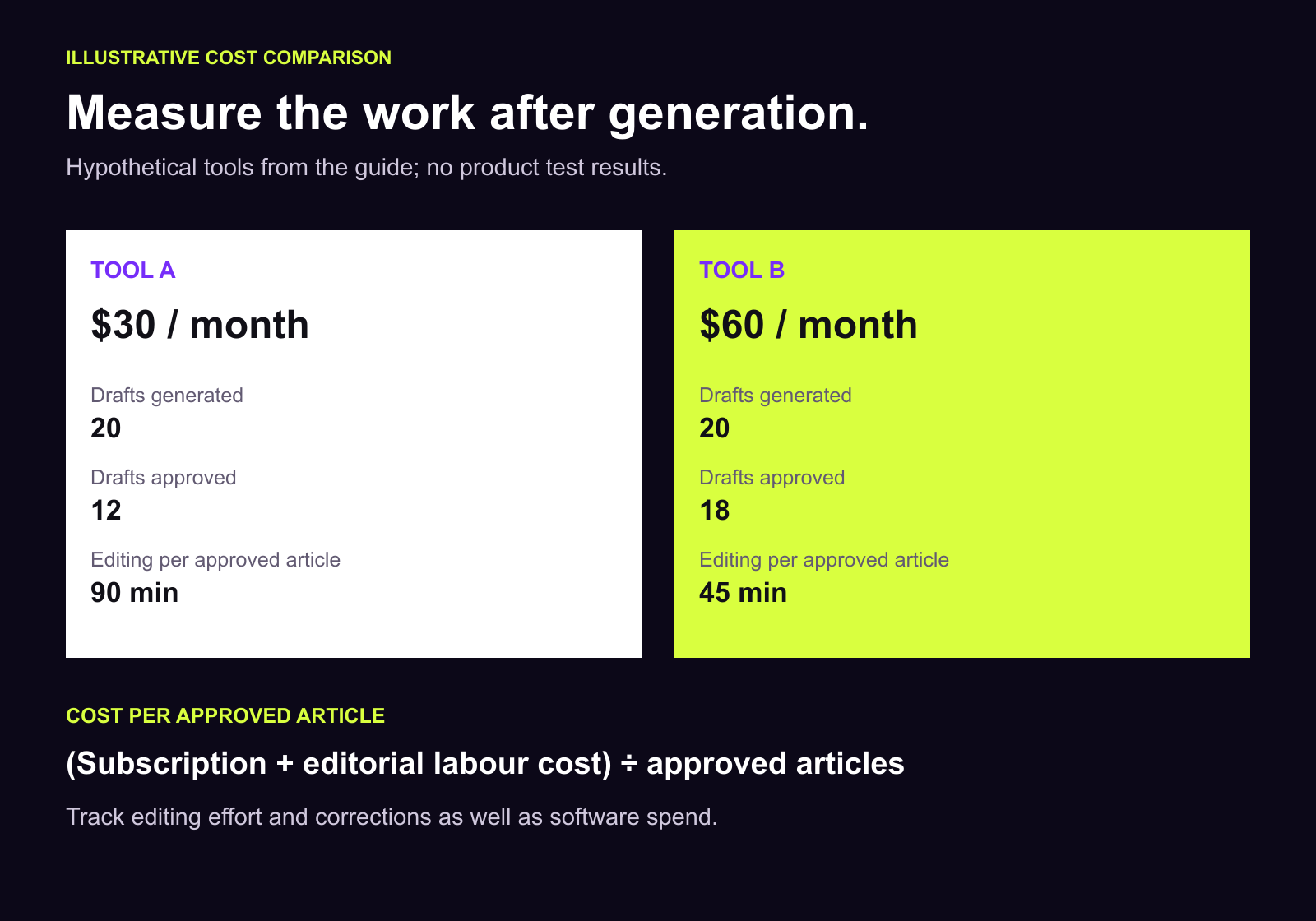
Tool A costs less per month.
But Tool B produces more accepted articles and requires less editing time.
If editorial labour is expensive, the higher-priced tool could be more economical.
These figures are illustrative, not actual performance results for Digimetrics or competing products.
When evaluating AI writing software, track subscription cost, editing hours, factual corrections and approved articles.
The useful metric is cost per publishable piece, not cost per generated word.
A well-written article may still contain inaccurate claims or unsupported recommendations.
Complete factual and editorial reviews before publishing.
Generating more words doesn’t necessarily create more value.
Focus on whether the content answers the reader’s question.
Automated quality grades can identify issues, but they don’t predict Google’s rankings.
Closely related keywords may share search intent.
Review your existing content before publishing another page.
Do not present fictional customer results, product tests or professional experiences as genuine evidence.
A fast generator isn’t necessarily efficient if its drafts require extensive rewriting.
Measure total production effort.
An AI content writing tool is worth considering when it reduces the time required to produce useful, accurate content.
But the value comes from improving the complete production process, not simply generating paragraphs faster.
A reliable workflow should include research, structured writing, quality checks and final editorial review.
Digimetrics AI Content Generator combines ranking-page research, outline planning, section-by-section drafting and 44-point quality grading.
Its wider toolkit also includes keyword research, content checking and optimisation tools for existing pages.
These capabilities make it useful for businesses, bloggers and content teams that want a repeatable approach to SEO writing.
The best AI content writing tool isn’t necessarily the one that writes the fastest. It’s the one that leaves you with less editing work and a stronger article to publish.
Have a topic or keyword but don’t want to start from a blank page?
Digimetrics AI Content Generator researches ranking pages, prepares an outline, creates the article and evaluates it against 44 quality criteria.
You receive the generated draft, quality grade and list of corrections to review before publication.
Try Digimetrics AI Content Generator through the seven-day free trial.
No credit card required. Usage limits apply.
An AI content writing tool uses artificial intelligence to generate, revise or improve written material based on topics, keywords, briefs or existing content.
The best choice depends on your workflow. Digimetrics is worth considering for SEO article production because it combines ranking-page research, outline generation, drafting and a 44-point quality check.
Yes. Digimetrics offers a seven-day free trial with no credit card requirement. Usage limits apply.
The product advertises a typical generation time of one to five minutes, depending on the article and selected settings.
Yes. Digimetrics provides settings for word count, tone and quality-check thoroughness.
Yes. Its AI Content Generator applies 44 quality criteria and reports corrections. Its separate Content Checker supports grammar, readability, keyword, tone and claim-related reviews.
They can help with research, article structure, readability and keyword alignment. However, no AI writing tool can guarantee improved rankings.
Yes. Google’s policies do not prohibit AI-assisted writing itself. Content must still meet applicable quality and spam requirements.
No. AI writing tools do not guarantee that all generated material is original or free from inappropriate similarities. Review the content before publishing.
AI can assist with research, outlining and drafting. Human expertise remains important for original reporting, factual verification, editorial judgement and accountability.

Tom is the CEO of MediaOne, a leading digital marketing agency. He is a business-experienced SEO consultant as well as a Google Gold Search Expert serving the international community. He has consulted for MNCs like Canon, Maybank, Capitaland, SingTel, ST Engineering, WWF, Cambridge University, as well as Government organisations like Enterprise Singapore, Ministry of Law, National Galleries, NTUC, e2i, SingHealth. His articles are published and referenced in CNA, Straits Times, MoneyFM, Financial Times, Yahoo! Finance, Hubspot, Zendesk, CIO Advisor. Under his stewardship, MediaOne has won dozens of prestigious digital marketing awards.
Run a free Digimetrics audit across SEO, AI search, content and technical health, and get a plan you can act on today.
Start free →You have a keyword worth targeting, but turning it into a useful blog post takes more than writing an introduction and filling the page…
AI article writer software can produce a complete blog post in minutes. But generating 2,000 words isn’t the same as producing 2,000 words worth…
You have a blog post to publish, three social media updates to prepare, and a paid advertising campaign that needs fresh copy. Each task…