Content
Free AI Content Generator: Create SEO Content With AI
You have a blog post to publish, three social media updates to prepare, and a paid advertising campaign that needs fresh copy. Each task…
Writing a blog post isn’t usually the hardest part of content marketing. The real work happens before and after the first draft.
You need to understand what people are searching for, examine the articles already ranking, decide which questions deserve an answer, organise the information, and check whether the finished content is accurate.
Then you need to do it again for the next keyword.
A free AI article writer can reduce the time spent on research, outlining, and drafting. Instead of starting with a blank document, you can generate a structured article and spend more time improving the information that makes it useful.
But there’s a difference between an AI tool that produces 1,500 words and one that helps create an article worth publishing.
Some free AI writers generate text from a short prompt. Others provide SEO research, content grading, and editing recommendations. Many also limit the number of articles or credits available without a subscription.
Digimetrics AI Content Generator combines keyword-focused research, article planning, drafting, and quality checks in one workflow. You can try it during a seven-day free trial without providing a credit card.
This guide explains how free AI article writers work, what features matter, how to produce a better first draft, and what to check before publishing AI-assisted content.
A free AI article writer is a tool that uses artificial intelligence to create written content from a topic, keyword, brief, or other instructions.
Depending on its features, it may generate:
Most tools use language models to predict and generate text based on the information they receive.
However, they don’t all follow the same process.
A basic generator might receive the instruction “Write a blog post about email marketing” and immediately produce an article.
A more structured tool may first examine the topic, review relevant search results, prepare an outline, and then generate individual sections.
The second approach can provide a stronger editorial starting point because it includes more information about what the article needs to cover.
Neither approach guarantees factual accuracy, originality, or strong search rankings.
The purpose of an AI article writer should be to accelerate the writing process without removing the need for research, evidence, and editorial judgement.
Yes. Several AI writing tools offer free plans, introductory credits, or limited trials.
However, the meaning of “free” varies considerably.
A tool may allow a few hundred words each month, offer a limited number of prompts, or provide full access for a short trial period.
These models are not interchangeable.
| Free Access Model | What It Means | What to Check |
|---|---|---|
| Permanently free plan | Ongoing access without subscription fees | Monthly word, prompt, or feature limits |
| Free credits | A fixed amount of initial usage | How much each article consumes |
| Free trial | Temporary access to paid features | Duration, usage limits, and card requirements |
| Free short-form generator | Produces small amounts of text | Whether full articles are supported |
| Free preview | Lets users inspect sample output | Whether generation and export are available |
For example, Digimetrics provides a seven-day free trial with access to its AI Content Generator and other marketing tools.
You don’t need a credit card to begin, although usage is subject to the trial’s allowances.
This is useful if you want to evaluate the complete article-generation workflow before subscribing.
It is not the same as a permanently free, unlimited AI writer.
When comparing free tools, calculate how many complete, usable articles you can produce rather than focusing only on the number of prompts advertised.
Generating text quickly is relatively easy. Creating a useful, well-organised article requires more.
The following capabilities can help distinguish a practical writing tool from a basic text generator.
An article should answer the question behind its target keyword.
Consider the keyword “best project management software for small teams.”
Someone searching for this phrase probably wants to compare available products, understand features and costs, and identify which solution suits their team.
An article explaining only what project management means would miss much of that intent.
A useful AI article writer should help identify the topic’s search context before drafting.
An outline determines how information is organised.
It helps establish which questions need answers, what deserves its own section, and where comparisons or examples would be useful.
Without an outline, AI-generated articles often repeat the same points under slightly different headings.
A short introductory guide requires a different structure from a detailed software comparison.
Look for tools that let you specify the intended article length, audience, and writing style.
More words do not automatically create a better article. The chosen length should reflect the information needed to satisfy the reader.
A first draft may contain unnecessary repetition, awkward sentences, missing keywords, or unsupported claims.
Quality checks can help identify these problems before publication.
However, an automated quality score should not be treated as proof that an article is accurate or likely to rank.
Some AI tools revise the generated text without clearly explaining what changed.
A visible change log makes it easier to review those revisions.
This matters when the tool removes a claim, changes a technical explanation, or rewrites important messaging.
Consider how much manual work remains after generating the article.
If you still need to research the keyword, rebuild the outline, remove invented facts, and rewrite most paragraphs, the apparent time savings may be smaller than expected.
The best tool for your workflow is the one that reduces total production effort while maintaining an acceptable level of quality.
The Digimetrics AI Content Generator is designed for creating keyword-focused articles rather than simply producing paragraphs from a prompt.
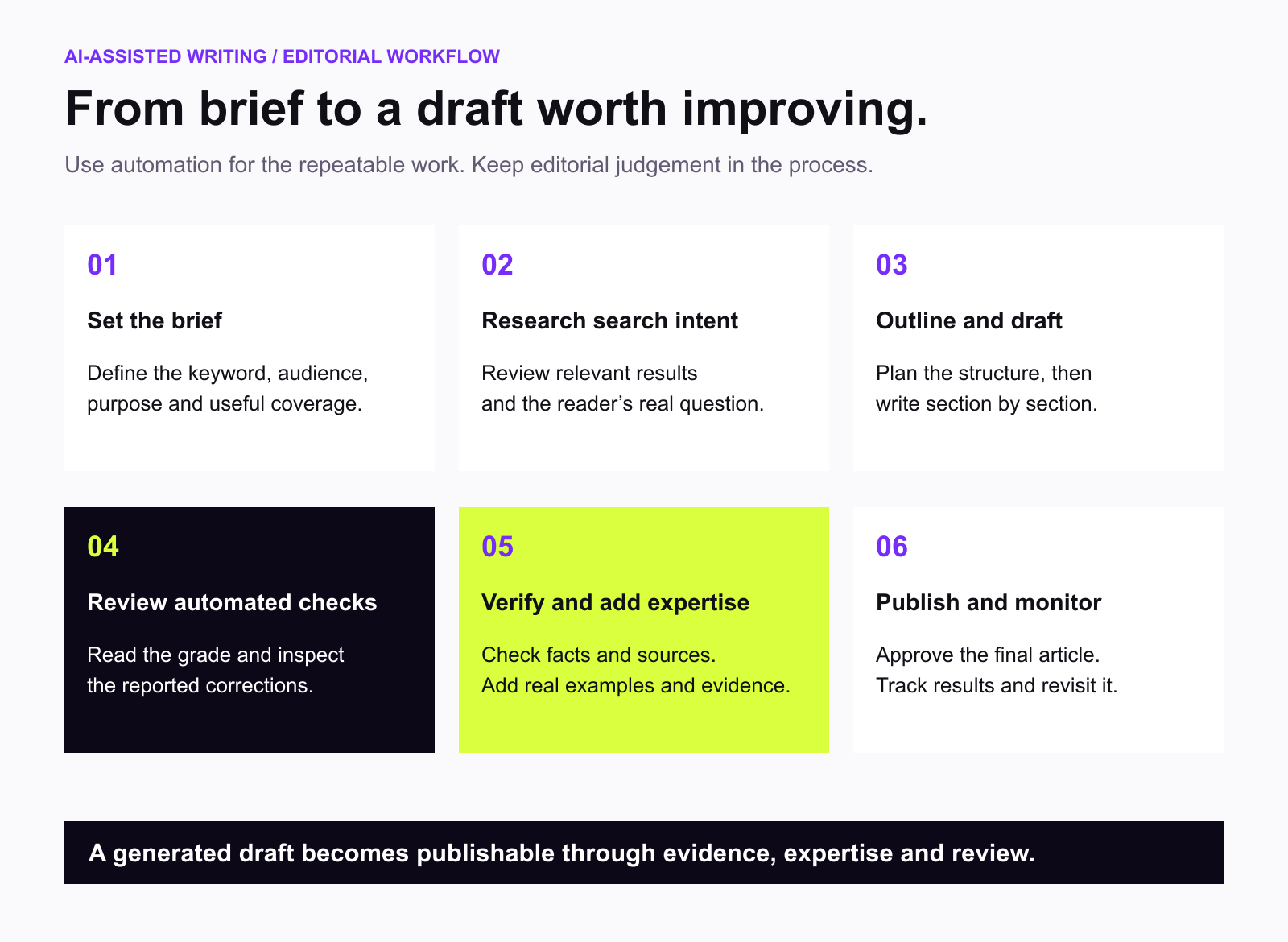
Its workflow begins with the topic and target keyword.
The tool examines pages already ranking for that keyword, prepares an outline, generates the article section by section, and evaluates the draft against a 44-point quality checklist.
It then provides the generated article, a quality grade, and a record of the changes made during its checks.
According to Digimetrics, a typical article generation takes approximately one to five minutes.
| Feature | What It Does |
|---|---|
| Search-result research | Examines pages ranking for the target keyword |
| Article outline | Plans headings and sections before drafting |
| Section-by-section writing | Generates the article using the planned structure |
| Word-count settings | Lets users control the intended length |
| Tone settings | Adjusts the writing style |
| Market targeting | Accounts for the selected market |
| 44-point quality check | Evaluates the draft against defined criteria |
| Quality grade | Returns a score out of 100 |
| Visible corrections | Lists changes made during quality checks |
| Free trial | Seven days, no credit card required |
These capabilities are useful for marketers producing recurring educational articles, comparison guides, and SEO content.
They also make the process easier to review.
Instead of receiving only the finished article, you can inspect the outline, examine the quality grade, and see which issues the generator identified.
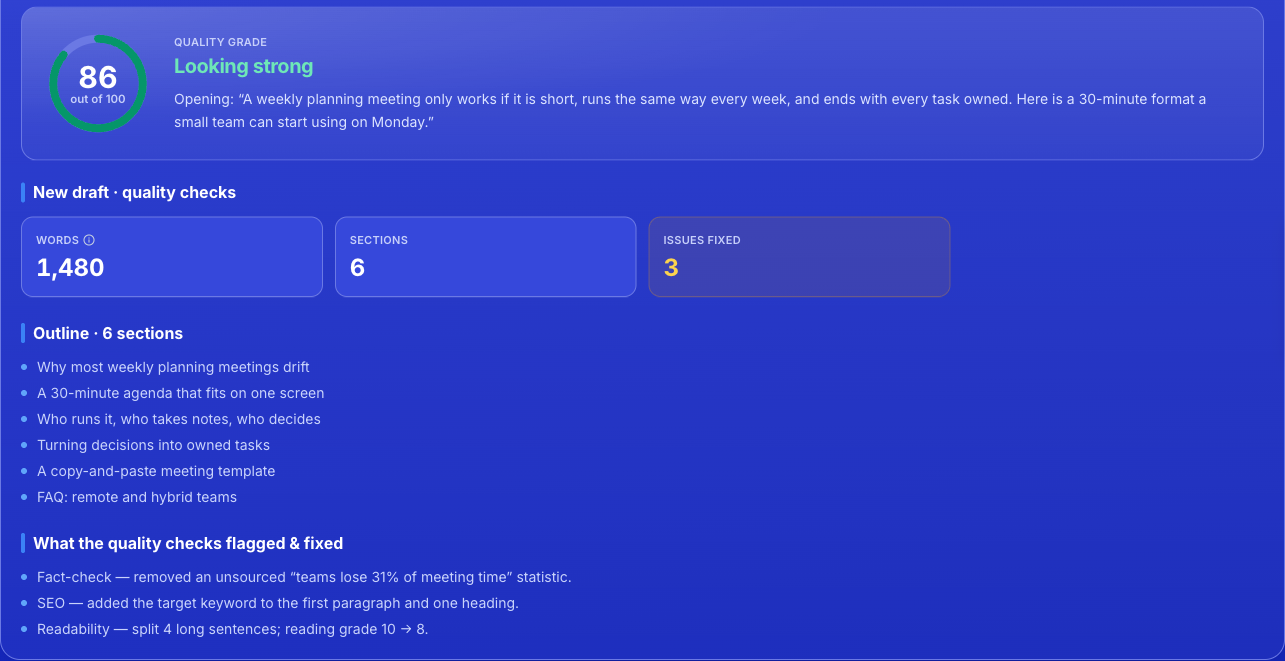
Digimetrics grades its generated articles out of 100 using a 44-point checklist.
In one official sample, the generator produced a 1,480-word article with six sections and received a quality grade of 86.
The tool reported three corrections, including removing an unsupported statistic, improving keyword placement, and simplifying long sentences.
This illustrates how its editing checks operate.
However, an 86/100 content grade does not mean the article has an 86% chance of ranking on Google.
The score measures performance against Digimetrics’ own criteria. It is not a Google metric, an independent editorial certification, or a substitute for human fact-checking.
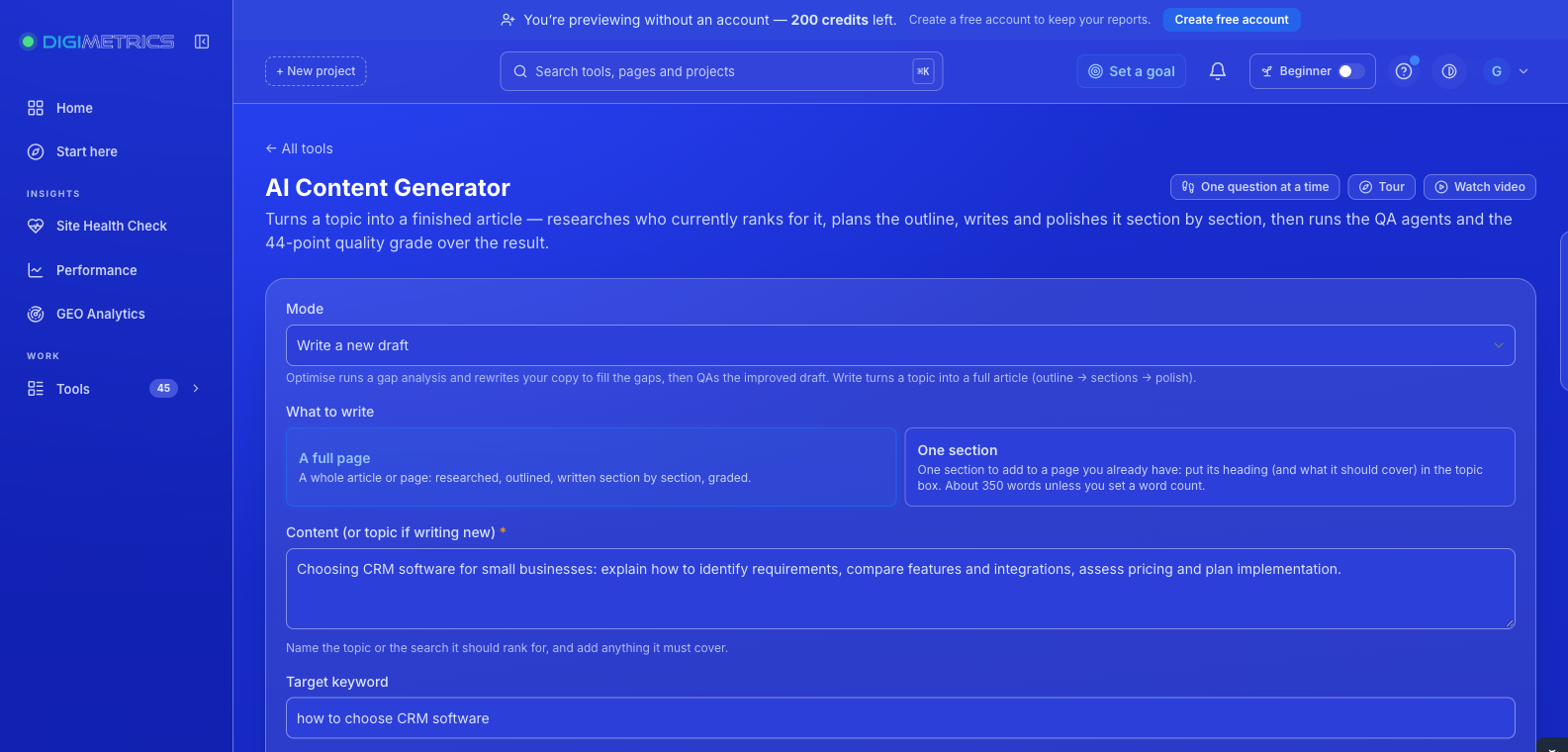
You can generate an initial article through the Digimetrics free trial in three main steps.
Open the Digimetrics AI Content Generator and provide a short topic brief.
For example:
Topic: How small businesses can improve email marketing performance.
Target keyword: email marketing tips for small businesses.
Market: Singapore.
The keyword helps establish the article’s search focus, while the market gives the generator useful context.
A clear brief is more helpful than an extremely broad instruction such as “write something about marketing.”
If you already have relevant customer questions or original research, keep that material available for the editorial stage.
Use the advanced settings to specify the intended word count and tone.
For example, a practical beginner’s guide might need 1,200–1,800 words, while a detailed comparison may require additional space.
These are editorial planning examples, not mandatory lengths.
Choose the level of detail based on what the reader needs.
The tone should also suit your audience.
An article for business owners may benefit from straightforward explanations and concrete examples, while a technical audience may expect more specialised terminology.
Digimetrics researches the ranking pages, prepares an outline, and writes the article section by section.
It then checks the output and returns the draft with a quality grade and reported edits.
Review the article before publishing.
Pay attention to whether the information is accurate, the headings make sense, and the content answers the intended question.
The tool can provide a structured first draft, but it cannot know everything about your customers, business, products, or firsthand experience.
Add those details where they make the article more useful.
Imagine a marketing team preparing an article targeting “how to choose CRM software for a small business.”
The article’s purpose is to help business owners understand which factors matter when comparing CRM platforms.
A practical brief might look like this:
| Setting | Example Input |
|---|---|
| Topic | Choosing CRM software for small businesses |
| Primary keyword | how to choose CRM software |
| Audience | Small business owners |
| Market | Singapore |
| Target length | 1,500 words |
| Tone | Practical and professional |
| Main objective | Help readers evaluate CRM requirements |
These are example inputs, not a live Digimetrics generation result.
A useful article would likely cover customer management requirements, essential features, integrations, pricing structures, implementation effort, and vendor evaluation.
The AI generator can help create the outline and initial explanations.
However, the editor should still confirm product-specific details and add information that isn’t available from general search results.
For example, a team that has implemented CRM systems for clients could contribute real observations about data migration, employee adoption, and implementation difficulties.
That original experience would make the article more useful than a generic summary of CRM features.
General-purpose AI assistants and dedicated article generators can both help create written content.
The difference is often in the workflow.
A general AI assistant can help with brainstorming, research, outlines, drafting, and editing, depending on the capabilities available and the instructions provided.
A dedicated SEO article generator packages several of these steps into a repeatable process.
| Capability | General AI Assistant | Digimetrics AI Content Generator |
|---|---|---|
| Generate long-form articles | Yes | Yes |
| Create an outline | Yes, with instructions | Built into the workflow |
| Research ranking pages | Depends on available research tools | Built into article generation |
| Target a keyword | With prompting | Dedicated keyword input |
| Control tone and length | With instructions | Dedicated settings |
| Evaluate writing quality | Can be requested | 44-point checklist |
| Provide a numerical quality grade | Depends on the workflow | Built in |
| Show quality-check corrections | Depends on instructions and tools | Included in output |
| Generate a draft in one workflow | Can be configured | Core product design |
Neither category is universally better.
A general assistant may be more flexible for unusual writing tasks, collaborative brainstorming, or iterative research.
A dedicated tool can be more convenient when your team repeatedly produces keyword-focused articles using similar requirements.
Digimetrics is particularly relevant when you want article research, drafting, and quality checks to follow a consistent process.
Yes, AI-assisted articles can appear in Google Search.
However, generating content with AI does not provide an automatic ranking advantage.
Google’s guidance on AI-generated content focuses on whether content is useful, accurate, original, and created primarily to help people.
Using AI to assist with writing is not inherently against Google’s guidelines.
Problems arise when publishers generate large volumes of low-value content primarily to manipulate search rankings.
That distinction is important.
An article that combines AI-assisted drafting with accurate information, original examples, and clear explanations can be useful.
A generic article copied from common information already available across dozens of websites may contribute little new value.
The strongest improvements usually come from information the AI cannot reliably invent.
These include:
Firsthand experience: What happened when you used a product, implemented a process, or solved a real problem.
Original data: Results from your own tests, surveys, experiments, or business operations.
Verified facts: Accurate prices, features, dates, and statements supported by reliable sources.
Specific examples: Realistic scenarios that demonstrate how recommendations apply.
Clear editorial judgement: Explanations of when a recommendation makes sense and when it doesn’t.
For example, an AI-generated article about SEO tools might describe the common features of a website crawler.
A stronger version could explain which types of crawl errors an agency prioritised during a real migration and why.
That information provides value beyond the ability to generate fluent text.
AI writing tools can produce clear sentences, but their drafts sometimes rely on predictable structures.
Common problems include repetitive introductions, vague statements, and too many paragraphs that communicate only one simple idea.
A useful editing process should improve both readability and substance.
Instead of writing:
“Content marketing is essential for businesses in today’s competitive digital landscape.”
Explain the actual challenge:
“A business publishing four articles a month may still struggle to attract qualified visitors if those articles target irrelevant keywords.”
The second statement gives readers a concrete problem to understand.
A long sequence of one-sentence paragraphs can make an article feel fragmented.
Group related explanations into cohesive paragraphs while keeping headings clear.
This helps readers understand the connection between ideas without excessive interruptions.
AI-generated articles sometimes explain the same benefit under several headings.
Review each section and ask whether it adds new information.
If two sections answer essentially the same question, combine them or remove the weaker one.
Review prices, statistics, software features, legal requirements, and performance claims.
An automated checker may identify unsupported statements, but it cannot guarantee that every remaining claim is correct.
If you have direct experience with the topic, include it.
Explain what you observed, which approach worked, and what you would do differently.
Do not invent tests, customer stories, or personal experience to make AI-generated content appear more credible.
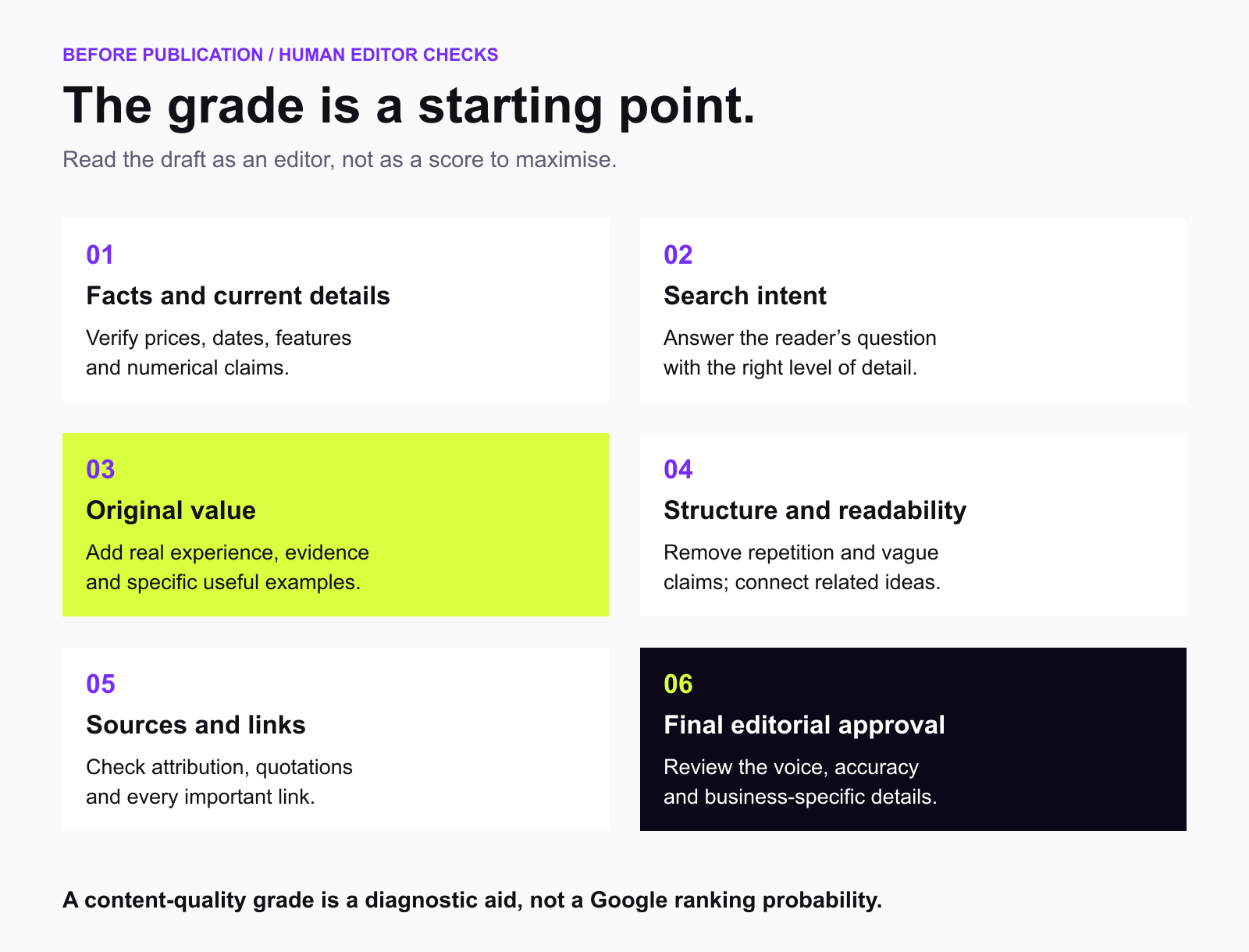
AI article generators can reduce repetitive work, but they still have limitations.
A generator may present outdated prices, invented statistics, or inaccurate product capabilities.
Even tools that flag unsupported claims can miss errors.
Verify important information against reliable sources.
Reviewing pages that already rank helps establish topic coverage.
It does not automatically produce new insights.
If every article follows the same sources and structure, the resulting content may become repetitive.
A numerical grade can identify writing and optimisation issues.
However, ranking depends on relevance, competition, site quality, search intent, and many other factors.
Some tools restrict monthly words, generations, or available features.
Digimetrics provides a seven-day trial rather than a permanently free unlimited article-writing plan.
An AI-generated article may be well structured but lack an original point of view.
Editors still need to review factual accuracy, content relevance, examples, and brand-specific messaging.
Digimetrics offers a seven-day free trial with access to its AI Content Generator and wider toolkit.
No credit card is required.
After the trial, the official pricing page lists three paid plans.
| Plan | Annual Billing (Monthly Equivalent) | Monthly Billing | Monthly Credits | Projects |
|---|---|---|---|---|
| Free trial | $0 for seven days | — | Trial allowance | 1 |
| Starter | $31 | $39 | 500 | 3 |
| Pro | $87 | $109 | 2,000 | 10 |
| Expert | $159 | $199 | 6,000 | 25 |
Prices are in USD. Annual prices require annual billing.
Every paid plan includes access to Digimetrics’ collection of 43 tools. Higher tiers provide more credits, projects, and other allowances.
The number of articles you can produce depends on the credits consumed by your chosen tool runs and settings, so the credit allowance should not be interpreted as an exact article quota.
You can compare current features and billing terms on the Digimetrics pricing page.
For a solo blogger, the Starter plan may be sufficient for a modest workflow.
A marketing team producing content for several websites may benefit from the higher project and credit allowances of Pro or Expert.
Choose based on actual usage rather than paying for capacity you don’t need.
Generating an article is only one part of content production.
A practical workflow also includes keyword selection, content planning, proofreading, and improving existing articles.
Digimetrics provides complementary tools for these tasks.
Start with the Digimetrics Keyword Research tool to investigate potential topics before generating an article.
The objective is to identify relevant searches and assess whether the content fits your audience.
The Content Pillar Generator helps organise content into broader themes and related subtopics.
This can prevent a publishing calendar from becoming a collection of disconnected articles.
Use AI Content Generator to research the chosen keyword, prepare the outline, write the article, and review its initial quality grade.
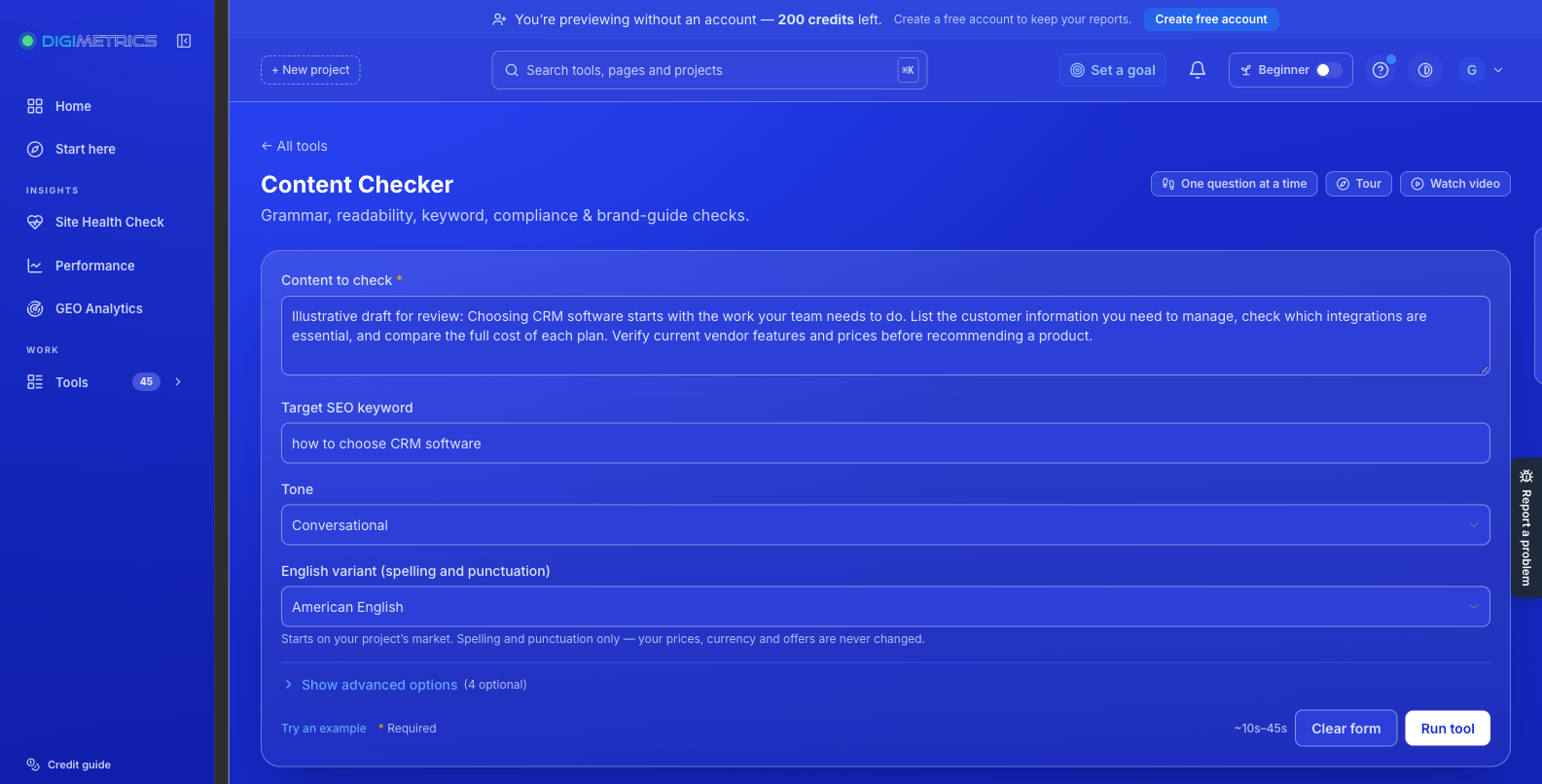
The Content Checker can help identify grammar problems, readability issues, keyword placement concerns, and claims that need attention.
Use it as an additional quality-control step rather than a replacement for fact-checking.
If the page is already published, the AI Content Optimiser is more appropriate than generating another article targeting the same query.
It evaluates existing content and suggests improvements.
This helps reduce unnecessary duplication and keeps attention on the pages you already have.
Yes, provided you understand what the tool can and cannot do.
A free AI article writer can help you get past the blank page, explore article structures, and produce first drafts faster.
But publishing more words isn’t the same as publishing better content.
A useful article still needs accurate information, relevant examples, a clear purpose, and meaningful editorial review.
For marketers who want a structured SEO writing process, Digimetrics combines ranking-page research, outlining, section-by-section drafting, and quality checks in one workflow.
Its 44-point evaluation and visible correction list make it easier to identify what the generator changed before publication.
The platform also provides complementary tools for keyword research, content optimisation, and proofreading.
The best use of AI writing isn’t to remove the human editor. It’s to reduce repetitive drafting work so more time can be spent on evidence, expertise, and content quality.
Have a keyword or article idea but don’t want to begin with a blank page?
Digimetrics AI Content Generator researches the ranking pages, creates a structured outline, generates the draft, and checks it against 44 quality criteria.
You get a complete starting draft, a quality grade, and a record of the changes made during the review.
Try Digimetrics AI Content Generator and see how the workflow fits your content production process.
Free for seven days. No credit card required. Usage limits apply.
Yes. Some AI writing tools offer permanently free plans, while others provide free credits or time-limited trials. Check word limits, generation allowances, and available features before choosing.
Yes. You can try the AI Content Generator during Digimetrics’ seven-day free trial, subject to the available credits and usage limits. No credit card is required.
It researches pages ranking for your keyword, prepares an outline, generates the article section by section, and grades the draft against a 44-point checklist. It also reports corrections made during the quality checks.
Digimetrics advertises a typical generation time of one to five minutes. Actual completion time can vary with the article and selected settings.
Yes. Digimetrics provides advanced settings for word count, tone, and the thoroughness of its quality checks.
Yes. AI can help structure articles, incorporate relevant keywords, and produce useful explanations. However, SEO performance still depends on accuracy, relevance, originality, and other factors.
Google does not automatically penalise content simply because AI helped create it. Its policies target manipulative practices, including scaled production of low-value content intended to influence rankings.
AI-generated content is not automatically guaranteed to be original. Review the output for copied passages, unattributed material, and other originality concerns before publishing.
It can assist with research, outlining, and drafting, but it doesn’t replace subject expertise, original reporting, firsthand experience, or editorial judgement.
No. Digimetrics offers a seven-day free trial with usage limits. Paid subscriptions provide different monthly credit allowances.
It depends on the task. Digimetrics provides a structured SEO article workflow with ranking-page research, a 44-point quality check, and a visible correction list. General AI assistants may offer more flexibility for other forms of writing and research.

Tom is the CEO of MediaOne, a leading digital marketing agency. He is a business-experienced SEO consultant as well as a Google Gold Search Expert serving the international community. He has consulted for MNCs like Canon, Maybank, Capitaland, SingTel, ST Engineering, WWF, Cambridge University, as well as Government organisations like Enterprise Singapore, Ministry of Law, National Galleries, NTUC, e2i, SingHealth. His articles are published and referenced in CNA, Straits Times, MoneyFM, Financial Times, Yahoo! Finance, Hubspot, Zendesk, CIO Advisor. Under his stewardship, MediaOne has won dozens of prestigious digital marketing awards.
Run a free Digimetrics audit across SEO, AI search, content and technical health, and get a plan you can act on today.
Start free →You have a blog post to publish, three social media updates to prepare, and a paid advertising campaign that needs fresh copy. Each task…
Your website has 150 published articles. Some attract consistent organic traffic, others haven’t generated a meaningful visit in months, and several cover nearly identical…
Writing a good advertisement sounds simple until you have to create 15 different headlines, stay within character limits, communicate your product’s benefits, and make…