SEO Audit
Free White Label SEO Audit Tool: What Agencies Actually Get
You’ve found a potential SEO client, reviewed their website, and identified several problems worth fixing. Now you need a professional audit report that explains…
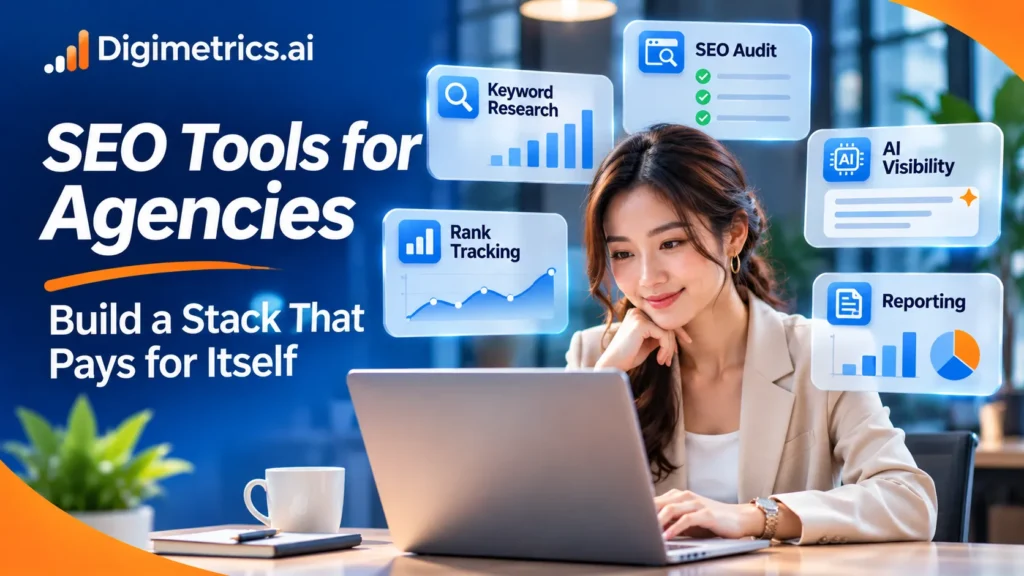
An agency does not necessarily need a separate platform for each task. It does need a reliable way to carry out six jobs: identify opportunities, diagnose problems, measure results, improve content, earn relevant links, and explain outcomes to clients. Local SEO and AI-search visibility may add specialized requirements.
Keyword research should go beyond search volume. A client-ready process also considers organic difficulty, intent, the current search results page, and whether a keyword supports a landing page or an informational article. The goal is to turn raw lists into a prioritized content and optimization plan.
Digimetrics Keyword Research brings search volume, keyword difficulty, cost per click, and search intent together. Ahrefs and Semrush provide broader competitive datasets for teams that need deeper market analysis. The right choice depends on how many domains, markets, and keywords the agency handles.

Technical audits uncover broken links, status-code errors, redirects, indexing directives, duplicated titles, and structural weaknesses. The key distinction is the crawl scope and whether the team can turn findings into verified fixes.
Screaming Frog SEO Spider is a strong desktop crawler. Its free version is limited to 500 URLs per crawl, and advanced functionality is paid. Digimetrics Technical SEO Crawler is a convenient cloud-based option for finding page-level issues and sorting them by severity. For very large or complex websites, test crawl completeness, JavaScript behavior, scheduling, and export requirements before choosing a platform.
Agencies need to track keyword rankings by relevant country, city, and device, particularly for local businesses. A movement of several positions should be interpreted alongside clicks, conversions, and search intent, rather than treated as proof that a campaign succeeded.
Digimetrics Rank Checker supports location-based ranking checks and historical movement. Use it alongside Search Console rather than treating the two as interchangeable: a rank checker records selected queries in a chosen market, while Search Console reports aggregated performance for a verified property.
Link research tools help an SEO agency review referring domains, link relevance, lost links, and competitor link opportunities. Outreach software handles a different job: identifying prospects, coordinating contact, and recording responses. Not every agency needs both categories at the beginning.
For research, consider Digimetrics Backlinks Explorer or established backlink suites such as Ahrefs. For dedicated outreach operations, Pitchbox offers prospecting and campaign features, but it costs substantially more than a lightweight SEO toolkit. Evaluate outreach on the number of legitimate placements and relationships it produces, not on email volume alone.
Content tools can surface topic gaps, heading opportunities, on-page issues, and competitor patterns. They can accelerate briefs and pre-publication checks, but a content score is not a substitute for editorial judgment, original evidence, or an accurate answer to the searcher’s question.
When possible, keep keyword discovery, on-page analysis, and editorial tracking connected. Digimetrics includes on-page optimization and content-related tools in its wider product suite; more specialized content platforms may still be worthwhile for large editorial departments.
Google Search Console reports Google search performance and indexing information. Google Analytics 4 helps analyze what visitors do on site and whether they convert. Looker Studio can turn those sources into a reusable client dashboard. Some third-party data connectors require separate subscriptions or licensing.
Do not report rankings alone. A useful monthly review includes search visibility, organic clicks, meaningful leads or revenue, completed actions, unresolved issues, and priorities for next month.
Search performance is no longer limited to conventional blue-link results. Agencies increasingly need to understand how brands are represented in AI-generated answers and which sources are being cited. Traditional SEO remains foundational; AI-search measurement is a complementary layer.
Digimetrics AI Mentions Tracker is a useful option for comparing brand mentions, citations, and sentiment across major AI-answer experiences. Treat the measurements as snapshots that can vary by prompt, model, and date. Repeat the same question set over time instead of claiming that one run proves lasting AI visibility.
The following shortlist combines multi-function SEO platforms with dedicated specialist and reporting tools. It is not a laboratory-tested ranking. Features and advertised prices were reviewed against available official vendor pages in November 2026. Confirm current terms and applicable taxes before purchasing.
| Tool | Main role | Indicative access or price | Strongest agency fit |
|---|---|---|---|
| Digimetrics.ai | Integrated SEO, content and AI visibility | From US$31/mo annually; US$39 monthly | Small and growing agencies seeking a broad toolkit |
| Screaming Frog SEO Spider | Desktop technical site crawling | 500 URLs free; £199/yr paid | Deep technical diagnosis and crawl exports |
| Ahrefs | Backlink, keyword and competitive SEO analysis | Plans vary by feature and allowance | Link-intensive research and competitive intelligence |
| Semrush | Broad SEO, competitive data and reporting | Plans and limits vary | Agencies needing an established suite |
| BrightLocal | Local rank tracking, listings and audits | Track from US$31/mo annually for one location | Local SEO and multi-location campaigns |
| Pitchbox | Outreach prospecting and campaign workflows | Pro US$210/mo annually; US$300 monthly | Dedicated link-building outreach teams |
| Google Search Console | Organic search, indexing and diagnostics | Free | All verified client websites |
| GA4 + Looker Studio | Conversion measurement and client dashboards | Core services free; connectors can have costs | Customized client-facing reporting |
| monday.com | Task assignment, approvals and production workflows | Free plan up to two seats | Agencies needing project coordination |
For agencies aiming to reduce subscription overlap, Digimetrics.ai is one of the more attractive consolidated candidates. Its published offering brings together technical SEO checks, keyword analysis, rank checking, backlink exploration, on-page optimization, and AI visibility. This makes it worth testing as a primary workspace before committing to multiple specialist subscriptions.
The pricing model is also relevant to agencies: the Starter plan is listed at US$31 per month when billed annually (US$39 month to month) for three projects. The Pro plan is US$87 per month with annual billing (US$109 month to month) for 10 projects. The Expert plan is US$159 per month with annual billing (US$199 month to month) for 25 projects and the listed white-label PDF and API capabilities. Plans use monthly tool credits and tracked-keyword allowances. New accounts can try all tools for seven days without a payment card.
Where it fits best: smaller or growing teams that want practical SEO and AI-search workflows in fewer places. What to verify: whether plan limits cover your client portfolio and whether required exports, multiple users, historical retention, or specialized outreach workflows are included at your chosen tier. See official Digimetrics pricing.
Start with the permanent free foundations: Search Console, GA4, Looker Studio, and the free Screaming Frog crawler for websites small enough to fit its limit. A Digimetrics Starter subscription can add keyword, auditing, and AI visibility tools without forcing you to buy several separate suites.
Decision rule: Upgrade only when a repeated client task cannot be completed reliably within a free or low-cost plan. Check the three-project Starter limit; agencies serving more domains may need Pro or another arrangement.
At this stage, switching between subscriptions becomes expensive. Choose a core research and optimization platform, then add only the specialist products your clients actually require. Digimetrics Pro may suit a portfolio within its 10-project and usage allowances. Screaming Frog can complement it when you need advanced desktop crawling; BrightLocal can complement it if location-specific listings and grid ranking are central to your services.
The aim is not to force every job into one vendor. It is to avoid paying twice for the same job while protecting the features that genuinely improve client delivery.
Larger agencies may need high-volume crawlers, advanced backlink datasets, dedicated outreach, custom data pipelines, or account-level access controls. Digimetrics Expert is worth evaluating where its 25-project allowance, white-label PDF exports, and API access match the workload. A specialist tool is justified when it delivers a capability, scale, or workflow that the core platform cannot provide.
Subscription comparisons miss one of the largest agency costs: time. Suppose an agency maintains three separate tools at US$120 each per month. The direct annual cost is 3 × US$120 × 12 = US$4,320.
If moving data, reformatting reports, and reconciling dashboards takes an additional two staff hours every week at an internal cost of US$45 per hour, that adds 2 × US$45 × 52 = US$4,680 annually. The combined illustrative annual cost is US$9,000. These are hypothetical budgeting assumptions, not measured agency benchmarks.
Before replacing a tool, calculate the net annual benefit:
Expected annual software savings + annual value of staff time saved − migration and training costs − any lost capability
A lower-priced tool is not automatically better. Measure whether you can still deliver accurate audits, strong briefs, and client reporting at the agreed service level.
Score each shortlisted tool from 1 (poor fit) to 5 (excellent fit) using the same four criteria: capacity for your number of clients, reporting frequency and output, team access and cost, and the services your agency actually sells.

For clarity, the table below is a hypothetical example of an agency evaluating platforms for a five-client SEO practice, not a verified customer survey, a hands-on benchmark, or a third-party rating. The favorable Digimetrics result represents a workload where consolidation matters. Different agencies should change the scores and weights.
| Agency-fit factor | Digimetrics.ai | Semrush | Screaming Frog | Pitchbox |
|---|---|---|---|---|
| Client-load fit | 5 | 4 | 3 | 3 |
| Reporting frequency fit | 4 | 4 | 3 | 2 |
| Team cost / access fit | 4 | 3 | 4 | 2 |
| SEO service coverage | 5 | 5 | 3 | 2 |
| Illustrative total / 20 | 18 | 16 | 13 | 9 |
Use the resulting totals to create a shortlist, not to skip a real trial. Score again after your team has delivered one audit, one keyword brief, one performance check, and one monthly client report with the candidate stack. Verify product limitations rather than assuming all plans include the same permissions or exports.
Use a dedicated project, folder, or workspace for each client, depending on the platform. Label properties consistently and record who owns access. Give staff only the permissions they need, confirm that exports belong to the correct account, and review access when team members change roles or leave.
Clients rarely need an unedited 40-page technical export. They need an explanation of what changed, why it matters, and what comes next. Build a standard reporting structure with an executive summary, search and conversion metrics, priority actions, and next month’s plan.

Important: An illustrated reporting flow does not imply that the displayed systems automatically integrate without configuration. Looker Studio and other platforms may need connectors, API access, or manual inputs for rank-tracking and non-Google data.
Assign an owner, due date, and acceptance criteria to every deliverable. A project management tool such as monday.com can support planning and approval queues, but it is not a substitute for an SEO crawler, ranking platform, or analytics product.
Review the stack again after a full quarter. Keep tools that demonstrably improve delivery quality or save time; remove those whose recurring cost no longer matches their contribution.
There is no universal best combination of SEO tools for every agency. The right stack depends on client count, website complexity, deliverables, team capability, and reporting expectations. Start with free measurement foundations, choose a broad core toolkit where it reduces duplication, and add specialist products only when they earn their place.
Digimetrics.ai belongs high on the shortlist for agencies looking to bring technical SEO, keyword research, rank tracking, content optimization, backlink insights, and AI visibility closer together. Its entry pricing can be attractive, while agencies that need higher project allowances and branded reporting should carefully evaluate the appropriate paid tier.
Next, compare your current software and staff-time costs withDigimetrics pricing and available tools, then test the proposed stack on a single representative client before rolling it out widely.
Begin with Google Search Console, GA4, Looker Studio, and Screaming Frog’s free crawler, where the 500-URL limit is sufficient. Digimetrics Starter is a strong paid addition for agencies that want more SEO and AI visibility capabilities in one workspace. Check the plan’s project allowance before signing up.
It can consolidate several common workflows, including keyword research, technical checks, rank tracking, and AI visibility. It may not replace specialized backlink data, very large crawls, extensive outreach campaigns, or unique integrations in every agency. Trial it against the tasks your clients actually pay for.
There is no universal monthly benchmark. Work backward from the services you sell, the clients you handle, the time software saves, and the margin on those contracts. A low fixed software budget is useful only if the stack can still support the agreed service quality.
Not necessarily. A broad platform can cover several tasks, while free Google tools handle measurement and dashboards. Use dedicated products only when the general platform cannot meet a real technical or operational requirement.
A desktop crawler runs on your computer and depends on its resources. Cloud crawlers process websites remotely and may support sharing or scheduling. Neither approach is automatically better: compare crawl limits, JavaScript support, scheduling, exports, and the pages your agency needs to analyze.
No. Its published pricing lists white-label PDF exports on the Expert plan, not Starter or Pro. Confirm the latest feature matrix and pricing before building white-label deliverables around that capability.
Review core costs and utilization quarterly, and reassess tools whenever client load or service mix changes materially. Check for data overlap, new quotas, unused licenses, security requirements, and time spent on manual reporting.
Product capabilities and plan limits were reviewed against official sources available in November 2026: Digimetrics tools, Digimetrics pricing, Screaming Frog pricing, BrightLocal pricing, Pitchbox pricing, monday.com pricing, and Google Search Central guidance on AI features. Costs, quotas, and availability may change. Illustrative charts and scores are not actual product results.

Tom is the CEO of MediaOne, a leading digital marketing agency. He is a business-experienced SEO consultant as well as a Google Gold Search Expert serving the international community. He has consulted for MNCs like Canon, Maybank, Capitaland, SingTel, ST Engineering, WWF, Cambridge University, as well as Government organisations like Enterprise Singapore, Ministry of Law, National Galleries, NTUC, e2i, SingHealth. His articles are published and referenced in CNA, Straits Times, MoneyFM, Financial Times, Yahoo! Finance, Hubspot, Zendesk, CIO Advisor. Under his stewardship, MediaOne has won dozens of prestigious digital marketing awards.
Run a free Digimetrics audit across SEO, AI search, content and technical health, and get a plan you can act on today.
Start free →You’ve found a potential SEO client, reviewed their website, and identified several problems worth fixing. Now you need a professional audit report that explains…
Your website has hundreds of pages, organic traffic is declining, and you’re not sure what’s causing the problem. Is Google struggling to crawl important…
The best SEO software for a small business is not necessarily the product with the most features. It is the tool that tells you…