Free
Kick the tyres for 7 days. Every tool, capped results.
$0for 7 days
No credit card needed
- 1 project
- Capped keyword + rank results
- Every tool included

Free Google Ads audit

BUILT FOR / ECOMMERCE
Ecommerce SEO is the work of getting product and category pages found by shoppers on Google and in AI answers. In Digimetrics it starts with three runs: Keyword Analysis labels each search by intent, On-Page Optimisation benchmarks a page against the top three results and AI Mentions Tracker checks five AI engines. New stores get every tool free for 7 days.
THE ONE JOB
Get product and category pages found and chosen, on Google and in AI answers.
SOUND FAMILIAR?

Same products, but their category page sits above yours.
If AI names three stores and you aren’t one, the sale is gone before the search.
Manufacturer copy, missing descriptions, nothing to quote.
YOUR FIRST THREE RUNS
You don’t need to learn 43 tools. Start with these three. Each one answers a question ecommerce ask every week.
 Keyword ResearchWhich keywords can I actually win?Find the buying-intent searches behind your products.Up to 25 keywords per run · about a minute
 On-Page OptimisationWhy is a competitor’s page outranking mine?Rewrite the category page that loses to a competitor.Benchmarked against the top 3 · 45 seconds to 3 minutes
 AI Mentions TrackerWhat’s my brand’s share of AI answers?See whether AI recommends your store when shoppers ask.Up to 10 questions per run · 2 to 5 minutes
FIX WHAT LOSES SALES
Speed, product-page clarity and AI readiness, ordered by impact against effort, with each fix one click from the right tool.
Start free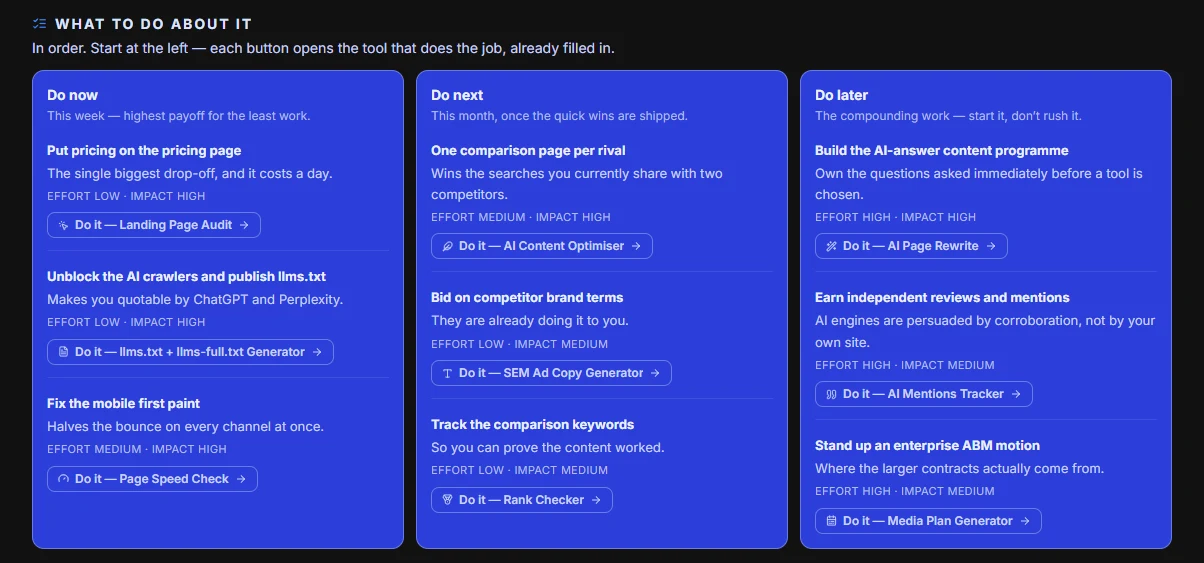
WATCH BEFORE YOU RUN IT
Official captioned walkthroughs of the real product, on sample data.
REAL PEOPLE. REAL WORK.
Digimetrics makes digital marketing much easier to teach. Instead of just showing students scores and reports, I can explain what the issues mean, why they matter, and how to fix them in a practical way.
 Ray TeohACLP Certified Trainer in Digital Marketing, ASK Training
Digimetrics doesn't just flag SEO problems. It explains what's wrong and how to fix it. I'm saving hours on audits and getting clearer, more actionable insights without jumping between multiple tools.
 Douglas KhuDirector, DNA Corporate Services
There are so many tools out there but few have the breadth and depth of Digimetrics in finding and fixing SEO, content, web, and social media issues. It's definitely a boon to marketers and agency owners alike.
 Walter LimFounder, Cooler Insights
SIMPLE PLANS. EVERY TOOL INCLUDED.
Start free for 7 days. Every plan includes every tool. Choose the projects and features that fit your work.
All prices in USD. Annual prices are per month, billed yearly.
Kick the tyres for 7 days. Every tool, capped results.
$0for 7 days
No credit card needed
For solo marketers shipping content + SEO.
$39per month
Billed monthly
The serious operator plan. Room to run the deep audits often.
$109per month
Billed monthly
Agencies-of-one and power users.
$199per month
Billed monthly
Treat them as two different jobs. Category pages win the broad, comparing searches ("running shoes for flat feet"); product pages win the exact, ready-to-buy searches (brand plus model plus size).
Most stores put their effort into product pages because there are more of them, then wonder why a rival's category page sits above theirs. Category page SEO usually matters more for traffic, because category searches are earlier in the journey and have more volume. Product page SEO matters more for conversion, because the shopper already knows what they want.
The table shows what each page type needs and which Digimetrics tool checks it.
| Category page | Product page | |
|---|---|---|
| Searches it should win | Broad and comparing: type, use, style | Exact: brand, model, size, colour |
| Search intent label | Compare | Buy |
| What usually holds it back | A grid of products with no words around it | Manufacturer copy shared with every other store |
| What to add | A short intro, buying guidance, an FAQ | Original description, specs, sizing, reviews |
| Structured data | ItemList or BreadcrumbList | Product with price, stock and reviews |
| Tool that checks it | On-Page Optimisation against the top three | Content Checker and Schema Generator |
Not sure which page should rank for which search? Keyword Mapping assigns each keyword to one page and shows where a new page is needed.
Filter and sort URLs that create thousands of near-duplicate pages, slow image-heavy product pages, and out-of-stock pages that return errors. A crawl finds all three.
Faceted navigation is the classic store problem: every colour, size and price filter can create its own URL, and Google may spend its time on those instead of your real categories. The fix is usually a canonical tag pointing filtered views back to the main category, plus clear rules on which filters deserve their own indexable page.
The Technical SEO Crawler lists each issue with the number of pages affected and a severity, so a template problem that hits every product shows up as one row, not hundreds. Then run the page speed test on your best-selling product page. In the official tutorial's sample (fictional brand Brightpath), the top fix was serving modern image formats, saving about 420 KB on one page. Product galleries are usually where that weight hides.
Give AI assistants specific, quotable facts on your own pages, make sure their crawlers can read the site, and earn mentions on the review and comparison sites they cite. Then measure whether it worked.
When a shopper asks ChatGPT for "the best waterproof hiking boots for wide feet", the answer names a handful of products and stores. Assistants favour pages that state facts plainly: materials, sizes, who it suits, how it compares. A product page that says "premium quality" gives them nothing to quote.
The AI Page Rewrite tool turns a page into what assistants can lift: a one-sentence answer at the top, a comparison table, specifics in place of vague claims and an FAQ for the exact buying questions. The llms.txt generator builds both files and lists your key category pages for AI crawlers.
AI Mentions Tracker then shows the sources each answer cited. If every answer about your category quotes the same two review sites, that is your outreach list.
For the wider method, read how to appear in Google AI Overviews.
With Digimetrics, the software side costs from $31 a month billed annually on Starter, and Pro ($87 a month billed annually, 10 projects) is the plan most growing stores pick. Agency retainers are a separate cost and vary widely.
Ecommerce SEO services charge for people's time: research, writing and technical fixes. Software replaces the research and checking part, so your time (or your agency's) goes on the fixes. Here is what common store tasks look like and what each one returns.
| Store task | Tool | What you get |
|---|---|---|
| Research 10 product or category keywords | Keyword Analysis | Volume, difficulty, CPC and intent |
| Benchmark one category page against the top three | On-Page Optimisation | Gaps against the top three results |
| Crawl 10 pages for duplicate and missing tags | Technical SEO Crawler | Issues with pages affected and severity |
| Speed-test a product page | Page Speed Check | 0-100 score and fixes by time saved |
| Generate Product schema | Schema Generator | Checked, paste-ready JSON-LD |
| Check if five AI engines name your store | AI Mentions Tracker | Mention rate, sentiment and sources |
Plan around your peak season: run the audit and rewrites a couple of months before it, so Google has time to pick up the changes. Compare plans on the pricing page.
QUESTIONS PEOPLE ASK
Still unsure? Email support@digimetrics.ai and a person will reply.
The best ecommerce SEO tool covers both Google and AI answers, because shoppers now use both. Digimetrics labels keyword intent, benchmarks category pages against the top three results, crawls for duplicate and missing tags, generates Product schema and checks five AI engines for store recommendations, all from one login.
Yes, and it compounds: a category page that ranks keeps bringing shoppers without paying per click. It is slower than ads, so most stores run both. Time to Rank forecasts how many months page one is likely to take for a keyword, given your site's authority.
Start with the category pages that already get some traffic, not the whole catalogue. Benchmark one against the pages beating it, fix the duplicate-URL issues the crawl finds, then add Product schema to your best sellers.
Yes. Digimetrics analyses the public pages of your store, so it works whichever platform runs it. It never edits your site. See our notes for Shopify stores and WooCommerce stores.
Yes. Schema Generator supports 16 schema types, including product, and returns checked JSON-LD with no missing or placeholder values, plus a one-click link to Google's Rich Results test.
If you have a few hours a week, the tools give you the research and a ranked fix list, which is most of what a specialist would start with. If you have a large catalogue or a migration coming, a specialist is worth it, and the same reports make their work faster to brief and check.
AI Mentions Tracker asks GPT-4o, Claude, Gemini, Perplexity and Google AI Overview the buying questions you choose and reports your mention rate, sentiment, citation rate, position and the sources each answer used.
LESS GUESSWORK. MORE FORWARD.
Your first three runs are included in the free trial. 7 days, no card needed.